Fetch vs Push Mail on iPhone: Which Should You Use?

The short answer
Push has the mail server notify iPhone Mail the moment a message arrives; Fetch has iPhone Mail check the server on a schedule. iCloud, Yahoo, Outlook.com and Exchange support Push in iOS 26. Gmail added via Google does not — it silently falls back to Fetch. Generic IMAP accounts get Push only if the server implements IMAP IDLE.
Push vs Fetch on iPhone Mail: which account types actually get Push in iOS 26, and how to set one behavior per account without draining the battery.
On this page
Fetch vs push mail on iPhone is one of the most-asked questions about the built-in Mail app, and most of the answers online are half right. Push is not a battery villain, Fetch is not always slow, and the setting you pick in Settings > Mail > Accounts > Fetch New Data does not always take effect the way the screen implies. Some account types silently ignore Push no matter what you choose.
This post walks through what each setting actually does in iOS 26, which accounts genuinely support Push (and which quietly fall back to Fetch), how the Automatic and Manual options work when your phone is locked or on cellular, and how to configure one behavior per account so the account that matters is instant and the rest do not wake the radio every fifteen minutes.
The verdict: push what actually matters, fetch the rest#
For most people the right answer is not global Push and not global Fetch. It is per-account. Turn Push on globally, set your primary account (the one you would want a notification for within thirty seconds) to Push if it supports it, set every low-priority account to Fetch on a schedule you actually want, and set anything you rarely check to Manual. The Fetch New Data screen is designed for exactly this — the schedule at the top is the default, and every account has its own override underneath.
Push does draw more battery than a light Fetch schedule, but the difference is small and it only applies to accounts that support Push in the first place. On a modern iPhone with a healthy battery, Push on one iCloud or Exchange account is not what runs your phone down. What actually costs battery is Fetch set to Every 15 Minutes on five accounts at once, because the radio wakes every three minutes on average and each wake burns more energy than a single push notification would.
The rest of this post is the detail behind that verdict — the account-by-account support matrix, what Automatic and Manual actually mean, and how to set it all in about two minutes.
Push vs Fetch at a glance#
The two mechanisms are opposite in direction. With Push, the server initiates — it opens a lightweight connection to your phone (via Apple Push Notification service for iCloud, or a persistent connection for Exchange ActiveSync and IMAP IDLE) and pings the moment a new message lands. With Fetch, your phone initiates — Mail wakes on a timer, opens a connection to the server, asks whether anything new has arrived, and closes.
| Dimension | Push | Fetch |
|---|---|---|
| Who initiates the connection | The mail server initiates. Your phone maintains a persistent lightweight connection (APNs for iCloud, ActiveSync for Exchange, IMAP IDLE for generic IMAP that supports it). | Your phone initiates. Mail wakes on a schedule you choose, connects to the server, asks for new messages, and disconnects. |
| Delivery latency | Seconds. The server pushes as soon as the message lands. | Up to the length of your fetch interval. Every 15 Minutes means an average delay of about 7.5 minutes; Hourly means an average of about 30. |
| Battery impact | Modest and steady. One persistent connection. | Depends on interval and account count. Frequent fetches across several accounts is worse than one Push account. |
| Which accounts support it | iCloud, Yahoo, Outlook.com/Hotmail, Exchange (via ActiveSync or EAS), generic IMAP that supports IMAP IDLE (Fastmail, some hosts). | Any account. Fetch is the universal fallback. |
| What happens on cellular vs Wi-Fi | Works on both. Push runs on any active internet connection. | Same schedule on either, but the Automatic option only fetches on Wi-Fi while the phone is charging. |
| What happens when the phone is locked | Delivers as normal. Push wakes the device for the notification. | Scheduled fetches still run in the background. Manual accounts do not check until you open Mail. |
Which iPhone Mail accounts actually get Push#
This is where most online guides get vague. The Fetch New Data screen shows a Push toggle at the top and lists your accounts underneath, and it is easy to assume every account gets Push if the toggle is on. That is not how it works. Whether an account supports Push depends on the mail protocol behind the account, not the toggle at the top of the screen.
| Account type | Push in iOS Mail? | How |
|---|---|---|
| iCloud | Yes. | Native Push via Apple Push Notification service. This is the reference implementation. |
| Yahoo Mail | Yes. | Push over Yahoo's own protocol, supported in iOS Mail since the account was added natively. |
| Outlook.com / Hotmail / Live.com | Yes. | Push via Exchange ActiveSync when the account is added through the built-in Outlook.com option. |
| Microsoft 365 / Exchange (work) | Yes. | Push via Exchange ActiveSync. Requires that the tenant has not disabled EAS. |
| Gmail (added via Google) | No. | Gmail does not offer Push to iOS Mail. The account silently falls back to Fetch even if the Push toggle is on and the account is listed as Push. |
| AOL | No. | Fetch only. Added as IMAP under the hood without IMAP IDLE negotiated for Push in Mail. |
| Fastmail, Zoho, ProtonMail Bridge (as IMAP) | Sometimes. | Generic IMAP accounts get Push if the server advertises IMAP IDLE and iOS negotiates it successfully. Fastmail does; many small providers do not. |
| Other generic IMAP | Rarely. | The default IMAP account added via Other > Add Mail Account is Fetch-only unless the server supports IMAP IDLE and Mail chooses to use it. |
The single most-searched question in this space is whether Gmail supports Push in the iPhone Mail app. It does not, and it has not for years. Google removed Exchange ActiveSync for consumer Gmail accounts in 2013, and Gmail's IMAP implementation is not one that iOS Mail treats as push-capable. If you add a Gmail account to Apple Mail on your iPhone, it will show up in Fetch New Data as a Push-capable account in some iOS versions, but new messages will not actually push. They arrive on your Fetch schedule.
If real-time Gmail notifications matter to you, the practical options are: install the Gmail app itself (which uses Google's own push channel), install a third-party mail client whose server watches your Gmail on your behalf and pushes to your phone, or accept a Fetch schedule and pick an interval you can live with.
The Fetch New Data screen can lie about Push
Where Push wins#
Push wins on latency and it wins on total battery across a busy inbox. If you receive fewer than a hundred messages a day on your primary account, one Push connection is cheaper than fetching every fifteen minutes, because the radio wakes far less often. A push notification is a short exchange initiated when there is something to deliver; a scheduled fetch is a full connection every interval whether the server has anything or not.
Push also wins on the situations that matter most: an incoming reply to a message you sent five minutes ago, a two-factor code you asked for right now, a meeting change the moment your colleague clicks send. On Fetch the same message can sit on the server for the entire interval before your phone knows about it — Every 15 Minutes means an average delay of about seven and a half minutes and a worst case of fifteen. If you have ever missed a code because the fetch had just run, you know the cost.
The battery arithmetic changes as account count grows. One iCloud account on Push draws less power over a day than the same account on Fetch every fifteen minutes, because Fetch keeps waking the modem even when nothing is happening. Five accounts on Fetch every fifteen minutes is significantly worse than one account on Push and four on Hourly, for the same reason — the total number of radio wakes is what determines the cost.
Where Fetch wins#
Fetch wins when the account is one you genuinely do not need to hear about immediately. A newsletter-only address, a receipts-only address, a legacy account you check once a day out of habit — none of these need to interrupt you the moment a message arrives, and putting them on Push burns a persistent connection you get no value from. Setting them to Hourly or Manually reclaims that cost.
Fetch also wins when a protocol does not actually support Push. Gmail is the obvious case: since the account is going to fetch regardless, setting it to Push in the UI is worse than setting it to Fetch, because you keep the label without the behavior and you have no idea what schedule the account is actually on. Setting it to Fetch, with a specific interval, means you know how stale your inbox can be — you chose the number.
The Manual option deserves a mention here too. Manual means the account never checks in the background. It only refreshes when you open Mail and pull down the message list, or open that specific mailbox. For an archive account you consult twice a month, Manual is correct — the account exists, mail is retrievable when you want it, and it costs zero background power.
What each setting costs you#
iOS 26's Fetch schedule offers five choices for accounts that fall back to Fetch or that you explicitly set to Fetch: Automatically, Every 15 Minutes, Every 30 Minutes, Hourly, and Manually. The trade-offs are real and measurable, and the cost you pay is a mix of battery, cellular data, and delivery delay.
| Setting | Delivery latency | Battery cost | Data cost |
|---|---|---|---|
| Push | Seconds. | One persistent lightweight connection. Modest but constant. | Very small — only when a message actually arrives. |
| Every 15 Minutes | 0–15 minutes, avg 7.5. | High if applied to several accounts. Radio wakes on every interval per account. | One connection per interval per account, even when there is no new mail. |
| Every 30 Minutes | 0–30 minutes, avg 15. | Moderate. | Half the connections of the 15-minute setting. |
| Hourly | 0–60 minutes, avg 30. | Low. | Low — 24 connections per account per day. |
| Automatically | Only when on Wi-Fi and charging. Otherwise no fetch until you open Mail. | Very low. | None on cellular. Wi-Fi only while charging. |
| Manually | Only when you open Mail and refresh. | Zero background cost. | Only when you refresh. |
The Automatic option is misunderstood almost universally. It does not mean iOS picks a smart interval based on how often you use the account. It means fetch runs only when the phone is connected to Wi-Fi and plugged in. On cellular, or on Wi-Fi while running on battery, an account set to Automatically does not fetch at all in the background — new mail arrives only when you open the Mail app. This is deliberate: it is Apple's most conservative option, designed for accounts you want kept fresh overnight on your charger but never on the go.
If Automatically is your global default and you have wondered why your email seems fine at home but goes stale during the day, this is why. Change the schedule to Hourly and the behavior becomes what most people expect from Automatically.
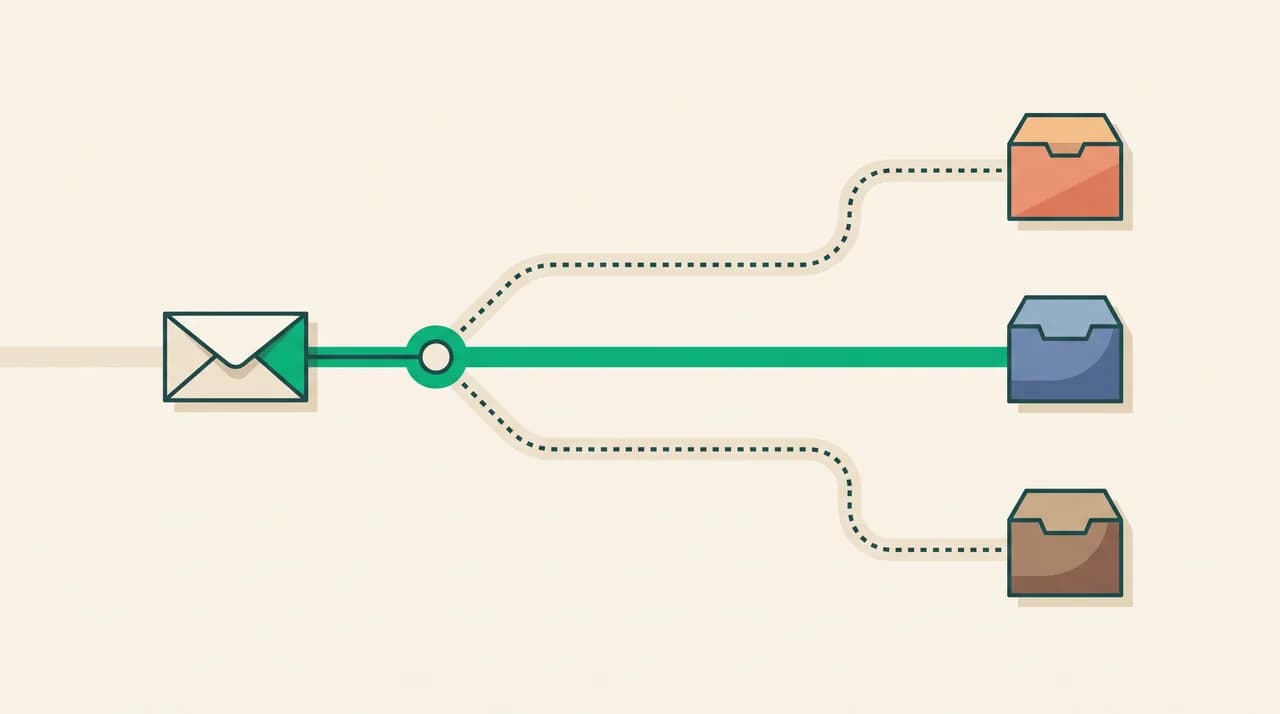
The one setting that fixes most complaints about delayed iPhone email
How to configure it per account#
- 1
Open Settings and go to Mail
On iOS 26, open the Settings app, scroll down to Apps, tap Mail, then tap Mail Accounts. On earlier iOS versions the same screen lives at Settings > Mail > Accounts.
- 2
Tap Fetch New Data
This is the master screen for Push, per-account overrides, and the global fetch schedule. Everything you need is on this one screen.
- 3
Turn Push on globally
Toggle Push on at the top. This does not force every account to Push — it just permits Push for the accounts that support it. Leaving it off disables Push everywhere even for accounts that would otherwise use it.
- 4
Set each account individually
Tap each account in the list and choose Push, Fetch, or Manually. Push is only visible as an option for accounts whose protocol supports it — if you do not see Push under an account, that account does not push (Gmail is the common case). For a primary account you want real-time, choose Push. For accounts you check periodically, choose Fetch. For accounts you consult on demand, choose Manually.
- 5
Pick the global fetch schedule
At the bottom of the Fetch New Data screen, choose Automatically, Every 15 Minutes, Every 30 Minutes, Hourly, or Manually. This schedule applies to any account whose per-account setting is Fetch. Hourly is the pragmatic default; Every 15 Minutes is worth it only if you have exactly one Fetch account that matters.
- 6
Handle Gmail deliberately
If you have a Gmail account added to Apple Mail and you have accepted that it will not push, set it explicitly to Fetch and pick an interval you can live with. Do not leave it on Push — the label is inaccurate and it is easier to reason about the schedule if the screen matches reality.
A third option: use a mail client with its own push#
The whole Push vs Fetch question exists because Apple Mail is downstream of whatever protocol your provider offers. When the provider does not push (Gmail), Apple Mail cannot invent it. The client that can push a Gmail message to you in seconds is one that watches the Gmail account on its own servers and forwards the notification to your phone through Apple Push Notification service — the same channel iCloud uses.
We build AI Emaily, an AI-native email client with a native iOS app and a server-side sync layer. The sync worker holds an IMAP IDLE connection to Gmail, Outlook, iCloud, and any IMAP host on our servers, and pushes new-message notifications to the iOS app via APNs. Gmail on our app behaves like iCloud on Apple Mail: the message arrives, the notification appears, no fetch interval involved. The trade-off is honest — you are trusting our servers to hold that connection, which is the same trade any hosted push-notification service makes.
Beyond notifications, the app runs an approval-first agent that triages the inbox, drafts replies in your set voice, and surfaces the messages that need you. Everything sends only on your approval in Copilot mode, with a gated Autopilot for routine replies if you turn it on. There is a 7-day free trial on the Pro and Autopilot plans, no permanent free tier — worth trying only if the notification and triage story is the reason you were looking at the Fetch screen in the first place.
Frequently asked
See it in AI Emaily
Keep reading

Written by
Nafiul HasanNafiul Hasan is an entrepreneur and AI automation system builder with 10+ years of experience turning messy, manual workflows into reliable automated systems. He designs and ships AI enterprise solutions end-to-end — the agent logic, the data plumbing, and the product people actually use — and founded AI Emaily to give busy professionals their attention back. He writes here from the builder's seat: what works, what breaks, and how to put AI to work without giving up control.