SLA Breach Apology Email to a Customer: 8 Templates

The short answer
An SLA breach apology email to a customer should name the SLA term and the measured result, own the miss without excuses, state the credit and how it applies (or how to claim it), say what changed, and give one named contact. Send it before the customer asks, and quote the contract's own wording for the credit.
SLA breach apology email to customer: 8 copy-paste templates for missed uptime and response-time SLAs, with service credit wording and follow-up.
On this page
- 01When should you send an SLA breach apology email?
- 02What does a good SLA breach apology email contain?
- 03How do you calculate a service credit?
- 04Should you proactively issue an SLA credit?
- 05Template 1: proactive notice, credit applied automatically
- 06Template 2: proactive notice, credit must be claimed
- 07Template 3: a missed response-time SLA
- 08Template 4: a missed uptime SLA
- 09Template 5: the customer asks for compensation
- 10Template 6: the credit is declined, with an explanation
- 11Template 7: escalating to a contractual review
- 12Template 8: a breach the customer has not noticed
- 13What is the hard version of this situation?
- 14What should you do if there is no reply?
- 15Where AI Emaily fits
A missed SLA is the one bad-news email where the number is already written down. The customer signed a contract that says [SLA TERM], you delivered [MEASURED RESULT], and the gap between the two is a fact, not a feeling. That leaves less room for vague apology than almost any other customer email, and more reason to be exact.
Below are eight copy-paste emails for the situations that come up: a credit you issue unprompted, a credit the customer has to claim, a missed response time, a missed uptime commitment, a customer asking for compensation, a credit you have to decline, an escalation to contractual review, and a breach the customer has not noticed. Brackets mark what you fill in. The credit arithmetic is yours to check against the actual contract wording.
When should you send an SLA breach apology email?#
Send one when a measured result falls below a term you committed to in writing. A slow afternoon that stayed inside the target is not a breach, and apologising for it as if it were teaches the customer to expect credits you never promised.
Atlassian's Incident Management Handbook lists "Atlassian knows before our customers do" as the first incident value, on the grounds that good monitoring should catch a problem before customers do. The SLA version of that is simple: you should be the one to do the counting, and the customer should hear the result from you.
| Situation | Send an email? | Template |
|---|---|---|
| Uptime fell below the monthly commitment and the contract applies a credit automatically | Yes, proactively, when the month closes | 1 or 4 |
| Uptime fell below the commitment but the customer must claim within a window | Yes, proactively, with the claim steps | 2 or 4 |
| First-response or resolution time missed on a ticket | Yes, the same business day you spot it | 3 |
| Customer writes in asking for compensation | Yes, reply within one business day | 5 |
| Measured result misses the target but the contract excludes the downtime | Yes, explain the measurement, no credit | 6 |
| Repeated breaches inside a rolling period | Yes, offer a formal review | 7 |
| You find a past breach the customer never raised | Yes, as soon as you have confirmed the numbers | 8 |
What does a good SLA breach apology email contain?#
Six things, in roughly this order. The customer reads the subject line, the first two sentences and the credit line; everything else is for the person who forwards it to their legal or procurement team.
| Element | What it does | Placeholder |
|---|---|---|
| Subject line that names the SLA | Lets a contract owner file and find it later | [SLA TERM] missed, [PERIOD] |
| The term and the measured result | Puts both numbers side by side so nobody has to ask for them | [SLA TERM] vs [MEASURED RESULT] |
| Plain ownership | One sentence, no passive voice, no blame on a vendor or a holiday | We missed it |
| The credit | States the amount and how it reaches the invoice, or how to claim it | [CREDIT AMOUNT] |
| What changed | One concrete fix with an owner and a date, not a promise to try harder | [REMEDIATION] |
| A named contact | A person with a direct address, not a no-reply mailbox | [Your Name] |
The contract wording wins over your email
How do you calculate a service credit?#
Start from the clause, not from what feels fair. Most credit clauses name a measurement period, a threshold, a tiered percentage of the fee for that period, and sometimes a cap or a list of exclusions such as scheduled maintenance. Calculate in that order and put the working in the email so the customer can check it.
The example below is hypothetical. Your tiers, fee base and exclusions will differ, and several contracts apply the credit to the fee for the affected service only, not the whole account.
Should you proactively issue an SLA credit?#
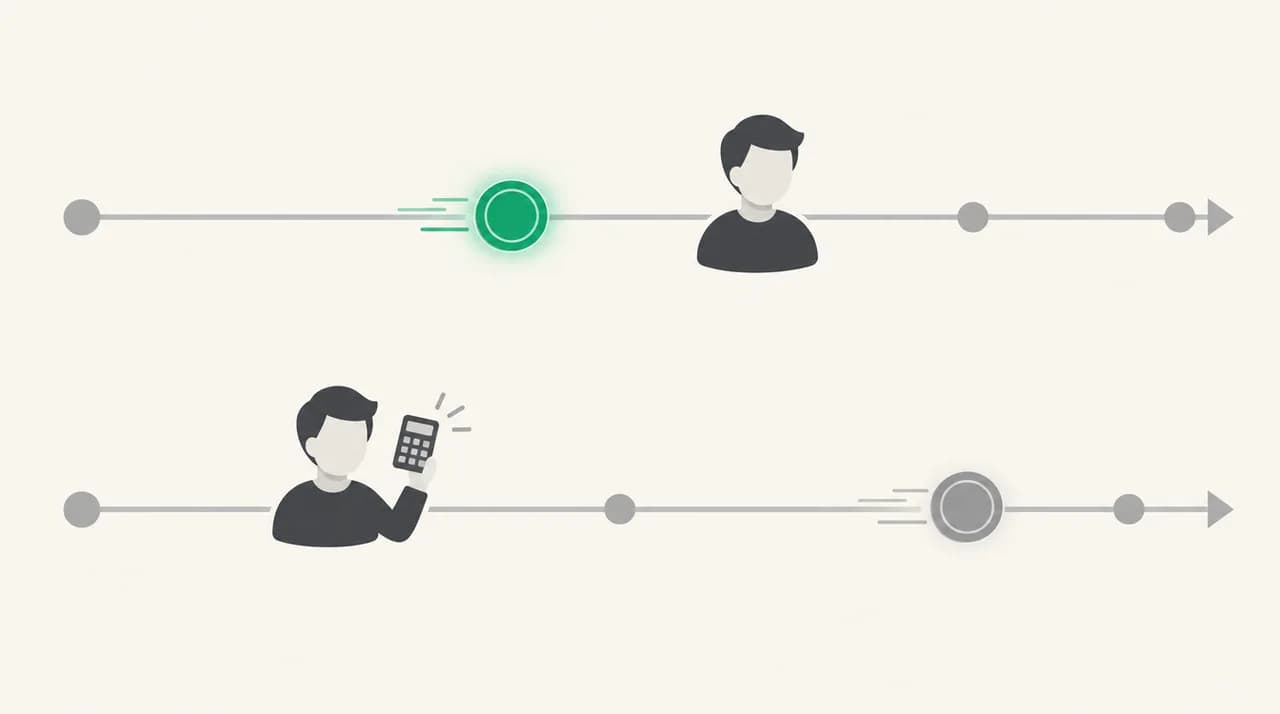
Yes, and where the contract makes you wait for a claim, tell the customer anyway. Our view, not a rule: a credit offered after the customer has done the maths reads as a concession, while the same credit offered first reads as a company that keeps its own books. The cost is the same; the trust is not.
Proactive does not mean improvised. If the credit is above what the sender is authorised to approve, get finance sign-off before the email goes out, because retracting a credit costs more than a late email.
| What the contract says | What the email does |
|---|---|
| Credit applies automatically | States the amount and the invoice it lands on (Template 1) |
| Credit must be requested within a window | Tells the customer the miss, the window and the one-line way to claim it (Template 2) |
| Credit is at the vendor's discretion | Decide first, then state the decision; do not make the customer ask twice |
| Credit is the customer's sole remedy | Still apologise and fix; do not use the clause as the opening line |
Template 1: proactive notice, credit applied automatically#
Use when the contract credits the invoice without a claim and you have confirmed the measurement.
Subject: [SLA TERM] missed in [PERIOD]: credit applied
Hi [Customer First Name],
In [PERIOD] we committed to [SLA TERM]. We delivered [MEASURED RESULT]. That is below the commitment and it is our miss.
Under section [SECTION] of our agreement, a credit of [CREDIT AMOUNT] has been applied to your [INVOICE DATE] invoice. You do not need to do anything.
The cause was [ONE-SENTENCE CAUSE]. We have [REMEDIATION], owned by [OWNER] and due by [DATE]. I will confirm when it is done.
If your numbers differ from ours, reply to me directly and we will compare them.
[Your Name], [Your Company]
Template 2: proactive notice, credit must be claimed#
Use when the contract says the customer has to request the credit within a window. Tell them about the window; do not let it expire quietly.
Subject: [SLA TERM] missed in [PERIOD]: how to claim your credit
Hi [Customer First Name],
We did not meet [SLA TERM] in [PERIOD]. The measured result was [MEASURED RESULT].
Our agreement entitles you to a service credit of [CREDIT AMOUNT]. It is claimed by replying to this email within [CLAIM WINDOW] of this message. Reply "claim" and we will apply it to your next invoice.
What we are changing: [REMEDIATION], owned by [OWNER], due [DATE].
I am sorry for the disruption this caused your team.
[Your Name], [Your Company]
Template 3: a missed response-time SLA#
Use when a ticket passed its first-response or resolution target. State the clock, not a feeling about how busy you were.
Subject: Your ticket [TICKET ID]: response target missed
Hi [Customer First Name],
Your ticket [TICKET ID] was opened at [TIME]. Our commitment is a first response within [SLA TERM]. Our first response went out at [TIME], which is [MEASURED RESULT].
That is outside the agreement and I apologise. The reason was [ONE-SENTENCE CAUSE], and it should not have reached you.
Your issue is now with [ENGINEER], who will update you by [TIME]. For this miss, [CREDIT AMOUNT or "the agreement provides no credit for response times, but I want you to know we logged it as a breach"].
[Your Name], [Your Company]
Template 4: a missed uptime SLA#
Use at the end of a measurement period when availability fell below the committed figure. Link or attach the incident record if you have one.
Subject: [PERIOD] availability below commitment: [CREDIT AMOUNT] credit
Hi [Customer First Name],
For [PERIOD], our availability commitment was [SLA TERM]. Measured availability was [MEASURED RESULT], across [NUMBER] incidents on [DATES].
Calculated under section [SECTION], the credit is [CREDIT AMOUNT]: [ONE-LINE WORKING]. It will appear on [INVOICE DATE] / It can be claimed by replying within [CLAIM WINDOW].
The largest incident was [ONE-SENTENCE CAUSE]. We have [REMEDIATION], due [DATE]. A full write-up follows within [NUMBER] business days.
[Your Name], [Your Company]
Template 5: the customer asks for compensation#
Use when the customer writes first. Do not open with the clause; open with the miss.
Subject: Re: [ORIGINAL SUBJECT]
Hi [Customer First Name],
You are right. We committed to [SLA TERM] and delivered [MEASURED RESULT]. I am sorry.
I have checked your request against section [SECTION]. The credit is [CREDIT AMOUNT], and I have asked finance to apply it to your [INVOICE DATE] invoice. You will get a confirmation from me when it is done, by [DATE].
If the impact on your business went beyond what the credit covers, tell me what happened and I will take it to [SENIOR PERSON] this week.
[Your Name], [Your Company]
Template 6: the credit is declined, with an explanation#
Use only when the contract genuinely excludes the downtime or the measurement does not show a breach. Show the working. A bare "no" with a clause number looks like a wall.
Subject: Re: [ORIGINAL SUBJECT]: how we measured [PERIOD]
Hi [Customer First Name],
Thank you for raising this. I understand why the outage on [DATE] felt like a miss.
I have gone through it against section [SECTION]. Of the [TOTAL DOWNTIME], [EXCLUDED DOWNTIME] falls under [EXCLUSION, for example scheduled maintenance notified on DATE]. That leaves [MEASURED RESULT], which is within the [SLA TERM] commitment, so no credit applies under the agreement.
I know that is not the answer you wanted. I have attached the measurement and I am happy to walk through it on a call. Separately, [REMEDIATION OR GOODWILL STEP, if you are offering one].
[Your Name], [Your Company]
Template 7: escalating to a contractual review#
Use after repeated breaches in a rolling period, or when the customer's own contract allows a review right. It is you volunteering the conversation before they invoke a termination clause.
Subject: [NUMBER] SLA misses since [DATE]: proposing a review
Hi [Customer First Name],
This is the [NUMBER] time since [DATE] that we have missed [SLA TERM]. The credits we have issued ([CREDIT AMOUNT] in total) do not fix the underlying problem.
I would like to propose a review with [SENIOR PERSON] and your [ROLE] before [DATE]. We will bring the incident history, the root causes and a written remediation plan: [REMEDIATION].
If the agreement gives you rights under section [SECTION] that you want to discuss, we will talk about those as well. Which times work for you next week?
[Your Name], [Your Company]
Template 8: a breach the customer has not noticed#
Use when you find, after the fact, that a commitment was missed and no one complained. This is the hardest email in the set, and the next section explains why it is still worth sending.
Subject: A miss against [SLA TERM] we found in [PERIOD]
Hi [Customer First Name],
During our [REVIEW NAME] we found that in [PERIOD] we did not meet [SLA TERM]. The measured result was [MEASURED RESULT]. You did not raise it, and we should have told you.
Under section [SECTION], the credit is [CREDIT AMOUNT]. We have applied it to your [INVOICE DATE] invoice / It can be claimed by replying to this email.
We found it because [HOW YOU FOUND IT]. We have [REMEDIATION] so that the next one is flagged on the day. I am sorry it took this long.
[Your Name], [Your Company]
What is the hard version of this situation?#
The hard version is Template 8: the customer is not angry, has not asked, and may never find out. The argument for staying silent is that nothing is lost. The argument for writing is that the numbers exist in your monitoring and your ticket system, an audit or a renewal review can surface them, and a breach you disclosed reads very differently from one that was discovered.
Our recommendation is to write, but in this order: confirm the measurement, check the exclusions, check the claim window in the contract, get the credit approved, then send. Do not send an unconfirmed number, because a corrected figure a week later undoes the point of being proactive.
- Check whether the contract requires you to notify the customer of a breach within a set period. If it does, the clock may already be running.
- Check whether an earlier claim window has passed. If it has, decide whether to honour the credit anyway; the email should be honest about that choice.
- Keep the wording about cause factual. Do not speculate about what the customer would have done had they known.
- If the amount is material or a dispute is likely, have the contract owner or counsel read the draft before it goes.
Atlassian's point about customers and causes
What should you do if there is no reply?#
Silence after a breach email is common and usually means the message reached an inbox nobody owns. Credits and contract notices often land with a technical contact while the person who signs the renewal sees nothing.
Follow up twice, then stop. Day three is a short reminder to the same person. Day seven goes to whoever the contract names as the commercial or billing contact, with the original message below it. Keep a dated record of both, especially where a claim window is running.
- 1
Day 3: a two-line nudge
Subject: Re: [SLA TERM] missed in [PERIOD]. Body: "Checking this reached you. The credit of [CREDIT AMOUNT] stands, and the claim window closes on [DATE]. Reply if you would like it applied."
- 2
Day 7: the contract contact
Send the original to the notices or billing contact named in the agreement, with one line on top: "Forwarding in case this did not reach the right person. No action is needed beyond confirming the credit."
- 3
Day 14: apply and record
If the credit is automatic, apply it and note it on the invoice. If it requires a claim, record that you notified the customer twice and the date the window closes, then decide whether to honour it anyway.
Where AI Emaily fits#
These emails are easy to write and easy to get slightly wrong, usually under time pressure with the contract in another tab. We build AI Emaily, and the part of it that helps here is drafting: you save the structure above as a Personal Context note or a client profile, and it produces a first draft in your own voice for each breach that you review and edit before anything is sent.
What it does not do is measure uptime, read your monitoring, or calculate the credit. The numbers come from you and the contract; the draft carries them. Because nothing sends until you approve it, a credit email can wait for finance sign-off first. Start from the AI Emaily homepage, or see the pricing page for the 7-day free trial.
Frequently asked
See it in AI Emaily
Keep reading

Written by
Nafiul HasanNafiul Hasan is an entrepreneur and AI automation system builder with 10+ years of experience turning messy, manual workflows into reliable automated systems. He designs and ships AI enterprise solutions end-to-end — the agent logic, the data plumbing, and the product people actually use — and founded AI Emaily to give busy professionals their attention back. He writes here from the builder's seat: what works, what breaks, and how to put AI to work without giving up control.