WISMO Automation: How to Reduce 'Where Is My Order?' Tickets for Good

The short answer
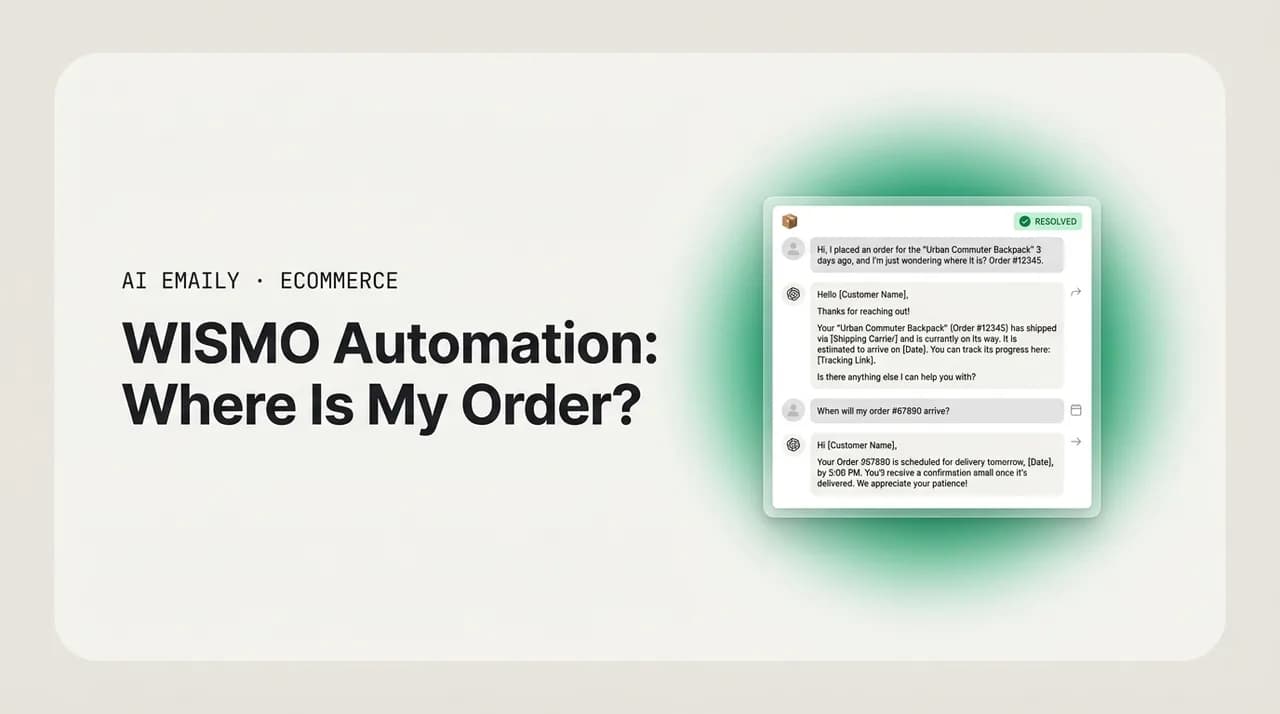
WISMO — 'where is my order?' — is often around a fifth of an ecommerce store's support volume. You cut it two ways: reduce it at the source with proactive shipping updates, self-serve tracking, and honest delivery estimates, then automate the replies that still land. Send routine order-status answers instantly, and keep a human on delays, lost packages, and anything angry.
WISMO automation is the fastest way to cut 'where is my order?' tickets, which make up roughly 20% of ecommerce support volume. Here is how to reduce WISMO at the source with proactive tracking, then automate the replies you still get.
On this page
- 01What is WISMO, and why does it dominate ecommerce support?
- 02How much is WISMO really costing you?
- 03What actually causes WISMO tickets?
- 04How do you reduce WISMO at the source?
- 05How do you automate the WISMO replies you still get?
- 06WISMO scenarios and how to respond
- 07WISMO reply templates you can use today
- 08How do you handle delays and lost packages well?
- 09How does AI Emaily help with WISMO?
- 10Putting your WISMO strategy together
What is WISMO, and why does it dominate ecommerce support?#
WISMO stands for "where is my order?" It is the shorthand support teams use for every message that boils down to a customer asking one thing: my package has not arrived yet, or I cannot tell where it is, so please tell me what is going on. It arrives as "has my order shipped?", "do you have a tracking number?", "it says delivered but I do not have it," "why is this taking so long?", and a hundred other phrasings of the same underlying question. Whatever words the customer uses, the job for you is identical: look up the order, check the shipment, and report the status back.
For most stores, WISMO is not a minor category. It is the category. On a typical ecommerce support desk, order-status and shipping questions make up roughly a fifth of everything that comes in, and in some stores considerably more. It is the single most repetitive, most predictable, and most automatable question you will ever answer, which is exactly why it deserves a strategy of its own rather than being lumped in with the general inbox.
The reason WISMO dominates is structural, not accidental. Every order that ships generates a window of uncertainty between "payment confirmed" and "package in hand," and during that window the customer has money spent and nothing to show for it. Multiply that anxious window across every order you fulfill, and a predictable slice of customers will reach out to close the gap. They are not being difficult. They are doing the most natural thing in the world: checking on something they paid for and cannot yet see.
What makes WISMO uniquely painful for a lean ecommerce team is the combination of high volume and low value-add. Each individual ticket is trivial to answer — you look at a tracking page and paraphrase it back — but there are so many of them that they crowd out the work that actually needs a human: the genuinely upset customer, the complicated return, the pre-sale question that turns into a sale. The founder or the small CX team ends up spending a large chunk of the day being a human copy-paste machine for tracking numbers, and none of that time moves the business forward.
This guide treats WISMO as a system to be engineered down, not a chore to be endured. The plan has two halves that work together. First, reduce the WISMO you get by closing the uncertainty window at the source — proactive shipping updates, self-serve order tracking, and delivery estimates the customer actually believes. Second, automate the WISMO you still get so the routine replies go out instantly and only the real problems reach a person. By the end you will have a concrete playbook, a scenario-to-response table, ready-to-use reply templates, and a clear picture of where an AI email client fits without pretending it solves everything.
Why the Amazon effect makes this urgent
How much is WISMO really costing you?#
Before you can justify spending effort on WISMO, it helps to see the true cost, which is almost always larger than the obvious one. The obvious cost is time: if WISMO is a fifth of your tickets and each one takes a few minutes to look up and answer, the minutes stack into hours every week that a founder or a small team spends on work that produces no revenue and no delight. That alone is usually enough reason to act.
But the time cost is only the surface. The deeper cost is what WISMO does to everything around it. Because these tickets flood the queue, they push your response time up across the board, so the customer with a real problem — a defective item, a wrong address, a genuine complaint — waits longer because a stack of "where is my order?" messages sat ahead of them. A slow queue is a leaky queue: the longer people wait, the more of them email again to follow up, which generates even more volume, which slows the queue further. WISMO left unmanaged is a self-feeding fire.
Then there is the retention cost, which is the quietest and most expensive of all. A shipping question is a moment of anxiety, and how you handle that moment shapes whether the customer buys again. Answer instantly and reassuringly and you have converted a worried customer into a confident one. Answer slowly, or not at all, and you have taught a paying customer that ordering from you comes with a side of stress. For a subscription or replenishment brand, where a single unresolved worry in the first month or two drives cancellation more than the product itself, that lesson is fatal — and most of that churn is silent, the customer simply going quiet rather than telling you why they left.
There is a counterintuitive upside hiding in all of this, and it is worth internalizing because it reframes the whole effort. A shipping worry that you resolve quickly and warmly can build more loyalty than an order that arrived so smoothly the customer never had to contact you at all. This is the service-recovery paradox: a well-handled bump in the road often leaves a stronger impression than a perfectly frictionless one. WISMO is not just a cost to be minimized. Handled well, it is one of your most frequent, most winnable chances to prove you are a brand that shows up when a customer is uncertain.
So the goal is not to make WISMO disappear entirely — some of it is healthy contact you want to answer beautifully. The goal is to shrink the avoidable share to near zero and answer the rest so fast and so well that it becomes a loyalty lever instead of a leak.
Measure your WISMO share before you optimize
What actually causes WISMO tickets?#
You cannot reduce WISMO at the source until you understand what drives it, and it is almost never a single cause. It is a handful of gaps that each push a slice of customers into your inbox. Name the gaps and you can close them one by one.
The root causes cluster into a few recognizable patterns:
- Shipping anxiety and the silent window. Between checkout and delivery, the customer has paid and received nothing. If you send them nothing during that window either, their only way to reduce the anxiety is to ask you. Silence manufactures WISMO.
- No proactive tracking. If the customer has to come find the status, a large share of them will come find it in your inbox rather than on a carrier site they have to dig up. The absence of a push means an inbound pull.
- Vague or optimistic delivery estimates. "Ships in 3 to 5 business days" that quietly means 3 to 5 days to hand it to the carrier, plus transit, plus a weekend, sets an expectation you then miss. Every gap between the estimate and reality becomes a ticket.
- Hard-to-find tracking information. The tracking number is buried in a confirmation email the customer archived, or the order page requires a login they have forgotten. Friction in self-serve converts directly into contact.
- Genuine delays and exceptions. Carrier delays, weather, customs, a stuck scan, a package marked delivered that never arrived. These are real problems, not information gaps, and they need a different response than the routine lookups.
- Post-purchase confusion. "Did my order even go through?" from a customer who did not get, or did not notice, an order confirmation. This is the earliest WISMO, and it is entirely preventable with reliable confirmations.
Notice that most of these causes are information gaps, not shipping problems. The package is very often moving along exactly as expected; the customer simply cannot see it, does not trust the estimate, or was never told what to expect. That is the good news, because information gaps are far cheaper to close than logistics problems. You do not need faster carriers to eliminate most WISMO. You need better communication around the carriers you already use.
The distinction between an information gap and a real exception is the hinge the entire strategy turns on. Information-gap WISMO — "where is it," "has it shipped," "what is my tracking number" — is safe to answer automatically because the answer is a factual lookup with a knowable, correct response. Exception WISMO — "it says delivered but it is not here," "this is two weeks late and I need it now" — needs judgment, empathy, and sometimes a refund or reship decision, which is human work. A good WISMO strategy automates the first bucket ruthlessly and routes the second bucket to a person immediately. Blur those two and you either annoy upset customers with robotic replies or waste human time on lookups a machine should have handled.
How do you reduce WISMO at the source?#
The cheapest WISMO ticket is the one that never gets sent. Every reduction tactic below works by closing an information gap before the customer feels the need to ask, which is why they compound: each one you add removes a slice of avoidable contact permanently, not just for one ticket. Think of this as building the fence at the top of the cliff rather than staffing the ambulance at the bottom.
Work through these in roughly the order below, because the earlier ones close the biggest gaps.
- 1
Send a reliable order confirmation, instantly
The moment payment clears, the customer should get a clear confirmation with the order number, items, total, and the delivery estimate. This kills the earliest WISMO — "did my order go through?" — before it can form. If your confirmations are slow, land in spam, or look like a receipt from 2009, fix that first; it is the foundation everything else sits on.
- 2
Set delivery estimates you can actually beat
Show an honest delivery window on the product page and at checkout, and make it slightly conservative. "Arrives by Friday" that lands Thursday delights; "arrives in 2 days" that takes 5 generates a ticket and a grudge. Separate processing time from transit time so the customer understands the full timeline, not just the part that sounds fast.
- 3
Trigger a shipping confirmation with a live tracking link
When the order ships, send a shipping-confirmation email that leads with a big, obvious tracking link — not a raw tracking number the customer has to copy into a carrier site. One tap to a live status page is the single highest-impact WISMO reducer, because it hands the customer the exact answer they would otherwise email you for.
- 4
Send proactive updates at the moments of doubt
Do not stop at "shipped." A short "out for delivery today" or "delivered" note, and crucially a proactive heads-up when something slips — "your package is running a day behind, here is the latest" — intercepts the ticket at the exact moment the customer was about to write it. Proactively naming a delay almost always lands better than making them discover it.
- 5
Put self-serve order tracking one click from everywhere
Add an "order status" or "track my order" link in your site header, your footer, your confirmation emails, and your email signature. Let customers check status with an order number and email, no account login required. The easier it is to self-serve, the fewer people default to your inbox.
- 6
Answer the shipping FAQ before it is asked
A crisp shipping and delivery FAQ page — processing times, carriers, cutoffs, what to do about a delay, how to track — deflects a steady stream of pre-emptive questions. Link to it from the same places as your tracking link so the curious customer finds an answer instead of a contact form.
The throughline across all six is proactivity. Reactive support waits for the customer to ask and then answers; proactive support answers before they ask. WISMO is the category where proactivity pays off most, because the questions are so predictable that you can nearly always get to the answer first. A store that emails "your order is out for delivery" the morning it arrives will get a fraction of the "where is my order?" tickets of a store that sends nothing after the shipping confirmation, even when both ship equally fast.
None of this requires you to be a large company. A solo founder on Shopify can turn on branded shipping notifications, add a tracking link to every email, drop a delivery estimate on the product page, and publish a shipping FAQ in an afternoon. The tactics scale down to one person as cleanly as they scale up to a CX team. The point is simply to stop treating shipping communication as an afterthought and start treating it as a designed part of the purchase.
The one-click tracking rule
How do you automate the WISMO replies you still get?#
Source reduction will cut your WISMO substantially, but it will not zero it. Some customers ignore the tracking link, some genuinely need a human, some ask in a channel you did not instrument, and new orders keep flowing. The residue that lands in your inbox is where automation earns its keep — because that residue is still overwhelmingly the same handful of factual questions, answered the same handful of ways.
The core insight is that most inbound WISMO is a lookup, not a conversation. "Where is my order?" has a correct answer that lives in your order and tracking data: it shipped on this date, it is in transit, it is expected to arrive by that date, here is the live link. Once you can reliably fetch that answer and phrase it warmly, the reply can be generated and sent far faster than a human can type it — often in seconds rather than the hours a busy inbox otherwise imposes. Teams that automate this well routinely take first-response time from hours down to minutes.
But automation only works if it respects the line drawn earlier: automate the factual lookups, escalate the exceptions. The tactics below assume that split. The aim is not to automate all WISMO; it is to automate the safe, routine, correct-answer slice and to hand off everything with a whiff of a real problem to a person, quickly and with context.
- Detect WISMO automatically. Recognize order-status and shipping questions on arrival — by keywords like "where," "tracking," "shipped," "delivered," "arrive," and by the shape of the message — so they can be routed to the automated path instead of sitting in the general queue.
- Match the message to the order. Pull the customer's most recent order and its live tracking status, so the reply is grounded in real data rather than a generic "please check your tracking" that helps no one.
- Draft the reply in your brand's voice. Generate an answer that states the current status, the expected delivery, and the tracking link, written the way your brand actually sounds, not in stiff canned-response language.
- Send routine answers instantly, review the rest. For clean, in-transit, on-time orders, the reply is safe to send automatically. For anything ambiguous, the draft waits for a human to glance at and approve.
- Escalate exceptions to a human immediately. "Says delivered but missing," "weeks late," angry tone, or a request for a refund or reship should skip automation entirely and land in front of a person, flagged, with the order context attached.
- Log everything and keep an undo. Every automated reply should be recorded and reversible, so you can audit what went out, catch any mistake, and fix it before it becomes a pattern.
A worked example makes the split concrete. Imagine two messages arriving a minute apart. The first says, "Hi, just checking on my order, when will it get here?" A lookup shows the order shipped yesterday and is on track to arrive Thursday. That is a clean, factual, on-time answer — the ideal candidate for an instant automated reply with the status and tracking link. The second says, "My tracking says delivered but there is nothing on my porch and I need this for the weekend." That is an exception: a possible lost package, a deadline, and rising frustration. It should never be auto-answered. It should jump the queue to a human with the order and tracking details already pulled up, so the person can lead with empathy and a fix instead of a lookup.
Get that division right and automation stops being a risk and becomes pure leverage. The routine 30 to 40 percent of your inbox — the order-status, returns-process, and simple FAQ questions — clears itself in seconds, and your human attention concentrates entirely on the tickets where a human actually changes the outcome. That is the whole game: let the machine handle the copy-paste, keep the people for the moments that matter.
WISMO scenarios and how to respond#
Not all WISMO is equal, and the single biggest mistake teams make is treating every shipping question the same way. The table below maps the common scenarios to the right response and, critically, to whether that response is safe to automate or belongs with a human. Use it as the logic behind your WISMO workflow: routine lookups go out instantly, real problems go to a person.
| WISMO scenario | Right response | Automate or escalate? |
|---|---|---|
| "Has my order shipped yet?" — order shipped, on track | State that it shipped, give the ship date and expected delivery, include the live tracking link. | Automate — factual, correct, low-risk. |
| "Where is my order?" — in transit, on schedule | Report current status and expected delivery date, link to live tracking, reassure it is on its way. | Automate — routine lookup. |
| "Did my order go through?" — order confirmed | Confirm the order, restate the items and estimate, resend the confirmation if needed. | Automate — reassurance from known data. |
| "What is my tracking number?" | Provide the tracking link (not just the raw number) and where to find it next time. | Automate — pure lookup. |
| "It is a day behind the estimate" — minor, still moving | Acknowledge the slip, give the updated expected date, apologize briefly, share tracking. | Automate with care — or draft for quick human review if tone is tense. |
| "It says delivered but I do not have it" | Empathize, check the scan details, advise standard first steps, and open an investigation or reship path. | Escalate — possible lost package, needs judgment. |
| "This is two weeks late and I need it now" | Lead with empathy, own the delay, offer a concrete fix (expedite, reship, refund) within your policy. | Escalate — deadline, frustration, a decision to make. |
| Package stuck at a scan / carrier exception / customs hold | Explain the exception plainly, set a realistic next step and timeline, offer a fallback if it does not move. | Escalate — non-standard, judgment required. |
| Angry or threatening tone, or a refund demand | Human-led, empathetic recovery; resolve fast to trigger the service-recovery upside. | Escalate — always human, always first. |
The pattern in that table is the whole philosophy in one view. Everything in the "automate" rows is a factual answer the customer could have gotten themselves if the information had been easier to reach; sending it instantly is a favor, not a risk. Everything in the "escalate" rows involves a missing package, a broken promise, a deadline, or a feeling — the exact situations where a fast, canned reply makes things worse and a thoughtful human reply can turn a frustrated customer into a loyal one. Build your automation to be confident on the top rows and humble on the bottom ones.
WISMO reply templates you can use today#
Templates are the connective tissue between your data and your customer. A good WISMO template leaves clear slots for the order-specific facts — status, dates, tracking link — and wraps them in a warm, on-brand sentence or two. Below are ready-to-use versions for the most common scenarios. Swap the bracketed details for real data, and adjust the voice to sound like your brand rather than a form letter.
Start with the everyday case: a customer asking where their order is when it is in transit and on time.
When a customer is worried their order never went through, the job is reassurance backed by facts. Confirm the order exists, restate what is coming, and offer the confirmation again.
For a minor delay where the package is still moving, get ahead of the frustration: name the slip, give the new date, and keep the tone light but sincere. This is the borderline case — safe to automate when the delay is small and the tone is calm, worth a quick human glance when the customer sounds tense.
The most sensitive template is the one you should be slowest to automate: a package marked delivered that the customer cannot find. Lead with empathy, not process. This is a human-first reply, and the template is a starting point for a person, not a send-it-and-forget-it message.
Never auto-send the sensitive scenarios
How do you handle delays and lost packages well?#
Delays and lost packages are the WISMO tickets that decide whether a customer forgives you or leaves you, so they deserve a deliberate approach rather than an improvised one. The instinct under pressure is to be defensive — to point at the carrier, to hedge, to promise nothing. That instinct is wrong. The customer does not care whose fault it is; they gave you money and do not have their thing. Your job is to own the outcome even when you did not cause the problem.
A reliable pattern for delays and losses runs in the same order every time, and it works because it front-loads empathy and ends with a concrete fix:
- 1
Acknowledge and empathize first
Open by naming the problem and the feeling: "I am sorry your order is late — I know you were counting on it." Skip the excuses. A customer who feels heard is far more patient than one who feels handled.
- 2
Tell them exactly what you know
Share the real status honestly, including bad news. "It is stuck at a sorting facility and has not moved in two days" builds more trust than a vague "it is on its way." Customers can handle the truth; they cannot handle being managed.
- 3
Own it, do not blame the carrier
Even when the carrier dropped the ball, the customer bought from you. "We are on it" lands; "that is the carrier's problem" does not. Owning the outcome is what separates a brand people trust from one they abandon.
- 4
Offer a concrete fix within your policy
Give a real choice: wait with a clear new date, get a reship, or take a refund. A specific remedy — not a vague "we will look into it" — is what turns a complaint into a resolution. Decide your delay and lost-package policy in advance so agents can act without asking permission.
- 5
Follow up proactively until it is closed
Do not make the customer chase you for the resolution. Send the reship confirmation, the refund notice, or the update the moment you have it. Closing the loop yourself is the difference between a grudging acceptance and a genuinely recovered relationship.
This is where the service-recovery paradox does its work. A customer whose package was lost and who then experienced a fast, empathetic, no-hassle replacement often ends up more loyal than a customer whose order simply arrived on time and who therefore never learned what you are like when things go wrong. Your response to a lost package is a live demonstration of your values, delivered at the exact moment the customer is paying closest attention. Treat it as the marketing opportunity it secretly is, not the nuisance it appears to be.
The operational key is to make these exceptions unmissable in your workflow. Delays and lost packages must never sit unseen in a queue behind a pile of routine lookups, because on these tickets, speed and tone are the whole product. That is precisely why separating the automatable lookups from the human-needed exceptions matters so much: it clears the routine noise so your people can pour their attention into the handful of tickets where their empathy and judgment actually change the outcome.
How does AI Emaily help with WISMO?#
Everything above works without any particular tool — the strategy is the strategy. But once you are automating replies, the practical question is what actually drafts and sends them while keeping you safely in control. This is where AI Emaily fits. It is an AI-native email client that connects to Gmail, Outlook, and any IMAP account, so it works on the support inbox you already use rather than asking you to migrate your store's help desk to something new.
For WISMO specifically, the value is in the split this guide keeps returning to: draft the routine lookups fast and in your voice, and keep a human on the exceptions. Because AI Emaily learns how your brand actually writes, a "where is my order?" reply comes back sounding like you — warm, on-brand, with the status and tracking framing you would use — rather than like a generic canned response. You get a real draft grounded in the message in front of you, not a stiff macro you have to rewrite.
The control model is built around the three modes that run through the whole product. In Manual mode, it drafts and you send every reply yourself. In Copilot mode, it prepares the answer and waits for your one-tap approval — ideal for the borderline WISMO like a minor delay, where you want a human glance before it goes. In Autopilot mode, it can send the safe, routine replies on its own, within rules you set, so the clean on-time "where is it" lookups clear themselves while you sleep. You decide which scenarios are trusted to send and which always pause for you.
The safety story matters more here than almost anywhere, because these replies go to real customers about real money. Autopilot only acts within the rules you define, so you can, for instance, allow automatic sends for straightforward in-transit order-status answers while forcing anything that looks like a lost package, a big delay, or an upset tone to escalate to you untouched. The genuine problems — the ones from the escalate rows of the table above — get flagged and routed to a person instead of being papered over with an instant reply.
And nothing is a one-way door. Every action AI Emaily takes is logged in a full audit trail, and every send has an undo, so if an automated reply ever goes out that should not have, you can see exactly what happened and reverse it before it becomes a pattern. That combination — voice-matched drafts, Autopilot bounded by your rules, hard escalation for real problems, and undo plus audit on everything — is what makes it safe to let a machine touch your customer replies at all. It is the same idea behind the rest of the app, which acts as an autonomous chief of staff for your inbox: it handles the repetitive busywork so your time goes to the customers and decisions that actually need you.
If WISMO is eating a fifth of your support day, the payoff is concrete: the routine order-status questions get answered in seconds instead of hours, your response time drops across the whole inbox, and the real problems reach a human faster because they are no longer buried under lookups. You can try it free at app.aiemaily.com/signup, with a Free plan at no cost and Pro at $12.42 per month on the annual plan.
Human approval before anything sensitive
Putting your WISMO strategy together#
WISMO is the most predictable problem in ecommerce support, which is exactly why it is the most solvable. It dominates your inbox not because your logistics are broken but because a natural anxiety — I paid and cannot see my thing — meets a gap in communication. Close the gap and the volume falls; answer what remains instantly and warmly and the rest becomes a loyalty lever instead of a leak.
The plan is two moves working together. First, reduce WISMO at the source: reliable instant confirmations, honest delivery estimates you can beat, a one-tap tracking link in every message, proactive updates at the moments of doubt, easy self-serve tracking, and a shipping FAQ that answers before the customer asks. Each tactic permanently removes a slice of avoidable contact. Second, automate the residue with a clean split — send the factual, on-time lookups instantly, and escalate every delay, lost package, and upset customer to a human immediately, with empathy first and a concrete fix to follow.
Start where the leverage is highest. Measure your WISMO share this week so you have a baseline. Turn on proactive shipping notifications and a prominent tracking link, because that one change closes the biggest gap. Then set up automated replies for the clean order-status lookups while keeping the exceptions human. Do those three things and the fifth of your inbox that WISMO used to consume shrinks to a manageable trickle — and the time you get back goes to the work that actually grows the brand.
Frequently asked
See it in AI Emaily
Keep reading
Sources

Written by
Nafiul HasanNafiul Hasan is an entrepreneur and AI automation system builder with 10+ years of experience turning messy, manual workflows into reliable automated systems. He designs and ships AI enterprise solutions end-to-end — the agent logic, the data plumbing, and the product people actually use — and founded AI Emaily to give busy professionals their attention back. He writes here from the builder's seat: what works, what breaks, and how to put AI to work without giving up control.