AI Email Assistant for Travel Advisors: Draft, Confirm & Follow Up on Autopilot

The short answer
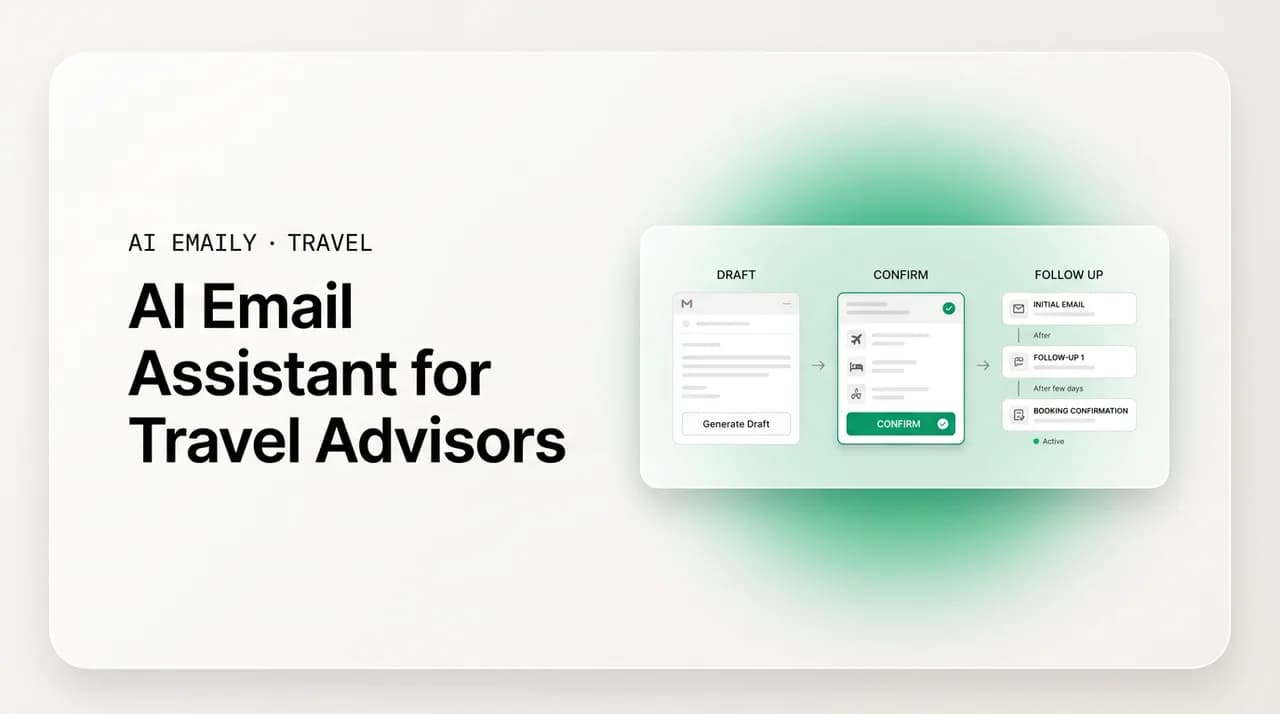
An AI email assistant for travel agents reads your inbox and writes replies in your own voice, so inquiry responses, booking confirmations, deposit reminders, and pre-trip notes go out without you typing each one. The best ones let you approve every draft at first, then autosend only the safe, repetitive messages once you trust them — with undo and an audit trail. AI Emaily does this across every email provider and works alongside a travel CRM like Travefy or TravelJoy, not instead of it.
An AI email assistant drafts travel-agent inquiry replies in your voice and autosends confirmations, deposit reminders and pre-trip info. What to look for.
On this page
- 01What is an AI email assistant for travel advisors?
- 02Why travel advisors feel the email load more than most
- 03What to look for in an AI email assistant for travel agents
- 04The three modes, mapped to how a travel advisor actually works
- 05The advisor email workflows an AI assistant should handle
- 061. Instant inquiry replies (the conversion moment)
- 072. Booking confirmations
- 083. Deposit and final-payment reminders
- 094. Pre-trip information and documents
- 105. Welcome-home and review requests
- 11"But will it actually sound like me?" and other honest objections
- 12"Will the drafts actually sound like me?"
- 13"My clients chose me because they want a person, not automation."
- 14"I work under a host agency — will this even fit?"
- 15Where AI Emaily fits (and how it works with your travel CRM)
- 16A sensible first month
- 17The bottom line
What is an AI email assistant for travel advisors?#
An AI email assistant for travel agents is software that reads your incoming mail, understands what each message needs, and writes the reply for you — in your own voice, using your real details — so that answering a client is a matter of glancing and approving rather than starting from a blank screen. For the repetitive, predictable messages that make up most of a travel advisor's inbox, a good one can go a step further and send the reply on its own, within limits you set. Think of it less as a fancier autocomplete and more as a junior team member who has read every email you have ever sent and drafts the way you would.
That distinction matters for travel advisors specifically, because the shape of the job is unusual. You are a solo business most of the time — the survey data consistently shows the overwhelming majority of advisors are home-based, working alone without support staff — and yet every booking generates a small avalanche of correspondence. An inquiry comes in and needs a warm, fast reply. A booking closes and needs a confirmation. A deposit falls due and needs a reminder. Final payment approaches and needs another. The trip nears and needs pre-departure information. The client returns and deserves a welcome-home note and, ideally, a nudge for a review or a referral. Multiply that by every client on your books and the inbox stops being a communication tool and starts being the thing that eats the hours you meant to spend actually designing trips and selling.
An AI email assistant for travel advisors is built to absorb exactly that load. It is not a marketing autoresponder that blasts the same newsletter to a list, and it is not a rigid template macro that pastes fixed text you then have to edit. It reads the specific email in front of it, pulls the specific client's specific details, and produces a specific reply that reads like you wrote it. The whole point is that the client on the other end cannot tell a machine was involved, because the tone, the phrasing, and the facts are all yours.
It helps to be honest about what the technology is and is not. An AI email assistant is very good at the routine: the messages where the content is largely known in advance and the value is in getting it out quickly, accurately, and in a human voice. It is not a replacement for your judgment on the messages that make you a great advisor — the delicate negotiation with a supplier, the reassurance of an anxious first-time cruiser, the bespoke luxury itinerary pitch. The goal is not to hand the whole inbox to a robot. The goal is to let the machine carry the predictable ninety percent so you have the time and attention to be excellent at the ten percent that only you can do.
That is the frame for the rest of this guide. We will look at what separates a genuinely useful assistant from a gimmick, walk through the specific advisor workflows an AI email assistant should cover, address the objections that every advisor rightly raises — will it sound like me, do my clients want a person, does it fit my host agency — and then explain where AI Emaily fits, including how it complements a travel CRM rather than trying to replace one.
Why travel advisors feel the email load more than most#
It is worth pausing on why email is such an acute pain for this profession in particular, because it explains why an AI email assistant lands differently here than in, say, a large corporate team.
First, the volume is per-booking, not per-client. A single group trip or destination wedding can involve dozens of travelers, each of whom needs the same sequence of deposit, document, and reminder emails on a fixed timeline. Group travel has been rising — reporting in 2025 pointed to a roughly twenty-one percent jump in group bookings as milestone trips returned — and every one of those travelers adds a lane of near-identical correspondence. Cruise specialists, the single most common advisor specialization, live in the same reality: cabins, promotional fares, and group blocks move fast, and the confirmation and reminder flow is virtually identical on every booking, sent by hand each time.
Second, the timing is unforgiving. Speed of response is not a nicety in this business; it is a conversion lever. Industry analysis has found that agencies using a travel CRM responded to leads meaningfully faster and converted a materially higher share of them — the often-cited figures are around a third faster and a quarter more conversions. An inquiry that sits in your inbox for six hours while you are on a supplier call is an inquiry that may have already booked with the advisor who replied in six minutes. And yet you cannot be at your desk replying instantly while also building itineraries, sitting on hold with a cruise line, and living your life.
Third, there is rarely anyone to hand it to. Most advisors are independent contractors working from home; a large and growing share operate under a host agency that provides supplier access and credentials but does not answer your client emails for you. Whether you are fully independent and keeping all your commission, or hosted and splitting it, the day-to-day inbox is yours alone. The host gives you a booking platform. It does not give you a person to write the deposit reminder.
The real cost is not the typing
What to look for in an AI email assistant for travel agents#
Not every tool that claims to write email with AI is built for the way advisors actually work. Some are marketing-blast tools wearing a new label; some draft nicely but never send, leaving you as the bottleneck they promised to remove; some are locked to a single email provider or bolt onto one CRM. Before you commit, check an AI email assistant against the criteria below. They are ordered roughly by how much they matter to a working travel advisor.
- 1
It writes in your voice, not a generic template
The whole value is that the client cannot tell. Look for an assistant that learns from your actual sent mail — your greetings, your sign-off, your level of formality — rather than one that fills a fixed template. A voice-matched draft reads like you on a normal day; a template reads like a form letter, and clients can feel the difference.
- 2
It uses your real client details, and never invents them
A reply that guesses a departure date or makes up a confirmation number is worse than no reply. The assistant should pull real, known values — the client's name, the sailing date, the deposit amount, the booking reference — from your context, and leave a clear gap when it does not have a fact rather than hallucinating one.
- 3
It has modes, so you control how much it does
You should not have to choose between doing everything yourself and handing the inbox to a black box. The best assistants let you start by approving every draft, then graduate specific, safe message types to autosend as your trust grows. One dial, moved when you are ready — not an all-or-nothing switch.
- 4
Every automated action is reversible and logged
Autonomy without an undo button is a liability. Insist on a full audit trail of what the assistant did and the ability to reverse a send. This is what makes it safe to let the machine handle confirmations and reminders — you can always see exactly what went out and to whom.
- 5
It works on your email, whatever provider you use
Advisors use Gmail, Outlook, iCloud, and everything in between; many run more than one account. An assistant tied to a single provider forces you to change how you work. Look for one that connects to the mailbox you already have rather than making you migrate.
- 6
It complements your CRM instead of replacing it
Your travel CRM — Travefy, TravelJoy, Tern, or a host portal — is where itineraries, trip records, and commissions live. An email assistant should sit alongside it and handle the inbox, not demand that you rip out the tool your business already runs on.
- 7
It is private with your clients' data
You hold passport details, travel dates, and payment context. Check that the tool does not train its models on your mail, encrypts what it stores, and — ideally — offers on-device or bring-your-own-key options so sensitive correspondence stays yours.
If a tool fails the first three of those tests — voice, real details, and controllable modes — it is not really an AI email assistant for travel advisors; it is a template library or a mail-merge with a chatbot bolted on. The last four are what separate a tool you can trust with real client correspondence from a novelty you will quietly stop using after a week.
Test it on your five most repetitive emails
The three modes, mapped to how a travel advisor actually works#
The single most important feature in an AI email assistant is not any one trick — it is the ability to control how much authority you hand over, message type by message type, and to move that dial as your trust grows. AI Emaily is built around three modes for exactly this reason. Here is what each mode means and, more usefully, how it maps onto the real texture of an advisor's day.
The mistake most people make is treating this as an all-or-nothing choice. It is not. A sensible advisor runs different message types in different modes at the same time — bespoke luxury correspondence stays Manual, routine confirmations run on Autopilot — and shifts each one only when they are ready.
| Mode | What it does | Where it fits a travel advisor |
|---|---|---|
| Manual | You drive. The AI assists on demand — a summary of a long supplier thread, a search, a draft only when you ask for one. | Your high-touch, high-stakes correspondence: a luxury itinerary pitch, a delicate rebooking after a schedule change, a first reply to a referral you want to get exactly right. You want the AI's help drafting, but you write and send. |
| Copilot | It prepares, you approve. Triage and voice-matched drafts sit ready and waiting; one click sends. Nothing leaves without you. | The default for most of your inbox at first. Inquiry replies, booking confirmations, and reminders are drafted and waiting when you sit down. You skim, tweak if needed, and approve — cutting the work to seconds while you stay in the loop on everything. |
| Autopilot | It acts, you set the rules. Within boundaries you define, the agent sends, schedules, and closes loops on its own — every action reversible and logged. | The safe, repetitive, high-volume messages you have seen the AI get right a hundred times: booking confirmations, deposit-due reminders, pre-trip checklists, welcome-home notes. You set the rules once and stop touching them — every send still reversible and in the audit trail. |
The right way to adopt an assistant is to walk down this table over weeks, not to jump to the bottom on day one. Start almost everything in Copilot so you see every draft before it goes. As you watch the assistant nail your booking confirmations again and again, promote that one message type to Autopilot. Then deposit reminders. Then pre-trip info. Keep your bespoke, client-relationship correspondence in Manual or Copilot indefinitely, because that is where your human touch is the product. Within a month or two, the boring ninety percent runs itself and you are spending your attention only where it moves the needle.
This is also the honest answer to the anxiety that automation means losing control. You are not flipping a switch and hoping. You are graduating specific, well-understood message types to hands-free only after you have personally watched them work, and every one of those sends remains reversible with a full record of what happened. Control is not something you give up; it is something you spend deliberately, on the messages that have earned it.
The advisor email workflows an AI assistant should handle#
Abstract talk about modes only goes so far. Here is the concrete part: the specific, recurring emails that make up a travel advisor's inbox, and how an AI email assistant handles each. These are the touchpoints where an assistant earns its keep, roughly in the order a client encounters them across the lifecycle of a trip.
1. Instant inquiry replies (the conversion moment)#
This is the highest-value email you send, because it is the one that decides whether a lead becomes a booking. A prospective client fills out your form or emails to ask about a river cruise, a family trip to Italy, a honeymoon in the Maldives. Speed matters enormously here — the advisor who replies first and warmest usually wins — and yet this is precisely the moment you are least likely to be free, because you are mid-itinerary or on hold with a supplier.
An AI email assistant reads the inquiry, understands what was asked, and drafts a warm, specific reply in your voice: acknowledging their request, asking the right qualifying questions, and setting up the next step. In Copilot, it is waiting for your one-click approval within moments of the inquiry landing, so even if you are busy you can fire off a real, personal reply in seconds rather than hours. For advisors comfortable letting the first-touch acknowledgment go out hands-free, Autopilot can send an immediate, on-brand "thank you, I have your inquiry and here's what happens next" while you finish your call — turning a six-hour gap into a six-second one.
The payoff is measurable in the way the whole industry already knows: faster responses convert more leads. An assistant that closes the response-time gap on inquiries is not a convenience, it is a direct lever on your booking rate.
Keep the qualifying human, autosend the acknowledgment
2. Booking confirmations#
Once a trip is booked, the client needs confirmation — and this is the archetypal message for automation. The content is highly predictable: what was booked, the key dates, the reference numbers, what happens next. You send a version of this on every single booking, and the value is entirely in getting it out promptly and accurately, not in creativity. This is where the repetitive load is heaviest for cruise specialists and group advisors especially, who send near-identical confirmations booking after booking.
An AI email assistant drafts the confirmation from the real booking details — the client's name, the sailing or departure date, the confirmation number, the deposit paid — and produces a clean, professional message in your voice. Because the structure is so consistent and the facts are pulled rather than invented, this is one of the safest message types to graduate to Autopilot once you have watched it a few times. Set the rule, and every booking confirmation goes out immediately and correctly without you touching it, each one logged and reversible if a detail ever needs fixing.
For an advisor doing meaningful volume, this alone can reclaim hours a week. Confirmations are pure repetition; handing them to the assistant is the clearest win in the whole workflow.
3. Deposit and final-payment reminders#
Payment reminders are the emails advisors most dread sending and most often let slip — and the ones where a lapse costs real money. A deposit due date passes unremarked, a final payment deadline sneaks up, and suddenly you are scrambling to save a booking or eating a penalty. The reminders themselves are templated and timing-driven: a courteous nudge a set number of days before the deadline, with the amount and the due date.
This is where an AI email assistant's ability to schedule and act on a timeline shines. It drafts the reminder in your voice — friendly, not nagging — with the correct amount and date, and can be set to send it automatically at the right point before each deadline. In Copilot it queues the reminder for your approval; on Autopilot it simply sends the courteous nudge on schedule, so the deposit-due and final-payment reminders that used to depend on you remembering now depend on nothing at all. Every send is recorded, so you always know exactly which reminders went out.
The relief here is as much psychological as operational. You stop carrying the anxiety of "did I remember to remind the Hendersons about their final payment," because the answer is always yes, automatically.
Reminders are safe to automate — refunds and disputes are not
4. Pre-trip information and documents#
As departure approaches, clients need practical information: check-in details, a pre-cruise or pre-departure checklist, document reminders (passports, visas, insurance), packing notes, and what to expect on arrival. This is high-value service that clients genuinely appreciate — and, again, largely templated by trip type. Every cruise client gets roughly the same pre-cruise checklist; every European escorted tour gets a similar document reminder.
An AI email assistant assembles the right pre-trip message for each client from your standard information, personalized with their specific dates and details, in your voice. Because these messages are tied to the departure date, they are a natural fit for scheduled, hands-free sending: the pre-trip checklist goes out a set number of days before departure, automatically, for every client. You define the content once per trip type; the assistant delivers it, personalized, on time, every time.
This is one of the touchpoints where clients most feel looked-after — a well-timed, thorough pre-trip note reads as attentive service — and it costs you almost nothing once the assistant is handling it. It is the rare automation that clients experience as more care, not less.
5. Welcome-home and review requests#
The trip ends, and the relationship should not. A welcome-home note when the client returns is a small gesture that lands warmly, and it is the natural moment to invite a review or, gently, a referral — the two things that grow an independent advisor's book more than any ad. Yet this is the email that most reliably falls off the bottom of the to-do list, because by the time the client is home you are three bookings deep into the next thing.
An AI email assistant closes this loop for you. It drafts a genuine welcome-home message in your voice, timed to their return, and can weave in a light request for feedback or a review where you want one. On Copilot it waits for your approval so you can add a personal line about their specific trip; on Autopilot it sends the warm note on schedule so no returning client is ever met with silence. Either way, the post-trip touchpoint that used to depend on you having a spare moment now happens reliably.
Over a year, this is the difference between a client who books with you once and one who becomes a repeat-and-referral relationship. The email is small; the compounding effect on your business is not.
Notice the pattern across all five workflows. The messages that are predictable, timing-driven, and repetitive — confirmations, reminders, pre-trip info, welcome-home notes — are exactly the ones an AI email assistant handles best, and exactly the ones that drain your hours for the least creative return. The messages that need your judgment — the qualifying conversation, the delicate rebooking, the bespoke pitch — stay with you, now with more of your attention available because the routine no longer competes for it. That is the whole promise: every inquiry gets answered, every loop gets closed, without it all having to come from your personal effort.
"But will it actually sound like me?" and other honest objections#
Advisors are right to be skeptical. Your client relationships are your business, and the idea of a machine writing on your behalf raises real, fair objections. Here are the ones we hear most, answered honestly.
"Will the drafts actually sound like me?"#
This is the objection that matters most, because if the answer is no, nothing else counts. The honest answer is that a good AI email assistant learns your voice from your own sent mail — how you greet people, how formal or warm you are, how you sign off, the phrases you reach for — and drafts in that register rather than in generic corporate boilerplate. It is not writing what a robot thinks a travel agent should say; it is writing the way you have demonstrably written across thousands of your own emails.
That said, you should verify it rather than take it on faith. This is exactly why you start in Copilot, approving every draft. In the first week you will read each one before it sends and see for yourself whether it sounds like you. If a draft is off, you correct it, and the assistant learns. By the time you graduate a message type to Autopilot, you have personally confirmed — dozens of times — that the voice is right. You are never gambling that it sounds like you; you are promoting it only after you have proven it does.
"My clients chose me because they want a person, not automation."#
This is a real concern, especially for luxury and high-touch advisors whose whole value proposition is personal attention. The fear is that visible automation reads as a downgrade — that the client feels processed rather than served. It is a legitimate risk, and the answer is to be deliberate about what you automate.
The key insight is that clients do not experience a booking confirmation or a well-timed pre-trip checklist as "automation." They experience it as promptness and thoroughness — as good service. What clients would notice and dislike is a canned, robotic-sounding message or, worse, silence when they email you. A voice-matched assistant that replies fast and sounds like you delivers more of the personal touch they came for, not less, because you are no longer too swamped to respond warmly and on time.
The genuinely high-touch, relationship-defining messages — the ones where the client really does want you, personally — are precisely the ones you keep in Manual or Copilot. Nobody is suggesting you autopilot a condolence message or a bespoke luxury proposal. You automate the plumbing so you have more of yourself to spend on the moments that are actually about the relationship. Done this way, automation makes you feel more present to your clients, not less — because you finally have the time to be.
"I work under a host agency — will this even fit?"#
A large and growing share of advisors operate under a host agency, and the fair question is whether adding an email assistant conflicts with the host's tools or terms. The short answer is that it usually fits well, because of a clean division of labor: your host provides supplier access, credentials, and often a booking platform, but the host does not answer your client emails for you. The day-to-day inbox is yours regardless of your model.
An AI email assistant lives in your email, not in the host's booking system, so it complements the host relationship rather than competing with it. You keep booking through your host portal exactly as you do now; the assistant simply handles the client-facing correspondence — confirmations, reminders, pre-trip notes — that the host was never going to write for you anyway. For hosted advisors on a commission split, where budget is tighter, this is often where the time savings matter most, because you are the one personally absorbing all the inbox work with none of it offloaded to the host.
Independent, fully accredited advisors who keep all their commission have even more freedom here — they choose their own stack with no approval chain — but the fit is the same in both models: the assistant owns the inbox, your host or your own accreditation owns the booking rails, and the two do not overlap.
Check your host's communication policy
Where AI Emaily fits (and how it works with your travel CRM)#
AI Emaily is an AI-native email client with an autonomous chief-of-staff built in. Instead of bolting an AI feature onto an old inbox, the whole client is designed around an agent that triages your mail, drafts replies in your voice, schedules, and closes loops — on every provider and every device, while you stay in control. For a travel advisor, that means the inbox described throughout this guide — inquiry replies, confirmations, reminders, pre-trip info, welcome-home notes — runs the way you want it to, from Manual all the way to Autopilot, one message type at a time.
It connects to the email you already use — Gmail, Outlook, iCloud, Fastmail, Proton, and any IMAP account — so there is nothing to migrate and no provider lock-in, which matters for advisors juggling more than one account. The three modes are exactly as described above: Manual for your high-touch correspondence, Copilot to prepare and wait for your one-click approval, and Autopilot to send the safe, repetitive messages hands-free within rules you set. In v1, Copilot approval is required before any send, and Autopilot is gated and bounded — every autonomous action is reversible with a full audit trail, so you can always see what went out and undo it. Drafts are grounded in a per-client context and typed-variables engine, so the assistant uses your real client details — names, dates, numbers, open loops — and does not invent them.
The most important thing to understand about fit is that AI Emaily complements a travel CRM; it does not replace one. Tools like Travefy and TravelJoy are where your itineraries, trip records, client profiles, and commission tracking live — that is their job, and AI Emaily does not try to do it. What AI Emaily does is own the inbox: the client-facing email correspondence that a CRM handles only partially and that otherwise falls entirely on you. You keep building itineraries in Travefy or TravelJoy and booking through your host portal; AI Emaily handles the replying, confirming, reminding, and following up around all of it. The two sit side by side — CRM for the trip, AI Emaily for the inbox.
That division is deliberate and honest. An email assistant that demanded you abandon the CRM your business runs on would be asking for a migration no advisor wants. AI Emaily instead slots into the gap the CRM leaves open — the sheer volume of personal correspondence — and lets each tool do what it is best at.
CRM for the trip, AI Emaily for the inbox
On privacy — which matters when you hold clients' travel dates, documents, and payment context — AI Emaily does not train models on your mail, encrypts data in transit and at rest, and offers on-device and bring-your-own-key options so sensitive correspondence stays yours. OAuth tokens and any keys you bring are envelope-encrypted and never logged. For a solo business owner who is personally responsible for client data, that is not a footnote; it is a requirement.
Pricing is straightforward. There is a Free plan to try the agent, and a Pro plan at $12.42 per month on the annual plan that includes voice-matched drafting and Copilot, per-client context and variables, and scheduling. Autopilot — the hands-free mode that sends your confirmations and reminders on its own — is available on the Autopilot plan at $20.75 per month on the annual plan, which also adds on-device AI, bring-your-own-key, and multi-model support. You can start free and move up only when the routine inbox has earned your trust. Start at app.aiemaily.com/signup.
A sensible first month#
If you are convinced enough to try it, here is a grounded way to roll an AI email assistant into an advisor practice without disrupting anything.
- 1
Connect your email and let it learn your voice
Connect the account you already use — Gmail, Outlook, or whatever it is — and give the assistant your sent mail to learn from. Do nothing else yet; just let it read how you write for a few days.
- 2
Run everything in Copilot for a week or two
Keep all message types in Copilot so every draft waits for your approval. Read each one before it sends. Correct anything that is off — the assistant learns from your edits — and pay attention to which message types it consistently nails.
- 3
Graduate booking confirmations to Autopilot first
Confirmations are the safest, most repetitive message type. Once you have watched the assistant produce them correctly a dozen times, set the rule to send them hands-free. This is usually the first place advisors feel real time come back.
- 4
Add reminders and pre-trip info as trust grows
Next, promote deposit and final-payment reminders, then pre-trip checklists — all timing-driven and predictable. Keep an eye on the audit trail so you always know what went out. Within a few weeks the whole timed, repetitive layer runs itself.
- 5
Keep your high-touch correspondence human
Leave bespoke pitches, delicate rebookings, and relationship-defining messages in Manual or Copilot indefinitely. The point of automating the routine is to give you more time and attention for exactly these — not to hand them off.
The bottom line#
An AI email assistant for travel agents is not a gimmick and it is not a threat to the personal service that makes you good at your job. It is a way to make sure every inquiry gets a fast, warm, on-voice reply, every booking gets confirmed, every deposit and payment reminder goes out on time, every client gets thorough pre-trip information, and every returning traveler gets a welcome-home note — without all of it having to come from your own scarce hours at the keyboard.
The best assistants let you keep control the whole way: draft in your real voice, use your real client details, approve everything at first, and graduate only the safe, repetitive messages to hands-free — with undo and an audit trail so nothing is ever a black box. They work on the email you already have and sit alongside the travel CRM your business already runs on, rather than demanding you rebuild your stack.
That is what AI Emaily is built to do. If the routine ninety percent of your inbox is eating the time you meant to spend designing trips and selling them, it is worth trying — free — to see the hours come back. You can start at app.aiemaily.com/signup.
Frequently asked
See it in AI Emaily
Keep reading
Sources

Written by
Nafiul HasanNafiul Hasan is an entrepreneur and AI automation system builder with 10+ years of experience turning messy, manual workflows into reliable automated systems. He designs and ships AI enterprise solutions end-to-end — the agent logic, the data plumbing, and the product people actually use — and founded AI Emaily to give busy professionals their attention back. He writes here from the builder's seat: what works, what breaks, and how to put AI to work without giving up control.