AI Emaily vs Intercom Fin: Per-Resolution AI vs Flat Plan

The short answer
Intercom's Fin is a customer-facing AI agent that resolves your customers' support conversations and is billed per resolved outcome. AI Emaily is an internal assistant that triages and drafts replies inside your own mailbox, waiting for your approval before it sends, on a flat subscription. They serve different jobs.
AI Emaily vs Intercom Fin for email: Fin resolves your customers' tickets and bills per outcome; AI Emaily drafts your own replies for approval on a flat plan.
On this page
If you run support out of your own inbox and you are comparing AI Emaily vs Intercom Fin for email, the first thing to settle is who the AI is meant to answer. Fin is a customer-facing agent: it replies to your customers directly and closes their tickets. AI Emaily is an internal assistant: it works inside your own mailbox, triages what lands there, and drafts your replies for you to approve.
That single difference decides most of this comparison, and it also decides the bill. One is billed for the work it does on your customers' behalf; the other is billed like a tool you use. This post lays out where each wins, how Fin's per-outcome pricing works, and which reader each one is genuinely for.
The short verdict#
Choose Fin, or a helpdesk with an AI agent, if your goal is to deflect a high volume of repetitive customer questions automatically, before a human sees them. That is what Fin is built for, and per-outcome pricing only starts to pay off once that volume exists.
Choose AI Emaily if you are a founder or small team still answering support and everything-else email yourself, and the pain is triage, drafting, and threads slipping through the cracks. It is a flat subscription with no per-conversation meter, and it drafts under Copilot, so nothing sends without your approval. We build AI Emaily, and that approval-first design is the point of it.
Many teams cross from the first situation to the second, and some run both at once. The two tools are not really rivals; they are built for two different jobs.
At a glance#
AI Emaily leads the table because it is the fit for the reader most likely searching this comparison: someone answering their own support email who wants help doing it, not a bot to replace them. Read the first column as what an internal assistant does and the second as what a customer-facing agent does.
| Dimension | AI Emaily | Intercom Fin |
|---|---|---|
| Who the AI answers | You — it works inside your own mailbox | Your customers — it replies to them directly |
| Where it runs | Your inbox: Gmail, Outlook and IMAP in one place | Your site, help center, chat and other channels |
| Control before sending | Copilot drafts; you approve every send, with undo and an audit trail | Resolves conversations on its own, handing off to a human when needed |
| Pricing shape | Flat subscription per user; no per-conversation meter | Per-seat plans plus Fin billed per resolved outcome — verify on vendor |
| Best at | Triaging and drafting your own replies across every account | Deflecting repetitive customer questions at volume |
| Role of email | A full email client you live in for all your mail | Support email handled as tickets, one channel among many |
| Training on your mail | No training on user mail | See Intercom's own data and privacy documentation |
The real difference: who the AI answers#
Strip away the feature lists and one axis explains the rest: who does the AI talk to. Fin talks to your customers. AI Emaily talks to you. Pricing, control and fit all follow from that.
Fin is Intercom's AI agent. Intercom now markets it at its own site, fin.ai, and as of August 2026 the older intercom.com/fin address redirects there, while Intercom's paid plans still bundle the Fin agent. So Intercom Fin and Fin are the same product; you will see both names.
Because Fin faces your customers, it is billed for the work it does on their behalf: a resolved conversation becomes a billable outcome. Because AI Emaily faces you, it is billed like a tool you use, a flat seat, and it never speaks for you without your approval.
Where AI Emaily wins#
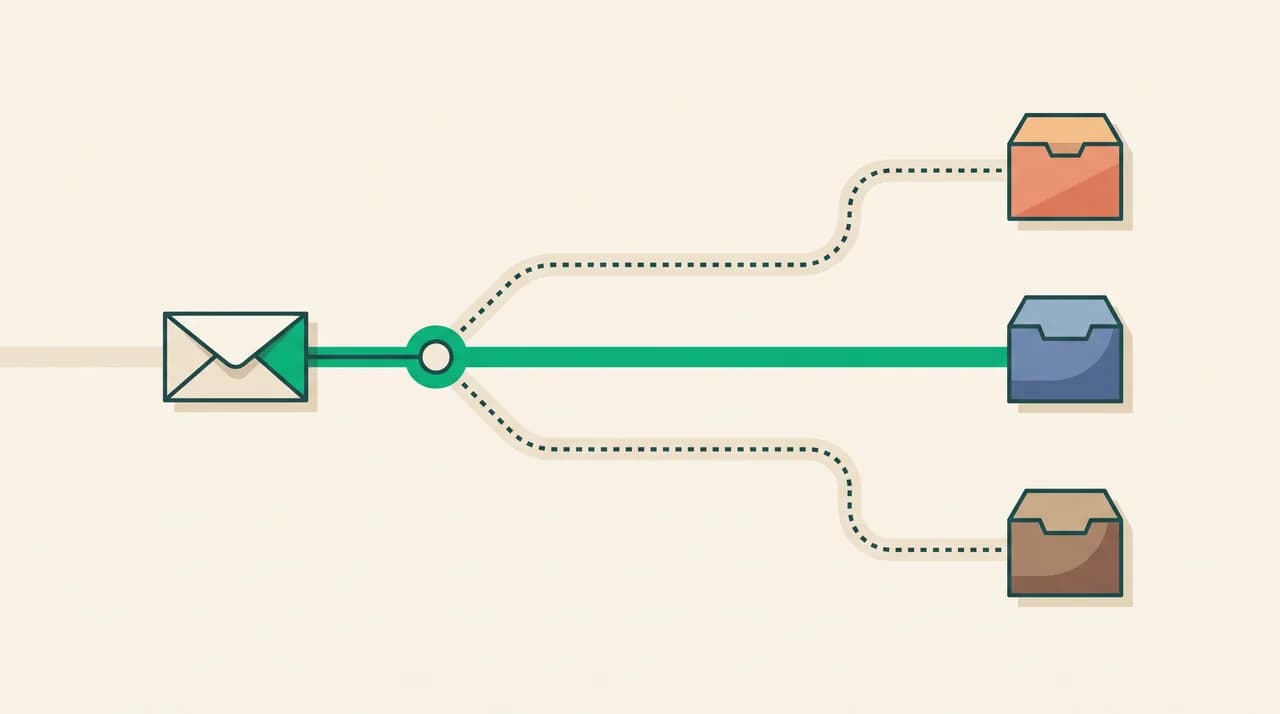
AI Emaily is built for the person who still answers email themselves. It connects Gmail, Outlook and IMAP accounts into one inbox, triages what arrives, and drafts replies you can approve — support email, but also vendor threads, investor updates and everything else in a founder's day. We build AI Emaily, so this is where we argue for it plainly.
Every reply runs through Copilot: the agent proposes a draft, you read it, and nothing sends until you approve. Undo and a full audit trail sit behind that, so an approval is reversible and every action is on the record. The voice comes from a Personal Context brain you set up, plus profiles for the people and clients you write to — not from scraping your old sent mail — and AI Emaily does not train on your mail.
The pricing is a flat subscription per user, so a heavy email week costs the same as a quiet one. What it is not: a customer-facing bot. AI Emaily will not sit on your website and resolve a stranger's ticket before a human sees it. If that is the job, this is the wrong tool, and the next section is about the tool that does it.
- One inbox for Gmail, Outlook and IMAP, not a separate support desk
- Copilot drafts; you approve every send, with undo and an audit trail
- Voice from a Personal Context brain and client profiles — no training on your mail
- Flat per-user pricing, so cost does not swing with email volume
How AI Emaily decides what to draft
Where Intercom Fin wins#
Fin is a customer-facing resolution agent. It sits on your site, help center and chat, answers your customers directly, and closes the conversation when it can, handing off to a human when it cannot. That is a genuinely different job from anything AI Emaily does, and at support volume it is where Fin earns its place.
Fin works across channels — chat, email, voice, Slack and social among them — so a growing support team can point many inflows at one agent. It draws its answers from your existing help content and knowledge sources, which means the more documentation you already have, the more it can resolve without a person writing anything new. Intercom publishes resolution-rate figures on fin.ai; treat those as vendor marketing and check the current numbers there rather than taking any single figure as fixed.
There is also a standalone deployment for teams already on another helpdesk, so you can add Fin without moving your whole support stack. If your bottleneck is a rising tide of repetitive questions, Fin is designed for exactly that, and AI Emaily is not. None of this is what an internal inbox assistant does, which is exactly why the two rarely land on the same shortlist once you are clear on the job.
How Intercom Fin's per-resolution pricing works#
Intercom now calls this outcome-based pricing, and the mechanics are worth understanding before you compare it to a flat plan. There are two layers: human seats and Fin usage.
Human agents sit on one of Intercom's three named plans — Essential, Advanced and Expert — priced per seat, per month. Fin is billed separately, per resolved outcome, on top of whatever seats you buy. The AI cost is usage-metered; the seat cost is not.
An outcome is counted, per Intercom's pricing page, when a customer confirms their issue is resolved, when they stop asking for help after Fin responds, or when Fin completes a workflow or hands off — and you are charged once per conversation even if it answered several questions. There is also a standalone Fin for platforms option for teams already on another helpdesk, with a monthly minimum and no seat requirement.
To compare it against a flat plan, put both on a spreadsheet with your real numbers. On the seat-plus-usage side, take the seats you need at the tier that has the features you want, then add an estimate of resolved outcomes for a busy month. On the flat side, it is one line: seats times the subscription. The comparison is only honest at the volume you actually expect, not at zero and not at your quietest week.
We are not printing the current rates here on purpose: usage pricing moves, and a stale number is worse than none. Read the figures on Intercom's pricing page and on fin.ai before you commit.
A variable support month is a variable bill
Who each is genuinely for#
The clean way to choose is by who is drowning.
If you are a founder or small team still answering support out of your own inbox — and the pain is threads slipping, slow first replies, and drafting the same answer for the hundredth time — an internal assistant fits. AI Emaily triages and drafts, you approve, and the bill does not swing with volume. That is the founder-led-support case.
If support has grown past what a few people can read, and most of it is repetitive questions a bot could answer without a human, a customer-facing agent fits. Fin, or a helpdesk with an AI agent, deflects that volume before it reaches a person, and per-outcome pricing starts to pay for itself. That is the scaling-support case.
Plenty of teams cross from the first to the second, and some run both at once: an internal assistant for the founders' inbox, a deflection agent for the support queue. Pick the tool for the stage you are actually in.

A third option, honestly#
Before you pay per resolution or per seat for either, check whether you have outgrown the simplest setup at all.
Microsoft documents shared mailboxes in Exchange Online as a way for a group to monitor and send from one common address like [email protected], using Full Access and Send As permissions, and Google Workspace has an equivalent. For a small team, one shared address everyone can see and reply from is often enough, with no AI and no per-conversation cost.
When a shared mailbox stops scaling — no assignment, no status, no reporting — the next step up is a helpdesk or shared-inbox platform such as Zendesk, Help Scout, or a shared-inbox tool like Front. These add ticketing and collaboration, and several now bolt an AI agent on top, which is the same category Fin competes in.
So the honest ladder is: shared mailbox, then helpdesk, then a customer-facing AI agent once volume justifies it, with an internal assistant like AI Emaily running alongside for the inbox you answer yourself. Pick the rung your volume actually sits on.
Frequently asked
See it in AI Emaily
Keep reading
Sources

Written by
Nafiul HasanNafiul Hasan is an entrepreneur and AI automation system builder with 10+ years of experience turning messy, manual workflows into reliable automated systems. He designs and ships AI enterprise solutions end-to-end — the agent logic, the data plumbing, and the product people actually use — and founded AI Emaily to give busy professionals their attention back. He writes here from the builder's seat: what works, what breaks, and how to put AI to work without giving up control.