Smart Mailboxes in Apple Mail on Mac: A Practical Setup

The short answer
A Smart Mailbox in Apple Mail is a saved search that displays matching messages without moving them. To create one: Mailbox > New Smart Mailbox, set your conditions, then click OK. Messages stay in their original folders; the Smart Mailbox is a live, auto-updating view that works across all your accounts.
A Smart Mailbox is a saved search: messages never move, one email can appear in five at once. Setup steps, four configurations worth building, and fixes when it stops updating.
On this page
- 01What is a Smart Mailbox in Apple Mail?
- 02Before you create a Smart Mailbox on Mac
- 03How to create a Smart Mailbox in Apple Mail on Mac
- 04What conditions can you use in Apple Mail Smart Mailboxes?
- 05Four Smart Mailbox setups worth building
- 06How to nest Smart Mailboxes into folders
- 07How Smart Mailboxes behave across macOS versions
- 08What to do when a Smart Mailbox is not updating
- 09A faster way to keep mail organised automatically
If you use Apple Mail on Mac and have never created a Smart Mailbox, you are looking at your mail the hard way. Smart Mailboxes are one of the most useful and underused features in Apple Mail: each one is a saved search query that updates itself automatically, showing every matching message from across your entire library without moving or copying anything.
This guide covers how to use Smart Mailboxes in Apple Mail on Mac from start to finish. It explains what a Smart Mailbox actually is and how it differs from a regular folder, walks through creating one step by step, lists every condition type worth knowing, describes four setups that are worth building, and explains what to do when a Smart Mailbox stops updating. Steps were verified against macOS Tahoe 26 and macOS Sequoia 15.
What is a Smart Mailbox in Apple Mail?#
A Smart Mailbox is a saved search, not a folder. Nothing moves when you create one, and nothing is deleted when you remove it. It is a live query that Apple Mail runs against your message library continuously: any message matching the conditions you set appears inside it, and when a message no longer matches, it disappears from the view. The original message stays exactly where it was — in your inbox, in your Sent folder, wherever it originally landed.
This distinction matters in practice. A regular mailbox stores messages. When you drag a message into a folder, it moves there and is no longer in the inbox. A Smart Mailbox shows messages. A single message can appear in five Smart Mailboxes simultaneously — waiting-on-reply, from a specific client, flagged this week, has a large attachment — and it is still one message, in one location, in its original folder.
The table below captures the key differences between Smart Mailboxes and regular mailboxes on Mac.
| Smart Mailbox | Regular Mailbox | |
|---|---|---|
| Stores messages | No — shows a live view only | Yes — messages are filed there |
| Messages move when added | No — the original stays in place | Yes — the message is relocated |
| Updates automatically | Yes — as new mail arrives | No — you file manually |
| Same message in multiple at once | Yes — non-exclusive | No — one folder per message |
| Conditions editable after creation | Yes — double-click to edit | Not applicable |
| Available on iPhone and iPad | Read-only — create and edit on Mac only | Yes, across devices |
Before you create a Smart Mailbox on Mac#
Smart Mailboxes work in Apple Mail on macOS Sequoia 15 and macOS Tahoe 26. The menu paths and condition options described in this guide were verified against Tahoe 26; on Sequoia 15 the interface is identical, and any version-specific differences are noted in the platform table further down.
Smart Mailboxes work across all account types in Apple Mail: iCloud, Gmail via IMAP, Microsoft Exchange, and On My Mac local accounts. One important limit applies on mobile: Smart Mailboxes are a Mail.app feature on macOS, not a server feature. Their conditions do not sync to iPhone or iPad. You can view a Smart Mailbox you created on Mac when you open Mail on iOS, but you cannot create new ones or edit existing conditions there. All Smart Mailbox setup happens on a Mac.
Smart Mailbox conditions are Mac-only
How to create a Smart Mailbox in Apple Mail on Mac#
Creating a Smart Mailbox takes under a minute. The setup is a dialog with a name field, a condition logic picker, and condition rows you build one at a time. The steps below reflect the behaviour in macOS Tahoe 26 and Sequoia 15, where the interface is identical.
- 1
Open the New Smart Mailbox dialog
In Mail on macOS Tahoe 26 or Sequoia 15, go to Mailbox in the menu bar and choose New Smart Mailbox. You can also Control-click anywhere in the Smart Mailboxes section of the sidebar and choose New Smart Mailbox from the contextual menu. A dialog opens with a name field at the top and one condition row pre-filled below it.
- 2
Name the mailbox
Type a descriptive name in the Smart Mailbox Name field. A name that says what the mailbox shows — Waiting on Reply, This Week, Big Attachments, From Acme Corp — is more useful later than a generic label. You can rename it at any time by double-clicking it in the sidebar.
- 3
Choose All or Any for the condition logic
The dropdown next to Contains messages that match lets you pick All or Any. All means every condition you add must be true at once; a message missing even one condition will not appear. Any means at least one condition must match; a message meeting any single condition will appear. All narrows results; Any broadens them. Most focused Smart Mailboxes use All.
- 4
Add conditions
Click the plus button on the right of the first condition row. Choose a condition type from the left dropdown — From, Subject, Date Received, Has Attachment, and others — then set the operator and value in the fields that appear to the right. Click the plus button again to add more conditions. Remove a row with the minus button on its right side.
- 5
Set the Sent and Trash options
At the bottom of the dialog, two checkboxes let you include messages from the Sent mailbox and from Trash. Both are unchecked by default. Turn on Include messages from Sent if you want the mailbox to surface outgoing threads — the Waiting on Reply setup described below requires this checkbox. Leave both off for views scoped to your inbox only.
- 6
Click OK
Click OK and the Smart Mailbox appears in the sidebar under the Smart Mailboxes heading. It populates immediately from your existing mail. If it is empty and you expected results, open the editor again by double-clicking the mailbox and review each condition and the Include messages from Sent checkbox before running a rebuild.
What conditions can you use in Apple Mail Smart Mailboxes?#
Apple Mail's condition picker covers around 20 distinct criteria, grouped by what part of the message they match. The most useful ones for building practical Smart Mailboxes are listed below.
| Condition | What it matches | When to use it |
|---|---|---|
| From | Sender address or display name | One-client view, VIP mailbox, or domain-wide filter |
| To or Cc | Recipient address | Find mail sent directly to you versus mass distributions |
| Subject | Subject line text | Track a project name, a keyword, or a ticket prefix |
| Message content | Body text | Surface any message mentioning a term, a name, or a phrase |
| Date received | Relative or absolute date | This week, last 30 days, or older than a specific date |
| Has attachment | Whether any attachment is present | Build an attachments view; combine with size for storage cleanup |
| Message size | Total message size in KB or MB | Locate large messages before an archive migration or backup |
| Flag color | Red, orange, yellow, green, blue, or purple flag | Support custom flag-based workflows |
| Read status | Read or Unread | Scope an unread view to one account or one sender |
| Message is replied to | Whether you sent a reply from Mail | Waiting-on logic — outgoing threads that received no response |
| Account | A specific email account in Mail | Restrict a Smart Mailbox to one inbox when you have several accounts |
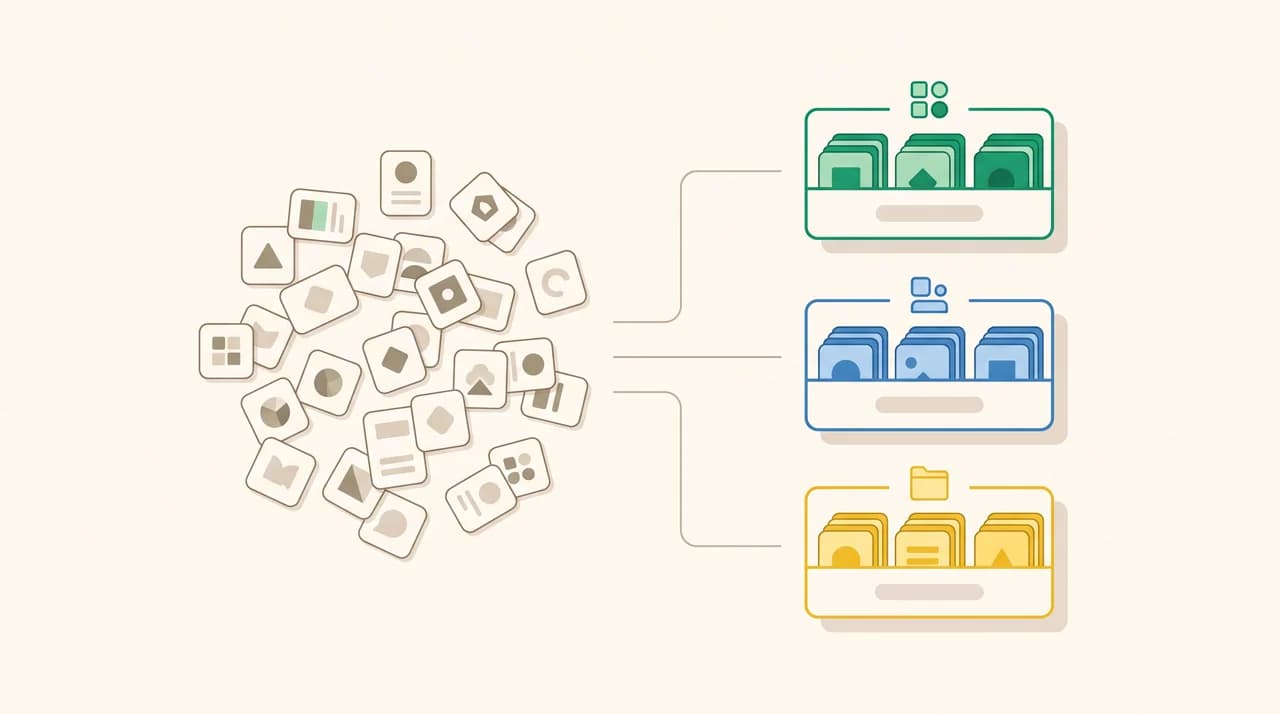
Conditions become more powerful in combination. The most useful Smart Mailboxes tend to pair a sender or date condition with a state condition — replied-to status, flag color, or read status — rather than using a single filter in isolation. The diagram below illustrates how a set of conditions routes messages into separate Smart Mailbox views while the originals remain in the inbox.
Four Smart Mailbox setups worth building#
These four setups cover the most common practical problems: tracking follow-ups, cutting through a full inbox, finding large files, and keeping a client relationship visible. Each is described by the conditions that produce it and why those conditions work together.
- 1
Waiting on reply
Conditions: Message is replied to is No; Date received is greater than 2 days ago; match All conditions; check Include messages from Sent. This view shows outgoing threads that have gone quiet — messages you sent that received no response. The date threshold filters out messages sent in the last two days, where silence is still normal. Adjust the threshold to match your usual reply window. This is the most useful Smart Mailbox for anyone who loses follow-ups in a busy week.
- 2
This week
Conditions: Date received is within the last 7 days; Mailbox is Inbox; match All conditions. A reset view for an inbox with hundreds of unread messages. It shows only the recent and potentially important, letting you triage the last week before tackling the backlog. Adjust the range to 3 days for a tighter view or 14 days if you check mail infrequently.
- 3
Big attachments
Conditions: Has attachment is Yes; Message size is greater than 5 MB; match All conditions. This view surfaces messages carrying large files. It is most useful before an archive migration, a Mail library backup, or a storage audit. Change the threshold to 20 MB to focus on video files and large archives rather than ordinary document attachments.
- 4
One client or sender
Conditions: From contains the client domain — for example the company domain name — or the person's full name; match Any if you add multiple people from the same organisation. This mailbox shows the full history of one relationship in one place, without a repeated search each time you need context. Edit the From condition when a new contact from the same organisation starts emailing you.
How to nest Smart Mailboxes into folders#
Once you have more than four or five Smart Mailboxes, the sidebar becomes hard to scan. Apple Mail provides a Smart Mailbox Folder for exactly this: go to Mailbox in the menu bar and choose New Smart Mailbox Folder. A folder appears in the sidebar. Drag any existing Smart Mailbox onto it to nest it inside. The folder itself has no conditions — it is a pure organising layer with no effect on what the nested Smart Mailboxes show.
Nesting is limited to one level. You cannot place a Smart Mailbox Folder inside another Smart Mailbox Folder. If you are building a larger system, group Smart Mailboxes by theme — follow-ups, client views, storage — and keep the total count small. A sidebar with twenty Smart Mailboxes stops being a useful at-a-glance system. Four to eight, organised into one or two folders, is the range that stays readable over time.
How Smart Mailboxes behave across macOS versions#
Smart Mailboxes are one of the Apple Mail features that has remained consistent across major macOS releases. The table below confirms what you can expect on the two current versions.
| Feature | macOS Sequoia 15 | macOS Tahoe 26 |
|---|---|---|
| Create and edit Smart Mailboxes | Yes — Mailbox menu or sidebar Control-click | Yes — same paths |
| Available condition categories | Approximately 20 criteria | Approximately 20 criteria — unchanged |
| Smart Mailbox Folder | Yes | Yes |
| Include messages from Sent or Trash | Yes | Yes |
| Create or edit conditions on iOS or iPadOS | Not available | Not available |
| iCloud sync of Smart Mailbox conditions | No — conditions stored locally in Mail on Mac | No — same behaviour |
| Search powered by Spotlight index | Yes — requires an up-to-date Spotlight index | Yes — same requirement |
What to do when a Smart Mailbox is not updating#
Three things account for the majority of Smart Mailboxes that appear broken. Work through them in order before assuming a system-level fault.
The most common cause is a misconfigured condition, not a software bug. Open the Smart Mailbox editor by double-clicking the mailbox in the sidebar and read every condition carefully: check the All versus Any selector at the top, the operator on each row (contains versus does not contain, greater than versus less than), and the value in the right field. A typo in a From contains condition or a flipped replied-to state will produce an empty mailbox with no error. Fix the condition and the mailbox updates immediately.
The second cause is a stale Spotlight index. Apple Mail uses Spotlight to power Smart Mailbox searches, and when the index falls behind — after a large Mail import, a system migration, or a long period of heavy use — the Smart Mailbox stops showing recent messages even though they exist. To fix it, select the inbox or account in the sidebar, go to Mailbox in the menu bar, and choose Rebuild. Mail re-indexes the account, which can take several minutes on a large library. The Smart Mailbox will populate correctly once the rebuild finishes.
The third cause is a missing checkbox. Smart Mailboxes do not include messages from the Sent mailbox or Trash by default. A Waiting on Reply mailbox that looks at outgoing threads will be empty until you open the editor and check Include messages from Sent. Similarly, a mailbox intended to surface recently deleted messages needs Include messages from Trash turned on.
Edit the conditions before running a Rebuild
A faster way to keep mail organised automatically#
Smart Mailboxes in Apple Mail solve the labelling problem: once you set them up, filtered views stay current without manual filing. What they do not solve is triage — deciding which messages deserve attention now, surfacing threads that have gone quiet, and keeping routine mail from burying the important ones. That part still runs on your attention, every time you open Mail.
If the reason you are setting up a Waiting on Reply Smart Mailbox is that follow-ups keep slipping, the underlying problem is triage, not organisation. AI Emaily is an AI-native email client built for that layer: it automatically surfaces the messages that need your attention, tracks threads that have gone quiet, and handles routine mail within rules you set — every send held for your approval before it goes out. We build AI Emaily. Start a 7-day free trial at aiemaily.com to see whether automated triage changes how much manual organising your inbox actually needs.
Apple Mail's Smart Mailboxes remain genuinely useful alongside it — they are built in, stable on Mac, and cost nothing. But if the inbox is still winning after the Smart Mailboxes are in place, the tool that changes the underlying dynamic is worth a look.
Frequently asked
See it in AI Emaily
Keep reading

Written by
Nafiul HasanNafiul Hasan is an entrepreneur and AI automation system builder with 10+ years of experience turning messy, manual workflows into reliable automated systems. He designs and ships AI enterprise solutions end-to-end — the agent logic, the data plumbing, and the product people actually use — and founded AI Emaily to give busy professionals their attention back. He writes here from the builder's seat: what works, what breaks, and how to put AI to work without giving up control.