Best Email App for Android Without a Google Account (2026)


The short answer
On a de-Googled Android with no Google account or Play Services, FairEmail leads: F-Droid install, IMAP IDLE push without FCM, and open source under scrutiny. Thunderbird for Android (the K-9 Mail rebrand), Tuta and Proton Mail are all viable. AI Emaily is a hosted PWA that needs an account, so it does not fit a fully de-Googled phone.
Most roundups assume Play Services is running. Six apps for no-Google-account Android — ranked on F-Droid availability, IMAP push without FCM, and GrapheneOS fit. FairEmail leads.
On this page
- 01The short answer for a de-Googled Android
- 02How we compared these de-Googled Android mail clients
- 03Comparison table
- 041. FairEmail — the F-Droid default for de-Googled Android
- 052. Thunderbird for Android (the app K-9 Mail became)
- 063. Tuta Mail — encrypted mailbox with its own push channel
- 074. Proton Mail — F-Droid available, with a caveat about push
- 085. Aqua Mail — the mature commercial IMAP client
- 09Where AI Emaily fits — and where it doesn't
- 10How push notifications work without Google Play Services
- 11How to choose for your setup
Most "best email app for Android" roundups quietly assume two things: that you signed into a Google account when you set the phone up, and that Google Play Services is running in the background delivering push notifications through Firebase Cloud Messaging. Drop either assumption — as GrapheneOS, CalyxOS, /e/OS and LineageOS-without-microG users do every day — and the shortlist collapses.
This guide is written for the setup those roundups ignore. No Gmail address on the device. No Play Store account. No Google Play Services or a minimal microG substitute at best. You install apps from F-Droid or a signed APK, you connect a mailbox by IMAP and SMTP against your own domain or a privacy-first provider, and you expect the app to notify you of new mail without a Google server in the middle. Six apps genuinely meet that bar. Some of the most-recommended options do not.
We build AI Emaily and we appear in this comparison, but not at the top. AI Emaily on Android is a hosted, server-side agent delivered as a Progressive Web App — the exact opposite architecture from a fully de-Googled, local-IMAP setup. Where the rest of the site places AI Emaily first, this page places us honestly: as the adjacent thing we actually do, with the limit stated plainly.
The short answer for a de-Googled Android#
For an Android phone with no Google account and no Play Services, install FairEmail from F-Droid. It is open source under scrutiny, uses IMAP IDLE for push through a foreground service instead of Firebase Cloud Messaging, works entirely against your own mailbox, and runs cleanly on GrapheneOS with the Sandboxed Google Play layer disabled and on /e/OS or CalyxOS out of the box. Thunderbird for Android — the app the K-9 Mail project became in late 2024 — is the strongest alternative if FairEmail's density of settings feels like too much.
The concession worth naming: FairEmail has built harder on Play-Services-free IMAP handling, on configurability, and on a documentation trail that actually explains the trade-offs than any AI-native mail client, including AI Emaily, ever will. If your requirement is a fully de-Googled phone that talks IMAP to a mailbox you control, stop reading and install FairEmail. Nothing in this ranking overtakes it on that spec.
The tools below are ranked for de-Googled fit, not for AI features. Ranking a hosted AI agent first on this page would be the category error the reader is here to avoid.
How we compared these de-Googled Android mail clients#
We compared six apps on the capability axes that matter when the phone has no Google account and no Play Services running. Feature completeness on a normal Pixel with a Gmail address is a different question and lands a different ranking — this one is deliberately narrow.
- F-Droid or direct-APK install. Is the app on F-Droid, on the vendor's own APK release page, or only in the Play Store? A Play-Store-only app is disqualifying without Aurora Store or a Play account.
- Push without Firebase. Does the app receive new-mail push through IMAP IDLE and a foreground service, through a vendor-run non-Google channel, through UnifiedPush, or does it fall back to Firebase Cloud Messaging when Play Services is absent?
- Provider freedom. Does the app work with an arbitrary IMAP + SMTP mailbox — your own domain, Fastmail, Mailbox.org, Migadu, a self-hosted stack — or is it locked to one provider's ecosystem?
- Open source under scrutiny. Is the app source-available under a real open source licence, and is the repository maintained and independently reviewed?
- Background sync behaviour. What actually happens on a de-Googled device when the app is closed — persistent IDLE connection, a scheduled poll, or nothing until the user opens the app?
- Battery cost of the honest push path. IMAP IDLE plus a foreground service is not free — how does the app expose the trade-off and let the user tune it?
We did not run a controlled trial
Comparison table#
Read the first three columns before anything else — F-Droid availability, push architecture and provider freedom are what actually decide this on a de-Googled phone.
| App | F-Droid / APK | Push without Play Services | Provider support | Licence |
|---|---|---|---|---|
| FairEmail | F-Droid, GitHub, Play Store | IMAP IDLE + foreground service | Any IMAP + SMTP mailbox | GPLv3, source on GitHub |
| Thunderbird for Android (ex-K-9) | F-Droid, direct APK, Play Store | IMAP IDLE + foreground service | Any IMAP + SMTP mailbox | Apache 2.0, source on GitHub |
| Tuta Mail | F-Droid, direct APK, Play Store | Vendor SSE channel (no FCM) | Tuta accounts only | GPLv3, source on GitHub |
| Proton Mail | Vendor F-Droid repo + Play Store | Falls back to polling without FCM; UnifiedPush support in progress | Proton accounts (IMAP via Bridge) | GPLv3, source on GitHub |
| Aqua Mail | Play Store only (Aurora Store possible) | IMAP IDLE + foreground service | Any IMAP + SMTP mailbox | Proprietary, freemium |
| AI Emaily (PWA) | Not an APK — installed from the browser | Standard web push through the browser vendor's channel; Chrome on Android routes web push via FCM | Hosted service, connects Gmail, Outlook, IMAP | Proprietary client + hosted backend |
1. FairEmail — the F-Droid default for de-Googled Android#
FairEmail is the app to install first on a phone with no Google account. It is open source under GPLv3, published on F-Droid and on the developer's GitHub releases page as well as the Play Store, and it has one of the most transparent documentation trails in the category — the developer publishes the reasoning behind each default and the trade-off behind each optional feature. On a de-Googled device it does the one thing that actually matters: it holds an IMAP IDLE connection open through a foreground service so new mail arrives as a notification, with no Firebase, no Play Services, and no third-party server between your mailbox and your phone.
It works with any IMAP + SMTP account, so a self-hosted Dovecot, a Mailbox.org address, a Migadu domain, a Fastmail account or a Proton Mail address exposed through the Proton Mail Bridge all connect the same way. It also handles PGP through OpenKeychain and S/MIME natively, which matters if your reason for going de-Googled includes end-to-end encryption on top of provider independence.
The trade-off is that FairEmail exposes almost every setting the underlying IMAP and Android APIs allow. That is the reason to pick it — nothing is hidden — and also the reason people bounce off it: the first-run flow is not a polished modern onboarding, and the volume of switches is deliberate rather than accidental. There is a free tier on F-Droid and an optional one-time in-app purchase for pro features (widgets, extra filters, encryption niceties). Verify the current shape on the FairEmail site before you commit.
Where it loses points: the interface is dense, and the notification icon that appears while IDLE is running is a permanent battery reminder that some users find intrusive. Neither of those is a bug — they are the visible cost of doing push honestly without Google.
2. Thunderbird for Android (the app K-9 Mail became)#
Thunderbird for Android is the current name of the codebase most privacy-focused Android users know as K-9 Mail. Mozilla's Thunderbird team took over the K-9 project and released it under the Thunderbird brand in late 2024; it is still Apache 2.0, still published on F-Droid, and still distributes a signed APK directly from the project's release page as well as through the Play Store. If a guide from 2023 tells you to install K-9 Mail, this is the app it means.
For a de-Googled setup its properties are almost identical to FairEmail's: works with any IMAP + SMTP mailbox, uses IMAP IDLE through a foreground service for push, does not depend on Firebase or Play Services. The differences are cultural rather than technical. Thunderbird for Android has a cleaner default UI, fewer knobs on the front page, a familiar Thunderbird-family feel on the desktop-mobile boundary, and — because it is a Mozilla-backed project — the promise of continued maintenance beyond a single developer.
The trade-off is a smaller set of advanced options than FairEmail exposes. It does not have the same fine-grained per-account tuning, PGP integration goes through OpenKeychain rather than being folded in as tightly, and some of the filter and rule surface that FairEmail treats as core is intentionally out of scope here. For most de-Googled users this is the point: fewer settings, sensible defaults, familiar shape.
3. Tuta Mail — encrypted mailbox with its own push channel#
Tuta Mail (formerly Tutanota) is the pick when the whole setup — mailbox, client, encryption — is meant to be one privacy-first stack rather than an arbitrary IMAP account. The Android app is open source under GPLv3, distributed on F-Droid, on Tuta's own download page as a signed APK, and on the Play Store. On a device without Play Services it uses Tuta's own server-sent-events push channel to deliver new-mail notifications; no Firebase involvement at any point.
Because Tuta encrypts subject lines and bodies at rest on their servers, IMAP is not offered — the client speaks Tuta's own protocol. That is the trade: you gain end-to-end encryption inside a single provider and a genuinely non-Google push path, and you lose the ability to point the app at your own domain over standard protocols. If your reason for going de-Googled is provider independence rather than encrypted-mailbox-at-a-provider, this is the wrong shape and FairEmail or Thunderbird for Android is what you want.
There is a free tier with one address and a set amount of storage, plus paid tiers for custom domains, aliases and calendar features. Verify the current tier structure on Tuta's own pricing page before you rely on any specific number.
4. Proton Mail — F-Droid available, with a caveat about push#
Proton Mail publishes its Android app in a first-party F-Droid repository — proton.me hosts an F-Droid repo URL you add to your F-Droid client — as well as on the Play Store. It is open source under GPLv3 with the source on GitHub, and on a device with Google Play Services it uses Firebase Cloud Messaging for push notifications the way most Android mail clients do.
On a de-Googled device the honest picture is more nuanced. Without Play Services the app cannot deliver new-mail notifications via FCM; it falls back to a scheduled polling mode, which means notifications arrive on the poll interval rather than instantly. Proton has been publicly working on UnifiedPush and non-Google push paths — check the Proton Mail Android release notes for the current state before you assume real-time push works on your GrapheneOS or /e/OS build. If instant notifications on a fully de-Googled phone are non-negotiable, FairEmail against a Proton Mail address exposed through the Proton Mail Bridge is the setup that actually delivers them.
IMAP against Proton is only available through the Bridge — the desktop application that translates IMAP to Proton's protocol locally. On mobile this means you either use Proton's own Android app (subject to the push caveat above) or you point another IMAP client at a Bridge instance running on a computer you control. Neither is elegant on a phone; both are the honest options.
5. Aqua Mail — the mature commercial IMAP client#
Aqua Mail is the long-running commercial IMAP client that most people who tried de-Googled Android around 2019 will remember. It supports any IMAP + SMTP mailbox, handles Exchange EWS, uses IMAP IDLE with a foreground service so push works without Play Services, and has a polished settings screen for account-by-account tuning. There is a free tier with a message-count-per-day limit and a paid tier that removes it; the paid tier packaging is subscription plus a one-time perpetual option — verify the current shape on the vendor's page.
The reason it ranks below the F-Droid picks for this specific query is distribution and licence. Aqua Mail is proprietary and Play-Store-first; there is no F-Droid build, so on a device without a Play account you are installing it through Aurora Store or a sideloaded APK from a mirror rather than from a signed release the developer publishes for de-Googled users. If the whole point of the setup is auditability of the client itself, that combination is a step down from FairEmail or Thunderbird for Android.
For a user who wants a modern, polished, well-supported IMAP client on a de-Googled device and does not require the client itself to be open source, Aqua Mail is still a reasonable pick. For anyone whose threat model includes the mail client, it is not.
Where AI Emaily fits — and where it doesn't#
This is the honest placement. AI Emaily is not the answer on a fully de-Googled Android, and we are naming that up front because a reader who arrives from a de-Googled setup expecting a native APK and finds a hosted PWA has been misled. We build AI Emaily.
On Android, AI Emaily is a Progressive Web App installed from the browser rather than a Play Store or F-Droid app. It requires an account on the AI Emaily hosted service — the AI triage, drafting and Copilot approval flow runs server-side against mailboxes you have connected. That architecture is the opposite of what most de-Googled Android setups are trying to build: a local IMAP client talking directly to a mailbox you control, with no third-party server in the middle. If the reason you dropped Play Services was to remove hosted intermediaries from your mail path, AI Emaily reintroduces one by design.
The push story compounds the mismatch. Web push in the AI Emaily PWA is delivered through the browser vendor's push service — and Chrome for Android routes web push through Firebase Cloud Messaging, which means Play Services in practice. Firefox for Android uses Mozilla's own push service and does deliver web push without Google, so if you are running Firefox on /e/OS or CalyxOS the PWA can notify you; on GrapheneOS with Vanadium there is no push channel wired up at all. That is a real limit, not a bug we are hiding.
There is one shape where the trade genuinely works: a Fastmail, Mailbox.org, Migadu, or self-hosted IMAP account connected to AI Emaily's hosted agent, used from Firefox on a de-Googled phone for AI triage and drafting, with FairEmail installed alongside as the local client that actually notifies you when a message arrives. That combination is defensible; leading with the PWA alone on this page would not be. Pricing on AI Emaily is a seven-day trial on Pro or Autopilot with no permanent free tier — see /pricing for the current shape.
How push notifications work without Google Play Services#
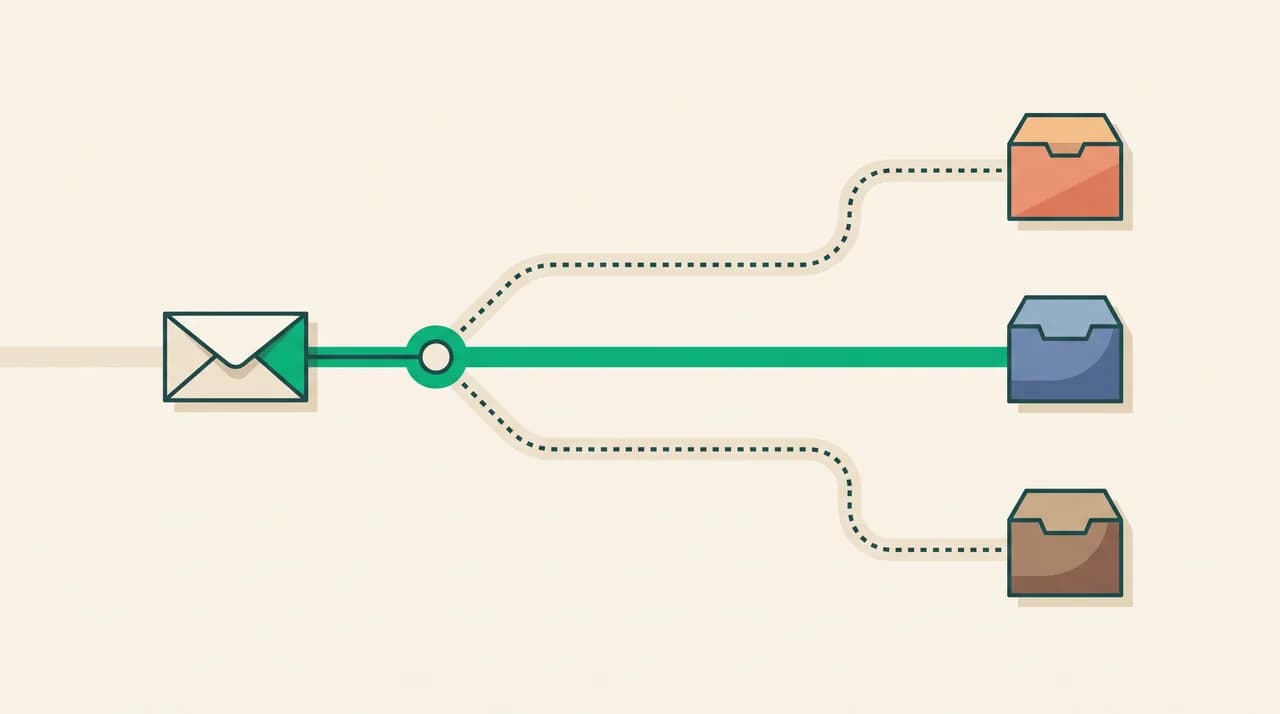
Push on Android is the load-bearing detail this whole post turns on. On a stock Pixel with a Google account, apps register with Firebase Cloud Messaging and Google's servers deliver a small wake-up message to Play Services, which then wakes the specific app. On a device without Play Services, that path does not exist — and the app has to either open its own channel to the server or accept that push simply will not work.
For an IMAP mail client, the honest replacement is IMAP IDLE inside a foreground service. IMAP IDLE is a decades-old command that tells the mail server to hold the connection open and tell the client the moment something changes. Android requires long-running network work to run as a foreground service, which is why FairEmail, Thunderbird for Android and Aqua Mail all display a persistent notification while push is on: that notification is what buys the app the right to hold the IDLE connection open. The battery cost is real and roughly proportional to how many accounts are IDLE at once, and both FairEmail and Thunderbird for Android expose per-account controls so you can trade instant delivery for a scheduled poll.
For provider-specific clients like Tuta Mail, the pattern is a vendor-run server-sent-events or WebSocket channel — the client holds a connection to Tuta's servers, and Tuta pushes over that channel instead of via Google. UnifiedPush is a newer standardised alternative that a growing number of apps (including some Proton clients in progress) can use to route push through a self-hostable or community-run distributor rather than FCM. If you are on GrapheneOS or CalyxOS, UnifiedPush plus a client that supports it is worth watching.
How to choose for your setup#
The right pick depends on which part of the de-Googled setup is the requirement and which parts are flexible. Work through the questions in order and the choice usually collapses to one or two apps.
- Your mailbox is on your own domain, or with Fastmail, Mailbox.org, Migadu, or a self-hosted stack, and you want push without Firebase: install FairEmail from F-Droid. Thunderbird for Android is the fallback if FairEmail feels overwhelming.
- You want a single privacy-first provider with encrypted-at-rest storage and a non-Google push channel: install Tuta Mail. Accept that IMAP is not on offer and that the mailbox lives inside one provider's ecosystem.
- You are already on Proton and want the first-party app: install Proton Mail from Proton's F-Droid repo, and accept that on a fully de-Googled device push will arrive on a poll interval rather than instantly until UnifiedPush support lands. If instant notifications are required, run Proton Mail Bridge on a computer you control and point FairEmail at it.
- You want a polished commercial IMAP client and do not require the client itself to be open source: use Aqua Mail via Aurora Store or a sideload.
- You want AI triage and drafting across Gmail, Outlook and IMAP: AI Emaily is the tool, but the honest shape on a de-Googled phone is Firefox for Android running the PWA, ideally paired with FairEmail as the local client that notifies you. On GrapheneOS with Vanadium and no Play Services at all, web push does not fire — plan for that.
Two apps beats one on a de-Googled phone
Frequently asked
See it in AI Emaily
Keep reading
Sources

Written by
Nafiul HasanNafiul Hasan is an entrepreneur and AI automation system builder with 10+ years of experience turning messy, manual workflows into reliable automated systems. He designs and ships AI enterprise solutions end-to-end — the agent logic, the data plumbing, and the product people actually use — and founded AI Emaily to give busy professionals their attention back. He writes here from the builder's seat: what works, what breaks, and how to put AI to work without giving up control.