Best Email Automation Builders for Inbox Rules (2026)


The short answer
The best tools for building inbox rules pair plain-English or AI conditions with a place actions are logged and undone — our pick is AI Emaily, then Shortwave, Superhuman Mail, Clean Email, SaneBox and Inbox Zero. Native Gmail and Outlook rules break on brittle string matches, and Outlook silently disables client-only rules whenever it is closed.
The best email automation builders for inbox rules, compared on AI conditions, plain-English rules and where sends are gated.
On this page
- 01The short answer: the best rule builder for each situation
- 02Why native Gmail and Outlook rules break so often
- 03How we compared these rule builders
- 04Best email automation builders for inbox rules, compared
- 051. AI Emaily — best overall rule builder
- 062. Shortwave — best plain-English filters for Gmail only
- 073. Superhuman Mail — best keyboard-first rule creation
- 084. Gmail filters — best free server-side rule engine
- 095. Outlook rules — best if you already live in Outlook, with limits
- 106. Clean Email — best add-on for turning a sweep into a standing rule
- 117. SaneBox — best training-based sorting, no rule syntax
- 128. Inbox Zero — best open-source AI rule builder
- 13Where rules actually break in production
- 14How to choose for your situation
- 15The verdict
Most roundups of email rule builders compare the same three things: how many conditions you can chain, whether the app looks nice, and which providers it connects to. None of them explain why the rules you already wrote in Gmail or Outlook keep breaking, and none of them separate the tools that write a rule for you from the tools that run one.
So that is the spine of this post. Eight live rule builders — one native engine per major provider, three add-on services and four AI rule builders that take plain-English instructions — compared on the questions that decide whether your rules survive month three: where the rule runs, what happens when a match is ambiguous, whether the tool logs what it did, and whether an action can be undone.
One disclosure up front: we build AI Emaily, and it leads this list. Read the rest with that in mind. Every entry states its limits, ours included, and we concede one dimension outright to a competitor by name — because a page that wins on everything is a page you stop trusting.
The short answer: the best rule builder for each situation#
There is no single winner because "rule builder" covers three different shapes of tool. Some people want a plain-English AI that turns "file invoices from suppliers into Accounting" into a running condition. Others want a filter they wrote themselves that they can point at and debug. A third group wants nothing on their machine at all — a service that trains itself from where they drag mail.
- Best overall, and our pick: AI Emaily — plain-English conditions across Gmail, Outlook and IMAP, with approval before send, undo and a full audit log.
- Best plain-English filters on Gmail only: Shortwave, whose filters are strings you write, read and reword.
- Best keyboard-first rule creation: Superhuman Mail, where Auto Labels classify and custom prompts add more.
- Best free rule engine, and the one that never depends on a client being open: Gmail filters.
- Best if you already live in Outlook: Outlook rules — with the client-only trap flagged and worked around.
- Best rule builder for bulk cleanup: Clean Email's Auto Clean, which turns a manual sweep into a standing rule.
- Best provider-agnostic sorting, no rule syntax at all: SaneBox, which trains from folder moves.
- Best open-source AI rule builder: Inbox Zero, which you can self-host and read.
Why native Gmail and Outlook rules break so often#
Before comparing the eight tools, it helps to name what native rules actually do — because the AI builders are trying to fix specific failures, not add features for the sake of it.
Gmail filters are server-side, which is the good news: they run when a message arrives, whether your client is open or not, and they match on from, to, subject, has-the-words, size and attachment. The bad news is that the whole match language is string matching. "has-the-words: invoice" catches every newsletter that quotes the word invoice, and a sender rotating between marketing@ and hello@ inside one domain escapes a filter written on a single address.
Outlook is worse for a different reason. Outlook rules split into two categories — server-side (Exchange runs them at delivery, regardless of whether Outlook is open) and client-only (Outlook runs them, once the client is open and connected). Any rule that involves a local action — playing a sound, moving to a PST file, running a script — is client-only, and if you never open Outlook that day, the rule never runs. Exchange also enforces a 256 KB size limit on the total rule set; once you cross it, new rules silently fail to save and old ones can go inactive without notice.
| Failure | Where it happens | What it looks like | How the AI builders address it |
|---|---|---|---|
| Rule matches on a single string | Gmail filters, Outlook rules | A newsletter that mentions "invoice" gets filed under Accounting | Match on sender behaviour, category and content classification, not one substring |
| Client-only rule stops running | Outlook | The rule works when Outlook is open on your laptop and does nothing overnight | Rules run on the vendor's server or on your provider, not in an app you must keep open |
| Rule set hits the 256 KB Exchange limit | Outlook, Microsoft 365 | New rules refuse to save, existing rules quietly go inactive | Conditions are stored as structured entries, not a flat XML blob per mailbox |
| Migration wipes the rules | Classic Outlook → New Outlook, Gmail account transfer | You open the new client and every filter is gone | Rules attach to your account inside the tool, so a client change does not lose them |
| Rule silently forwards or deletes something important | Both | You find out weeks later from an angry sender | Every action is logged with the reason and can be undone from the log |
How we compared these rule builders#
This is a capability comparison built from vendor documentation and product pages checked in August 2026. We did not run eight tools side by side for a month, and any roundup that claims it did should be read with suspicion. What we can compare honestly is what each vendor documents and how the architecture caps it.
There are no prices, ratings or review counts here on purpose — this category repriced itself repeatedly in the last year, so check each vendor's own page on the day you buy. The five dimensions below decide whether a rule builder survives a real inbox.
- Where the rule runs — server-side at your provider, on the vendor's server, or in a client you must keep open.
- How conditions are written — a form of dropdowns, a plain-English string, or an AI classification you cannot fully see.
- What actions the rule can take — label, move, forward, archive, draft, send.
- Whether actions are logged and undoable — is there a record of every fired rule and its outcome.
- What happens when the rule is wrong — a visible folder to drag out of, or a silent archive you find later.
The five questions to ask before a rule touches a work inbox
Best email automation builders for inbox rules, compared#
Where a cell says not documented, we could not find a public answer in August 2026. Treat that as unknown and ask the vendor rather than as a missing feature. Providers are listed on the vendor's own page — verify at write time.
| Tool | Shape | How conditions are written | Where the rule runs | Logged and undoable |
|---|---|---|---|---|
| AI Emaily | AI client — Gmail, Outlook, IMAP | Plain-English conditions plus an AI classification layer you can inspect | On our server, tied to your account — not your local client | Yes — every fire recorded with reason, undo window on writes |
| Shortwave | AI client — Gmail only | Plain-English filter strings you write and reword | On Shortwave's side, applied to Gmail via API | Actions land in Gmail; All Mail is the fallback record |
| Superhuman Mail | AI client — Gmail, Outlook | Auto Labels from content plus custom prompts (business plan) | On Superhuman's side, applied via provider API | Labels are visible and undoable; a formal log is not documented |
| Gmail filters | Native — Gmail, Google Workspace | A form of dropdowns and a has-the-words string | Server-side at Google, at delivery | No action log; changes fire silently |
| Outlook rules | Native — Outlook, Microsoft 365 | A form of dropdowns; some conditions client-only | Server-side at Exchange or client-only in Outlook | No fire log; server rules run without your app |
| Clean Email | Add-on — Gmail, Outlook, iCloud, IMAP | Auto Clean rules from your manual sweep, plus custom conditions | On Clean Email's server, applied via IMAP or API | Actions land in a visible folder; the app records what it moved |
| SaneBox | Filtering layer over the account | No rule syntax — trains from where you drag mail | On SaneBox's server, at delivery, over the account itself | Everything is a folder you drag out of; that is the record |
| Inbox Zero | Overlay — Gmail, Outlook, open source | Plain-English AI rules or hand-written conditions | On the instance you host, or Inbox Zero's, applied via API | You can read the source, which beats a claim about the source |
1. AI Emaily — best overall rule builder#
AI Emaily is an AI email client rather than an overlay, connecting Gmail, Microsoft 365, Outlook and standard IMAP accounts into one inbox. We build it, which is why it leads this list and why its limits get the longest paragraph on the page. Nothing migrates — your mail stays with your provider.
Rules are written in plain English into the Rules Brain, and each one has two halves. The condition can be a structured match on sender, domain, folder, subject or content, and it can also lean on the AI classification layer that already sorts your inbox — so "file invoices from any supplier into Accounting" works without you enumerating every sender. The action can be a label, a move, an archive, a draft or an auto-reply, and each authority level decides which are allowed to run without you.
Authority is set per account. Manual is a fast plain client with no agent. Copilot is the default — rules propose actions and drafts, and nothing reaches a recipient until you approve it. Autopilot is opt-in per account and gated, with an undo window behind it. Every fired rule is written to the audit log with the reason it was taken, which is why a wrong call is something you review on Monday rather than discover in a client's reply on Thursday.
The limits, plainly: packaging is a 7-day free trial on Pro or Autopilot (card required, $0 if you cancel before day 7), not a permanent free tier. Downloadable desktop apps for macOS (Apple Silicon only) and Windows, built as an Electron shell around the web app rather than a native binary. A native iOS app; Android as a PWA with a native app on the roadmap; no Linux build; and offline support is partial by design, because the agent needs a server. We build AI Emaily.
2. Shortwave — best plain-English filters for Gmail only#
Shortwave is an AI-native Gmail client from former Google engineers, and its rule builder is the most transparent of the AI options here. You write a filter as a plain-English sentence — "label anything from a company that mentions pricing as Sales" — and the tool converts it into a running condition that labels, stars, archives or splits the message into a bundle. Packaging is a paid client with a trial; check the vendor page for the current shape.
The transparency cuts both ways. A rule you wrote is easier to debug than a model's judgement, but a loosely worded rule quietly removes mail — and Gmail's All Mail is where you look for what disappeared. Shortwave is Gmail and Google Workspace only, so it will not help on Outlook or IMAP.
Where Shortwave beats us outright
3. Superhuman Mail — best keyboard-first rule creation#
Start with the naming, because most reviews predate it. Grammarly acquired Superhuman, the email client, in July 2025, and renamed the parent company to Superhuman in October 2025. Superhuman Mail is the client; the Superhuman Suite is the broader bundle. Anything calling Superhuman an independent startup was written before either move.
For rules, Superhuman Mail leans on Auto Labels: every message is classified from its content, subject, sender and recipients into built-in categories such as marketing, cold pitches and social updates, which move out of Important into Other. On the business plan you can add custom Auto Labels written as a prompt, capped at ten. Labels are visible and a keystroke undoes them, but a formal action log is not documented, so ask if that matters to your review. Providers: Gmail and Outlook — verify the tier that holds the AI features you want.
4. Gmail filters — best free server-side rule engine#
Gmail filters remain the unbeatable free option for one reason: they run on Google's servers at delivery, so they never depend on a client being open, a laptop being awake, or a subscription being active. If your entire world is Gmail and your conditions are simple, this is where to start — and one of the tools above may still turn out to be unnecessary.
Create a filter from Show search options in the search bar, then Create filter from the result. Actions cover skip inbox, apply label, forward, star, mark read, delete and categorize. Two known limits: matches are string matching, so a sender that rotates addresses inside one domain will escape a filter written on one address, and there is no log of what a filter fired on. Where a filter goes wrong, All Mail is your recovery folder.
5. Outlook rules — best if you already live in Outlook, with limits#
Outlook rules are worth understanding on their own terms, because the AI builders above solve specific things Outlook cannot. Create a rule from Settings → Rules in new Outlook, or from Manage Rules & Alerts in classic Outlook. The rule engine is more expressive than Gmail's — you can chain conditions, run scripts, defer sends and route to any folder.
The trap is the client-side versus server-side split. Server rules run on Exchange at delivery and keep working when Outlook is closed; client-only rules — anything that touches your local machine, such as playing a sound or moving to a PST — only run once Outlook is open and connected. If overnight mail is not sorting, that is usually why. The other trap is the 256 KB total rule size limit at Exchange; once you cross it, new rules silently fail to save. Consolidate old rules before adding new ones, and keep an eye on the migration from Classic to New Outlook, which has wiped rule sets in real deployments.
6. Clean Email — best add-on for turning a sweep into a standing rule#
Clean Email is a rule builder built around the idea that your existing cleanup habits are the training data. You do a manual sweep — delete 200 promos, archive an old newsletter — and Auto Clean offers to make it a standing rule that fires on future messages matching the same criteria. It also has hand-written conditions if you prefer.
It works across Gmail, Outlook, iCloud and any IMAP account, which is a wider surface than most items here. Two things to know. It is a service that connects to your account, not a client, so the app you open in the morning does not change. And because its cleanup actions are aggressive by default, we suggest running it in review mode for a week before letting Auto Clean fire without you — the log of what it moved is genuinely useful, but only if the mail is somewhere you can drag it back from.
7. SaneBox — best training-based sorting, no rule syntax#
SaneBox is the oldest idea here and, for people who do not want to write rules at all, still the best. It is neither client nor overlay — it works on the account itself, moving unimportant mail into SaneLater, newsletters into SaneNews and blocked senders into SaneBlackHole. You train it by moving mail between those folders; there is no rule editor.
Its privacy claim is unusually narrow in a good way: SaneBox says your emails never leave your server, that it analyses only headers to decide what is important, and that when optional features retrieve a body it is never stored. That is a tighter data footprint than any tool here that reads content, ours included. What you give up is everything downstream of reading the message — it sorts reliably across Google, Microsoft, iCloud and Fastmail, and it stops there. No drafts, no writing, no auto-reply.
8. Inbox Zero — best open-source AI rule builder#
Inbox Zero is an open-source AI email assistant for Gmail, Google Workspace and Outlook. You can write plain-English AI rules or hand-written conditions, auto-archive, bulk-unsubscribe, draft replies and file attachments to cloud storage. It runs as a hosted service or on your own instance, and every rule fired is a database row you can read.
For a rule-builder comparison it has an answer no commercial vendor here can match: you can read what the code does. Every other tool on this page, ours included, asks you to trust a documentation page about what an approval gate or an undo window means. Trade-offs are the usual ones — self-hosting means you own the setup, keys and upgrades, and the hosted plan puts you back to trusting a vendor. If a security review is going to ask what a rule is actually allowed to do, this is the entry that answers with source.
Where rules actually break in production#
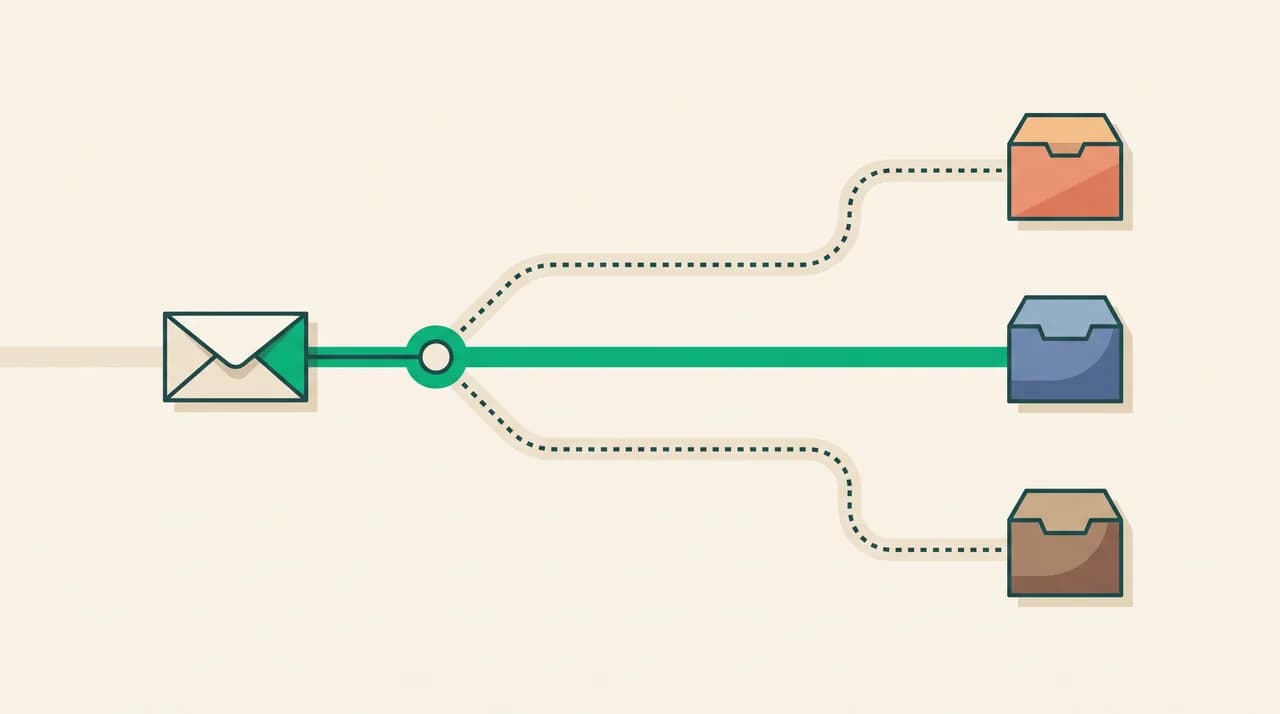
This is the table nobody publishes, and it predicts how a tool feels in month three. A wrongly fired rule is inevitable; what varies is whether you find out in an hour from a visible folder, or in a week from an annoyed client.
The pattern is consistent: tools that only move mail between visible folders are recoverable without vendor tooling at all. Tools that act — draft, forward, auto-reply — have to give you more, which is why the log and the undo matter more than the number of conditions on the form.
| Tool | Where a wrongly fired rule lands | How you get it back |
|---|---|---|
| AI Emaily | The label or folder the rule chose, with the reason recorded | Undo from the audit log, then adjust the condition |
| Shortwave | Wherever your plain-English filter sent it, archive included | Search Gmail All Mail, then reword the filter |
| Superhuman Mail | The Other split or a custom Auto Label | Move it back; the label is visible either way |
| Gmail filters | The label or archive the filter matched | Search All Mail; there is no filter-fire log |
| Outlook rules | The folder the rule chose, or nowhere if it was client-only | Check Deleted Items, then look at server vs client status |
| Clean Email | A visible folder Clean Email created | Drag back and remove or narrow the Auto Clean rule |
| SaneBox | SaneLater, SaneNews or the blocked-sender folder | Drag it back to the inbox — that is how you train it |
| Inbox Zero | Archived or labelled by a rule you set | Gmail All Mail or the Outlook archive, then adjust the rule |
How to choose for your situation#
Match your line, then trial two options at most. Evaluating eight rule builders at once produces a month of half-configured rules and no decision, and half-applied rules on a live inbox are worse than none.
| If this is you | First pick | Second look |
|---|---|---|
| Gmail, Outlook and an old IMAP address in the same day | AI Emaily | SaneBox, if you only want sorting |
| Your whole world is Gmail and you want to read the rule | Shortwave | AI Emaily, if a second provider is likely |
| Simple conditions, unbeatable price, everything server-side | Gmail filters | SaneBox, to add training |
| You already live in Outlook and rules mostly work | Outlook rules, server-side only | AI Emaily, for the audit log |
| Your problem is bulk cleanup that keeps coming back | Clean Email Auto Clean | SaneBox for newsletters specifically |
| You want no rule syntax and a tight data footprint | SaneBox | Gmail categories, free and built in |
| You have to defend the choice to a security review | Inbox Zero self-hosted | AI Emaily, for the audit log and zero-retention terms |
| Rules that also draft the reply | AI Emaily | Inbox Zero, if drafting quality is enough |
The verdict#
AI Emaily is our pick, for a reason narrow enough to check rather than take on trust: it is the only rule builder here that runs plain-English conditions across Gmail, Outlook and IMAP while recording every fired rule with its reason and putting an approval gate and an undo window between the agent and your recipients. A rule that also drafts and files is only worth having if a wrong call is visible and reversible. We build AI Emaily.
If your world is Gmail and you want the rule to be a string you wrote, Shortwave is the more transparent choice and we said so above. If simple conditions and a free server-side engine are enough, Gmail filters are still the answer — and you may not need any of the paid tools here. If you cannot stand the idea of writing a rule at all, SaneBox trains from where you drag mail and stops at reading headers, which is the tightest data footprint on the page.
Whichever you pick, run it with the approval gate on for two weeks before loosening anything, and check what it moved at the end of each week. Every rule builder here looks the same in a demo. They differ entirely in what they leave behind when they are wrong.
Frequently asked
See it in AI Emaily
Keep reading
Sources

Written by
Nafiul HasanNafiul Hasan is an entrepreneur and AI automation system builder with 10+ years of experience turning messy, manual workflows into reliable automated systems. He designs and ships AI enterprise solutions end-to-end — the agent logic, the data plumbing, and the product people actually use — and founded AI Emaily to give busy professionals their attention back. He writes here from the builder's seat: what works, what breaks, and how to put AI to work without giving up control.