Best Email Client for Content Creators (2026): 6 Tools Picked


The short answer
AI Emaily is our pick for a creator whose inbox is sponsorship offers, guest pitches and audience mail — it separates real brand deals from mass outreach with a cold-email filter and drafts replies in the creator's voice from a user-set Personal Context brain. Shortwave wins for Gmail-only creators who dig into old sponsor threads constantly.
Best email client for content creators in 2026 — six apps compared on sorting real sponsorship offers from mass pitches and replying in your voice.
On this page
- 01The short answer: which client fits which creator
- 02How we compared these six clients
- 03Comparison at a glance
- 04The shape of a creator's inbox, visualised
- 05The clients, in order
- 061. AI Emaily — the pick for creators drowning in cold pitches
- 072. Shortwave — the Gmail-native pick with real archive search
- 083. HEY — the pick if you want senders vetted before they reach you
- 094. Superhuman Mail — the keyboard-first speed pick
- 105. Fyxer — the overlay pick if you want to keep Gmail or Outlook
- 116. Spark — the free unified pick without AI overhead
- 12How to choose for your situation
- 13Where AI Emaily fits in a creator's stack
A creator's inbox is a strange shape. On any given morning there is a real sponsorship offer from a brand with a budget, twenty near-identical pitches from agencies who scraped your channel description, three podcast guest requests, a few dozen viewer replies to your last video, a chargeback from Stripe, a DMCA notice, and one message from your accountant that has been sitting there for a week. The email client that wins for a YouTuber, podcaster or newsletter writer is the one that pulls the two or three messages that matter out of the noise before you open the app.
This guide compares six email clients on that job specifically — separating real brand deals from mass outreach, triaging guest pitches, and replying in the creator's own voice at scale — rather than on generic features you would use in a corporate inbox. Every claim is checked against each vendor's live product page in August 2026. No competitor prices are printed, because pricing in this category shifts every few months and any number here would age immediately.
One disclosure up front: we build AI Emaily, and it is entry #1 on this list. That colours the ranking, which is exactly why every entry names a limit and one competitor is called out by name for doing a specific thing better than we do.
The short answer: which client fits which creator#
Find the shape of your channel first, then read only those entries. All six clients here are actively shipping as of August 2026, and packaging shape is described rather than priced.
- Best overall, and our pick: AI Emaily — separates real sponsorship offers from mass outreach with a cold-email filter, drafts replies in your voice via a user-set Context brain, and works across Gmail, Outlook and IMAP.
- Best if you live entirely in Gmail and dig through old sponsor threads a lot: Shortwave — semantic search across your Gmail archive answers plain-language questions about deals from two years ago.
- Best if you want incoming senders vetted before they reach you at all: HEY — the Screener asks 'do you want to hear from this person?' for every new sender, which is a genuinely different shape for a creator drowning in cold pitches.
- Best if your day is triaging a hundred emails fast by keyboard: Superhuman Mail — one-keystroke everything and AI drafts inside a second, on Gmail and Microsoft 365.
- Best AI overlay if you want to keep Gmail or Outlook and add drafting on top: Fyxer — sits on your existing inbox rather than replacing it.
- Best free unified client for a creator who wants no AI and no subscription: Spark — one inbox across every provider you touch, with a free tier for individuals.
How we compared these six clients#
This is a capability comparison built from vendor documentation and public product pages read in August 2026. We did not run six email clients on a live creator business for a month, and any roundup that claims to have done that at scale should be read with that caveat. What we can honestly compare is what each product publishes and where its architecture puts a hard ceiling on what a creator inbox needs.
For a creator, the axes that decide it are different from the ones a corporate buyer scores. The list below is what actually separates a usable inbox from a punishing one when your job is being visible on the internet.
- Cold outreach filtering. The volume of unsolicited pitches to a public creator is not the same as spam and is not the same as newsletter noise. It looks legitimate, it uses your name, and it has to go somewhere other than the same inbox as the deal you have been chasing for six weeks. The client either has a dedicated cold-outreach filter or it does not.
- Voice fidelity in replies. Your reply to an audience member is warm and short. Your reply to a brand about rate sheet terms is formal and specific. Your reply to another podcaster about a guest swap is casual and fast. Either the app has a place to teach it those differences per sender or client, or it drafts one flat voice for everyone and you rewrite half of them.
- Provider coverage in one working view. Most creators have a public creator@ address on their own domain plus a personal Gmail plus a manager-provided outlook.com. If the client is Gmail-only, that filter alone eliminates it for anyone with a real business setup.
- Who presses send. For a creator, a bad reply to the wrong brand is a lost deal and, sometimes, a screenshot on X. Whether the AI suggests, drafts or acts autonomously, and what stands between it and a sent message, is not a preference — it is the whole risk model.
- What leaves with you. Creators move tools. Anything that lives inside the client rather than in your provider's storage — labels, categorisations, drafts, agent memory — has to either export cleanly or has to be rebuildable in the next tool.
Packaging shape, not prices
Comparison at a glance#
| Client | Cold outreach filtering | Voice fidelity | Provider coverage | Who presses send | Packaging shape |
|---|---|---|---|---|---|
| AI Emaily | Dedicated cold-email filter matching on sender behaviour and domain, not just address | Per-client profiles plus a user-set Personal Context brain | Gmail, Microsoft 365 Outlook and any IMAP — one unified inbox | Copilot approves-before-send default; Autopilot gated per rule | 7-day free trial on Pro/Autopilot, card required, $0 if you cancel before day seven |
| Shortwave | AI triage into categories; no dedicated cold-outreach lane published | AI drafts inherit thread voice; no explicit per-sender profile | Gmail only (Workspace or consumer Gmail) | AI suggests and drafts; you send | Paid tiers with a trial — verify shape on the current pricing page |
| HEY | Screener — every new sender is Yes/No before they ever reach the Imbox | You write replies; no AI drafting inside the service | @hey.com addresses; HEY for Work supports custom domains | You send; no agent | Paid annual subscription per user; separate Personal and Work tiers |
| Superhuman Mail | Split inbox and Instant Reply suggestions; no dedicated cold-pitch lane | AI drafts learn a tone from your writing across the account | Gmail and Microsoft 365 (Grammarly-owned since July 2025) | AI drafts; you send with one keystroke | Paid per user, monthly or annual — verify on the live page |
| Fyxer | Categorises inside Gmail or Outlook; overlay, not a filter you can rewrite | AI drafts learn tone from your existing sent mail in the underlying inbox | Overlay on Gmail or Outlook only — not a standalone client | AI drafts inside Gmail or Outlook; you send | Paid subscription with a trial — verify on the vendor page |
| Spark | Smart Inbox groups newsletters and notifications; no dedicated cold-pitch lane | No client-aware tone; AI drafts on paid plans use one voice | Gmail, Outlook, iCloud, Yahoo, IMAP and Exchange — genuinely unified | You draft and send; AI assists only | Free tier for individuals plus paid Premium — check the current plans page |
The shape of a creator's inbox, visualised#
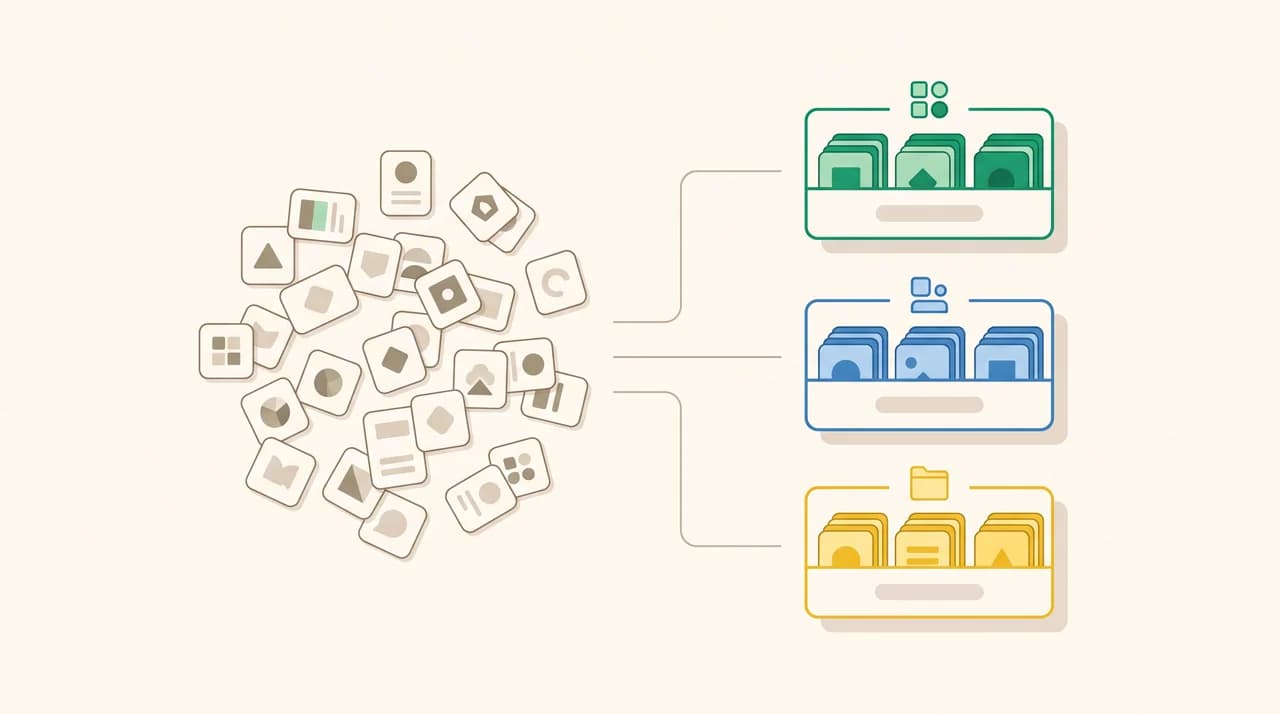
Before the individual write-ups, the diagram below shows the sorting problem this guide is scored on. The six clients differ mostly in how many of these bins they create automatically and how much rewriting you do to keep them accurate.
The clients, in order#
Six write-ups, roughly 180 words each, longer for the one we build. Each entry names who it is right for, what it does well for a creator specifically, and where it hits a ceiling.
1. AI Emaily — the pick for creators drowning in cold pitches#
AI Emaily is the email client we build, and this post is on our site. It leads the list because it is built for exactly this shape of user: one person, several inboxes, sponsorships and audience mail mixed with mass outreach, and no assistant paid to sort them by hand every morning.
The reason cold pitches keep landing in a creator's main inbox is that generic spam filters match on suspicious content, and a well-written outreach pitch is not spam — it is a real person, at a real agency, sending a real proposal to hundreds of creators from a rotating set of addresses inside one domain. AI Emaily's cold-email filter matches on sender behaviour and domain patterns rather than a single address, so a bulk pitch that changes its from-address every send does not reset the filter. The genuine sponsorship offer from a brand you have talked to before goes to Imbox; the templated agency blast goes to a separate lane where you can skim it in one pass.
Voice in replies is set by a user-written Personal Context brain plus per-client profiles that scope tone, boilerplate and signature per recipient or label. Your reply to a brand you already have a rate sheet with, your reply to a first-time viewer, and your reply to another podcaster asking for a guest swap are drafted in three different voices because you wrote three different profiles. The framing is deliberately not 'learns from your past mail' — you write the context, the agent uses it, and you rewrite it when a relationship changes.
Send is Copilot by default: the agent drafts and files, nothing leaves the outbox until you approve it. Autopilot can be turned on per rule — auto-decline out-of-scope pitches with a template, auto-file every Stripe receipt — with an undo window and an audit log for anything the agent did on its own. Provider coverage is Gmail, Microsoft 365 Outlook and any IMAP account in one unified inbox. AI Emaily has no permanent free tier — it is a 7-day free trial on Pro/Autopilot with a card required, $0 if you cancel before day seven. We build AI Emaily.
2. Shortwave — the Gmail-native pick with real archive search#
Shortwave has built harder on Gmail archive search than we have. It is a native Gmail client written by ex-Google engineers, and its semantic search reaches into old threads with plain-language questions in a way that our search matches on recent mail but not across ten years of Gmail history. A creator whose entire business lives in one Gmail account and who regularly needs to answer 'what rate did that brand offer me two winters ago' or 'which podcast did that guest pitch me on last year' will find Shortwave's archive answers more consistent than ours on that specific job.
Where it is the wrong fit for creators: it is Gmail-only, so a creator with a Microsoft 365 outlook.com from a manager or a Fastmail-hosted business address has to keep a second client open — which is the multi-inbox burden most creators are trying to escape. Shortwave has AI triage that categorises incoming mail, but does not publish a distinct cold-outreach lane the way our cold-email filter does. Packaging is a paid tier structure with a trial; verify current shape and prices on the Shortwave plans page at the time you evaluate.
3. HEY — the pick if you want senders vetted before they reach you#
HEY is not just a client — it is an email service from Basecamp, which means you either use a @hey.com address or, on HEY for Work, connect a custom domain that the service becomes the authoritative destination for. That distinction matters for a creator: switching to HEY is a mail-provider decision, not just an app decision.
The reason it belongs on a creator's shortlist is the Screener. Every new sender is Yes/No the first time they email you — a real yes puts them in the Imbox from then on, a no means you never see them again without knowing. For a creator who has published a business address on a channel banner and now receives forty cold pitches a day, that shape is a different answer to the problem than a filter. It is a gate rather than a sorter. The trade is that HEY has no AI drafting, no unified inbox across other providers, and adopting it means moving your working mail to their storage. Packaging is a paid annual subscription per user, with separate Personal and Work tiers; verify current pricing on hey.com.
4. Superhuman Mail — the keyboard-first speed pick#
Superhuman is now two things sharing a name after Grammarly acquired it in July 2025 and renamed the parent company to Superhuman in October 2025. This entry is the email client — Superhuman Mail — not the Superhuman Suite bundle. The client itself is unchanged in shape: a Gmail and Microsoft 365 mail app that treats the keyboard as the primary input, split inbox by account, and AI drafts written on top of the thread.
For a creator whose morning routine is triaging a hundred and fifty messages fast — audience replies, a run of podcast guest requests, a handful of Stripe emails — Superhuman is the tool where every action is one keystroke and every draft is inside a second. It does not unify beyond Gmail and Microsoft 365 and there is no IMAP support, so a creator with a Fastmail or self-hosted business domain is out. It does not publish a dedicated cold-outreach lane and its voice model is one tone learned across your writing rather than per-sender profiles. Packaging is paid per user with monthly and annual options; verify on the vendor page.
5. Fyxer — the overlay pick if you want to keep Gmail or Outlook#
Fyxer is not a mail client. It is an overlay that installs into your existing Gmail or Outlook, adds AI triage, drafting and meeting-note capture, and leaves the underlying client untouched. For a creator who has spent years memorising Gmail keyboard shortcuts and does not want to learn a new client just to get AI drafting, that shape is the point.
It categorises incoming mail into groups like 'to respond' and 'FYI' inside your Gmail or Outlook, and drafts replies that inherit tone from your sent-mail history in that inbox. The trade is what an overlay always trades: it can only do what the underlying client permits, it moves at the underlying client's update cadence, and it is not the place a creator with three business addresses across two providers wants to sit — because the overlay only unifies inside one provider at a time. Overlay-versus-client is the sharpest axis in this category and most comparisons blur it. Paid subscription with a trial; verify shape on Fyxer's current pricing page.
6. Spark — the free unified pick without AI overhead#
Spark is the honest pick for a creator who wants one inbox across every provider they touch, is not looking for an AI agent, and does not want to pay a subscription for their mail app. It folds Gmail, Outlook, iCloud, Yahoo, IMAP and Exchange into one unified inbox with clean apps on macOS, iOS, Android, iPadOS and Windows.
The Smart Inbox groups newsletters and notifications away from your personal senders automatically, which handles the platform-mail bin for a creator without any setup. On the free tier there is no client-aware tone system — you write your signatures and templates per account by hand — and there is no dedicated cold-outreach filter, so agency pitches will still land alongside real deals until you build filters yourself. That is the trade for zero cost: it does the unifying, you do the writing. There is a paid Premium tier that adds team features, AI drafting and larger attachments; verify current tier limits on the Spark plans page.
How to choose for your situation#
Three questions eliminate four of the six options in under two minutes. Start there before you install anything.
- 1
How many business addresses do you actually run?
If it is one Gmail account and nothing else, Shortwave, Superhuman Mail, AI Emaily and Fyxer are all on the table. If you have a manager-provided Microsoft 365 address, drop Shortwave. If you have a Fastmail, iCloud or self-hosted domain, drop Shortwave, Superhuman Mail and Fyxer — you are choosing between AI Emaily, Spark and HEY (with HEY only if you can move mail to their service or connect the domain to HEY for Work).
- 2
Where do you want the cold-pitch problem to be solved?
If you want unsolicited outreach filtered on the way in but still available to skim, AI Emaily's cold-email filter is the shape. If you want new senders vetted Yes/No before they ever reach you at all, HEY's Screener is the shape — a gate rather than a sorter. If you are fine writing filters by hand, Spark and any generic client will do it.
- 3
How much does per-sender voice matter?
If your reply to a brand, your reply to a viewer and your reply to another creator have to sound different from each other, only AI Emaily surfaces per-client tone profiles as a first-class feature. Superhuman Mail and Fyxer draft in one tone learned across the account. Shortwave inherits thread voice. HEY and Spark do not draft at all on their base tiers.
- 4
How do you feel about the agent pressing send?
For a creator, a wrong reply to a brand is a public relationship problem. If the answer is 'never without me looking', AI Emaily's Copilot default matches exactly, with per-rule Autopilot for the boring stuff. Superhuman Mail, Shortwave and Fyxer all draft-but-you-send. HEY and Spark send only what you send.
Disclose brand deals in the reply, not just later
Where AI Emaily fits in a creator's stack#
A creator does not need an email client to be a CRM. Your sponsorships pipeline lives in a spreadsheet or a Notion board. Your video schedule lives in your editing tool. Your accounting lives somewhere with a Making Tax Digital or 1099 button. What lives in email is the conversation layer around all of that — the pitch before the sponsorship, the guest confirmation before the podcast, the follow-up nudge on a proposal that has been silent for two weeks, the audience reply that turns into a case study.
AI Emaily is built for that conversation layer specifically: a cold-email filter that separates real brand deals from mass agency pitches on the way in, a user-set Context brain that lets your reply to a viewer and your reply to a brand sound like two different people, an agent that drafts but does not press send without your consent, and an audit trail of anything the agent did do on its own. That is why it leads this list. We build AI Emaily. The 7-day trial is on the pricing page — card required, $0 if you cancel before day seven, no permanent free tier.
Frequently asked
See it in AI Emaily
Keep reading
Sources

Written by
Nafiul HasanNafiul Hasan is an entrepreneur and AI automation system builder with 10+ years of experience turning messy, manual workflows into reliable automated systems. He designs and ships AI enterprise solutions end-to-end — the agent logic, the data plumbing, and the product people actually use — and founded AI Emaily to give busy professionals their attention back. He writes here from the builder's seat: what works, what breaks, and how to put AI to work without giving up control.