Best Email Client for Managing Email Aliases (2026): Ranked by Reply-From-Alias and Filter Fidelity


The short answer
For alias-heavy workflows, the right client depends on the provider: Gmail's own web app and Superhuman inherit send-as verification, Apple Mail handles iCloud Hide My Email natively, Fastmail's apps own Masked Email end to end, Thunderbird's per-identity auto-selection works on any IMAP account, and AI Emaily preselects the alias on Gmail with AI triage layered on top.
Best email client for email aliases: which apps reply from the right one automatically, filter by alias, handle SimpleLogin, Hide My Email and plus-addressing.
On this page
An alias-heavy inbox breaks most email clients in the same predictable way: mail arrives at hello@ or support@ or a SimpleLogin mask you set up six months ago, you hit reply, and the client sends the reply from your real personal address. The recipient now knows two things you did not want them to know — your real address, and the fact that you use an alias service in front of it. The alias has done its job on the way in and been silently undone on the way out.
That behaviour is not a bug in the sense of a client-side crash. It is the default in most mail apps, because "reply from the account's primary address" is the assumption every generic composer starts with. The clients that handle aliases properly are the ones that go looking at the To and Cc lines of the incoming message, find the address in your verified list, and preselect it as the From on the reply. Some clients do it; most do not; and the ones that do vary sharply by which provider is behind the alias.
Top pick for most alias-heavy users depends on where your aliases actually live. AI Emaily preselects the right alias when your account is on Gmail and layers AI triage on top; that is the fit we lead with, and we are honest below about the two big places we are not the answer. Gmail's own web app is the fullest send-as picture on Google-hosted mail. Apple Mail is the only client that treats iCloud Hide My Email as a first-class identity. Fastmail's own apps are the only ones that let you mint a Masked Email from the composer. Mozilla Thunderbird has the most provider-agnostic per-identity auto-selection of anything on this list. We build AI Emaily — that is a disclosure, and the ranking below is written knowing you will check any of these claims against the vendor's own page.
How we compared#
We graded on four things an alias-heavy user feels every day. Search speed, keyboard density and UI polish are all fine dimensions to grade a mail client on, and none of them decide whether an alias workflow works. These four do.
First: does the client reply from the alias the message arrived at, automatically? The mechanism has to be that the client scans the incoming To/Cc against a verified identity list, matches an alias, and preselects it as the From on your reply. "You can manually change the From dropdown to the alias" does not count — nobody remembers to do that consistently across a hundred replies a week, which is the whole point of the feature.
Second: can you filter or label by the alias the mail arrived at? A filter that says "if To contains [email protected] then apply label Sales" is the difference between a catch-all being useful and a catch-all being a firehose. Plus-addressing ([email protected]) is the same problem in miniature.
Third: how well does the client handle the four alias services people actually use? SimpleLogin (Proton), Apple's Hide My Email, Fastmail Masked Email, and provider-native send-as identities on Gmail and Outlook. These are architecturally different, and a client that gets one right often gets another one wrong.
Fourth: what happens when the alias is revoked or a masked address bounces? A good client surfaces the failure; a bad one silently sends from your real address anyway. This is the failure mode people actually get bitten by, because it happens quietly.
We checked each claim against the vendor's own live page as of August 2026 rather than relying on old forum threads. Where a vendor's docs disagreed with a widely cited third-party review, we went with the vendor's page and said so.
- Auto-reply-from-alias — does the client preselect the alias the message arrived at, or make you remember?
- Filter/label by inbound alias — first-class, workaround, or unsupported
- Alias service coverage — SimpleLogin, Hide My Email, Fastmail Masked Email, Gmail send-as, Outlook aliases
- Failure handling when the alias is revoked, unverified, or bouncing
Alias-handling scoreboard#
One thing to notice before reading the table: the "send from any address" column is a tri-state, not a boolean, because the underlying constraint is the provider's. Gmail only accepts a From that matches a server-verified send-as identity; Microsoft rejects an unauthorised From on Graph; a generic SMTP relay accepts whatever the client hands it. A client that appears to "support any alias" on IMAP is often just deferring to the SMTP server, which is fine if you own the domain and the relay, and a spoofing primitive if you do not.
| Client | Auto-preselect alias on reply | Filter/label by inbound alias | Alias services first-class | Send-as verification model |
|---|---|---|---|---|
| AI Emaily | Yes on Gmail — inbound To/Cc scanned, verified alias preselected | Yes via Rules Brain conditions on the To header | Gmail send-as; SimpleLogin/Hide My Email/Fastmail Masked Email receive-only | Gmail-verified only; other providers refused rather than silently spoofed |
| Gmail (web) | Yes — the "reply from the same address" setting is on by default | Yes — filters can match Deliveredto or To with plus-addressing | Gmail send-as (native); external aliases via forwarding | Full server-side verification per identity |
| Apple Mail | Yes on iCloud Hide My Email and on manually added identities | Server-side via iCloud Rules; no native client-side filter by alias | Hide My Email (first-class on iCloud+), plus manual identities | iCloud verifies its own; other IMAP accepts whatever SMTP takes |
| Mozilla Thunderbird | Yes — per-identity Reply-To matching across every IMAP account | Yes — Message Filters match on To/Cc; also custom headers | Any account with multiple identities; add manually | None — trusts the SMTP relay you configured |
| Fastmail apps | Yes — Masked Email and aliases both preselect on reply | Yes — Sieve rules match on To/Cc or the alias itself | Fastmail Masked Email (first-class in composer) | Fastmail-verified on its own aliases |
| Mailmate | Yes — richest per-identity rules, including regex matches on To | Yes — smart mailboxes on the To header | Any IMAP with manual identity; JMAP mode for Fastmail | None — SMTP relay decides |
| Superhuman Mail | Yes on Gmail via Google's send-as verification | Limited — Gmail filters do it; Superhuman's own splits are label-based | Gmail send-as; Microsoft aliases on the Outlook side | Inherits Google's server-side verification |
| Spark by Readdle | Yes on accounts with manual aliases configured | Yes for smart folders based on incoming address | Manual identities per account | None — SMTP relay decides |
"Send from anything" is a provider decision, not a client one
How aliases actually arrive at your inbox#
Aliases are not one thing. The four common shapes each behave differently at the client, and a client that handles one of them cleanly can be useless at another. Getting the taxonomy right is what makes the ranking below make sense.
Plus-addressing is the simplest. You give out [email protected] and Gmail delivers it to [email protected], and any filter that matches on To can route it. Almost every serious mail client supports filtering on this because it is just an incoming header match; the catch is that any bulk sender that strips everything after the plus (a lot of them do) defeats it entirely.
Provider-native send-as is the Gmail and Outlook model. You add an alternate address in the provider's settings, verify ownership by clicking a link sent to that address, and the provider will now accept sends with that From. Gmail exposes this as "Send mail as", Microsoft as an aliased user. The address may live on a completely separate mail server; the client sends through the provider, and the provider signs it. This is the only send-as model that survives DMARC scrutiny at scale.
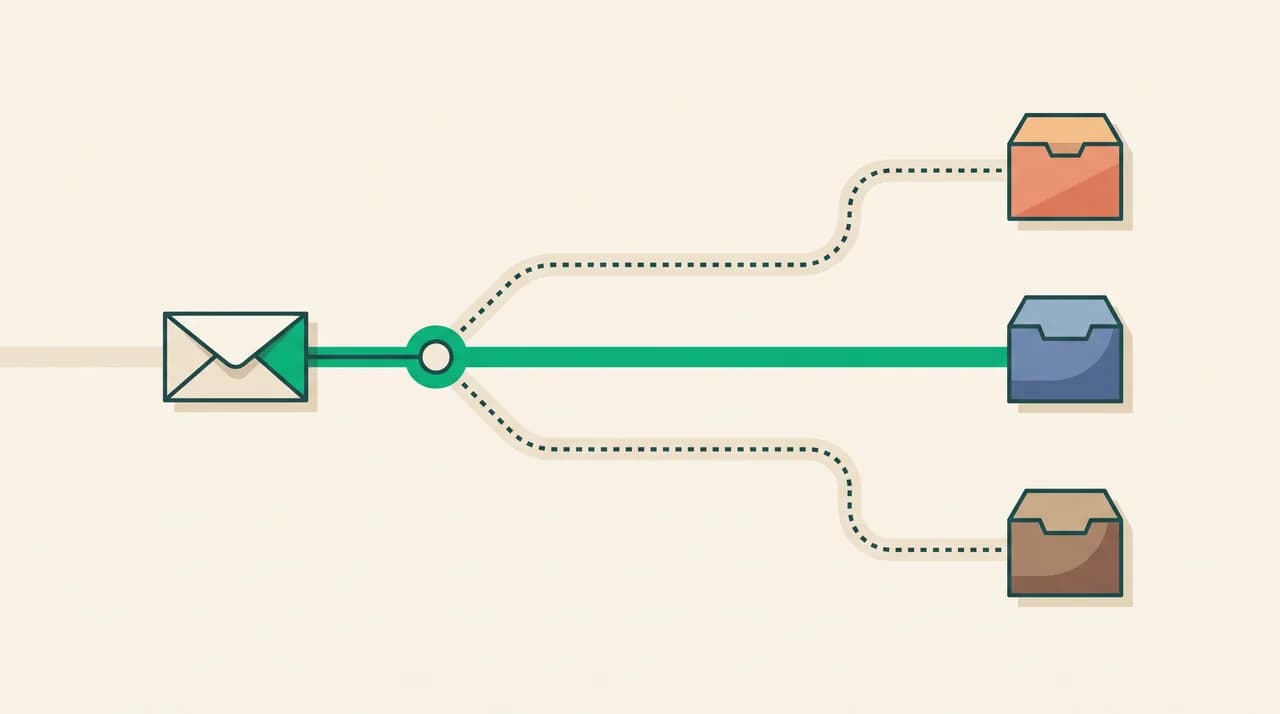
Forwarding-alias services — SimpleLogin (Proton-owned), AnonAddy, Hide My Email, Fastmail Masked Email — sit in front of your real inbox. Mail sent to the mask lands in your inbox; when you reply, the service rewrites the reply through a reverse-alias address so the recipient sees the mask, not your real address. The client's job is to reply through the reverse-alias address the service embedded in the incoming message headers. A client that does not know about the reverse-alias will reply from your real address and break the whole scheme.
Catch-all domains are a superset: you own the domain, MX points to your provider, and any address at that domain lands in one inbox. Now every filter is a To match. This is powerful and messy, and the client that handles it well is one that lets you filter and label on To with the same ease you filter on From.
The tools#
1. AI Emaily — AI triage layered on alias-aware Gmail send-as (and honest limits elsewhere). We build AI Emaily and we are naming that up front. On a Gmail account, we do the thing the section header of this post asks about: when a message comes in addressed to a verified send-as alias, our composer preselects that alias as the From on your reply, automatically, using the incoming To/Cc line rather than the account's primary address. Our Rules Brain lets you route or label based on the inbound To, which covers both plus-addressing and catch-all domains. On Outlook we surface Microsoft's own aliased-user identities where present. The honest limits: because Gmail is the only widely used provider that verifies From server-side, our send-as picker is Gmail-only — on a plain IMAP + SMTP account we refuse an unverified alias rather than silently trust the relay, which is what most IMAP clients do. And for the forwarding-alias services (SimpleLogin, Hide My Email, Fastmail Masked Email), we render the reverse-alias headers on incoming mail but we do not mint new masks from the composer the way the service's own client does. AI Emaily is a paid subscription with a 7-day free trial on Pro and Autopilot (no permanent free tier); see /pricing for current shape, and the AI Emaily homepage at / for what the client does beyond alias handling. If you live entirely in Gmail with a heavy send-as workflow and want AI triage on top, we are the fit. If your aliases are mostly a Fastmail Masked Email workflow, or you need to send from arbitrary addresses on IMAP without server verification, the two picks below are more honest answers than we are.
2. Gmail (web) — the fullest picture on Google-hosted aliases. Gmail's Send Mail As settings verify each identity you add (Google sends a code to the alias, you paste it back), and Gmail exposes a per-account preference that most people forget to change: "When replying to a message, reply from the same address to which the message was sent." With that on, Gmail's composer already does the auto-preselect this post is grading for. Filters can match on To with plus-addressing intact, so a catch-all domain routed through Gmail is straightforward to shape into folders. What Gmail's own client does not do: it does not know about forwarding-alias services beyond the fact that a reverse-alias address is in the headers, and it will not surface the mask as a first-class identity the way Apple Mail does with Hide My Email. Free with Google Workspace tiers above, packaging on workspace.google.com.
3. Apple Mail — the only client that treats iCloud Hide My Email as first-class. On macOS, iOS and iPadOS, an Apple Mail account with iCloud+ shows Hide My Email addresses as pickable identities in the composer. Reply to a message that arrived at a Hide My Email alias and Apple Mail sends from that alias, through iCloud's relay, and the recipient never sees your real address. You can add manual identities per account for non-iCloud aliases, and Apple Mail will match on them too. What it does not have is a strong client-side filter-by-alias story — Apple Mail defers routing to server-side rules (iCloud, Gmail, Fastmail), and its own Rules layer is weaker than any of them. If your aliases are Hide My Email and your accounts are iCloud, this is the strongest fit and it is included with iCloud+.
4. Mozilla Thunderbird — the most provider-agnostic per-identity auto-selection anywhere. This is the concession, and it deserves its own line: Thunderbird's per-account identity system with auto-selection is more flexible than AI Emaily's on any non-Gmail account, and it has been for a decade. You add each alias as an Identity under the account, set a matching Reply-To rule, and Thunderbird preselects the identity based on the incoming To/Cc regardless of provider — Fastmail, iCloud, generic IMAP, Zoho, GMX, everything. Message Filters handle catch-all and plus-addressing filing cleanly, and Sieve editors as add-ons let you write server-side rules from inside the same window. The trade-off is that Thunderbird trusts the SMTP relay for verification — it will send from any address you configure — so on a personal domain with a hosted SMTP that you control this is a superpower, and on a corporate account with strict DMARC it can produce mail that fails alignment silently. Free, cross-platform, open source; on Linux this is essentially the only credible answer on this list.
5. Fastmail's own apps — the only client where you mint a Masked Email from the composer. Fastmail authored Masked Email as a JMAP extension and its own web, iOS and Android apps are the only clients that expose "generate a new mask" as a first-class action inside the compose flow. Any alias on the account preselects on reply, Sieve rules on the server let you filter by alias with more precision than any client-side filter can offer, and the whole flow is designed around alias hygiene rather than bolted on. Packaging is a paid subscription across Individual, Duo and Family plans with a 30-day trial; there is no free tier, so if that was the plan for handling your masks, it is not how Fastmail is sold. Fits anyone whose alias workflow is genuinely Fastmail-centric.
6. Mailmate — power-user per-identity fidelity on macOS. Mailmate is a small independent macOS client with the most granular per-identity rules on this list. Regex matches on To, custom-header conditions, smart mailboxes that treat alias addresses as first-class filter dimensions, and a JMAP transport mode explicitly built for Fastmail sit alongside standard IMAP. Where Thunderbird is provider-agnostic and cross-platform, Mailmate is deeper on the identity axis and macOS-only. Trade-offs: it is single-developer, has no AI layer, and the interface is unapologetically for people who want rules that look like IMAP search expressions. If that description sounds like a feature, it will be one.
7. Superhuman Mail — Gmail-inherited send-as with the fastest keyboard workflow. Note the disambiguation first: since Grammarly acquired the email client in July 2025 and renamed the parent company in October, "Superhuman" now covers both Superhuman Mail (the client) and the broader Superhuman Suite; this section is about the mail client. On Gmail and Google Workspace accounts, Superhuman inherits Google's send-as verification and gets the auto-preselect behaviour for free. It does not add first-class support for forwarding-alias services, and its own routing splits are label-based rather than alias-based, so a heavy catch-all workflow is Gmail-filter territory rather than something Superhuman uniquely enables. Packaging is per-seat paid tiers with a trial; check superhuman.com for current shape.
8. Spark by Readdle — cross-platform with manual identity support and a caveat. Spark connects to Gmail, iCloud, Outlook, and generic IMAP, and it lets you configure multiple identities per account so aliases can be selected in the composer and matched on incoming To. The architectural caveat is worth saying plainly: Spark historically routes mail through Readdle's servers to power features like push notifications and shared conversations, so your account tokens live server-side at Readdle rather than only on your device. For an alias workflow whose whole point is minimising who sees your real address, that is a decision to make deliberately. Read Readdle's current privacy documentation before you commit; free tier plus paid tiers above.
Setting up auto-reply-from-alias correctly, on any of these#
- 1
Verify the alias on the provider first, not the client
Every provider that verifies From (Gmail, Microsoft, Fastmail, iCloud) requires you to prove ownership of the alias before it will accept a send. Add the alias in the provider's settings, click the verification link, and only then wire it into your client. Skipping this on Gmail produces a 5.7.0 rejection at send time; skipping it on Microsoft produces a silent bounce.
- 2
Turn on "reply from the same address" where the provider offers it
Gmail has this setting under Accounts and Import; it is the switch that flips reply-from-alias from a manual dropdown selection into automatic behaviour. Fastmail's own apps do this by default. Apple Mail does it automatically for iCloud identities including Hide My Email. Thunderbird does it via per-identity matching rules you set up once per account.
- 3
Register each alias as an identity in the client, not just the provider
Thunderbird, Apple Mail, Mailmate and Spark do not read the provider's send-as list — you add the identity to the client alongside adding it in the provider settings. AI Emaily and Superhuman inherit Gmail's list automatically. Fastmail's own apps inherit their own list. If the alias is not registered where the client can see it, no client-side auto-preselect will fire.
- 4
For forwarding-alias services, understand the reverse-alias
SimpleLogin, Hide My Email, Fastmail Masked Email and AnonAddy each embed a reverse-alias address in the incoming message so a plain reply through your normal mail client is routed back through the service. That means the client does not need to know about the alias service to make replies work — it just needs to reply to the address the incoming message actually came from, not to the display-name address it appears to be from. Most modern clients get this right; check by sending a test to yourself.
- 5
Add a Rules or filter to file by inbound alias, not by sender
For a catch-all domain or plus-addressing, the useful filter is "if To contains [email protected] then label Sales", not "if From contains anything". Gmail, Fastmail Sieve, iCloud Rules, Outlook Rules and AI Emaily's Rules Brain all support this. Client-side rules in Apple Mail and Thunderbird do too, but they only run on the machine you configured them on, so prefer server-side rules where the provider offers them.
How to choose for your situation#
If your aliases live on Gmail or Google Workspace and you want AI triage on top of the auto-reply-from-alias behaviour Gmail already gives you: AI Emaily. Our composer preselects the verified alias from the inbound To/Cc, our Rules Brain files by alias for catch-all domains and plus-addressing, and we do not train on your mail. We are a paid subscription with a 7-day trial on Pro and Autopilot — see the AI Emaily homepage at / for what the client does beyond alias handling and /pricing for current shape. This is the honest scoping: on Gmail we are a strong fit; on non-Gmail providers where you need to send from arbitrary addresses without server verification, the picks below fit better.
If your aliases are iCloud Hide My Email and your account is iCloud, or you are deep in the Apple ecosystem on macOS and iOS: Apple Mail. Nothing else treats Hide My Email as a first-class identity, and iCloud+ includes it in the plan you are probably already paying for.
If your aliases are Fastmail Masked Email, or you want to create new masks directly from the composer rather than in a separate tab: Fastmail's own apps. Third-party clients receive Masked Email fine but they cannot mint new ones from the compose window — only Fastmail's apps do that.
If you have aliases across multiple providers (a Fastmail Masked Email, a Gmail send-as, a SimpleLogin mask, a catch-all on a personal domain) and you want one client that auto-preselects the right identity on any of them: Mozilla Thunderbird. This is the concession from the AI Emaily paragraph above — Thunderbird's per-identity auto-selection is more flexible than ours on non-Gmail accounts, and it has been for years. On Linux, this is essentially the only real answer on this list.
If you are on macOS, want the sharpest per-identity rules available, and do not want any AI layer at all: Mailmate. Regex matches on To, JMAP mode for Fastmail, and rules that look like IMAP search expressions — an unapologetic power-user tool.
If you are already on Superhuman and your accounts are Gmail: Superhuman Mail inherits Google's send-as verification and gets the auto-preselect behaviour for free. It does not add first-class alias service support beyond what Gmail already provides.
If your provider is truly generic IMAP and you own the SMTP relay, and "send from arbitrary addresses" is what you actually want: Thunderbird again, deliberately, with the SMTP relay's DMARC posture checked so you are not accidentally sending mail that fails alignment.
Aliases stop mail reaching your address. They do not triage what does.
Frequently asked
See it in AI Emaily
Keep reading
Sources

Written by
Nafiul HasanNafiul Hasan is an entrepreneur and AI automation system builder with 10+ years of experience turning messy, manual workflows into reliable automated systems. He designs and ships AI enterprise solutions end-to-end — the agent logic, the data plumbing, and the product people actually use — and founded AI Emaily to give busy professionals their attention back. He writes here from the builder's seat: what works, what breaks, and how to put AI to work without giving up control.