Best Email Tools for Program Managers (2026): 6 Ranked


The short answer
AI Emaily is the best email tool for program managers coordinating multiple workstreams: Rules plus a Context Brain file threads by workstream automatically, Copilot drafts status nudges you approve before sending, and every action is audited. If your workstreams are owned by rotating teams instead of one PgM, Front's cross-team assignment model fits better.
Best email tool for program managers in 2026: six ranked on tracking commitments across workstreams, cross-team status, and exec reporting cadence.
On this page
- 01What the program manager inbox problem actually is
- 02How we compared the six
- 03The six tools compared at a glance
- 04How the shortlist actually plays out
- 05The six tools, ranked
- 061. AI Emaily — best for one PgM coordinating multiple workstreams across mixed providers
- 072. Front — best when a program's workstreams are covered by a rotating team
- 083. Superhuman Mail — best for a keyboard-first PgM inside Gmail or Outlook
- 094. Missive — best for a small PMO sharing one program inbox with team chat inside it
- 105. Shortwave — best if the whole program lives entirely in Gmail
- 116. Fyxer — best if you want AI triage on top of the Gmail or Outlook you already keep
- 12How to choose for your specific situation
- 13The verdict
A program manager's inbox is not a project manager's inbox with more messages in it. The job is different. A PgM tracks commitments across five or six workstreams at once, chases status from workstream owners who each have their own tools and cadence, and rolls all of it up into an exec-facing narrative on a fixed weekly beat. The email tool that fits that shape has to survive cross-workstream context, not just per-thread triage.
We ranked six tools on the specific job: tracking commitments across workstreams, holding the weekly status cadence together, and unifying inbound from vendors, exec sponsors, and internal owners who are not going to switch clients for you. Packaging shape is described where relevant; every current price is on the vendor's own page and we don't reprint one here because those numbers move.
What the program manager inbox problem actually is#
The failure mode for a PgM is not an unread message. It's a commitment nobody is tracking. A workstream owner said in a Tuesday thread they would have the vendor SOW signed by Friday; Friday passes; the exec sponsor asks about it on the Monday portfolio review and the answer is a shrug. The inbox did its job — the reply arrived, was read, and was archived. The problem is that nothing linked the promise on Tuesday to the silence on Friday.
That is why generic "AI email" features under-deliver here. A summary of a single long thread is useful. A draft in your voice is useful. Neither of them, on their own, closes the loop across five workstreams running on different weekly cadences, each with its own owner, its own vendor, and its own set of dependencies you did not personally set up.
The second job is the recurring status cadence. Most PgM roles carry a fixed weekly (or twice-weekly) portfolio update to an exec sponsor or steering committee. That output is only as good as the raw material feeding it, and the raw material lives in email — status replies, blocker calls, vendor commitments, dates that slipped without anyone flagging it. A tool that helps here surfaces the deltas since last week automatically, not just the latest message.
The third is cross-provider reality. Program-level work spans a client's Gmail domain, a vendor's Microsoft 365 tenant, an internal Outlook you actually own, and often one legacy IMAP box for a legal or contracts alias nobody has migrated. A tool that only speaks Gmail is not a program-management tool; it's a Gmail tool that happens to help program managers who only work with Gmail people.
How we compared the six#
This is a capability comparison built from each vendor's own live product and pricing pages as of early August 2026, cross-checked against their public documentation. We did not run six mail clients side by side for a program-length engagement, and we would be skeptical of any roundup that claims to have done that in a couple of weeks.
We deliberately did not score on price. Every product in this category has repackaged at least once in the past year — Shortwave's plan sheet no longer matches what many reviews describe, and Superhuman's AI features moved into a higher business tier after the Grammarly acquisition. Any number printed here would be stale before you finished reading. Confirm packaging on each vendor's own pricing page on the day you decide.
- Commitment tracking across workstreams — does the tool actually link a promise made in one thread to the missing reply a week later, or is it just labels and stars you maintain by hand?
- Status cadence support — can it surface what changed across a workstream since last week, or does it only summarise one thread at a time?
- Provider coverage — Gmail, Outlook / Microsoft 365, and standard IMAP together, not one at a time
- Cross-team coordination shape — one PgM directing owners, or a shared queue rotated across a team
- Approve-before-send control — for a PgM speaking on the program's behalf to execs and vendors, unsupervised autonomy is not the default anyone wants
- Audit trail — when a status update goes to a steering committee, someone eventually asks what the underlying thread actually said
The six tools compared at a glance#
This table is the shortlist and the axes that actually decide the pick. The reasoning behind each row is in the ranked sections below, including where a competitor is the honest better fit for a specific shape of PgM work.
| Tool | Best for | Cross-workstream commitment tracking | Providers | Team shape | Packaging |
|---|---|---|---|---|---|
| AI Emaily | PgMs coordinating multiple workstreams across mixed providers | Rules + Context Brain file by workstream; Copilot drafts status nudges you approve | Gmail, Outlook / M365, IMAP | One PgM directing owners; delegation, not a rotation queue | 7-day free trial on Pro / Autopilot, see /pricing |
| Front | A team rotating coverage of the program's shared address | Explicit assignment + thread-level status per workstream owner | Gmail, Outlook, IMAP | Shared inbox with formal hand-offs — the core product | Tiered Starter / Professional / Enterprise; AI is a paid add-on outside Enterprise |
| Superhuman Mail | PgMs whose weekly cadence lives in Gmail or Outlook and who process everything themselves | Manual follow-up reminders; Split Inbox to isolate tool notifications | Gmail, Outlook | Live sharing, collision detection — not a rotation queue | Trial then tiered paid; AI in a higher business tier post-Grammarly |
| Missive | Small PMOs where two or three people share one program inbox | Convert an email into a task with visible ownership; internal comments per thread | Gmail, Outlook, IMAP | Shared inbox + team chat in one app — the core product | Free tier + per-seat paid |
| Shortwave | PgMs whose stakeholders and archive are entirely inside Gmail | AI thread summaries and semantic search; no dedicated commitment tracker | Gmail / Google Workspace only | Shared channels | Business / Premier / Max with a 14-day trial; no free plan as of August 2026 |
| Fyxer | PgMs adding AI triage on top of Gmail or Outlook they already keep | Drafting and meeting notes; not a commitment tracker | Gmail, Outlook (overlay, not a client) | Solo | Per-seat paid; no published free tier |
Verify pricing on the vendor's page
How the shortlist actually plays out#
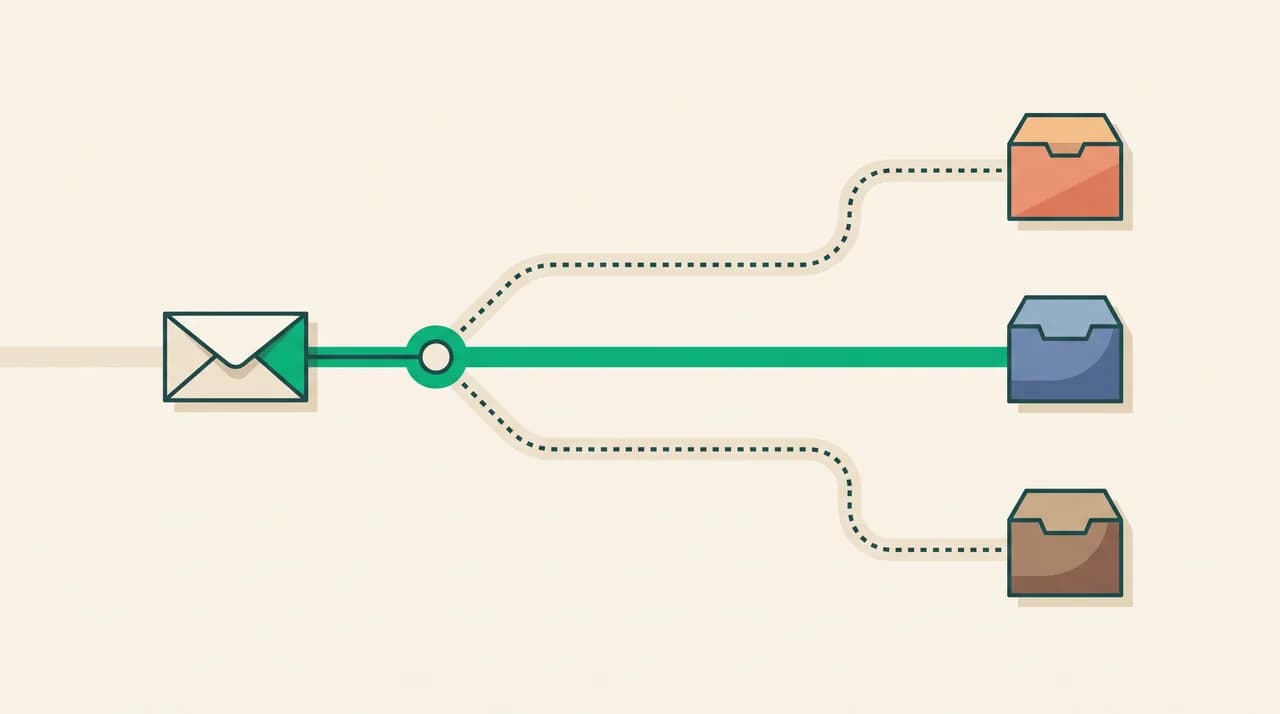
Feature grids flatten what matters most. The chart above says AI Emaily, Front and Missive all cover Gmail, Outlook and IMAP; that is true and it hides the more interesting fact, which is that they solve different problems on top of that coverage. The illustration below is the shape of the decision — pick the path first, then the row.
The six tools, ranked#
AI Emaily leads this list because commitment tracking across mixed providers is close to what we're built for, and because a PgM's approve-before-send instinct maps directly onto our default authority model. We build AI Emaily, so read entry #1 knowing that — and read the ones after it for where another tool is honestly the better fit.
1. AI Emaily — best for one PgM coordinating multiple workstreams across mixed providers#
A program manager's threads never all live in one provider. The vendor is on Gmail, the exec sponsor is on Microsoft 365, and the legal contracts alias is still on a legacy IMAP domain nobody has moved. AI Emaily unifies Gmail, Outlook and IMAP in one inbox and lets Rules plus a Context Brain file threads by workstream automatically — so the SOW review, the vendor go-live, and the internal QA thread each land in the right lane without you tagging them by hand every morning.
The load-bearing feature for the weekly cadence is the Living Brief. It runs on a schedule you set, groups what changed across each workstream since the last brief, drafts the nudges to owners who owe a reply, and delivers to Slack, Telegram, Discord, or in-app. What used to be an hour of scrolling on Monday morning to build the exec update is a scan you do between meetings, on the workstream lanes you already care about.
Copilot is the default authority mode, and for this role that is a feature, not a limitation. Every draft — the status nudge, the escalation, the follow-up on the missed commitment — stages for your approval before it leaves. Autopilot is available and gated: it sends only to allow-listed senders, holds anything below a configurable confidence threshold, forces human review on escalate-if keywords regardless of confidence, and every autonomous action is written to an audit log with its reasoning. When a steering committee asks what the program said to a vendor three weeks ago, that log is the answer.
Voice comes from a user-set Personal Context brain and per-client profiles you write — open loops, guardrails, don't-forget notes — never from learning your past mail or reading your sent archive. That matters more for a PgM than for most roles, because the same person writes to a vendor in one register and to a CFO in another, and a profile per client is a cleaner model than one voice averaged from an archive.
The limits, stated plainly: the macOS app is a real downloadable build but Apple Silicon only, there is no Intel Mac build and no native Linux client; Android runs as a PWA rather than a native app; offline is partial by design across surfaces. There is no permanent free tier — it's a 7-day free trial on the Pro and Autopilot tiers, and the current details are on /pricing.
2. Front — best when a program's workstreams are covered by a rotating team#
Front is a shared-inbox platform, not a personal client, and this is where we concede a dimension outright: Front has built harder on cross-team assignment and thread-level status than AI Emaily has. If your program is structured so that each workstream has a rotating pod of two or three people covering its inbound — customer implementations, vendor onboarding, a change-management queue — Front's assignment layer and status per thread is the more mature tool for that specific shape of work. AI Emaily's shared inbox assumes one PgM directing owners, not a queue that rotates.
As verified on Front's own pricing page in late July 2026, the tiers are Starter, Professional and Enterprise. Starter is capped at one channel type (email or chat or SMS, not combined), a small number of automation rules, one workspace and around ten seats. Professional adds omnichannel support, macros, more workspaces and a larger seat cap. AI Copilot, QA and CSAT are paid add-ons on both Starter and Professional and are only bundled into Enterprise. Contracts over a stated dollar threshold include a mandatory onboarding package; annual billing runs meaningfully below monthly. Read the current tier page before committing — this category repackages often.
Where Front is the wrong answer: if you are one PgM and the workstream owners are the people you assign to, not people in a shared queue with you, Front's whole assignment layer is overhead for a coordination problem you don't actually have.
3. Superhuman Mail — best for a keyboard-first PgM inside Gmail or Outlook#
A naming note first: Grammarly acquired Superhuman, the email client, in July 2025, then renamed the parent company to Superhuman in October 2025. Superhuman Mail means the client; Superhuman Suite is the bundle. Most reviews still circulating predate both changes, so treat older feature lists with care.
Superhuman Mail is built for speed: Split Inbox that can isolate messages from specific tools (its own page names Asana- and Notion-style notifications as a use case, which is exactly the noise a PgM wants out of the primary lane), follow-up reminders on sent mail, shared snippets, live email sharing, and collision detection so two teammates don't reply to the same thread. For a PgM who processes a very high volume personally and lives one keystroke at a time, this is the strongest option on raw throughput in the roundup.
The gap for this role is that a follow-up reminder is a timer you set on a specific message; it does not know that the message is a workstream commitment, and it does not roll up across a program. Split Inbox splits notification lanes; it does not group threads by workstream. Superhuman is Gmail and Outlook only — an IMAP-only vendor or contracts alias falls outside it. AI features moved into a higher business tier post-acquisition, so confirm the tier that holds them on Superhuman's own pricing page before evaluating.
4. Missive — best for a small PMO sharing one program inbox with team chat inside it#
Missive is built around the same shared-inbox idea as Front, at a smaller-team scale, and it bundles internal team chat into the same app. A team shares an inbox, discusses a thread in an internal comment instead of forwarding it, and can convert a message into a task with visible ownership so the whole team can see who is covering what — without leaving the app for a separate Slack channel.
For a two- or three-person PMO running one client-facing or portfolio-facing address as a team, Missive is a legitimate option ahead of a heavier platform like Front. It connects to Gmail, Outlook and IMAP, advertises a broad set of third-party integrations for pulling in context, and automation rules cover the repetitive filing that would otherwise eat the morning. It offers a free tier to try before moving to per-seat paid plans; the current terms are on Missive's own pricing page.
Where Missive is the wrong answer: a solo PgM working an inbox by themselves gets the coordination-layer overhead and none of the coordination benefit, and the AI drafting is secondary to the team workflow architecture rather than the point of it.
5. Shortwave — best if the whole program lives entirely in Gmail#
Shortwave is an AI-native Gmail client built by former Google engineers, and its semantic search over a large Gmail archive is a real strength — honestly stronger than what AI Emaily has built for pure archive recall. If your job is finding the exact thread from six months ago where a vendor committed to a specific date before a steering-committee review, Shortwave is a strong candidate for that one job.
It is Gmail and Google Workspace only. The moment a workstream owner, exec sponsor or vendor is on Outlook or a self-hosted domain — which is the normal case at program scale — Shortwave stops being the answer. As of August 2026, Shortwave's own pricing page lists Business, Premier and Max tiers with a 14-day trial and no free plan, though older reviews still describe one; check the current page yourself rather than relying on secondhand summaries.
6. Fyxer — best if you want AI triage on top of the Gmail or Outlook you already keep#
Fyxer is an overlay, not a client. It attaches to your existing Gmail or Outlook, adds AI triage, drafting and meeting notes, and writes drafts into your normal drafts folder without replacing the inbox you already know. That architectural choice matters for a PgM inheriting a mailbox with years of filters, labels and delegated access already configured — there is no migration cost.
The upside of an overlay is zero disruption. The downside is that it inherits every limit of the client underneath: an overlay cannot produce a cross-provider brief spanning Gmail, Outlook and IMAP because it only speaks the one it is attached to, and it cannot own the thread lifecycle in a way that a full client can. For a program-level workflow that spans providers and needs commitment tracking across workstreams, that ceiling is the reason it sits at the bottom of this list — not because Fyxer does its job badly, but because its job is a smaller slice of the PgM problem.
How to choose for your specific situation#
The single most useful question is who owns each workstream's inbound: you personally, or a rotating team. That answer picks the row before any feature list does. The next question is whether your stakeholders live inside one provider or span three — because that rules out Gmail-only tools on the spot regardless of how good they are at what they do.
- One PgM coordinating multiple workstreams across Gmail, Outlook and IMAP with a fixed weekly cadence — AI Emaily is built for exactly this: workstream-lane filing, a Living Brief that groups deltas since last week, Copilot approval on every send, and an audit trail.
- A program whose workstreams are covered by rotating pods of two or three people, needing formal hand-offs and thread-level status — go to Front; its cross-team assignment model is more mature than any single-operator client's, ours included.
- A small PMO where two or three people share one program address and want internal comments on threads without leaving the inbox — Missive fits that shape ahead of a heavier platform.
- A program that lives entirely inside Gmail and whose main need is finding a specific commitment buried in a big archive — Shortwave is the honest pick for that one job.
- A PgM already deep in Gmail or Outlook, who wants AI triage without changing anything else — Fyxer's overlay model is the lowest-migration path; just expect its ceiling to be the underlying client's ceiling.
- A PgM whose org has picked Microsoft 365 or Google Workspace at the IT level and won't move — stay on native Outlook or Gmail and add an AI layer rather than fighting for a new client, since the pain is the missing brief and the missing commitment tracker, not the underlying inbox.
The reader who should stop here
The verdict#
AI Emaily is our pick for most program managers, and the reason is specific enough to check on your own inbox in a week: it is the only entry here that combines workstream-level filing across Gmail, Outlook and IMAP, a Living Brief that groups deltas across workstreams for the weekly exec update, approve-before-send drafts by default, and an audit trail for every autonomous action. The PgM role depends on nothing being dropped between workstreams. Those features map directly onto that requirement.
Front is the honest alternative when the program's workstreams are covered by rotating teams and the coordination problem is formal cross-team assignment rather than one PgM directing owners. We conceded that dimension above and we mean it — a page that claims to win everything is a page a reader with any category experience stops trusting.
Whichever you pick, audit the triage and the Rules after the first two weeks and build your escalate-if list from the edge cases you find there — not only from the ones you anticipated on day one. The exec sponsor is relying on the program's judgment, and some of that judgment is now running inside a tool that needs to be calibrated on your program's specific communication patterns before it can be trusted with what reaches the steering committee.
Frequently asked
See it in AI Emaily
Keep reading

Written by
Nafiul HasanNafiul Hasan is an entrepreneur and AI automation system builder with 10+ years of experience turning messy, manual workflows into reliable automated systems. He designs and ships AI enterprise solutions end-to-end — the agent logic, the data plumbing, and the product people actually use — and founded AI Emaily to give busy professionals their attention back. He writes here from the builder's seat: what works, what breaks, and how to put AI to work without giving up control.