Best Lead-Response & Email Software for Contractors in 2026 (Compared)

The short answer
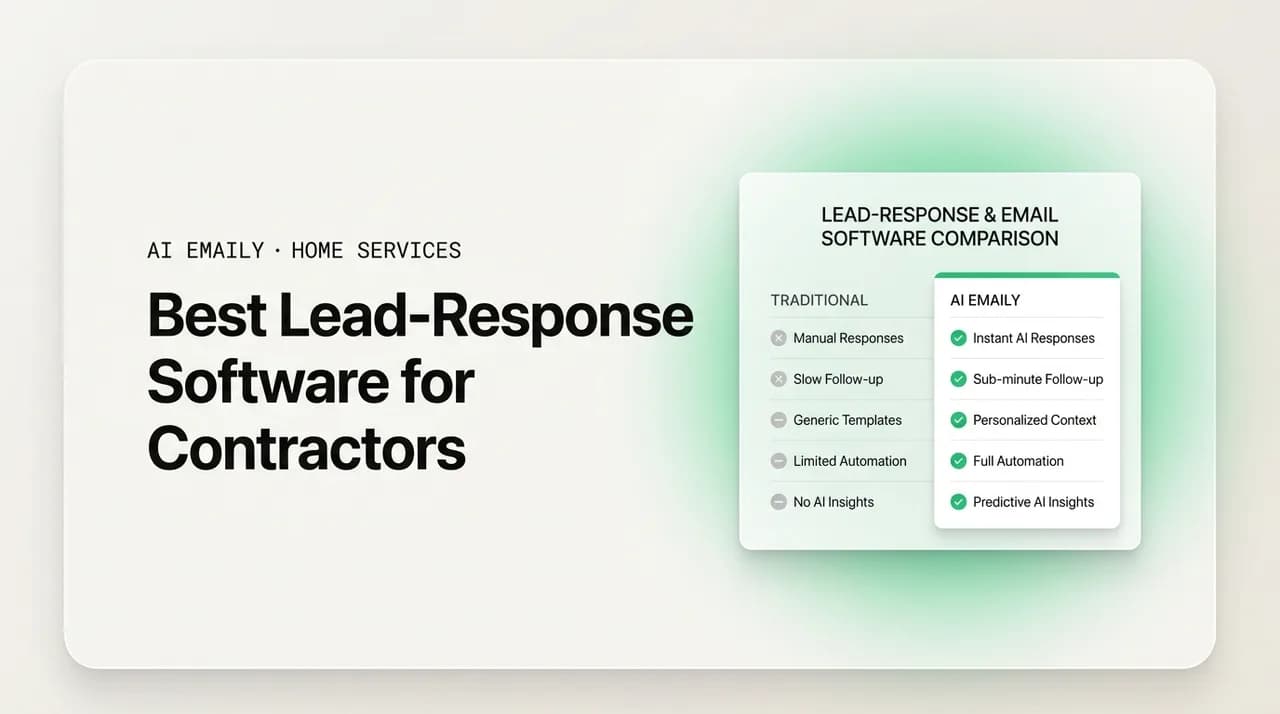
The best lead-response software for contractors is the tool that replies first, follows up without you, and sounds like you — because the company that answers first usually wins the job. AI Emaily ranks first for speed-to-lead and voice-matched follow-up on any email provider; field-service platforms like Jobber, Housecall Pro, and ServiceTitan lead on scheduling and invoicing but treat email as an afterthought. Most contractors run one of each.
The best lead-response software for contractors in 2026, compared. How AI Emaily, Jobber, Housecall Pro, ServiceTitan, JobNimbus, AccuLynx, Angi Leads, and Gmail/Outlook stack up on speed-to-lead, follow-up automation, and voice-matched replies — with honest pros, cons, and who each is for.
On this page
- 01Why lead-response software decides who wins the job
- 02What contractors actually need from lead-response software
- 03The best lead-response software for contractors in 2026, ranked
- 041. AI Emaily — best for instant, voice-matched lead response and follow-up
- 052. Jobber — best all-around FSM for small home-services businesses
- 063. Housecall Pro — best for service trades that want booking plus marketing
- 074. ServiceTitan — best for large, multi-crew home-services operations
- 085. JobNimbus — best FSM/CRM for roofing and exterior contractors
- 096. AccuLynx — best purpose-built platform for roofing contractors
- 107. Angi Leads — best as a lead source, not a response system
- 118. Gmail / Outlook — the free default most contractors start on (and outgrow)
- 12Comparison: lead-response software for contractors at a glance
- 13How to choose the right combination for your business
- 14Putting it all together
Why lead-response software decides who wins the job#
For a contractor, a lead is not a name in a spreadsheet. It is a homeowner standing in a flooded basement, a family staring at a leaking roof after a storm, or a couple who just decided, finally, to redo the kitchen. They fill out a form or fire off an email, and then they do the most predictable thing in the world: they contact the next company on the list, and the one after that. By the time you climb down off the ladder and check your phone at 6 p.m., three of your competitors have already called back, and one of them has an appointment on the books for tomorrow morning.
This is the single defining problem of home-services sales, and it has a name: speed-to-lead. The research is blunt about it. Roughly 78% of buyers hire the company that responds first, yet most contractors are structurally incapable of responding first because they are on jobsites all day, not in an inbox. In solar and insurance restoration, leads are frequently sold to three to eight companies at once and the winning rep responds in under a minute. Meanwhile, the benchmark data is grim: one widely cited analysis found that 88% of home-services responses take longer than five minutes, and only about 3% happen inside a minute. The gap between what customers reward and what contractors actually do is enormous — and it is measurable money.
That gap is exactly what lead-response software exists to close. But "lead-response software" is a fuzzy category that covers several very different kinds of tools, and choosing the wrong kind is how contractors waste money on software that looks impressive in a demo and never actually answers a lead faster. This guide sorts them out. We compare the best lead-response software for contractors in 2026 — from AI-native email clients to full field-service management platforms to the lead marketplaces themselves — and tell you honestly what each one is genuinely good at, where it falls short, and which type of contractor it fits.
One thing to get straight up front, because it saves a lot of confusion: no single tool does everything. A platform that is brilliant at dispatching crews and generating invoices is usually mediocre at writing a warm, personal reply to a lead at 9 p.m. A tool that answers leads instantly in your own voice is not going to run your payroll. The contractors who win are not the ones who found one magic app; they are the ones who understood which job each tool is actually for and stopped expecting their scheduling software to also be their inbox.
So we will be specific throughout. When we say a tool is the best at something, we will say what. When it is weak, we will say where. And we will lead with the thing that matters most — how fast, how consistently, and how personally each tool actually responds to a new lead — because that is the metric that decides who books the job.
What contractors actually need from lead-response software#
Before ranking anything, it helps to define the job. A lot of "best contractor software" lists rank tools on features that look good on a pricing page but have nothing to do with winning more work. Here is what actually moves the needle for a home-services business trying to convert more leads into booked jobs. Judge every tool below against these six criteria, in roughly this order of importance.
- 1
Speed-to-lead — an instant first response
The moment a lead arrives — a web form, an email, a marketplace inquiry — something needs to acknowledge it in seconds, not hours. This is the highest-leverage capability there is, because first-responder economics reward it directly. The best tools reply automatically the instant a lead lands, day or night, so the homeowner hears from you before they hear from anyone else.
- 2
Follow-up automation that doesn't quit
Most jobs are not won on the first touch; they are won on the third, fourth, or fifth. Manual follow-up is where deals die, because it depends on a busy owner remembering to chase a warm lead between jobs. Good software runs a relentless, templated follow-up sequence on its own — reminders, check-ins, quote nudges — so no lead goes cold from neglect.
- 3
Voice-matched, human-sounding replies
Homeowners can smell a canned auto-reply, and "Thank you for your inquiry, a representative will contact you shortly" wins nobody. The response has to sound like a real person at a real local company — like you. The best tools draft in your voice, with your details, so an instant reply still reads as a warm, personal one.
- 4
A unified inbox across every channel
Leads come from everywhere: your website, Google, Angi, Facebook, referrals, and half a dozen email addresses. If they scatter across apps and accounts, some get missed — and a missed lead is a lost job. A single inbox that pulls every provider and channel into one place is how you stop leads falling through the cracks between jobsites.
- 5
Context from your CRM or field-service system
The best replies know who they're talking to — whether this is a repeat customer, what was quoted last time, which crew is free. Software that plugs into your field-service management (FSM) or CRM, or holds per-client context itself, writes smarter, more accurate responses and avoids the embarrassing mistakes that come from replying blind.
- 6
Mobile-first, because you're in the field
You are not at a desk. Whatever you choose has to work from a phone on a roof, in a truck, or between service calls — approving a drafted reply with one tap, seeing what needs you at a glance. A tool that only really works on desktop is a tool that won't get used when it matters.
Notice how much of that list is about email and messaging, and how little of it is about scheduling, invoicing, or job costing. That is not because those things do not matter — they matter enormously for running the business — but they are not lead response. This is the distinction most "contractor software" comparisons blur. Field-service management platforms are outstanding at operations and merely adequate at the top of the funnel, where leads are actually won or lost. Dedicated lead-response and email tools are the reverse. The ranking below reflects that reality rather than pretending one category covers both.
The two-tool stack most contractors actually run
The best lead-response software for contractors in 2026, ranked#
Here is our ranking. It is weighted toward the criteria above — speed-to-lead, follow-up automation, and voice-matched replies first, because those are what convert leads into jobs — with operations depth, context, and mobile experience factored in. Where a tool is genuinely the best at something, we say so, even when it is not our own. Every entry includes who it is honestly the right fit for, and where it falls short.
A note on fairness before we start: we make AI Emaily and are ranking it first, so treat that with appropriate skepticism and check the honest cons — the biggest of which is that AI Emaily is not a field-service management platform and never claims to be. If you need dispatch, invoicing, and job costing, you will still want one of the FSM tools further down this list alongside it. With that on the table, here is the list.
1. AI Emaily — best for instant, voice-matched lead response and follow-up#
AI Emaily is an AI-native email client built around an autonomous chief-of-staff for your inbox — and for contractors, that translates directly into the two things that win jobs: answering leads first, and following up relentlessly, without you having to be at a keyboard. It connects to Gmail, Outlook, iCloud, Fastmail, Proton, and any IMAP account, and pulls every one of them into a single unified inbox on web, macOS, iOS, and Android. That matters for a contractor whose leads are scattered across a personal Gmail, a business Outlook, and a marketplace forwarding address: they all land in one place, so nothing slips between them.
The core of it is the agent. When a lead email arrives, AI Emaily can draft an acknowledgment in seconds, written in your voice rather than in generic auto-reply boilerplate, because it learns how you actually write. It stages follow-ups before a warm lead goes cold, and it runs on three authority modes so you decide how much rope it gets. In Manual mode the AI only helps when you ask. In Copilot mode — the default for anything customer-facing — every reply is drafted and waiting, and you approve it with one tap from your phone before it sends; nothing leaves without you. In Autopilot mode, within boundaries you set, the agent can send routine replies and run follow-up sequences on its own, with every action reversible and written to a full audit trail.
For a solo operator on a roof, the value proposition is simple: a lead lands, and the moment it does, a warm, personal reply is either sent or sitting in your pocket waiting for a one-tap approval — while your competitors' leads sit unread until evening. For a growing crew, it means follow-up capacity that does not depend on hiring another CSR. Per-client context and typed variables let the drafts use real details — the right name, the last quote, the open loop — rather than inventing them, so an instant reply is also an accurate one.
- Best-in-class speed-to-lead: drafts or sends a warm acknowledgment the instant a lead email arrives, day or night, in your own voice.
- Relentless, staged follow-up so warm leads don't go cold — the third and fourth touches that actually close, handled for you.
- Truly universal inbox: Gmail, Outlook, iCloud, Fastmail, Proton, and IMAP unified across web, macOS, iOS, and Android.
- Three control modes (Manual / Copilot / Autopilot) with undo and a full audit trail — you decide how much the agent does on its own.
- Per-client context and typed variables keep instant replies accurate, not generic; Copilot approval before any send in v1.
- Privacy-serious: zero-retention AI that never trains on your mail, envelope-encrypted keys, and a bring-your-own-key option on the Autopilot and Team plans.
Who it's for: contractors — especially roofing, solar, HVAC, and remodeling owner-operators and growing crews — whose biggest leak is slow or inconsistent lead response and follow-up, and who want every inquiry answered first and chased relentlessly without hiring more admin staff. Pricing starts free (the full client, one connected account, and a small monthly AI credit allotment to try the agent, no card required), with Pro at $12.42/month on the annual plan and an Autopilot plan at $20.75/month annual for fully autonomous, bounded handling. It is the strongest choice on this list for the specific job of responding faster and following up better — provided you pair it with an operations platform for the parts of the business that live outside the inbox.
2. Jobber — best all-around FSM for small home-services businesses#
Jobber is the field-service management platform most small contractors reach for first, and for good reason. It is genuinely excellent at the operational core of a service business: quoting, scheduling, dispatching, invoicing, and getting paid. Its mobile app is polished and clearly built by people who understand that the user is standing in a customer's driveway, not sitting at a desk. For a growing plumbing, HVAC, landscaping, or cleaning business that needs to get organized, Jobber is a strong, sensible default.
On the lead-response side specifically, Jobber has invested in the right areas over the past few years, adding online booking, automated quote and appointment follow-ups, and integrations that help capture inbound leads. Its follow-up automations are a real strength — templated reminders and nudges that fire on a schedule are exactly the kind of thing that keeps warm leads from going cold. Where it is weaker, relative to a dedicated email-and-AI tool, is in the quality and immediacy of the first response: the automations are rule-based and templated rather than AI-drafted in your voice, and the platform is built around jobs and clients more than around a fast, universal inbox. It answers leads well when they come through Jobber's own funnel; it is not the tool that unifies every scattered email address and drafts a personal reply the instant anything lands.
- Excellent core operations: quoting, scheduling, dispatch, invoicing, and payments in one place.
- Strong, genuinely mobile-first app built for people working in the field.
- Solid rule-based follow-up automations and online booking to capture and nurture leads.
- Cons: first-response is templated rather than AI-drafted in your voice; not a universal email client; per-user pricing adds up as you grow.
3. Housecall Pro — best for service trades that want booking plus marketing#
Housecall Pro sits in the same field-service management category as Jobber and competes closely with it, with a particular strength for service-heavy trades like HVAC, plumbing, and electrical. It covers the operational essentials — scheduling, dispatch, invoicing, and payments — and layers on a heavier marketing and customer-communication toolkit, including online booking, review generation, email and postcard marketing, and, notably, a missed-call-text-back feature that automatically texts back a caller you couldn't answer. That last capability is directly relevant to lead response for the phone-heavy trades, where a missed call is a missed job.
For lead response, Housecall Pro's strengths are its automated customer communications and that missed-call recovery, which plug a real hole for contractors whose leads come in as calls. Its limitations mirror Jobber's: the communications are largely template-and-trigger based rather than AI-written in your own voice, and it is an operations platform first, so its email handling is functional rather than a true unified, intelligent inbox. It is a strong operations-plus-marketing backbone, not a replacement for a dedicated response layer if your edge is answering email leads first and following up with a human touch.
- Well-rounded FSM for service trades: scheduling, dispatch, invoicing, and payments.
- Strong marketing and customer-comms suite, including review generation and email/postcard campaigns.
- Missed-call-text-back automatically recovers unanswered calls — real speed-to-lead value for phone-heavy trades.
- Cons: communications are template-driven, not voice-matched AI; email handling is basic; costs climb with add-ons.
4. ServiceTitan — best for large, multi-crew home-services operations#
ServiceTitan is the enterprise-grade platform of the home-services world, built for larger residential and commercial operations — think multi-truck HVAC, plumbing, and electrical companies with call centers, dispatchers, and serious revenue. It is deep: call booking and tracking, dispatch, sophisticated pricebook and sales tools, marketing attribution, financing integrations, and reporting that can actually run a big business. For an operation of that size, the lead-response story is genuinely strong because ServiceTitan instruments the whole funnel — it tracks which marketing generated a call, records and scores the booking, and gives managers the data to hold response times accountable across a team.
The honest catch is that ServiceTitan is powerful, expensive, and heavy. It is priced and scoped for established companies, typically with custom quotes rather than a self-serve price, and it carries an implementation and training burden that only makes sense above a certain size. For a solo operator or a small crew, it is overkill — more platform than the business can absorb, at a cost that does not pencil out. And like the other FSM platforms, its communications are workflow-driven rather than AI-drafted in an individual owner's voice; it is built for a call-center-and-dispatcher model, not for a one-person shop that just needs its email answered first.
- The most complete platform for large, multi-crew operations: call tracking, dispatch, pricebook, marketing attribution, and financing.
- Excellent funnel instrumentation — you can measure and manage response time and lead source across a whole team.
- Deep reporting and sales tooling that genuinely runs a big business.
- Cons: expensive and complex, custom-quoted, heavy implementation; overkill for solos and small crews; comms are workflow-based, not voice-matched AI.
5. JobNimbus — best FSM/CRM for roofing and exterior contractors#
JobNimbus is a field-service management and CRM platform with a strong following among roofing and exterior contractors specifically. It combines a visual sales pipeline (boards you can drag jobs across as they progress) with the operational pieces — estimating, scheduling, job tracking, and invoicing — plus roofing-specific integrations like aerial measurement tools and material ordering. For a roofer, the appeal is a system that speaks the trade's language and manages the whole lifecycle from lead to closed job in one pipeline view.
As a CRM, JobNimbus is better than the general FSM tools at holding lead context and moving a deal through stages, which helps with organized follow-up on the high-ticket, longer-cycle jobs common in roofing and restoration. Its lead-response weakness is the familiar one: the automations are pipeline-and-template driven, and communication is built around the CRM record rather than around a fast, intelligent, universal inbox that drafts personal replies in your voice the instant a lead arrives. It is a strong operational and pipeline home for a roofing business — and a natural candidate to pair with a dedicated response layer that handles the first-reply-fastest part.
- Roofing-and-exterior-focused FSM/CRM with a visual sales pipeline from lead to closed job.
- Trade-specific integrations (aerial measurement, material ordering) that fit how roofers actually work.
- Good at holding lead context and driving organized, stage-based follow-up on longer-cycle jobs.
- Cons: response automations are template-driven; communication centers on the CRM record, not a universal AI inbox.
6. AccuLynx — best purpose-built platform for roofing contractors#
AccuLynx is another roofing-specialist platform, and among roofing contractors it is one of the most established names for end-to-end job management. It is built specifically for the roofing workflow: lead and CRM management, estimating with integrated aerial measurements, production and material ordering, insurance-claim tracking (important for storm-restoration work), and job-costing and payments. For a dedicated roofing company, especially one doing insurance-restoration volume, AccuLynx is deep and purpose-fit in a way general FSM tools are not.
On lead response, AccuLynx gives roofers a CRM and pipeline to manage inbound leads and keep follow-up organized through the sales stages, which is valuable given roofing's high job values and near-universal callback expectation. But as with the other platforms in this tier, it is an operations-and-CRM system rather than an intelligent inbox: its communications are structured around the CRM and job record, not around instantly drafting a warm, voice-matched reply the second a lead lands across whatever email address it came to. It is best understood as the operational backbone of a serious roofing business — with the fast-first-response job well suited to a complementary tool.
- Purpose-built, end-to-end roofing platform: CRM, estimating with aerial measurement, production, material ordering, and insurance-claim tracking.
- Especially strong for storm-restoration and insurance-heavy roofing work.
- Solid pipeline and CRM for organized lead management and stage-based follow-up.
- Cons: roofing-only focus; premium pricing; comms are CRM-and-record driven, not an AI-drafted universal inbox.
7. Angi Leads — best as a lead source, not a response system#
Angi Leads (the contractor-facing side of Angi, formerly Angie's List and HomeAdvisor Pro) belongs on this list because so many contractors treat it as part of their lead-response setup, but it is important to be clear about what it actually is. Angi is a lead marketplace: you pay for leads, and Angi sends you homeowner inquiries in your service area. It is a source of leads, not a system for responding to them. It has an app that notifies you of new leads and lets you respond, but the marketplace model creates the exact pressure this whole guide is about — Angi typically sells the same lead to multiple contractors, so the one who responds first almost always wins it.
That makes Angi Leads a demand-generation channel that raises the stakes on your response speed rather than solving it. Contractors have well-known frustrations with the model — lead quality varies, the same lead goes to several companies, and costs add up — but plenty still use it as one channel among several. The key insight for this article: whatever you spend on Angi leads is wasted if you can't answer them first. Angi puts the leads in front of you; it does not answer them for you in your voice or run your follow-up. That is precisely the gap a dedicated response tool fills, and pairing a fast response layer with a paid marketplace channel is how you actually convert what you're paying for.
- A genuine lead source: puts homeowner inquiries in your service area in front of you.
- Useful as one channel in a broader mix for filling the top of the funnel.
- Cons: it's a marketplace, not a response system; the same lead is sold to multiple contractors, so speed-to-lead is everything; variable lead quality and ongoing cost.
8. Gmail / Outlook — the free default most contractors start on (and outgrow)#
It would be dishonest to write a lead-response comparison for contractors without acknowledging where most of them actually start: a plain Gmail or Outlook inbox on their phone. These are excellent, reliable email services, they are free (or nearly so), and every contractor already knows how to use them. For a brand-new operator with a handful of leads a week, a well-organized Gmail with a few filters and a couple of saved templates is a perfectly reasonable starting point, and you should not feel behind for using one.
The problem is not that Gmail and Outlook are bad — it is that they are passive. They store and display your leads; they do not answer them. There is no instant AI reply the moment a form comes in, no relentless automated follow-up in your voice, no unified view across your personal, business, and marketplace addresses, and no agent making sure the third and fourth touches actually happen. Gmail's out-of-office responder and basic templates are the closest built-in features, and they are generic by design. As lead volume grows, the manual work of triaging, replying fast, and following up consistently becomes exactly the bottleneck that lets faster competitors win jobs. That is the point at which contractors outgrow the raw inbox and add a response layer on top of it — which, notably, is what an AI-native client like AI Emaily is: it connects to your existing Gmail or Outlook rather than replacing it, and adds the speed and follow-up the bare inbox lacks.
- Free, familiar, and reliable — a fine starting point at low lead volume.
- Basic tools exist: filters, labels, saved templates, and an out-of-office responder.
- Cons: passive by design — no instant AI reply, no automated voice-matched follow-up, no unified multi-account inbox, no agent driving the sequence.
Comparison: lead-response software for contractors at a glance#
Here is the whole field in one view, scored on the criteria that decide who wins the job. Read "Yes" as a genuine strength, "Partial" as present-but-limited, and "No" as not really this tool's job. The pattern is clear once it's laid out: the FSM platforms own operations, and the dedicated response tools own speed-to-lead and voice-matched follow-up — which is why most contractors run one of each.
| Tool | Instant AI first reply | Voice-matched follow-up | Universal email inbox | Scheduling / invoicing (FSM) | Best for |
|---|---|---|---|---|---|
| AI Emaily | Yes | Yes | Yes (all providers) | No | Fast, personal lead response + follow-up |
| Jobber | Partial | Partial (templated) | No | Yes | All-around FSM for small businesses |
| Housecall Pro | Partial (call-back) | Partial (templated) | No | Yes | Service trades wanting ops + marketing |
| ServiceTitan | Partial | Partial (workflow) | No | Yes | Large, multi-crew operations |
| JobNimbus | No | Partial (pipeline) | No | Yes | Roofing/exterior FSM + CRM |
| AccuLynx | No | Partial (pipeline) | No | Yes | Purpose-built roofing platform |
| Angi Leads | No | No | No | No | A lead source, not a response system |
| Gmail / Outlook | No | No | Partial (one account) | No | Free starting point at low volume |
The table makes the core argument of this guide visible in one glance. Every field-service platform is a column of "Yes" on operations and "Partial" or "No" on instant, voice-matched response — because that is not what they were built to do. The dedicated response layer is the mirror image. Neither is a failing; they are simply different jobs. The mistake is expecting your scheduling software to also be your speed-to-lead engine, or expecting a lead marketplace to answer the leads it sells you.
How to read this ranking
How to choose the right combination for your business#
The decision is less "which single tool" and more "which combination," and it comes down to a few honest questions about your business. Work through these and the right stack usually becomes obvious.
Start with your biggest leak. If leads are coming in but you're losing them to slow response and dropped follow-up — the classic owner-on-a-jobsite problem — then your highest-ROI move is a fast response layer, and you should prioritize that over yet another operations feature. If instead your leads are handled fine but your scheduling, quoting, and invoicing are a mess, fix operations first with an FSM. Most established contractors eventually need both, but the order you buy them in should follow where you're actually bleeding.
Then match the FSM to your trade and size. Solo and small crews are best served by Jobber or Housecall Pro — lighter, self-serve, mobile-first. Large multi-crew operations grow into ServiceTitan. Roofing and exterior contractors get real value from the trade-specific depth of JobNimbus or AccuLynx. There is no universally best FSM; there is a best FSM for your trade and headcount.
- If your leak is slow response and follow-up → prioritize a speed-to-lead layer (AI Emaily) first.
- If your leak is operations chaos → prioritize an FSM matched to your trade and size first.
- Solo / small crew, any trade → Jobber or Housecall Pro for operations.
- Large multi-crew operation → ServiceTitan.
- Roofing / exterior / restoration → JobNimbus or AccuLynx.
- Buying marketplace leads (Angi) → you must have a fast response layer, or you're paying for leads you'll lose.
- Just starting, low volume → Gmail/Outlook is fine; add a response layer the moment leads start slipping.
The through-line across every one of these paths is the same, and it is the reason speed-to-lead software earns its place in the stack: whatever generates your leads — your website, Google, a marketplace, referrals — the money is only realized when someone answers first and follows up until the job is booked. Operations software makes sure you can deliver the work well. Response software makes sure you win the work in the first place. Contractors who invest only in the former often wonder why great operations aren't translating into more booked jobs; the answer is usually sitting unanswered in an inbox from 2 p.m. that afternoon.
That is the specific, unglamorous problem AI Emaily was built to solve, and why it tops this list for lead response even though it is not — and does not pretend to be — a field-service platform. Pair it with whichever operations backbone fits your trade, and you have covered both halves of the job: win the lead, then deliver the work.
Putting it all together#
The best lead-response software for contractors in 2026 is not a single product — it is a pairing. On one side, a field-service platform that fits your trade and size to run scheduling, dispatch, quoting, and invoicing: Jobber or Housecall Pro for small-to-midsize shops, ServiceTitan for large operations, JobNimbus or AccuLynx for roofing and exteriors. On the other side, a fast, intelligent response layer that answers every lead first and follows up relentlessly in your voice — the job AI Emaily is built for and ranks first at here.
The reason to take the response half seriously is simply that the numbers are unforgiving. The company that responds first usually wins, most contractors respond slowly because they're in the field, and every lead you buy or earn is wasted if a faster competitor answers it before you do. A tool that closes that gap — instantly, in your voice, on any provider, from your phone — is the highest-leverage software a contractor can add, because it acts on the exact metric that decides who books the job.
If your operations are already handled and your real leak is response speed and follow-up, that is where to start. You can connect your existing Gmail or Outlook and try the agent free at app.aiemaily.com/signup — no card required — and keep whatever field-service platform already runs your operations. Win the lead first; deliver the work second. In that order, both halves pay off.
Frequently asked
See it in AI Emaily
Keep reading
Sources

Written by
Nafiul HasanNafiul Hasan is an entrepreneur and AI automation system builder with 10+ years of experience turning messy, manual workflows into reliable automated systems. He designs and ships AI enterprise solutions end-to-end — the agent logic, the data plumbing, and the product people actually use — and founded AI Emaily to give busy professionals their attention back. He writes here from the builder's seat: what works, what breaks, and how to put AI to work without giving up control.