After-Hours & Missed-Lead Recovery for Home-Services Pros (41% of Jobs Book After Hours)

The short answer
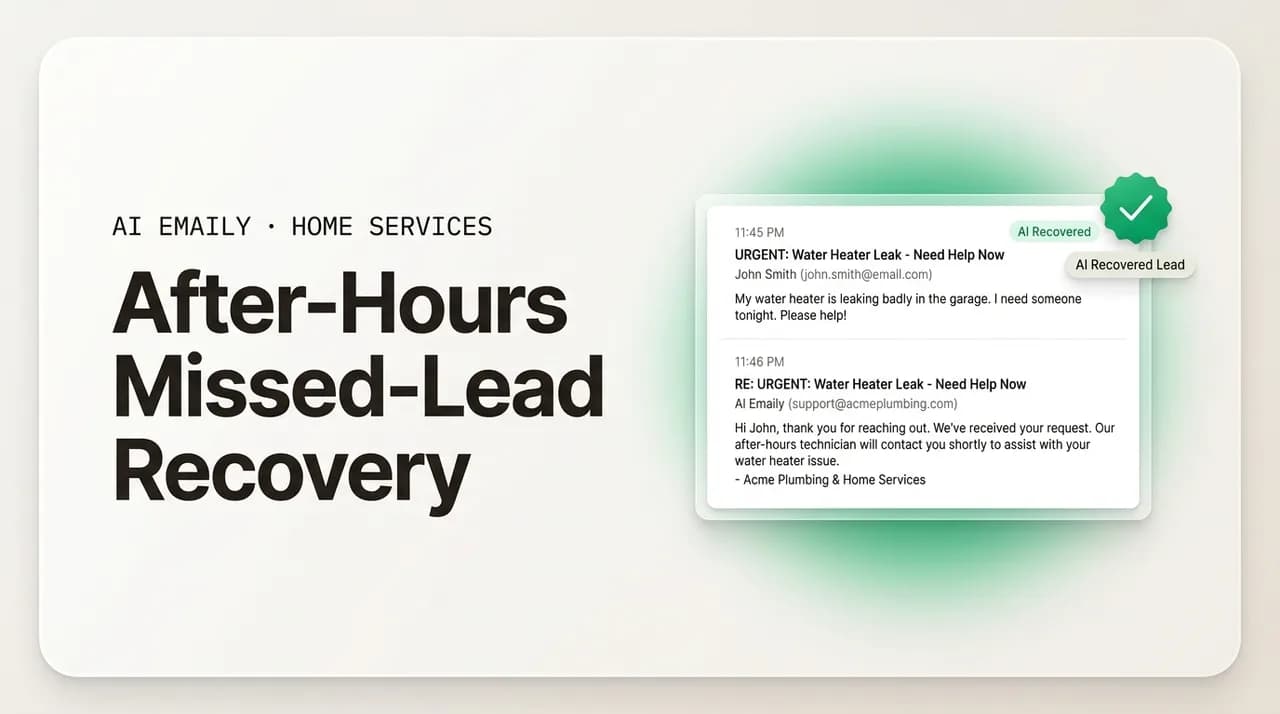
Roughly 41% of home-services jobs book after hours, when the owner and dispatcher are gone, so leads sit until morning and a faster competitor books the customer first. After-hours lead response for home services means an instant acknowledgment on every inquiry, a real emergency escalation path, and a next-morning follow-up that runs on rules instead of memory. Build that system once and stop paying for leads you never answer.
A practical guide to after-hours lead response for home services: why roughly 41% of jobs book after hours, what morning-only replies cost, and how to build a 24/7 system with instant acknowledgment, emergency escalation, and boundaries that prevent burnout.
On this page
- 01Why do so many home-services leads arrive after hours?
- 02What does a morning-only reply actually cost you?
- 03What are your options for covering after-hours leads?
- 04How do you build an after-hours system that still feels personal?
- 05What should an after-hours instant-acknowledgment message say?
- 06How should emergency escalation actually work?
- 07How do you cover after hours without burning out?
- 08How does AI Emaily help with after-hours lead response?
- 09Putting it all together
Why do so many home-services leads arrive after hours?#
Here is the number that should change how you staff your inbox: roughly 41% of home-services jobs are booked after hours, and 88% of home-services responses take longer than five minutes. Put those two facts side by side and you get the quiet crisis at the center of this article. A huge share of the work comes in exactly when the owner is at dinner, the dispatcher has clocked out, and the office phone rolls to voicemail. After-hours lead response for home services is not an edge case you can safely ignore; it is closer to half of the pipeline, and most shops are answering it the next morning if they answer it at all.
It helps to understand why the after-hours window is so loaded, because the reasons are baked into how homeowners live rather than into anything you are doing wrong. There are two big engines driving it, and they stack on top of each other.
The first is emergencies. A water heater fails at 9 p.m. A furnace quits during the first cold snap and the house is already dropping through the fifties by bedtime. A storm peels shingles off a roof and the homeowner is standing in the driveway with a flashlight watching water find its way inside. None of these events check your business hours before they happen. The homeowner is not browsing; they are in a small panic, and they will contact the first three or four companies they can find until somebody answers. Emergency demand is, almost by definition, after-hours demand, because a broken thing that fails during the workday often gets handled during the workday, while the ones that fail at night become the frantic 10 p.m. inquiries in your inbox the next morning.
The second engine is quieter and, in raw volume, probably bigger: evening browsing. A homeowner is not going to research a roof replacement or a kitchen remodel from their desk at 2 p.m. while they are supposed to be working. They do it after the kids are down, on the couch, on a phone, at 9:30 p.m. That is when people finally have the mental space to think about the project they have been putting off, pull up three contractors, read a few reviews, and fire off web-form inquiries or a text through a lead marketplace. The evening is when considered, high-ticket home-improvement decisions actually get made, and the inquiries that come out of that window land in an inbox nobody is watching until 7 a.m.
There is a third, structural reason worth naming: the way modern leads are distributed almost guarantees an after-hours pileup. Marketplaces and lead-gen platforms sell the same inquiry to multiple companies at once, and homeowners who fill out one form often fill out several. So the after-hours lead is not sitting patiently in your inbox waiting for you to wake up. It is being worked, right now, by whoever else bought it and happens to have a system that responds at night. The clock that matters is not your business hours; it is the homeowner's attention span, and that span is shortest in the emotionally charged evening and emergency windows where most of this volume lives.
The uncomfortable takeaway is that "we respond first thing in the morning" is, for a large slice of your leads, functionally the same as "we don't respond." By 7 a.m. the emergency has been solved by someone who answered at 10 p.m., and the evening browser has already had a warm reply from a competitor sitting at the top of their inbox. The rest of this article is about closing that gap without hiring a night-shift dispatcher or chaining yourself to your phone.
What "after hours" actually means for a home-services shop
What does a morning-only reply actually cost you?#
It is tempting to treat a slow reply as a minor service lapse: the lead is still there, you will get to it, no harm done. The data says otherwise, and the cost compounds in three separate ways. Understanding each one is what turns after-hours lead response for home services from a nice-to-have into an obvious priority.
The first cost is the first-responder penalty. Across home services, the company that responds first wins a wildly disproportionate share of the jobs, because speed is read by the homeowner as competence and eagerness. When a lead is sold to several companies and answered by whoever is fastest, a reply that lands at 7 a.m. is not competing on price or reputation; it has already lost to the 10:15 p.m. reply before the homeowner ever compares quotes. You can be the better roofer with the better warranty and still lose the job on a nine-hour head start you handed to a competitor for free.
The second cost is decay. A sales lead is a perishable good, and it spoils fast. The classic research on online lead response found that the odds of even making meaningful contact with a lead drop off a cliff within the first hour and keep falling from there, which is why the difference between a five-minute reply and a five-hour reply is not a little worse but categorically worse. An overnight lead answered at 7 a.m. is often eight, ten, twelve hours old. The homeowner's urgency has cooled, they have moved on to other tabs, and the emotional moment that made them reach out has passed. You are now trying to reheat a lead that a faster shop served hot.
The third cost is the one that shows up on your P&L, and it is the one owners underweight the most: you already paid for these leads. In home services, a lead is not free traffic. Depending on the trade, you are paying anywhere from around forty-five dollars for an HVAC lead to several hundred for a premium remodeling lead, and exclusive or high-intent leads run higher still. Every after-hours inquiry that sits until morning and goes cold is not a missed opportunity in the abstract; it is a lead you bought and threw away. If you are spending real money on lead generation and answering a large share of those leads eight hours late, you are effectively lighting a chunk of your marketing budget on fire and never seeing the smoke.
Stack the three costs and the math gets stark. Say a modest slice of your after-hours leads are winnable jobs. A single booked HVAC replacement or roofing job can be worth thousands in revenue and hundreds in margin. Lose one or two a week to slow replies and you are not out a few phone calls; you are out tens of thousands of dollars a year, on leads you already paid to generate, given away to whoever built a system that answers at night. The morning-only reply feels free because the loss is invisible. Nobody sends you an email saying "I hired the other guy because he answered faster." They just go quiet, and you assume the lead was never serious.
The invisible leak is the dangerous one
What are your options for covering after-hours leads?#
Once you accept that after-hours is roughly half the game, the question becomes how to cover it. There is no shortage of options, and each one trades cost, speed, personal touch, and burnout differently. Before recommending anything, it is worth walking through the real menu honestly, because the right answer depends on your volume, your trade, and how much of your evening you are willing to give up.
There are four broad approaches, and most shops end up combining two of them rather than picking one.
- 1
Answer it yourself, after hours
The default for most solo operators and small shops: keep your phone on, glance at the inbox from the couch, reply when you can. It is free and maximally personal, and for low volume it works. But it does not scale, it does not sleep, and it is the single biggest driver of owner burnout in the trades. You will miss the 2 a.m. inquiry, the reply you fire off during dinner will be terse, and the boundary between work and life quietly disappears.
- 2
Hire an answering service or 24/7 call center
A live answering service picks up the phone around the clock and takes a message or books an appointment against a script. It covers calls well and buys you real nights off. The trade-offs: it is a recurring monthly cost, the agents are not you and do not know your trade, and it is built around phone calls, so web-form and text leads (an increasing share of inbound) often fall outside its coverage. Great for emergency dispatch, weaker for nuanced quote conversations.
- 3
Hire a virtual assistant or after-hours CSR
A virtual assistant or a dedicated customer-service rep working evenings can watch the inbox, reply to leads, and book appointments with more context than a generic call center. More personal than an answering service, cheaper than a full night-shift hire. The trade-offs: you have to train them on your voice and your process, coverage has gaps (one person cannot watch the inbox 24/7), and there is a real lag between a lead landing and a human noticing it — the very lag speed-to-lead is trying to erase.
- 4
Automate the first response
Use software to fire an instant acknowledgment the moment a lead lands — an auto-responder, a missed-call text-back, or an AI assistant — so every after-hours inquiry gets an immediate, on-brand reply while a human sleeps. This is the only option that responds in seconds rather than minutes, covers every channel at once, and costs nothing per lead. The trade-off is quality: a crude auto-responder feels robotic and can hurt more than help, which is why the how matters enormously (and why the rest of this article is mostly about doing it well).
None of these is strictly right or wrong; they sit on a spectrum from cheap-and-personal-but-slow to fast-and-scalable-but-impersonal. The table below lays out the trade-offs side by side so you can see where each one wins and loses. The pattern most successful shops land on is a hybrid: automate the instant first response so nobody ever waits, and route genuine emergencies to a human (you, a call center, or an on-call tech) so the water-heater-at-midnight caller talks to a person fast. Automation handles the speed problem; the human handles the judgment problem.
| Option | Response speed | Personal touch | Cost | Main weakness |
|---|---|---|---|---|
| Answer it yourself | Minutes to hours (whenever you notice) | Highest — it's really you | "Free" (paid in your evenings) | Doesn't scale or sleep; burnout |
| Answering service / call center | Fast on calls, slow/none on web + text | Low — generic script, not your trade | Recurring monthly fee | Phone-only; doesn't know your business |
| Virtual assistant / evening CSR | Minutes, with coverage gaps | Medium — trainable on your voice | Hourly or salaried | Not 24/7; lag before a human notices |
| Automated first response | Seconds, every channel, 24/7 | Depends entirely on setup quality | Low, no per-lead cost | Feels robotic if done crudely |
| Hybrid (automate + escalate) | Seconds to acknowledge, minutes to a human | High — instant ack, human on real emergencies | Low software cost + on-call plan | Requires clear rules up front |
How do you build an after-hours system that still feels personal?#
The objection every good operator raises about automation is the right one: "I don't want a homeowner to feel like they got a robot." That instinct is correct. A generic "Thank you for your inquiry, a representative will contact you during business hours" auto-reply can be worse than silence, because it confirms the homeowner is talking to a machine and gives them a reason to keep shopping. The goal is not to sound automated fast; it is to sound like you, fast. Those are very different things, and the gap between them is where most DIY auto-responders fail.
A good after-hours system rests on four principles. Get these right and the automation becomes invisible — the homeowner just feels like a responsive, professional company got back to them quickly, which is exactly the impression you want.
- Acknowledge instantly, don't pretend to be fully staffed. The first message should confirm you received the request and set a clear expectation for what happens next. Honesty reads as competence: "We got your message and someone from our team will call you first thing in the morning" beats a fake "an agent is standing by" that no one can back up at 11 p.m.
- Sound like a person, in your voice. Use the homeowner's name, reference what they actually asked about, and write the way you talk. A message that says "Hi Dana — sorry to hear the AC quit on a night like this" lands completely differently than a form letter. Specificity is the tell that a human (or a system that writes like one) is on the other end.
- Set an honest next step, then hit it. The instant reply should promise something concrete and achievable — a call at a specific time, a quote by end of day tomorrow, a dispatch window — and then the promise has to be kept. Speed with a broken promise is worse than slowness. The acknowledgment buys you the morning; the follow-through wins the job.
- Give real emergencies a fast lane to a human. Not every after-hours lead can wait for morning. A burst pipe or a no-heat call in January needs a person now. Your system should recognize the difference and route true emergencies to an on-call human immediately, while letting routine quote requests get a warm acknowledgment and a next-morning follow-up.
The sequence, put together, looks like this. A lead lands at 9:40 p.m. Within seconds it gets a warm, personal acknowledgment in your voice that confirms receipt and sets the next step. If the message signals an emergency — words like "flooding," "no heat," "gas smell," "water everywhere" — the system also pings your on-call phone so a human can jump in. If it is a routine quote request, it waits, and first thing the next morning a follow-up goes out (or a task lands on your dispatcher's screen) so the lead is worked while it is still warm, not rediscovered three days later. The homeowner never waited. You never lost an evening. And nobody got a robot.
This is the part worth internalizing: the personal touch and the automation are not in tension. The automation is what makes the personal touch possible at scale and at speed. You cannot personally, warmly, individually reply to every lead within thirty seconds at 10 p.m. — but a system trained on how you write can, and then you step in for the conversations that actually need you. Done right, customers consistently rate the fast, on-brand automated first touch as more responsive and more professional, not less.
The 30-second ack, the next-morning close
What should an after-hours instant-acknowledgment message say?#
Templates are where this gets concrete. The instant acknowledgment is the most important message in your entire after-hours system, because it is the one that runs while you sleep and sets every impression that follows. Below are field-tested patterns you can adapt. The rule for all of them: warm, specific, honest about timing, and one clear next step. Swap in your trade, your name, and your real response window.
Start with the general-purpose after-hours acknowledgment that works for any trade and any routine quote request:
For emergency-prone trades like HVAC, plumbing, and roofing, the acknowledgment should do double duty: warmly acknowledge the routine leads, but give anyone in a genuine emergency an immediate path to a live human. This version builds the fast lane right into the message.
For high-ticket, longer-cycle trades like remodeling and solar, where the homeowner is browsing rather than panicking, the acknowledgment can be a little warmer and less urgent. The goal here is to feel responsive and consultative, not to rush someone who is early in a big decision.
The acknowledgment is only half the system. The other half is the next-morning follow-up that actually moves the lead toward a booking, sent while it is still warm rather than three days later. This is the message a human sends (or approves) first thing, and it should reference the overnight inquiry directly so it feels like continuity, not a fresh cold outreach.
How should emergency escalation actually work?#
The single most important design decision in an after-hours system is how it tells an emergency apart from a routine request, because getting that wrong in either direction is costly. Escalate everything and you are back to answering your phone at 2 a.m. for someone who wanted a bathroom-remodel quote. Escalate nothing and the no-heat family in January gets a "we'll call you tomorrow" and hires whoever picked up. The whole point of escalation is to spend your scarce after-hours human attention only where it truly matters.
A workable escalation model has three tiers, and you can implement it whether a human, an answering service, or software is doing the sorting.
- 1
Tier 1 — True emergency, escalate to a human now
Signals: no heat or no cooling in extreme weather, active water leak or flooding, gas smell, electrical hazard, roof actively leaking during a storm, or explicit words like "emergency," "urgent," "ASAP," "right now." Action: instant acknowledgment plus an immediate ping to your on-call phone or dispatcher so a human makes contact within minutes. This is the tier that justifies interrupting your evening.
- 2
Tier 2 — Time-sensitive but not a crisis, prompt next-morning contact
Signals: a service problem that can wait until morning but shouldn't wait days — an aging system limping along, a small leak that's contained, a repair they want scheduled soon. Action: warm instant acknowledgment tonight, and a prioritized human follow-up first thing in the morning, ahead of the routine queue.
- 3
Tier 3 — Routine or exploratory, standard follow-up
Signals: quote requests, remodels, replacements being planned, general questions, price shopping. Action: warm instant acknowledgment, then a normal next-morning follow-up in sequence. No one needs to be woken up, but the lead still gets a fast, personal first touch so it doesn't go cold overnight.
Two practical notes make this tiering hold up in the real world. First, define your emergency keywords and criteria explicitly, in writing, so the sorting is consistent whether it is you, a rep, or software doing it at midnight. Ambiguity is what causes both over- and under-escalation. Second, decide who is actually on call and how they get reached, because an escalation path that pings a phone nobody is watching is not a path — it is a false sense of security. Rotate on-call duty across techs if you can, so no single person owns every night.
Done well, the escalation tiering is what lets you sleep. You are not choosing between "answer everything" and "miss the emergencies." You are building a filter that lets the 3% of inquiries that genuinely need a human at 11 p.m. reach one, while the other 97% get a warm, instant, honest acknowledgment and a proper follow-up in the morning. That is the difference between an after-hours system and just being permanently on call.
Write your emergency rules down before you automate them
How do you cover after hours without burning out?#
There is a version of "never miss a lead" that quietly destroys the owner. It is the one where the answer to after-hours coverage is simply "the owner is always available," phone on the nightstand, inbox checked at every red light, dinner interrupted, weekends porous. That is not a system; it is a slow-motion burnout, and it is one of the most common reasons good operators lose their love for the business they built. Covering after-hours leads should make your life better, not worse.
The core insight is that speed-to-lead and personal availability are not the same thing, and conflating them is the trap. The homeowner does not need you personally, at that instant. They need a fast, warm, honest response and a clear next step. If a system can deliver that in your voice while you eat dinner in peace, the homeowner is fully served and you are fully off the clock. Automation is not the enemy of the personal touch here; it is what buys back your evenings while still delivering the responsiveness the customer wants.
A few concrete boundaries make after-hours coverage sustainable:
- Separate "acknowledged" from "handled." Let the system acknowledge every lead instantly, 24/7, so the customer is never left hanging — but reserve actual handling (calls, quotes, scheduling) for working hours and your genuine on-call windows. The instant ack is what removes the pressure to personally jump on every 10 p.m. message.
- Set real on-call windows and rotate them. If you have any team, share the on-call load rather than owning every night yourself. If you're solo, define the hours you'll respond to true emergencies and let everything else wait honestly for morning — the acknowledgment already told the customer that.
- Trust the tiering. The whole reason to write down your emergency criteria is so you can ignore your phone for Tier 3 with a clear conscience. If it's not a real emergency, it can wait, and the customer already knows it will.
- Protect a hard-off window. Decide on hours when nothing reaches you — say, after 10 p.m. — and let the automated acknowledgment plus a next-morning follow-up carry the load. A business that requires you to be reachable literally every waking hour is not sustainable and, ironically, tends to produce worse, more resentful responses.
- Measure the leak, not your presence. The goal is zero unanswered leads, not zero personal time. If your system is acknowledging everything instantly and escalating real emergencies, you have already solved the problem that matters. Being personally awake at 3 a.m. adds nothing except your own exhaustion.
The reframe that helps most owners: the point of an after-hours system is to protect two things at once — the lead and you. A shop that answers every lead instantly but runs its owner into the ground is not healthy, and it will show up eventually in curt replies, missed follow-ups, and an owner who wants out. The best systems make the responsiveness feel effortless precisely because a machine is carrying the always-on part and a human carries only the judgment part. That division of labor is the whole game.
How does AI Emaily help with after-hours lead response?#
Everything above is doable with a patchwork of tools: an auto-responder for the acknowledgment, a call-forwarding rule for emergencies, a reminder system for the morning follow-up, and a lot of discipline to keep it all in sync. The friction is in the seams. The auto-responder sounds like a robot because it is a static template. The follow-up gets forgotten because it lives in a different tool than the inbox. The emergency escalation depends on you manually skimming messages at night. AI Emaily is built to collapse those seams into one system that runs in your inbox, in your voice.
AI Emaily is an AI-native email client with an autonomous chief-of-staff that watches your inbox around the clock. When a lead lands after hours, it does the thing a static auto-responder cannot: it reads what the homeowner actually wrote and drafts an instant acknowledgment in your voice — using their name, referencing their specific job, sounding like you rather than like a form letter. Because it learns how you write, the 10 p.m. reply reads like you tapped it out yourself, not like a canned bounce-back. That is the difference between an acknowledgment that reassures a homeowner and one that sends them back to the search results.
The escalation logic maps directly onto the Copilot and Autopilot model that runs through the whole product. In Copilot mode, AI Emaily drafts the after-hours acknowledgment and the next-morning follow-up and holds them for your one-tap approval — mandatory human approval before anything sends, which is the right default while you build trust in the system. As you define your rules, Autopilot can send the routine instant acknowledgments on its own, within the boundaries you set, while still routing anything that looks like a genuine emergency to you for a human touch. Per the autopilot angle for this exact situation: instant lead acknowledgment and templated follow-up are high-ROI things to automate, while diagnostics, custom scope, and pricing stay human-checked. Every autonomous action comes with undo and a full audit trail, so you can always see exactly what went out at 11:40 p.m. and reverse it if it was wrong.
In practice, that means the after-hours system in this article stops being a project you have to assemble and maintain and becomes something your email client just does. A lead arrives while you are asleep. AI Emaily acknowledges it instantly in your voice, sets the honest next step, and — if it reads as an emergency — surfaces it for immediate attention. The next morning, the follow-up is already drafted and waiting for your approval, referencing last night's inquiry so it lands as continuity, not cold outreach. You review, tap send, and get on with your day. The homeowner never waited, you never lost an evening, and the lead you paid for never went cold in the dark.
It works the way the rest of the product does — an autonomous chief of staff for your inbox that triages, drafts, and follows up so you spend less time watching messages and more time on the jobs that actually pay. You can try it free at app.aiemaily.com/signup, with a Free plan at no cost and Pro at $12.42 per month on the annual plan.
Start in Copilot, graduate to Autopilot
Putting it all together#
Roughly 41% of home-services jobs book after hours, and the shops that answer only in the morning are, for a large share of their pipeline, effectively not answering at all. The lead has been sold to competitors, worked by whoever responds at night, and gone cold by 7 a.m. — and you already paid to generate it. That is the leak this article is about, and it is almost always invisible because a missed after-hours lead never complains; it just quietly hires someone faster.
Fixing it does not require a night-shift dispatcher or an owner tethered to their phone. It requires a system: an instant, warm, on-brand acknowledgment on every after-hours lead; a real emergency escalation path that sends the water-heater-at-midnight caller to a human fast while routine quote requests wait honestly for morning; a next-morning follow-up that works the lead while it is still warm; and boundaries that let you sleep. Automation carries the always-on part so a human only has to carry the judgment part — that division of labor is what makes after-hours lead response for home services both effective and survivable.
Whether you assemble that system from separate tools or let an AI-native email client run it in your voice, the goal is the same: never let a lead you paid for sit unanswered in the dark. Acknowledge instantly, escalate the true emergencies, follow up in daylight, and protect your evenings while you do it. The competitor who answers at 10 p.m. is beating you on a system, not on skill — and a system is something you can build.
Frequently asked
See it in AI Emaily
Keep reading
Sources

Written by
Nafiul HasanNafiul Hasan is an entrepreneur and AI automation system builder with 10+ years of experience turning messy, manual workflows into reliable automated systems. He designs and ships AI enterprise solutions end-to-end — the agent logic, the data plumbing, and the product people actually use — and founded AI Emaily to give busy professionals their attention back. He writes here from the builder's seat: what works, what breaks, and how to put AI to work without giving up control.