Speed to Lead for Contractors: Why the First to Reply Wins the Job (2026)

The short answer
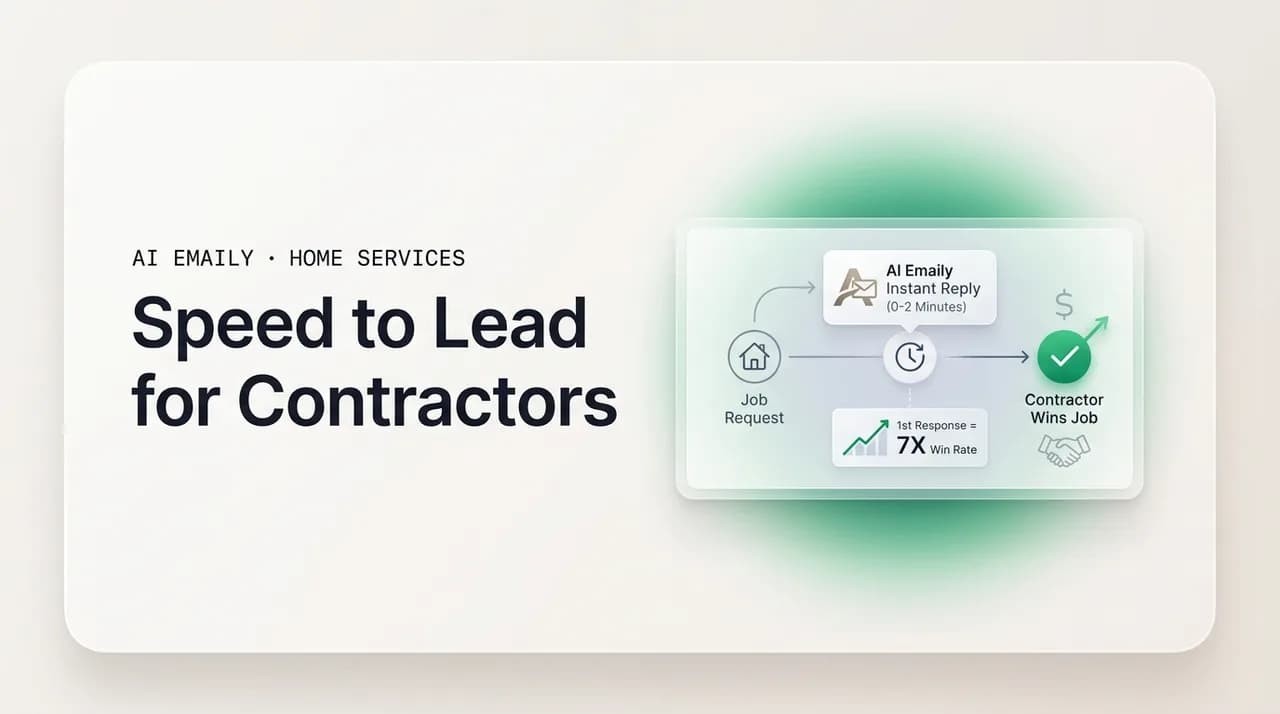
Speed to lead for contractors decides who wins the job, because roughly 78% of buyers hire the company that replies first and the same lead is often sold to three to eight firms at once. Aim to answer every inbound lead in under five minutes, ideally instantly, with an automatic acknowledgment followed by a personal reply. Owners on ladders and jobsites cannot do this by hand, so the fix is a system that fires a first touch the second a lead lands, day or night.
Speed to lead for contractors is the difference between a booked job and a missed one: 78% of buyers hire whoever replies first. Here is a sub-5-minute reply system for roofing, HVAC, solar, and remodeling pros who live on the jobsite, not the inbox.
On this page
- 01What is speed to lead, and why does it decide the job?
- 02What does the research actually say about lead response time?
- 03Why are contractors so slow to respond to leads?
- 04What does a sub-5-minute lead response system look like?
- 05Auto-acknowledgment vs. personal reply: what is the difference?
- 06What are the best instant first-touch templates for contractors?
- 07How should contractors handle after-hours and weekend leads?
- 08How does AI Emaily help contractors win on speed to lead?
- 09Putting it all together
What is speed to lead, and why does it decide the job?#
Speed to lead is the time between a customer raising their hand, a web form, a call, a text, a form on a lead-gen site, and you getting a real reply back in front of them. For contractors, that single number quietly decides more jobs than pricing, reviews, or craftsmanship, because a homeowner with a leaking roof or a dead furnace is not shopping for the best answer. They are shopping for the first answer. Speed to lead for contractors is the discipline of getting that first answer out fast enough that the customer stops looking before your competitor ever gets a word in.
The reason this matters so much in home services comes down to a stark piece of buyer behavior: about 78% of customers buy from the company that responds first. Not the cheapest, not the one with the most five-star reviews, the fastest. When a homeowner submits a request, they are anxious, they want the problem solved, and every minute of silence pushes them to keep clicking. The company that lands in their inbox or on their phone while that intent is still hot gets the appointment. Everyone who shows up an hour later is bidding on a job that is already gone.
Now layer on how home-services leads actually get sold. On the big lead-generation platforms, a single homeowner's request is frequently sold to three to eight companies at the same moment. So it is not a race where you are the only runner and can jog to the finish. It is a race where five to eight of you get the starting gun simultaneously, and the homeowner has already decided they will hire whoever crosses the line first and sounds competent. Slow speed to lead is not a minor inefficiency in that world. It means you paid for a lead and then handed the job to the contractor who happened to be near their phone.
This guide is about closing that gap. We will cover why the first responder wins, why contractors are structurally slow (it is not laziness, it is ladders and jobsites), the research behind sub-5-minute response, a practical instant-reply system you can run, the difference between an automatic acknowledgment and a personal reply, copy-paste first-touch templates, how to handle after-hours leads, and an honest look at how AI Emaily fits into all of it.
Before we go further, one framing worth holding onto: speed to lead is the cheapest growth lever a contractor has. You are not buying more leads, running more ads, or hiring another closer. You already paid for these leads. Improving how fast you answer them squeezes more booked jobs out of the exact same spend. A roofer paying $79 to $200 for a lead who books an extra one job in ten purely by replying faster has quietly cut their real cost per job in half. That is why speed to lead for contractors is worth taking seriously even when the inbox feels like the least urgent thing on a job-packed day.
The one number to watch
What does the research actually say about lead response time?#
The idea that faster is better sounds obvious, but the size of the effect is what makes it worth reorganizing your day around. The foundational study here, run across thousands of companies and reported in Harvard Business Review, found that firms contacting a lead within an hour were about seven times more likely to have a meaningful conversation with a decision-maker than those who waited even one hour longer, and roughly sixty times more likely than companies that waited a full day. Yet most companies were slow: the median first-response time in that data ran into dozens of hours, and a large share never responded at all. The gap between what buyers reward and what businesses actually do is enormous, which is exactly where the opportunity lives.
The classic lead-response research went a level deeper and found the curve is brutally front-loaded. The odds of qualifying a lead drop sharply after the first five minutes, and by thirty minutes they have fallen off a cliff. Responding in five minutes versus thirty minutes was not a small edge; the studies put the difference in the odds of making contact at roughly a hundred times. The window where a lead is warm, present, and reachable is measured in minutes, and it closes fast. That is the single most important fact in this entire guide: the value of a lead is decaying by the minute from the moment it arrives.
Home-services data tells the same story with sharper edges, because the trades are unusually competitive on speed. In 2026 benchmarks, roughly 88% of home-services responses take longer than five minutes, and only about 3% of businesses respond in under a minute. Read that again: the bar is on the floor. Almost nobody in your market is fast, which means speed to lead for contractors is not a crowded advantage, it is a wide-open one. If you can consistently answer in the first minute or two, you are competing against the 3% instead of the 88%, on leads everyone else is fighting over.
The payoff shows up directly in booked jobs. One frequently cited analysis of HVAC lead data found that lifting the response rate from 20% to 80%, mostly by answering more leads and answering them faster, produced about four times more booked appointments on the same set of leads. No new ad spend, no new lead source, four times the appointments. That is the entire argument for speed to lead for contractors in one number: the leads are already yours; you are just failing to reach most of them in time.
It helps to picture the decay curve as a table, because the drop-off is not linear and does not feel intuitive until you see it laid out. The figures below synthesize the widely reported lead-response research into a directional picture of how booked-job odds fall as response time stretches out. Treat them as orders of magnitude, not lab-precise constants, the shape is what matters, and the shape is a cliff.
| Time to first reply | What is happening | Relative odds of booking the job |
|---|---|---|
| Under 1 minute (instant) | Lead is on the page, phone in hand, intent at its peak. You are the first voice. | Highest — the 3% who reply this fast win disproportionately |
| 1–5 minutes | Still warm and present. You likely beat most competitors on a shared lead. | Very high — near the top of the curve |
| 5–30 minutes | Attention is drifting; a faster competitor may already be talking to them. | Sharply lower — odds of contact can fall ~10x vs. under 5 min |
| 30–60 minutes | The homeowner has probably heard back from someone else and started forming a preference. | Low — a fraction of the sub-5-minute odds |
| 1–24 hours | Intent has cooled; the job is often already booked with whoever replied first. | Very low — you are now the fallback, not the front-runner |
| Over 24 hours | Most shared leads are gone. You may reach them, but you are re-selling from scratch. | Marginal — closer to a cold outreach than a warm lead |
The through-line across every one of these studies is the same, and it is worth saying plainly: speed compounds. Being first does not just improve one metric, it stacks advantages. You get the conversation, so you get the appointment, so you get the chance to build rapport, so you get the review, so you get the referral. Being slow does the reverse, quietly, on every lead you paid for. This is why the trades that win on speed to lead tend to win on everything downstream, and why fixing your response time is less a marketing tactic than a structural change to how the business captures the demand it already generates.
Why these numbers are directional
Why are contractors so slow to respond to leads?#
If speed to lead for contractors is this valuable and the research this clear, why is 88% of the industry slow? Because the person best equipped to answer the lead is the person least able to reach a keyboard. Contractors are not slow out of indifference; they are slow because of the physical reality of the work. The owner who would give the warmest, most credible first reply is thirty feet up on a ladder, elbow-deep in a furnace, or under a sink when the lead comes in. By the time they climb down, drive to the next job, and finally check their phone, hours have passed and the homeowner has already booked the roofer who answered from his truck.
This is the core tension in the trades. In many home-services businesses, especially solo operators and small crews, the owner is also the salesperson, the dispatcher, and the estimator. There is no front desk, no CSR, no one whose entire job is to pounce on inbound leads. The same hands that do the work are the ones expected to answer the leads, and those two jobs happen at the exact same time and in physically incompatible places. You cannot install a roof and reply to a form in the same minute, and the lead does not care about your schedule.
Then there is the after-hours problem, which is bigger than most owners assume. A large share of home-services jobs get requested outside normal business hours, evenings, weekends, the middle of the night when a pipe bursts or the AC dies in a heat wave. Industry data puts something like 41% of jobs booked after hours. But the owner is home with family, the phone is on the charger, and the web form sits unread until the next morning. By then, the homeowner has already called three other numbers and hired whoever picked up. The lead you paid for on Tuesday night was lost before you woke up Wednesday.
The structural slowness gets worse the more successful you are. A growing crew doing $500K to $2M generates more leads, across more channels, at more hours, than any owner can personally triage while also running the jobs. The instinct is to hire a customer-service rep to catch the leads, but a CSR is expensive, inconsistent, works one shift, and still cannot answer at 11 p.m. on a Sunday. So even businesses that can afford staff hit a ceiling: human coverage does not scale to the always-on, respond-in-seconds reality that speed to lead for contractors now demands. The gap between when leads arrive and when a human is free to answer them is the single largest, most expensive leak in the trades.
It is worth naming the emotional trap here too. Because the work feels more urgent, and it is, the leads always lose. There is a real job on the calendar with a real customer expecting you at 8 a.m., versus an abstract form from someone you have never met. Every owner rationally chooses the job in front of them. But that daily, sensible choice, do the work, deal with leads later, is exactly how a contractor slowly starves the top of the funnel while feeling busy the whole time. The leads are not less valuable than the jobs; they are the jobs, a week from now. Solving speed to lead means removing the requirement that a busy human be the one to make the first touch.
What does a sub-5-minute lead response system look like?#
The goal is simple to state and hard to do by willpower alone: every inbound lead gets a real first touch in under five minutes, and ideally in seconds, no matter what you are doing when it arrives. You do not get there by trying harder or checking your phone more often. You get there by building a system that does not depend on a human being free at the moment the lead lands. Here is the system, step by step. It works whether you are a solo operator or a growing crew, and it is the backbone of every contractor who consistently wins shared leads.
- 1
Consolidate every lead into one inbox
You cannot respond fast to leads scattered across a website form, three lead-gen sites, Google, Facebook, texts, and a personal email. Route everything into a single place you actually watch. If a lead can land somewhere you check once a day, it will, and it will die there. One inbox is the precondition for everything else.
- 2
Fire an instant automatic acknowledgment
The moment a lead arrives, an automatic first reply should go out, within seconds, confirming you received their request and will follow up shortly. This is not the real reply; it is the flag on the finish line that tells a homeowner comparing three contractors that you are the one who answered. It buys you time to send a proper reply without losing the lead to silence.
- 3
Send a personal reply within five minutes
The auto-acknowledgment holds the door; a short, specific human (or human-sounding) reply walks through it. Reference what they asked for, offer a concrete next step (a call window, a site-visit slot, a quick question to qualify), and sign it like a real person. This is the touch that actually converts, and the five-minute clock is the deadline.
- 4
Ask one qualifying question, then propose a time
Do not send an estimate blind and do not interrogate them. One question (address, roof age, is this a repair or replacement, when did the AC stop) plus a proposed appointment window moves the lead toward the calendar instead of into a long email thread. The aim of the first reply is a booked slot, not a closed sale.
- 5
Follow up relentlessly on a schedule
Most leads do not reply to the first message, and the contractor who follows up five, six, seven times books jobs the one-and-done competitor leaves on the table. Set a cadence, same day, next day, day three, day seven, and stick to it. This is where templated, automated follow-up earns its keep, because no busy owner runs a seven-touch sequence by memory.
- 6
Cover after-hours the same way you cover the day
The system has to run at 11 p.m. on Sunday exactly as it runs at 11 a.m. on Tuesday, because that is when a huge share of leads arrive. An instant acknowledgment plus a queued personal reply for the morning means the after-hours lead gets caught in the net instead of leaking through it overnight.
Notice what this system is really doing: it separates the instant part from the human part. The instant acknowledgment does not need judgment, so a machine can send it in seconds with zero risk. The personal reply needs a little judgment, so a human either writes it or reviews a draft, but the deadline is five minutes, not five hours, and the draft is already waiting. This split is the whole secret of speed to lead for contractors. You stop asking a human to be instant, which is impossible on a jobsite, and instead you make the instant thing automatic and the human thing fast. That is achievable even when you are on a roof.
Set your own deadline before the market sets it for you
Auto-acknowledgment vs. personal reply: what is the difference?#
The most common mistake contractors make when they finally try to speed up is treating these as the same thing, either firing a robotic autoresponder and calling it done, or insisting every reply be hand-written and staying slow forever. They are two different tools doing two different jobs, and a good system uses both. Getting the distinction right is what separates a speed-to-lead system that converts from one that just annoys people.
The automatic acknowledgment is about presence. Its only job is to prove, in seconds, that a real business is on the other end and the request did not vanish. It goes out instantly, the same to everyone, and it does not try to sell or qualify. Think of it as the digital equivalent of a receptionist saying "got it, someone will be right with you." It is short, warm, and specific enough to feel human without pretending to be a personal answer. Its power is entirely in its speed: it lands while the homeowner is still on the page comparing contractors, and it plants your flag first.
The personal reply is about conversion. This is the message that references their actual request, answers the real question, and proposes a concrete next step. It can be written by you, by your CSR, or drafted by AI and approved by you, but it has to sound like a person who read what they wrote and knows the trade. It carries the judgment, the pricing hints, the appointment offer, the little signals of competence that make a homeowner think "this is the one." It is slower than the acknowledgment by design, but under the system above it still lands inside five minutes.
The failure modes are worth naming so you can avoid them. Sending only an auto-acknowledgment and no timely personal reply is how you get a homeowner who feels acknowledged, then ignored, which is worse than silence because you raised the expectation and missed it. Sending only personal replies with no automatic acknowledgment means the on-a-ladder gap swallows your speed and you lose shared leads to faster firms. And sending an auto-acknowledgment so generic and salesy that it reads like spam actively repels people. The pattern that works is: instant acknowledgment that feels human, followed fast by a personal reply that clearly is human, with a clean handoff between them.
One more nuance specific to the trades: keep pricing and scope out of the automatic layer. It is fine, and smart, to autosend appointment confirmations, dispatch windows, "we got your request" acknowledgments, and follow-up nudges. It is not smart to let a machine quote a roof or diagnose a system. The job value is too high and the specifics too variable. The reliable rule is to automate the acknowledgment and the logistics, and keep a human on the money and the diagnosis. That keeps you fast without letting speed create a promise you cannot keep.
A fast wrong answer is still wrong
What are the best instant first-touch templates for contractors?#
Templates are what make speed to lead for contractors survivable. You are not composing from scratch at 11 p.m. or between jobs; you are swapping details into a proven skeleton. Below are first-touch templates for the two layers, the instant acknowledgment and the fast personal reply, plus trade-specific variants. Copy the one that fits, replace the bracketed parts, and keep them short. The best first touch is one the homeowner can read on a phone in five seconds and act on.
Start with the instant automatic acknowledgment. This fires the second a lead lands, before a human is involved. It is deliberately generic and warm.
Next, the fast personal reply. This is the one that converts, sent within five minutes, referencing what they actually asked for and pushing toward a time on the calendar. This general version works for most trades; the ones after it are tuned per niche.
For a roofing lead, where the callback expectation is near-universal and the job value is high, lead with reassurance and a fast on-site window. Roofing homeowners are often dealing with an active leak or storm damage and want to know a real person is coming.
For an HVAC lead, split the urgency: an emergency no-cool or no-heat call needs a same-day dispatch offer, while a replace-or-repair inquiry can go straight to a scheduled diagnostic. This version handles both by asking one triage question up front.
For a solar lead, speed is everything, these leads are routinely sold to three to eight companies and answered in under a minute. Keep the first reply extremely short, confirm interest, and lock a call time before a competitor gets there.
For a remodeling or kitchen-and-bath lead, the job is premium and the cycle is long, so the first reply sets up a longer conversation rather than racing to a same-day slot. Speed still matters for the first touch, but the tone is consultative.
Finally, the follow-up templates, because most leads do not answer the first message and the contractor who follows up wins the ones who did not. Keep them short and space them out. Here is a simple three-touch follow-up you can queue after the first reply.
How should contractors handle after-hours and weekend leads?#
After-hours is where speed to lead for contractors is won or lost, because roughly 41% of home-services jobs get requested outside business hours and almost nobody answers them. This is simultaneously the biggest leak and the biggest open opportunity. If a large share of your leads arrive when you and every competitor are off the clock, then being the one business that responds at 9 p.m., even automatically, means you catch demand the entire market is sleeping through.
The mechanics are the same as the daytime system, with one adjustment: the personal reply is queued, not necessarily sent live. When a lead lands at midnight, the instant acknowledgment fires immediately, confirming you received the request and will follow up first thing in the morning. That single automated message does most of the work, because it beats the silence the homeowner is getting from the three other contractors they messaged. Then a personal reply is either drafted and waiting for you to approve at 7 a.m., or, for logistics-only messages like an appointment confirmation, sent automatically overnight.
The result is that the after-hours homeowner wakes up to a business that clearly answered, while your competitors wake up to a lead that already booked with you. You did not have to be awake. You had to have a system that was. This is the single highest-ROI change most contractors can make, because it turns the 41% of after-hours demand from your biggest source of leakage into a stream of leads your slower competitors never even see.
Weekends are after-hours too
How does AI Emaily help contractors win on speed to lead?#
Everything above describes the system. The honest problem is that running it by hand is exactly what the on-a-ladder, on-a-jobsite reality makes impossible, which is why 88% of contractors are still slow despite knowing all of this. This is the specific gap AI Emaily is built to close. It is an AI-native email client with an autonomous chief of staff for your inbox, and for a contractor its job is to make sure no lead ever sits unanswered while you are up a ladder or asleep.
Here is how that maps to the system, concretely. When a lead lands, AI Emaily can fire the instant acknowledgment in seconds, so your flag is planted on the finish line before a competitor on a shared lead has typed a word. It then drafts the fast personal reply in your voice, because it learns how you actually write, so the message that reaches the homeowner sounds like you read their request from the truck, not like a generic autoresponder. It runs the relentless follow-up sequence on schedule, the day-one, day-three, day-seven touches no busy owner keeps up by memory, so the leads that did not answer the first message still get worked.
Critically for the trades, it respects the line between logistics and judgment. Because the app runs in Manual, Copilot, and Autopilot modes, you decide what happens without you. The templated, high-ROI, low-risk touches, the instant acknowledgment, appointment confirmations, dispatch windows, follow-up nudges, are the natural candidates to automate, exactly the pattern the job value justifies. The parts that need your judgment, quoting a five-figure roof, diagnosing a system, committing to scope, stay human-checked. In v1, Copilot means you approve replies before they send, so a person is always on the money and the diagnosis; Autopilot is gated and rolled out carefully, and every action has undo and a full audit trail so nothing goes out that you cannot see and reverse.
The after-hours story is where it matters most. AI Emaily does not sleep, so the 41% of leads that arrive on evenings and weekends get an instant acknowledgment the moment they land, and a drafted personal reply waiting for your morning approval, or an auto-sent confirmation for the pure logistics. The homeowner who submitted a form at 11 p.m. hears back at 11 p.m. You find out about it, and approve the follow-up, over coffee. Your competitors find out about their version of that lead after it is already yours.
It connects to Gmail, Outlook, and any IMAP account, and pulls your leads into one place, which closes the first and most-skipped step of the system: consolidation. Leads scattered across a website form, lead-gen sites, and email land in one inbox that is being watched every second, by software, so the on-a-ladder gap stops swallowing them. The point is not to remove you from your business. It is to remove the impossible requirement that a busy human be instant, and let you be fast and personal instead, on every lead, day and night. You can try it free at app.aiemaily.com/signup, with a Free plan at no cost and Pro at $12.42 per month on the annual plan.
Start with acknowledgment and follow-up
Putting it all together#
Speed to lead for contractors is not a marketing nicety; it is the mechanism by which the demand you already pay for turns into booked jobs. Roughly 78% of buyers hire whoever replies first, the same lead is often sold to three to eight companies at once, the odds of reaching a lead fall steeply within the first minutes, and 88% of your competitors are still slow. That combination is not a problem, it is an opening. The contractor who consistently answers first, on jobs everyone is bidding on, wins a disproportionate share of them without buying a single extra lead.
The reason most contractors do not capture this is structural, not moral. The owner who gives the best first reply is on a ladder, in a crawlspace, or asleep when the lead arrives, and a huge share of leads arrive after hours. You do not fix that by trying harder. You fix it by building a system that does not need a human to be instant: consolidate every lead into one inbox, fire an automatic acknowledgment in seconds, follow with a personal reply inside five minutes, ask one qualifying question, propose a time, and follow up relentlessly, day, night, and weekend, on a schedule.
The split at the heart of it, automate the acknowledgment and the logistics, keep a human on the price and the diagnosis, is what lets you be both fast and accurate. Whether you run that system with templates and discipline or let an AI email client run it for you, the goal is the same: never let a lead you paid for die in silence while you were doing the work. Get there first, sound like a person who knows the trade, and follow up until they book. That is the whole game, and right now most of your market is not playing it.
Frequently asked
See it in AI Emaily
Keep reading
Sources

Written by
Nafiul HasanNafiul Hasan is an entrepreneur and AI automation system builder with 10+ years of experience turning messy, manual workflows into reliable automated systems. He designs and ships AI enterprise solutions end-to-end — the agent logic, the data plumbing, and the product people actually use — and founded AI Emaily to give busy professionals their attention back. He writes here from the builder's seat: what works, what breaks, and how to put AI to work without giving up control.