Roofing Lead Callback Automation: Never Miss a Storm-Season Lead Again

The short answer
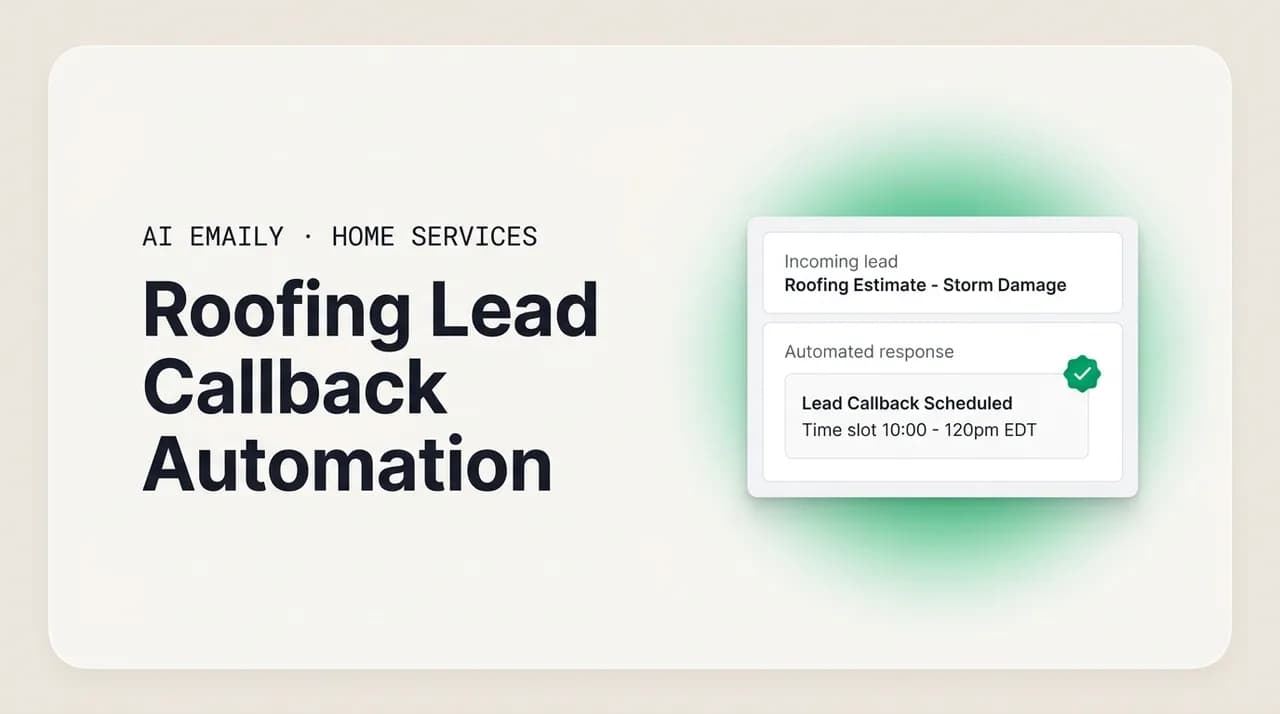
Nearly every roofing customer expects a fast callback, but owners are on ladders when leads arrive, so the first contractor to respond usually wins the job. Roofing lead response automation fixes this by sending an instant, on-brand acknowledgment to every new lead, then running templated follow-up for inspections, insurance claims, and estimates, while keeping pricing and scope decisions in human hands.
A practical guide to roofing lead response automation: why a fast callback wins the job, how to build an instant-acknowledgment and follow-up system, and copy-paste email templates for storm-season leads, inspections, insurance claims, and estimates.
On this page
- 01Why roofing lead response automation decides who wins the job
- 02The roofing lead-response problem, in plain numbers
- 03What an instant-callback and email system actually looks like
- 04The instant acknowledgment: your most important message
- 05Scheduling the inspection without the phone tag
- 06Guiding insurance-claim leads without giving bad advice
- 07Following up on the estimate until it closes or clears
- 08Scaling for storm season without dropping leads
- 09Common mistakes when automating roofing lead response
- 10How AI Emaily helps roofing contractors respond first
- 11Putting it all together
Why roofing lead response automation decides who wins the job#
In roofing, the job is often won or lost in the first hour, long before anyone climbs a ladder or writes an estimate. A homeowner who just noticed a leak, or whose neighbor's roof was torn up by last night's hail, does not calmly interview five contractors. They fill out a form or leave a voicemail, and then they wait. Whoever answers first, clearly and quickly, becomes the front-runner. Everyone who calls back that evening, or the next morning, is competing for a customer who has already started talking to someone else.
This is the core problem roofing lead response automation solves. The expectation of a fast callback in this trade is close to universal: the overwhelming majority of roofing customers expect to hear back within a week, and more than half expect it within two days. Those are not stretch goals a customer hopes for; they are the baseline they use to decide whether you are serious. Miss the window and you are not just slow, you are quietly filed under "did not seem interested," no matter how good your crews are.
The cruel part is that the people best equipped to sell a roofing job, the owners and experienced estimators, are exactly the people who cannot answer the phone during the day. They are on a roof, on a ladder, in an attic, or driving between sites with a phone in a jacket pocket they cannot reach. The lead arrives at 10:40 a.m. on a Tuesday. The owner sees it at 6:15 p.m., after the crews are loaded out. By then the homeowner has already booked an inspection with the company that texted back in four minutes. Nothing about the owner's skill mattered, because the owner never got into the conversation.
Roofing lead response automation closes that gap without pretending to be something it is not. It does not diagnose the roof, quote the job, or make promises about scope. It does one thing extremely well: it makes sure every lead gets an instant, professional, on-brand acknowledgment the moment it lands, so the customer knows a real company saw their request and is on it, and so you stay in the running until a human can take over. This guide walks through the roofing lead-response problem in detail, then shows you how to build a system that answers every lead in seconds, with copy-paste templates for the moments that matter most in roofing: the first reply, the inspection booking, the insurance-claim conversation, and the estimate follow-up.
A note on scope before we go further. Automation in roofing is not about replacing the human judgment that sells and prices a roof. It is about removing the delay between a lead arriving and a human being able to engage. The fast, repetitive, templatable parts, acknowledge, schedule, remind, follow up, are where automation earns its keep. The parts that require looking at a roof, reading an adjuster's scope, or committing to a number stay firmly with a person. Get that division right and automation makes you faster without making you reckless.
The one-sentence version
The roofing lead-response problem, in plain numbers#
It helps to name the specific ways roofing leaks leads, because each one has a different fix. Roofing is not like a generic service business. It has storm surges that flood you with leads on a single afternoon, insurance jobs with their own multi-week rhythm, and lead sources that sell the same homeowner to several contractors at once. Any one of these can quietly erode a month's revenue if your response process is a person checking a phone between jobs.
Here is the shape of the problem, piece by piece.
- 1
The callback expectation is near-universal
Almost all roofing customers expect a callback within a week and over half within two days. This is not a preference you can train customers out of; it is the standard they measure you against. A slow reply reads as disinterest, and disinterest loses the job before pricing is ever discussed.
- 2
The owner is on a ladder, not in the inbox
The person who closes roofing jobs is in the field all day. Leads that arrive between 8 a.m. and 5 p.m., which is most of them, sit untouched until the owner is back at a desk. A competitor with an office or an automated first reply is already in the customer's phone by then.
- 3
Storm surges break manual follow-up
A single hail or wind event can generate a week's worth of leads in an afternoon. Manual response does not scale to that spike. The leads that fall through the cracks during a surge are the ones that were most ready to buy, because storm-motivated homeowners act fast and shop several contractors at once.
- 4
Leads are shared and expensive
Roofing leads are pricey, often $79 on average and $200-plus for exclusive ones, and shared leads are sold to several companies simultaneously. When you pay that much and the lead is also in three competitors' hands, a four-hour delay is not a minor inconvenience, it is the difference between recouping the cost and eating it.
- 5
Insurance jobs have their own clock
Storm-damage roofing is often an insurance job, which means the customer is juggling an adjuster, a claim number, and a deadline, not just a repair. A contractor who guides them through that process, clearly and promptly, becomes the trusted party. A contractor who goes quiet during the claim window loses to whoever kept communicating.
Read those together and a pattern emerges: roofing does not primarily have a lead-generation problem, it has a lead-response problem. Marketing dollars buy the phone call and the web form. What happens in the minutes and hours after that, whether the lead is acknowledged, scheduled, and nurtured, decides whether the marketing paid off. You can pour money into ads and lead services and still lose, job after job, on the response step alone.
The good news is that the response step is the most fixable part of the whole funnel. It is repetitive, it is predictable, and it happens the same way every time: a lead comes in, it needs a fast reply, it needs a next step scheduled, and it needs follow-up until it books or clearly says no. That is exactly the kind of process automation was built for, which is why roofing lead response automation is one of the highest-return changes a roofing business can make.
A quick honesty check
What an instant-callback and email system actually looks like#
Before templates, it helps to see the whole system at a glance, because the templates only work if they are wired into a sequence. A roofing lead-response system is not one message; it is a chain of triggers and responses, where each event a customer creates gets a defined, prompt reply. Think of it as a set of if-this-then-that rules that run whether or not the owner has service on the roof.
The table below maps the common triggers a roofing lead creates to the response the system should produce. This is the spine of the whole approach. Everything after it is just filling in the words.
| Trigger (what the customer does) | Automated response (what the system does) |
|---|---|
| New web-form or ad lead arrives | Instant acknowledgment email within seconds, confirming you received the request and stating the next step and a rough timeframe. |
| Missed call during a job | Immediate text-back or email acknowledging the missed call and offering to schedule an inspection, so the caller does not dial the next contractor. |
| Storm-surge inbound (many leads at once) | Every lead gets the same fast acknowledgment regardless of volume, with a queue note setting an honest expectation for a busy period. |
| Customer mentions insurance / storm damage | Send the claim-guidance message explaining next steps, then flag the thread for a human to handle scope and adjuster coordination. |
| Inspection is booked | Confirmation email with date, time, what to expect, and how to prepare, plus a reminder the day before. |
| Estimate has been sent | Scheduled follow-up sequence: a check-in a few days later, then a gentle nudge, spaced out, until the customer books or declines. |
| Customer goes quiet after estimate | A final, low-pressure follow-up that leaves the door open and asks whether the timing or scope changed, rather than repeating the same pitch. |
Two things make this system work, and both are easy to get wrong. The first is speed on the very first response. The acknowledgment has to be genuinely instant, seconds, not minutes, because the entire point is to reach the customer before a competitor and before they mentally move on. A fast, plain reply beats a slow, polished one every time in this trade.
The second is the honest handoff to a human. Automation should carry the lead to the doorstep of a real conversation and then clearly hand it over. The acknowledgment can promise a callback; a person has to make it. The system can send claim guidance; a person has to read the actual adjuster's scope. The estimate follow-up can nudge; a person has to talk price. When automation tries to close the sale itself, it either overpromises or sounds robotic, and either one costs you the trust that sells roofing. Keep the machine on the fast, factual, repetitive parts and keep the human on judgment, and the system feels like great service rather than a bot.
Design for the storm, not the calm
The instant acknowledgment: your most important message#
Of every message in the sequence, the instant acknowledgment matters most, because it is the one that keeps you in the running. Its job is narrow and it should not try to do more: confirm you received the request, sound like a real, competent company, state the next step, and give a realistic timeframe for a human callback. That is it. It is not the place to quote, to sell hard, or to ask a dozen qualifying questions. It is the digital equivalent of a professional saying "got it, we are on it," the second the customer reaches out.
Here is a clean, all-purpose version for a new web-form or ad lead. Swap in your company details and keep it short.
Notice what that message does and does not do. It confirms receipt, names the company, promises a human callback, invites a quick reply with a phone number, and flags the storm-versus-leak distinction so the right person can prioritize. It does not quote, it does not oversell, and it does not pretend a human wrote it in that exact moment. It reads as prompt and competent, which is exactly the impression that keeps a homeowner from dialing the next contractor on their list.
For a missed call during a job, a slightly different version works better, because the customer just tried to reach a person and got voicemail. The message has to acknowledge that directly and offer an immediate path forward, so the missed call does not become a lost lead.
Do not let the acknowledgment make claims it cannot keep
Scheduling the inspection without the phone tag#
Once a lead is acknowledged, the next job is getting an inspection on the calendar, and this is where a lot of roofing leads quietly die in a loop of missed calls and unanswered voicemails. The customer calls, you are on a roof; you call back, they are at work; three days pass and the urgency fades. Automating the scheduling step, even partially, removes most of that friction by letting the customer lock in a time without a live phone call, and by confirming and reminding so the appointment actually happens.
The confirmation message should do three things: lock the details, tell the customer what to expect so they are not anxious or absent, and give a simple way to reschedule so a conflict does not turn into a no-show. Here is a version that covers all three.
A same-day or day-before reminder does a surprising amount of work here. No-shows are pure waste in roofing, a crew or an estimator drives out and finds nobody home, and the lead cools. A short reminder cuts that dramatically and gives the customer one more easy chance to reschedule instead of ghosting.
Confirm access, not just time
Guiding insurance-claim leads without giving bad advice#
Storm-damage roofing is frequently an insurance job, and this is a moment where good communication genuinely wins work, because the homeowner is often overwhelmed. They may have never filed a roof claim before. They do not know the order of operations, what an adjuster does, or whether they are even covered. A contractor who calmly explains the process and stays in touch becomes the trusted guide. One who disappears into the claim's dead air loses to whoever kept the homeowner informed.
This is also the most sensitive place to automate, so the rule is strict: the message can explain the general process and set expectations, but it must never interpret the customer's specific policy, promise coverage, or coach them on how to get a claim approved. That last one crosses into territory that can be illegal in some places and is always risky. The automated message hands the customer a map of the process and then hands the thread to a human who works the actual claim with them. Here is a version that stays firmly on the safe side of that line.
The value of that message is that it makes you look organized and trustworthy at the exact moment the customer feels lost, while carefully not promising anything about their coverage. It positions your company as the calm professional who has done this many times, without your automation making a single claim it cannot back up. Notice it repeatedly points the customer back to their insurer for coverage questions and flags that a human will call. That is the shape every insurance-related automated message should take.
Insurance messaging is a compliance surface, not just a sales one
Following up on the estimate until it closes or clears#
The estimate follow-up is where roofing revenue is most often left on the table, because it is the least urgent-feeling step and the easiest to forget. You inspected the roof, you sent a number, and then, because you are back on a ladder, nobody follows up. The homeowner, who was ready to decide, drifts. Weeks later they hire whoever stayed in touch. A disciplined, automated follow-up sequence fixes this by making sure every estimate gets a series of spaced, low-pressure nudges without anyone having to remember.
The key is restraint. Follow-up should feel like helpful attentiveness, not nagging. Space the touches out, vary the message, and always give the customer an easy way to say where they stand. Here is a first check-in, sent a few days after the estimate.
If the first check-in gets no reply, a second nudge a week or so later is fair game, as long as it adds something rather than just repeating the ask. A reminder about seasonality, material lead times, or scheduling availability gives the customer a real reason to act now without pressure.
Finally, when a lead has gone quiet through a couple of touches, send one clean closing message that leaves the door open and, crucially, asks for a simple answer. The goal is not to guilt them into buying; it is to learn whether this is a dead lead or a delayed one, so you stop chasing the former and stay warm on the latter.
A quiet lead is data, not a loss
Scaling for storm season without dropping leads#
Storm season is where a manual response process breaks and an automated one shines. A single significant hail or wind event can generate more roofing leads in one afternoon than a normal month, and severe weather in the United States is common enough, and destructive enough to roofs, that most roofing businesses will face at least one of these surges a year. When it hits, the businesses that capture the surge are the ones whose response does not depend on a person having time, because during a surge, nobody has time.
The failure mode during a storm surge is predictable. Leads pile up faster than anyone can call them back. The owner triages by gut, calling the ones that seem biggest and losing the rest to silence. Meanwhile competitors who automated the first response have already acknowledged every one of those leads and booked inspections. Two weeks later, the difference between the roofer who scaled and the one who did not shows up as booked jobs versus missed calls, from the exact same storm.
Automation scales in a way a human simply cannot. Whether one lead arrives or two hundred, every single one gets the same instant, on-brand acknowledgment, the same offer to schedule, and the same follow-up sequence. The machine does not get tired, overwhelmed, or forgetful at lead number ninety. That consistency is worth the most precisely when it is hardest to achieve manually.
The one adjustment worth making for surges is honesty about timing. During a normal week your acknowledgment can imply a quick callback. During a major storm, when you genuinely have a backlog, it is better to set a realistic expectation than to promise a callback in an hour you cannot deliver. A short, honest queue note keeps trust intact and still keeps you ahead of the contractors who said nothing at all.
Give emergencies a fast lane
Common mistakes when automating roofing lead response#
Automation done badly can hurt you more than no automation at all, because a robotic or overreaching message can turn a warm lead cold. Here are the mistakes that come up most often, and what to do instead, so your system reads as great service rather than a bot standing between the customer and a human.
- Letting the automation try to close the sale. The machine's job is to acknowledge, schedule, and follow up. The moment it tries to quote, negotiate, or promise outcomes, it either overpromises or sounds fake. Keep selling human.
- Making promises about insurance coverage. Never let a template tell a customer their claim will be approved, offer to handle their deductible, or coach them on an adjuster call. Describe the general process, point coverage questions to their insurer, and escalate to a person.
- Sounding like a robot. Generic, stiff auto-reply language undercuts the trust roofing runs on. Write the messages in your company's real voice, the way you would actually talk to a homeowner on the phone.
- No human handoff. Automation that acknowledges a lead and then goes silent is worse than a slow human, because it raised expectations and dropped them. Every acknowledgment must lead to a real callback from a real person, promptly.
- Over-following-up. Six identical nudges in a week is harassment, not attentiveness. Space touches out, vary the message, add a reason to act, and stop gracefully with a break-up message that asks for a simple yes or no.
- Ignoring the emergency case. Treating an active-leak lead the same as a routine estimate request during a storm loses the customer whose ceiling is dripping. Build a fast lane for genuine emergencies and staff it with a human.
- Setting it and forgetting it. Templates that mention "busy season" in December or the wrong company name erode trust fast. Review your automated messages periodically and keep them current, seasonally accurate, and correct.
Automation amplifies whatever you point it at
How AI Emaily helps roofing contractors respond first#
Everything above is the strategy; the hard part is running it reliably when you are on a roof all day. This is exactly the kind of fast, repetitive, high-stakes work an AI-native email client is built to handle. AI Emaily connects to your existing Gmail, Outlook, or IMAP inbox and acts as an autonomous chief of staff for it, so new leads get acknowledged, sorted, and followed up on without you having to be at a desk, while the decisions that require judgment stay with you.
For roofing specifically, the fit maps directly onto the response system in this guide. When a lead lands, AI Emaily can send an instant acknowledgment in your company's voice, because it learns how you actually write rather than defaulting to generic boilerplate. It can recognize an inspection request and start the scheduling and confirmation flow, run the spaced estimate follow-up sequence so warm leads do not go cold, and detect when a message mentions storm damage or insurance, sending the general-guidance reply while flagging the thread for you to handle the actual claim. Instant lead reply, appointment scheduling, and quote follow-up are exactly the templated, high-ROI tasks that make sense to automate given what a roofing job is worth, and scope and pricing specifics stay human-checked, which is precisely where they belong.
The way it stays safe is the three-mode design. In Manual mode you write everything yourself with AI drafting help. In Copilot mode, the default and the one we recommend for anything customer-facing in roofing, AI Emaily drafts the acknowledgment, the confirmation, or the follow-up and waits for your one-tap approval before it sends, so a human is in the loop on every outbound message. In Autopilot mode, which you can turn on narrowly for the safest, most repetitive replies once you trust it, it can handle routine acknowledgments on its own, always with undo and a full audit trail of exactly what it did and when. You decide how much to hand over, and you can dial it back at any time.
That division is deliberate, and it matches the honest scope this whole guide has argued for. The instant acknowledgment, the inspection confirmation, the reminder, the estimate nudge, the general insurance-process explainer: these are fast, repeatable, and safe to automate, and automating them is what keeps you first to respond during a storm surge that would bury a manual process. The pricing conversation, the read of an adjuster's scope, the promise about coverage, the final negotiation: these stay with you, every time. AI Emaily handles the speed so you can handle the roof. You can try it free at app.aiemaily.com/signup, with a Free plan at no cost and Pro at $12.42 per month on the annual plan.
Putting it all together#
Roofing is a first-responder business. Nearly every customer expects a fast callback, the person best able to sell the job is on a ladder when leads arrive, storms flood you with leads on a single afternoon, and the same expensive lead is often sitting in three competitors' hands. Win or lose, the decisive moment is usually the first hour, and it turns on one thing you can actually control: whether the lead got a prompt, professional, on-brand response while it was still warm.
Roofing lead response automation is how you control that moment without being chained to your phone. Build the system as a chain of triggers and responses: an instant acknowledgment on every lead, easy scheduling with confirmations and reminders, calm general guidance for insurance jobs, a disciplined estimate follow-up sequence, and an honest queue note for storm surges. Keep the machine on the fast, factual, repetitive parts, and keep every judgment call, pricing, scope, coverage, on a human. That division is what makes automation feel like excellent service instead of a wall between the customer and a real person.
Grab the templates above, wire them into your inbox, and make sure no lead ever again waits until evening for a reply it needed in the first four minutes. Whether you set it up by hand or let an AI-native client run the fast parts for you, the goal is the same: be the roofer who answered first, so you are still in the conversation when trust, quality, and price decide the job.
Frequently asked
See it in AI Emaily
Keep reading
Sources

Written by
Nafiul HasanNafiul Hasan is an entrepreneur and AI automation system builder with 10+ years of experience turning messy, manual workflows into reliable automated systems. He designs and ships AI enterprise solutions end-to-end — the agent logic, the data plumbing, and the product people actually use — and founded AI Emaily to give busy professionals their attention back. He writes here from the builder's seat: what works, what breaks, and how to put AI to work without giving up control.