Best Tools to Track Email Link Clicks (2026)

The short answer
For one-to-one email, UTM tags on your real links plus site analytics is the safest way to track clicks: it adds no new domain. Rewritten-link trackers such as Mailtrack and HubSpot give per-recipient data but route each click through a redirect domain, which can hurt deliverability if that domain's reputation is poor.
Best tools to track email link clicks in 2026, ranked by deliverability risk: UTM tags, CRM trackers and rewritten-link services, and when each fits.
On this page
- 01The short answer
- 02How we compared
- 03The tools at a glance
- 04Does link rewriting hurt your deliverability?
- 05UTM tags plus analytics — the deliverability-safe default
- 06Mailtrack by Mailsuite — per-recipient tracking inside Gmail
- 07HubSpot and CRM sales tools — clicks next to the contact
- 08Custom tracking domain — the setup that protects your reputation
- 09Link shorteners — click counts, with a domain caveat
- 10Marketing platforms — right for lists, wrong for one-to-one
- 11Where AI Emaily fits — the adjacent thing, not a click-tracker
- 12How to choose for your situation
- 13The verdict
If you send one-to-one or small-batch email — a founder emailing 40 prospects, a recruiter following up with candidates — the best tools to track email link clicks are not the tools a marketing team reaches for. At that scale the thing you are protecting is your sending reputation, and the most common way to record a click can quietly erode it.
This guide compares three approaches: appending UTM parameters to your real links, letting a CRM or Gmail extension rewrite links to record per-recipient clicks, and running a custom tracking domain so those rewritten links stay on your own name. Each carries a different deliverability cost, and we rank them with that cost in front rather than behind.
Prices and plan names in this category change often. Treat the packaging shapes below as a starting point and verify the current details on each vendor's own page before you commit.
The short answer#
The safest way to see whether your links get clicked is to tag them with UTM parameters and read the results in your website analytics. UTM tags sit on the end of your real URL as query parameters. Nothing is rewritten, no redirect domain is introduced, and the address a recipient hovers over is the address they land on.
That last point matters more than it looks. Gmail's own sender guidance asks that web links be visible and that recipients know what to expect when they click. A link whose visible destination differs from where it actually goes is the exact pattern phishing filters are built to flag.
UTM tagging has one real limit: on its own it tells you a click happened and which message it came from, not which named person clicked. If you need per-recipient data you move to a rewritten-link tool — and you accept the deliverability trade-off that comes with it. The rest of this guide is about making that trade-off with your eyes open.
How we compared#
We did not install and A/B test every tool here, and we are not going to claim we did. We compared them on documented, checkable dimensions — the ones that decide whether click tracking is worth the deliverability cost for a low-volume sender.
These are the axes that actually change the answer:
- Does it rewrite links? A rewritten link routes the click through a redirect domain before sending the recipient on to the real page.
- Per-recipient or aggregate? Whether you learn who clicked, or only that someone did.
- Whose domain carries the redirect? A shared tracking domain pools reputation across every sender using it; a custom one is yours alone.
- Deliverability risk for genuine one-to-one sending, where inbox placement matters most.
- Packaging shape — free tier, trial, or per-seat. We describe the shape, not the price, because prices move.
The tools at a glance#
| Approach / tool | Rewrites links? | Per-recipient? | Deliverability risk (1:1) | Packaging shape |
|---|---|---|---|---|
| UTM tags + GA4 or site analytics | No | No — session-level | Lowest — no new domain | Free (your analytics tool) |
| Mailtrack by Mailsuite (Gmail) | Yes | Yes | Moderate — pixel + redirect | Free tier + paid |
| HubSpot / CRM sales tools | Yes | Yes | Moderate | Free tier + paid Sales Hub |
| Yesware, Mixmax, Streak | Yes | Yes | Moderate | Trial or free tier + per-seat |
| Custom tracking domain (setup) | Yes — via your subdomain | Yes | Lower than a shared domain | Provider-dependent |
| Bitly / link shortener | Yes — short link | Aggregate unless unique links | Moderate — worse on a generic domain | Free tier + paid (custom domain) |
| Mailchimp, Brevo (ESP) | Yes | Yes | Bulk-sender rules apply | Free tier + paid |
| AI Emaily (this site) | No — by design | N/A — not a click-tracker | N/A — blocks incoming trackers | 7-day free trial, no free tier |
Does link rewriting hurt your deliverability?#
It can, and the mechanism is specific rather than mystical. A rewritten link replaces your real URL with one that points at the tracking provider first, records the click, then forwards the recipient to the real destination. Two things about that can cost you a place in the inbox.
First, reputation. Spam filters assess the domains found in a message, including the domain a link redirects through. If that redirect domain is shared across thousands of senders — the default for most cheap trackers — your clean mail borrows the reputation of whoever else is on it, spammers included.
Second, appearance. A link whose visible text points one place and whose real destination points somewhere else is the defining shape of a phishing link. In high-volume marketing this is routine and filters expect it. In a genuine one-to-one email from a person, a redirect-wrapped link is more conspicuous, not less.
None of this means never rewrite a link. It means: if you do, put the redirect on your own custom domain, keep your spam complaints low, and reserve rewriting for when per-recipient data is genuinely worth the cost. For most one-to-one senders, UTM tags avoid the question entirely.
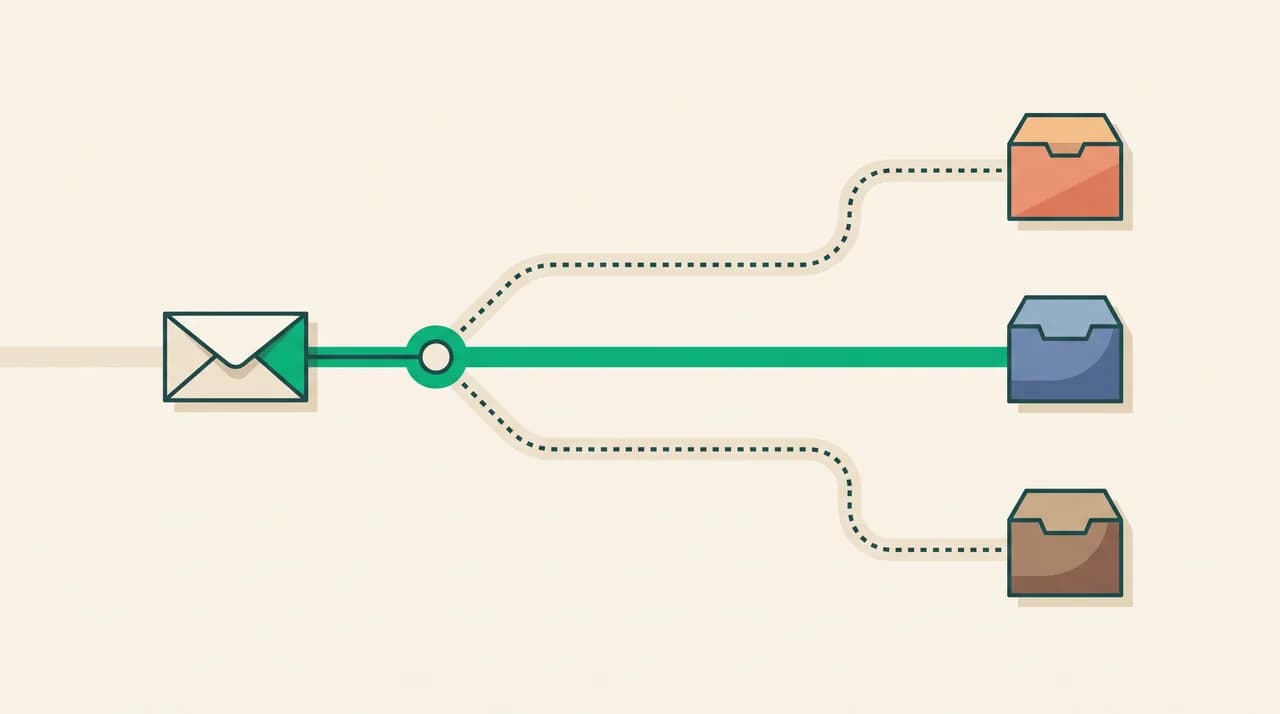
Shared redirect domains pool reputation
UTM tags plus analytics — the deliverability-safe default#
UTM parameters (utm_source, utm_medium, utm_campaign, and optionally utm_content and utm_term) are the free, standard way to attribute a click to the message that produced it. You append them to your real link; when the recipient clicks, your analytics tool records the visit and which campaign sent it.
Because nothing is rewritten, this approach adds no deliverability risk. There is no new domain, no redirect, and no mismatch between the visible link and the real one. For genuine one-to-one sending, that is most of the battle.
The cost is granularity. Standard UTM tracking is session-level: it tells you a click from utm_campaign=q3-outreach landed on your pricing page, not that a specific person clicked. You can close that gap by giving each recipient a unique utm_content value or a unique landing URL — but at that point you are hand-building what a rewritten-link tool does for you.
Best for: anyone whose real question is which message drove traffic, and who values a clean sending reputation over per-person detail. Google Analytics 4 is the common reader, but any analytics tool that respects UTM parameters works.
Mailtrack by Mailsuite — per-recipient tracking inside Gmail#
Mailtrack — part of Mailsuite since 2024 — is a Gmail extension that adds read receipts and, on its tracked links, per-recipient click data without leaving your inbox. It is the simplest option for a solo Gmail sender who wants to know who opened and who clicked.
It works the way most inbox trackers do: an invisible pixel for opens and rewritten links for clicks. That is genuinely convenient per-recipient data. It is also exactly the mechanism that carries the deliverability risk above — the pixel and the redirect are what a cautious spam filter scores.
Packaging is a free tier plus paid plans, with click tracking limited to a small number of emails on the free tier and unlimited on paid. Confirm the current limits on Mailsuite's page, since this vendor revises its tiers. If you rely on it for real outreach, check whether it lets you route rewritten links through your own tracking domain rather than a shared one.
HubSpot and CRM sales tools — clicks next to the contact#
If you already run a CRM, tracking clicks there keeps the data beside the contact record. HubSpot is the common example: it bundles email tracking into its sales tools and offers a free tier, with the extension logging activity when you send through Gmail or Outlook.
The nuance worth knowing before you rely on it: HubSpot's free tier centres on open tracking with a monthly cap on notifications, and richer click-level tracking sits in its paid Sales Hub tiers. Confirm exactly what your tier tracks on HubSpot's pricing page — the split between free opens and paid clicks is easy to assume wrong.
Peers in this category — Yesware, Mixmax and Streak — take the same shape: link rewriting for per-recipient clicks, tied to a contact or a deal, sold as a trial or free tier plus per-seat paid plans. They earn their place when the click is one signal in a sales cadence rather than the whole point. Verify each vendor's current features and packaging before you choose.
Custom tracking domain — the setup that protects your reputation#
This is not a product; it is a configuration, and it is the single most useful thing on this page if you are going to rewrite links at all. Most tracking tools default to a shared redirect domain used by thousands of senders, so your rewritten links inherit the reputation of everyone else on that domain.
A custom tracking domain points a subdomain of your own — say links.yourcompany.com — at your provider's tracking endpoint with a CNAME record. Rewritten links now travel through your name, so the redirect's reputation is yours to keep clean rather than a stranger's to spoil.
Setup requires provider support and one DNS change, and it is available on most CRM and ESP tools rather than lightweight Gmail extensions. If a tool offers it, turn it on. M3AAWG's published sender best practices are a good reference for keeping that domain, and your sending reputation, in good standing.
Link shorteners — click counts, with a domain caveat#
Link shorteners such as Bitly wrap your URL in a short redirect and report click counts. With a custom domain, the short link uses your own brand instead of a generic shortener domain — the same reputation logic as a custom tracking domain.
Shorteners give you aggregate click counts per link by default, not per-recipient data, unless you generate a unique short link for each person. Generic shortener domains are also heavily used in spam, so a bare shortener link in a cold one-to-one email can be a spam signal on its own. A custom short domain is close to mandatory if you go this route.
Packaging is typically a free tier plus paid plans, with custom branded domains and fuller analytics on the paid side — verify the current limits on the vendor's page. Best for: sharing one link across many recipients where you want a click count, not a per-person map.
Marketing platforms — right for lists, wrong for one-to-one#
Every email marketing platform — Mailchimp, Brevo and the rest — tracks link clicks natively, because click-through is their core metric. If you are sending a real newsletter to a real list, this is where click tracking belongs.
For one-to-one email it is the wrong tool, and not only because it is heavier than you need. Sending through a marketing platform pulls you toward the bulk-sender regime: authenticate with SPF, DKIM and DMARC, keep the spam rate reported in Postmaster Tools below 0.3%, and support one-click unsubscribe on marketing mail. Those rules bite hardest once you cross roughly 5,000 messages a day to personal Gmail accounts (verify on Google's sender guidelines, as of August 2026).
Applying a mass-mail platform to a 40-person founder email is effort spent in the wrong place. If your list is genuinely a list, use an ESP; if your list is genuinely 40 people you know, it is not.
Where AI Emaily fits — the adjacent thing, not a click-tracker#
A note on where AI Emaily fits, since this is our site and you should know that up front. AI Emaily is an email client — the app you read, triage and reply in — not a click-tracking service. It deliberately does not rewrite your outbound links or embed tracking pixels in the mail you send. If your goal is to instrument your own sends, AI Emaily is not the tool, and we are not going to imply it is.
Where it is relevant to this topic is the receiving side and the sending discipline. On incoming mail, AI Emaily blocks tracking pixels and sandboxes links, so senders trying to track you get less back. On your own sending, every reply is approve-before-send with undo and a full audit trail, and there is no covert instrumentation bolted onto your mail — which is part of keeping a clean reputation, not tracking against it.
So the honest placement is adjacent: if you want to track the mail you send, use one of the approaches above; if you want the mail that reaches you triaged and the mail you send kept clean, that is the job we do. We build AI Emaily. It is a 7-day free trial on Pro and Autopilot — card required, $0 if you cancel before day seven — with no permanent free tier. See the shape at [aiemaily.com](/).
How to choose for your situation#
Match the tool to the question you are actually asking, and to how much per-recipient detail is worth to you:
- You only need to know which message drove traffic: UTM tags plus GA4 or your site analytics. No new domain, no deliverability cost, no per-person data.
- You need to know who clicked and you are a solo Gmail sender: a Gmail tracker such as Mailtrack, and set up a custom tracking domain if it supports one.
- The click is one signal in a sales process: your CRM or a sales-engagement tool (HubSpot, Yesware, Mixmax, Streak), tracked against the contact.
- You are sending a genuine newsletter to a list: an ESP such as Mailchimp or Brevo, and accept the bulk-sender rules that come with it.
- You are rewriting links at all: put the redirect on your own custom tracking domain, never a shared one.
The one rule that outlives the tool list
The verdict#
For one-to-one and small-batch email, the best way to track link clicks is the one that touches your deliverability least: UTM tags on your real links, read in your analytics. It answers the question most senders actually have — which message worked — without introducing a redirect domain or a pixel.
Reach for a rewritten-link tool only when who-clicked is worth a small, managed deliverability cost, and when you reach for one, put its links on your own custom tracking domain. If you are sending to a real list, that belongs in an ESP under the bulk-sender rules. And if you want the mail reaching you kept free of other people's trackers while your own sends stay clean, that is where AI Emaily fits — as the client, not the tracker.
Frequently asked
See it in AI Emaily
Keep reading

Written by
Nafiul HasanNafiul Hasan is an entrepreneur and AI automation system builder with 10+ years of experience turning messy, manual workflows into reliable automated systems. He designs and ships AI enterprise solutions end-to-end — the agent logic, the data plumbing, and the product people actually use — and founded AI Emaily to give busy professionals their attention back. He writes here from the builder's seat: what works, what breaks, and how to put AI to work without giving up control.