How Travel Advisors Book More Clients: Email Lead Nurture That Converts

The short answer
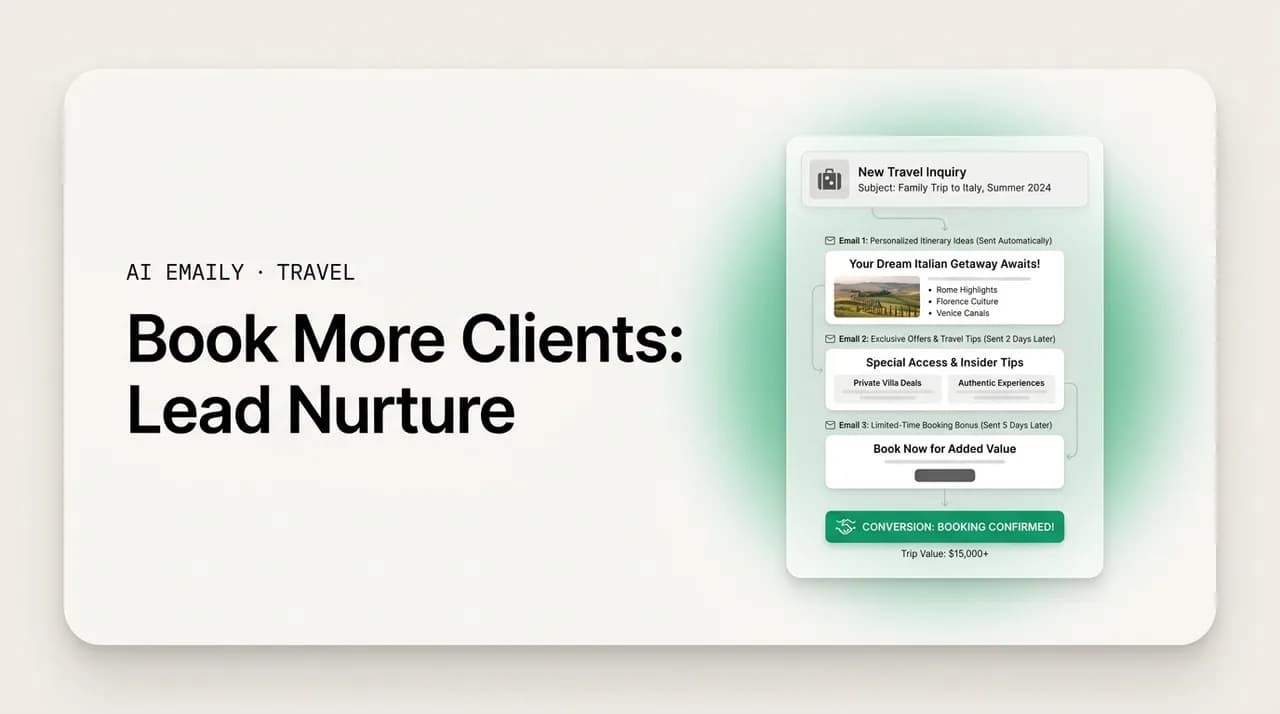
If you want to know how to get more clients as a travel advisor, the answer is rarely more leads — it is nurturing the ones you already have. Most inquiries do not convert because the advisor is busy designing a trip when a new prospect emails, the first reply comes hours or days late, and there is no system to follow up after that. Build a five-stage nurture flow: a fast first reply, value-add touches while the prospect decides, a nudge to book the consult, disciplined quote follow-up, and a past-client repeat-and-referral loop. Use templates so you are never writing from scratch, and let an AI email client draft each stage in your voice and follow up on schedule so warm leads stop leaking while you are heads-down on someone else's itinerary.
To get more clients as a travel advisor, fix the follow-up: why inquiries stall, the booking funnel, a five-stage nurture system, and copy-paste templates.
On this page
- 01Why do travel advisors lose bookings they should have won?
- 02What does the travel advisor booking funnel actually look like?
- 03Why don't travel inquiries convert into bookings?
- 04How do you build a lead nurture system that converts?
- 05Stage one: the fast first reply
- 06Stage two: value-add touches that keep leads warm
- 07Stage three: nudging the consult
- 08Stage four: quote and proposal follow-up
- 09Stage five: the repeat and referral loop
- 10How do you keep the whole nurture system running when you're busy?
- 11How does AI Emaily help travel advisors nurture leads?
- 12Putting the nurture system together
Why do travel advisors lose bookings they should have won?#
Here is the uncomfortable truth about how to get more clients as a travel advisor: most of the clients you are missing already raised their hand. They filled out your inquiry form, replied to your Instagram post, or got your name from a friend and sent a hopeful email asking whether you could help plan their anniversary trip to Italy. They were interested. And then, somewhere between that first message and a signed trip, they quietly disappeared. Not because your itineraries are bad or your prices are wrong, but because nobody followed up with them at the right moment, in the right way, while they were still warm.
This is the single most expensive problem in an independent travel practice, and it is almost invisible, because a lead that leaks does not send you an angry email. It just goes silent. You assume they booked elsewhere, or decided to stay home, or were never serious. Sometimes that is true. But far more often, the prospect stayed interested for a week or two, waited for you to reply or follow up, heard nothing, and drifted to whoever answered first or stayed in touch. You never find out, so the problem never surfaces on your radar. It only shows up in the number that matters: fewer trips booked than the number of people who asked.
The maddening part is that you are not losing these bookings because you are bad at your job. You are losing them because you are good at it. You are deep in a client's Amalfi Coast itinerary, on hold with a cruise line, or three tabs deep comparing villa rates, and in that window a new inquiry lands and sits. By the time you surface, the fast, curious energy that prompted the email has cooled. You reply anyway, warmly and thoroughly, and hear nothing back. The trip you would have designed beautifully never became yours to design.
Speed and persistence are not soft skills here; they are the mechanics of conversion. Research on online sales leads is blunt about how fast the window closes: firms that tried to contact a prospect within an hour of an inquiry were far more likely to have a meaningful conversation than those that waited even a couple of hours, and the odds fall off a cliff after that. Travel inquiries behave the same way. A prospect dreaming about a honeymoon at 9 p.m. is in a very different state of mind than the same prospect three days later when the excitement has faded and two other advisors have already replied.
And it is not just the first reply. Most bookings are not won on the first email; they are won on the third, fourth, or fifth touch, long after most advisors have quietly given up. Sales research consistently finds that the majority of deals require multiple follow-ups to close, yet a large share of sellers stop after one or two attempts. If you reply once and wait, you are competing only for the small fraction of prospects who were ready to commit that day. Everyone else — the browsers, the comparison shoppers, the not-quite-ready-but-genuinely-interested — needs nurture, and nurture is exactly the thing a busy solo advisor has no time to do by hand.
This guide is about closing that gap. Not by chasing more leads or spending more on ads, but by building a lightweight email nurture system that keeps every inquiry warm from the first reply to the booked trip, and keeps past clients coming back. We will walk the advisor booking funnel stage by stage, give you copy-paste templates for each, and show, honestly, where an AI email client can carry the parts you keep dropping.
Nurture is not spam
What does the travel advisor booking funnel actually look like?#
Before you can fix the leaks, you need to see the pipe. Every trip you book, whether it is a quick cruise or a three-week bespoke safari, travels through the same five stages. Naming them matters, because at each stage a different message is due, and a lead that stalls at one stage needs a different nudge than a lead stalled at another. Most advisors carry this funnel loosely in their head and lose track the moment they get busy. Writing it down turns a vague feeling of "I should follow up with some people" into a concrete, workable list.
The five stages run in order, and a prospect can stall, and leak, at any one of them:
- 1
Inquiry
Someone reaches out — a form fill, a referral email, a DM that moves to email. This is the hottest they will ever be. The clock starts now, and the first reply is the highest-leverage message in the entire funnel. Leak here and you never even got in the game.
- 2
Consult
You get them on a call or a detailed intake to understand the trip, the budget, the travelers, and the dreams behind it. The goal of the inquiry reply is to book this consult. Many advisors skip straight to quoting and lose the relationship and the fee-worthy value they could have shown here.
- 3
Quote / proposal
You design and send the itinerary and pricing. This is where excited prospects go quiet, because they are comparing, checking with a partner, or simply overwhelmed. A quote with no follow-up is a coin flip; a quote with disciplined follow-up is a booking in progress.
- 4
Book
They say yes, pay the deposit, and the trip is real. The nurture job here is momentum — making it effortless to commit while the enthusiasm is high, and confirming quickly so buyer's remorse never gets a foothold.
- 5
Repeat / referral
The trip happens, they come home glowing, and this is the most under-worked stage of all. A client who just had a great trip is your warmest possible future lead and your best source of referrals — but only if you stay in touch instead of vanishing until you happen to email a newsletter.
Notice where the money leaks. The inquiry-to-consult jump is a speed problem: a slow or missing first reply, and the prospect is gone. The quote-to-book jump is a persistence problem: the proposal lands, the advisor moves on to the next fire, and the follow-up that would have closed it never gets sent. And the repeat/referral stage is a memory problem: the relationship simply goes cold because nobody is minding it. Each leak has a different cause, which means each needs a different fix — and all three fixes are email.
The data backs up why this matters for a solo practice specifically. Independent advisors who work home-based as their own bottleneck — no assistant, no support desk — feel every one of these leaks personally, because they are the one who was supposed to send the reply, the follow-up, and the check-in, and they were busy. Agencies that put a real system behind their client communication respond faster and convert more; the ones running on memory and good intentions convert whatever happens to fall through when they are not underwater. The system is the difference, and the good news is a system is buildable.
Map your own funnel first
Why don't travel inquiries convert into bookings?#
It is worth sitting with the specific reasons inquiries fail to convert, because each one points to a fixable habit. When you name the failure modes, the nurture system stops being abstract advice and becomes a checklist of leaks to plug. Almost every lost booking in a solo travel practice traces back to one or more of these.
- The first reply came too late. The prospect emailed at the peak of their enthusiasm, you were mid-itinerary for someone else, and by the time you answered — hours or a day later — they had cooled off or already heard back from a faster advisor. Speed is not politeness here; it is the whole game.
- It was one-and-done. You sent a thoughtful reply, got no response, and assumed disinterest. In reality the prospect got busy, got distracted, or was waiting on a partner, and simply needed one more nudge you never sent. Most bookings need several touches; one is rarely enough.
- You quoted before you connected. Jumping straight to a price for a trip you barely understand turns a relationship into a transaction, and a transaction competes only on cost. A consult first lets you sell your expertise, justify a planning fee, and design something they cannot easily price-shop.
- The quote went out and then silence. Sending a proposal and waiting is the single most common way advisors lose deals that were almost closed. The prospect is comparing, hesitating, or overwhelmed, and your silence reads as indifference right when a gentle check-in would have carried them over the line.
- The excitement wasn't maintained. A trip is an emotional purchase. If weeks of silence pass between touches, the daydream fades and the trip slides from "let's do this" to "maybe next year." Small, warm, value-add touches keep the dream alive while logistics catch up.
- Past clients were forgotten. The easiest booking you will ever make is the second trip for someone who loved the first one — and it is the one advisors neglect most, because the relationship goes quiet the moment the trip ends. No check-in, no anniversary note, no "where to next?" means a warm client becomes a stranger.
- There was no system, only memory. When follow-up depends on the advisor remembering to follow up, follow-up loses every time to the urgent work in front of them. Leads do not leak because advisors do not care; they leak because caring is not a schedule.
Read that list again and notice the through-line: none of these failures is about being bad at travel. Every single one is about email not going out at the right moment. The advisor who wins the booking is not necessarily the one with the best villa connections; frequently it is simply the one who replied first and stayed in touch. That is genuinely good news, because email timing and persistence are systematizable in a way that raw talent is not. You cannot clone your taste in hotels, but you can absolutely build a machine that never forgets to follow up.
How do you build a lead nurture system that converts?#
A nurture system sounds elaborate, but for a solo travel advisor it is really just five reliable habits, one for each stage of the funnel, each anchored to a template so you never write from a blank page. The point is not to automate warmth out of your business; it is to make sure the warm, personal touch you are already good at actually reaches the prospect at the moment it matters, instead of getting stuck behind whatever fire you are fighting. Here is the system, stage by stage.
The table below is the whole thing at a glance — the five nurture stages, when each fires, what it does, and the mindset behind it. Keep it somewhere you can see it; it is the skeleton everything else in this guide hangs on.
| Nurture stage | When it fires | What it does | The goal |
|---|---|---|---|
| Fast first reply | Within minutes to an hour of the inquiry | Acknowledges the prospect instantly, shows you are engaged, asks one or two smart questions. | Win the speed race; get the conversation going before the excitement fades. |
| Value-add touches | Every few days while the prospect decides | Sends something genuinely useful — a destination tip, a timing insight, a relevant idea — with no pressure. | Keep the dream alive and stay top of mind without nagging. |
| Consult booking nudge | After the first reply, if no consult is scheduled | Makes it effortless to grab time with you and reframes the call as valuable, not a sales pitch. | Move the lead from inquiry to a real conversation where you can sell your expertise. |
| Quote follow-up | A day, then a few days, then a week after the proposal | Gently checks in, answers unspoken objections, and offers to adjust — without discounting reflexively. | Close the deals that were almost yours; convert the silent 'maybe' into a booked trip. |
| Repeat / referral loop | Post-trip: welcome-home, then periodic check-ins | Welcomes them home, invites a review, plants the next trip, and makes referring easy. | Turn one great trip into a lifetime of repeat bookings and warm introductions. |
Stage one: the fast first reply#
The first reply is where most bookings are won or lost, and it is worth being almost fanatical about speed. A prospect who gets a warm, human acknowledgment within minutes of hitting send experiences something rare and reassuring: the sense that a real person is paying attention to their trip. That feeling is worth more than any polished proposal you could send three days later, because it arrives while the excitement is still hot and before anyone else has replied.
The mistake advisors make is treating the first reply as the place to answer everything. You do not need to. The job of the first reply is not to solve the trip; it is to open the relationship, show you are engaged, and move toward a consult. A short, fast, warm note that asks one or two smart questions beats a comprehensive essay that took you a day to compose. Speed and warmth first; depth comes at the consult.
Notice what that reply does in four short sentences: it thanks them, it shows genuine enthusiasm for their specific trip, it asks a small number of questions that move things forward, and it offers a consult with a real booking link. It does not quote, it does not overwhelm, and crucially it could be sent within minutes. The speed is the feature. If you can reliably send something like this fast — even when you are buried in another client's itinerary — you have already solved the biggest single leak in the funnel.
The hard part, of course, is the "reliably, fast, even when you are buried" bit. That is precisely the point where a human bottleneck breaks down and where an AI email client earns its place, which we will get to. For now, the principle stands: a fast, warm, question-led first reply that points at a consult is the foundation everything else is built on.
Stage two: value-add touches that keep leads warm#
Between the first reply and the booked trip, there is a stretch of time — sometimes days, sometimes weeks — where the prospect is deciding, comparing, checking with a partner, or simply living their busy life. Most advisors go silent during this stretch, either out of politeness ("I don't want to pester them") or simply because they forgot. Silence is the enemy. Every day of silence, the daydream cools a little and a competitor's email has a chance to land.
The antidote is the value-add touch: a short, genuinely helpful message that keeps you top of mind without asking for anything. The key word is value. This is not "just following up" for the third time, which reads as needy. It is you being useful — sharing a timing insight, a destination tip, a relevant idea sparked by what they told you. Each touch says, quietly, "I am thinking about your trip and I know my stuff," and that is exactly the impression that wins bookings.
The discipline with value-add touches is spacing and restraint. Every few days is a reasonable rhythm while a prospect is actively deciding; daily is too much and monthly is too cold. And every touch should carry something the prospect can actually use, even if they never book — a tip, an idea, a helpful nudge on timing. If you find yourself writing "just checking in!" with nothing attached, stop and add the value first. Two or three good value touches will keep a warm lead warm far longer than five empty check-ins ever could, and they position you as the expert who was worth waiting for.
Build a small library of value touches
Stage three: nudging the consult#
The consult — a call or a thorough intake — is where you stop being a search result and start being their advisor. It is where you understand the real trip behind the request, demonstrate expertise that justifies a planning fee, and build the relationship that makes price a secondary consideration. Skipping it and jumping straight to a quote is one of the most expensive habits in the business, because it reduces you to a price on a screen that anyone can undercut.
So the nurture goal after the first reply is simple: get the consult booked. If a prospect has not grabbed time with you, a gentle, well-framed nudge is due — one that reframes the call not as a sales pitch they need to brace for, but as the genuinely valuable, no-pressure planning conversation it actually is. Make it effortless: one click, a real calendar link, and a clear sense of what they will get out of it.
The framing matters as much as the ask. "Hop on a sales call" makes people flinch; "a quick call to shape your trip, and you'll leave with a clearer direction either way" makes people say yes, because you have promised value even if they do not book. Lower the friction — a real one-click link, not "let me know what works" — and lower the stakes, and the consult rate climbs. And if they still do not book after the nudge, that is not a dead end; it is a signal to drop back to a value-add touch and try again in a few days. Persistence, not pressure.
Stage four: quote and proposal follow-up#
This is the stage where the most money leaks, and it leaks for the most avoidable reason: the advisor sends a beautiful proposal and then goes silent. Understand what is happening on the other end. Your prospect is excited, but also comparing, also checking with a partner, also a little overwhelmed by a big emotional purchase, and also busy. Your silence, which you intend as politeness, reads to them as indifference — right at the moment a warm, confident check-in would tip them over the line.
A quote follow-up sequence is the highest-ROI habit you can build, because these are your warmest, most-qualified leads. They asked, you consulted, you proposed — they are inches from booking. A simple cadence works: a check-in the day after the proposal lands, a gentle nudge a few days later, and a final warm touch about a week out. Each one should do something useful — answer a likely unspoken objection, offer to adjust an element, or simply reaffirm your enthusiasm — rather than just repeating "any thoughts?"
The instinct many advisors have at this stage is to discount at the first sign of hesitation. Resist it. Silence after a quote rarely means "too expensive"; more often it means "life got busy" or "I need one small reassurance." Lead with service and flexibility — "tell me what would make this perfect" — not with a price cut, and you will close more deals at full value. Save any concession for when a genuine budget objection is actually voiced, not as a reflex to fill silence.
And know when to stop gracefully. After three or four thoughtful follow-ups with no response, a final warm note — "I'll leave this with you; whenever the timing is right, I would love to help" — closes the loop with class and often, surprisingly, prompts the reply that leads to a booking. It also keeps the door open for the value-add and repeat loops later. Persistent is not pushy; pushy is five identical "just checking in" emails, and persistent is four genuinely helpful ones that respect the prospect's pace.
Stage five: the repeat and referral loop#
If the quote stage is where advisors leak the most money, the post-trip stage is where they leave the most on the table, because a client who just had a great trip is the single warmest lead you will ever have, and most advisors go completely quiet the moment the trip ends. That is a tragedy of the funnel. The hard, expensive work of earning trust is already done. A repeat booking or a warm referral is a fraction of the effort of winning a cold inquiry, and it is sitting right there in your past-client list, cooling off through neglect.
The repeat and referral loop is a small set of touches that keeps the relationship alive after the trip. It starts the day they get home, while the glow is brightest, and continues at a gentle rhythm — a check-in, an anniversary note, a "where to next?" as the seasons turn. Each one reminds them, warmly and without pressure, that you are their travel person and that the next adventure is a single reply away.
Notice that the welcome-home touch does three jobs gently: it deepens the relationship, it invites a review (your best marketing asset), and it plants the seed of the next trip. None of it feels like selling, because it is genuine care with a light commercial thread. That is the tone the whole repeat loop should carry — you are their trusted travel person checking in, not a business chasing another sale.
The referral ask deserves its own small touch, sent when the goodwill is high — usually a week or two after the welcome-home note, once they have raved to you about the trip. Keep it warm and specific: "If any friends mention wanting a trip like yours, I would be honored if you passed my name along — I always take great care of the people you send me." A happy client is usually delighted to refer; they just need the invitation and an easy way to do it. And a light, periodic check-in a few times a year — an anniversary note, a seasonal idea — keeps you top of mind so that when the next trip stirs, you are the obvious first email, not an afterthought they have to dig up.
The repeat loop compounds
How do you keep the whole nurture system running when you're busy?#
By now the objection has probably formed in your mind, and it is a fair one: this all sounds great, but who has the time? A fast first reply to every inquiry, value-add touches every few days, consult nudges, a three-touch quote follow-up, and a post-trip loop for every past client — for a solo advisor already stretched thin between designing trips and actually selling, that is a second full-time job of email. And that is exactly why nurture, for all its obvious value, so rarely happens. The system is simple; running it by hand, reliably, while you are underwater is not.
There are three honest ways to close that gap. The first is discipline and templates alone — batching your follow-ups, keeping a swipe file, blocking calendar time for nurture. This helps, but it still depends on you remembering and finding the time, which is the exact thing that breaks when you get busy. The second is to hire help, which few solo advisors can justify for what is essentially timely email. The third is to let software carry the repetitive, timing-sensitive parts of the system so that the warmth still reaches the prospect even when you are on hold with a cruise line. That third option is where an AI email client changes the math.
How does AI Emaily help travel advisors nurture leads?#
AI Emaily is an AI-native email client — it connects to your existing Gmail, Outlook, iCloud, Fastmail, Proton, or any IMAP inbox, so there is no new platform to move your clients into and no CRM migration. It works in the inbox you already run your business from. What it adds is an assistant that handles the timing-sensitive, repetitive email work of nurture that keeps slipping when you are busy — drafting each stage in your voice, and following up so warm leads stop leaking. Here is how that maps onto the five-stage system above, honestly, including where you should keep your hands on the wheel.
Start with the fast first reply, the highest-leverage message in the funnel and the one speed matters most for. When an inquiry lands, AI Emaily can draft a warm, question-led first reply in your voice within moments — the four-sentence, consult-pointing note from Stage one — so a prospect who emailed at 9 p.m. is not waiting until tomorrow afternoon while you are mid-itinerary for someone else. Because it learns how you actually write, the draft sounds like you, not like generic auto-reply boilerplate. You are winning the speed race without having to drop the client in front of you.
The staged touches — value-add messages, the consult nudge, the quote follow-up sequence, the post-trip loop — are exactly the kind of never-drop follow-up that human memory loses to urgent work. AI Emaily can keep track of where each prospect sits in the funnel and surface (or draft) the next touch when it is due: the value tip while they are deciding, the gentle consult nudge, the day-after-quote check-in, the welcome-home note the day they return. The system stops depending on you remembering to follow up, which is precisely the point of failure, and starts running on schedule, in your voice, drawing on the value-touch library you build over time.
Crucially, you decide how much control to hand over, because not every nurture message deserves the same level of autonomy. AI Emaily works in three modes. In Manual, you write and it assists. In Copilot, it drafts every message and waits for your review and approval before anything sends — the right default for anything client-facing and relationship-shaped, like a consult nudge or a nuanced quote follow-up, where you want your eyes on it first. In Autopilot, you can let genuinely routine, templated touches go out on their own — the kind of message that is safe to automate with light voice-matching — while everything sensitive still routes to you. Every action, in every mode, comes with undo and a full audit trail, so you always know exactly what went out and can pull anything back.
Match the mode to the message
The honest framing is this: AI Emaily does not replace the judgment, taste, and relationships that make you a great advisor — those are the parts clients pay for, and they should stay yours. What it replaces is the failure mode where a warm lead leaks because the follow-up that would have closed it never got sent while you were busy being a great advisor to someone else. It is the same idea behind the rest of the product, which acts as an autonomous chief of staff for your inbox — drafting, triaging, and handling the busywork so you spend less time managing email and more time designing trips and selling them. You can try it free at app.aiemaily.com/signup, with a Free plan at no cost and Pro at $12.42 per month on the annual plan.
Putting the nurture system together#
So, how to get more clients as a travel advisor? Not usually by finding more leads — by stopping the ones you already have from leaking. The inquiries are coming; the bookings are being lost between the stages, when a fast reply does not go out, when a warm lead cools in silence, when a quote sits without a follow-up, when a happy past client is quietly forgotten. Every one of those leaks is an email that did not get sent at the right moment, which means every one of them is fixable.
The fix is the five-stage system: a fast, warm first reply that points at a consult; value-add touches that keep the dream alive while the prospect decides; a friendly nudge to book the call where you sell your expertise; a disciplined, non-discounting quote follow-up that closes the almost-booked; and a post-trip repeat-and-referral loop that turns one great trip into a lifetime of them. Anchor each stage to a template so you are never writing from scratch, map your own funnel to find your biggest leak first, and lead every touch with genuine value rather than empty check-ins.
And where the system breaks — the part where a solo advisor cannot possibly run all of that reliably by hand while also designing trips — let your email client carry it. Fast first replies in your voice, never-drop follow-ups on schedule, Copilot approval where relationships are on the line and Autopilot where the work is routine, always with undo and audit. Do that, and the number that has quietly been costing you — inquiries in, far fewer trips out — finally starts to close. The clients were always there. Now you stop losing them.
Frequently asked
See it in AI Emaily
Keep reading
Sources

Written by
Nafiul HasanNafiul Hasan is an entrepreneur and AI automation system builder with 10+ years of experience turning messy, manual workflows into reliable automated systems. He designs and ships AI enterprise solutions end-to-end — the agent logic, the data plumbing, and the product people actually use — and founded AI Emaily to give busy professionals their attention back. He writes here from the builder's seat: what works, what breaks, and how to put AI to work without giving up control.