How to Respond to Travel Inquiries Faster (and Book More Trips)

The short answer
To respond to travel inquiries faster, split every reply into two moves: an instant acknowledgment within minutes that captures the lead and buys you time, then a personal, priced reply once you have designed. Time-sensitive cabins and promos reward speed, and advisors using a CRM respond about 33% faster and convert roughly 25% more leads.
How to respond to travel inquiries faster as a solo advisor: why speed wins the booking, why designing trips makes you slow, and a fast-response system with instant-ack and personal reply templates.
On this page
- 01Why does responding to travel inquiries faster win the booking?
- 02Why are solo travel advisors so slow to respond?
- 03What is the fast-response system for travel inquiries?
- 04What is the difference between an instant acknowledgment and a personal reply?
- 05What should an instant acknowledgment email say?
- 06How should you write the personal, priced reply?
- 07How does a follow-up cadence recover lost bookings?
- 08How does AI Emaily help you respond to travel inquiries faster?
- 09Putting it all together
Why does responding to travel inquiries faster win the booking?#
When you learn to respond to travel inquiries faster, you are not just being polite. You are changing the math on how many of those inquiries turn into booked trips. A travel inquiry is a perishable thing. The person on the other end is excited, a little impatient, and almost never talking only to you. They have filled out a form on your site, replied to a post, or been referred by a friend, and in the same sitting they have very likely emailed two or three other advisors, opened a couple of cruise-line sites, and started pricing the trip themselves. The window in which you are the obvious choice is measured in hours, sometimes minutes, not days.
Two forces make speed matter more in travel than in almost any other service business. The first is inventory. Cabins on a popular sailing, award space, a promotional fare, a group block, a suite category at a resort during peak season, these are finite and they move. A price you quote on Monday can be gone by Wednesday. When a client asks about a specific sailing or a limited-time promotion, the honest answer has a shelf life, and every hour you wait is an hour that answer can expire. Responding quickly is not a nicety here; it is the only way to hold the thing the client actually wants.
The second force is comparison shopping. Modern travelers price-check everything. They can see a headline fare on a cruise-line site or an OTA in seconds, and if your reply lands a day later than a competitor's, you are arguing against a number they already have in their head and a relationship a competitor has already started building. The advisor who replies first gets to frame the trip, set the expectations, and become the person the client trusts to sort it all out. Everyone who replies later is playing catch-up against that framing.
There is hard evidence that speed converts. Research on sales leads has repeatedly found that the odds of qualifying a lead drop sharply the longer you wait to respond, with a well-known study finding companies that contacted a lead within an hour were many times more likely to have a meaningful conversation than those who waited even a few hours. In travel specifically, agencies using a proper CRM to manage and respond to inquiries have been reported to respond about 33% faster and convert roughly 25% more of their leads. Faster replies are not a vanity metric. They are, quite directly, more booked trips.
It helps to picture the inquiry from the client's side. Someone has decided they want a trip, which is an emotional decision as much as a financial one. They have taken the small, vulnerable step of reaching out to a professional. In the hour after they hit send, they are in the most receptive state they will ever be: motivated, curious, and open to being guided. That is the moment to arrive. Wait two days and the mood has cooled, the doubts have crept in, the spouse has floated a cheaper idea, and a competitor may already have a quote in the inbox. The trip has not gone away, but your odds on it have.
None of this means you must send a full, priced itinerary in ten minutes. That is neither possible nor wise, and we will spend most of this guide showing why the fast reply and the good reply are two different jobs. What it means is that silence is the enemy. The single most valuable thing you can do with a fresh inquiry is prove, quickly, that a real person has it and is on it. Everything else, the pricing, the options, the beautiful itinerary, can follow at the pace good work actually takes.
Speed is a promise, not a quote
Why are solo travel advisors so slow to respond?#
If speed wins, the obvious question is why so many good advisors are slow. The answer is not laziness or a lack of care. It is the structure of the job. Most independent travel advisors are a one-person business. Surveys of the profession consistently find that the large majority work home-based as independent contractors, without an assistant, a receptionist, or a support desk to catch inquiries while they are busy. When an inquiry lands, the same person who has to answer it is also the person designing three other trips, chasing a supplier, and picking up their kid from school.
The deeper problem is that the work that makes you slow is also the work that makes you good. Designing a trip is deep, focused work. Comparing cabin categories, checking availability, pricing options, building a day-by-day itinerary, coordinating a group, these tasks require an uninterrupted hour or two of concentration. And you cannot do that focused work and monitor your inbox at the same time. So the advisor faces a genuine dilemma every single day: stay heads-down and design the trip in front of you well, or break concentration every few minutes to triage inbox and answer new leads fast. Do the first and new inquiries sit for hours. Do the second and your actual trip design turns into a scattered, error-prone mess.
This is the core tension the CRM statistic quietly points at. When advisors adopt a system that responds to and organizes inquiries for them, they respond about 33% faster and convert about 25% more, not because they suddenly care more, but because the system absorbs the triage so the human does not have to choose between designing and answering. Without that, the solo advisor is structurally forced to be slow at exactly the moments speed matters most.
A few specific patterns make solo advisors slower than they realize, and it is worth naming them because each one has a fix later in this guide.
- The design black hole. You sit down to build an itinerary and disappear for two hours. It is the right thing to do for the client in front of you, but three new inquiries land in that window and get nothing, not even an acknowledgment.
- The blank-page tax. Every inquiry feels like it deserves a thoughtful, custom reply, so you wait until you have the time and energy to write one from scratch. That bar is so high that the reply keeps getting pushed to "later," and later becomes tomorrow.
- The research-before-reply trap. You believe you cannot answer until you have checked availability and priced options, so the whole reply waits on research you have not had time to do. Meanwhile a two-line acknowledgment would have held the lead perfectly.
- The context-switch tax. Selling, designing, servicing existing bookings, and marketing all live in the same inbox and the same brain. Every new inquiry competes with all of it, and the newest thing rarely wins against the thing with a deadline attached.
- No triage, no priority. Without a system, a hot, ready-to-book cruise inquiry and a vague "maybe someday we'll do Europe" note look identical in the inbox. The urgent one waits behind the tire-kicker because nothing is sorting them.
- Evenings and weekends. Leisure travelers dream and inquire at night and on Sundays, exactly when the solo advisor is off the clock. By Monday morning the Saturday-night inquiry is 36 hours cold and has probably heard back from someone else.
Notice that none of these are character flaws. They are the predictable result of one person trying to do sales, operations, and delivery at once with a single inbox and no help. The fix is not to try harder or feel guiltier about slow replies. It is to build a system that separates the fast job from the slow job, so the fast job can happen instantly and the slow job can happen well. That is what the rest of this guide is about.
The solo advisor's real bottleneck
What is the fast-response system for travel inquiries?#
The whole game is to separate acknowledgment from answer. The acknowledgment is fast, light, and can happen in minutes; the answer is deep, priced, and happens at the pace of good work. Once you stop trying to do both in a single email, the pressure evaporates and your response times collapse. Here is the system, step by step. It works whether you handle it manually, with templates, or with an AI email client doing the fast half for you.
- 1
Acknowledge within minutes, every time
The instant an inquiry lands, the sender gets a warm, human note confirming a real advisor has it, roughly when a full reply will come, and one small question that moves things forward. This is the single highest-leverage habit in the whole system. It converts a silent form-fill into a started relationship and buys you the hours you need to actually design.
- 2
Triage by heat and urgency
Sort new inquiries into hot (specific dates, a named sailing or resort, ready to book), warm (real interest, flexible timing), and cool (dreaming, no dates). A hot inquiry about a time-sensitive cabin or promo jumps the queue; a "someday" note can wait for a batch. Without this sort, everything feels equally urgent, which means nothing gets prioritized.
- 3
Capture the details you'll need before you research
Your acknowledgment should quietly gather the inputs that unblock the real reply: travel dates and flexibility, number and ages of travelers, budget range, must-haves, and how they like to travel. The more of this you collect up front, the less back-and-forth later and the faster your priced reply lands.
- 4
Protect a design block, then reply for real
Batch your deep work. Once or twice a day, sit down and build the actual priced options for the hot inquiries, uninterrupted, because the acknowledgments have already bought you that focus. This is where trip design belongs, and it is far better done in a protected block than in scattered two-minute bursts between notifications.
- 5
Send the personal, priced reply
Now the good email goes out: two or three curated options, honest pricing, a clear recommendation, and a single next step. Because you acknowledged fast and gathered details early, this reply is faster to write and better targeted than a cold-start proposal would have been.
- 6
Follow up on a schedule, not on a whim
Most bookings need a nudge. Set a simple cadence, for example a follow-up two days after the quote, another four or five days later, then a gentle check-in a week after that, and stop. A structured travel inquiry follow up recovers a large share of leads that would otherwise ghost, and it removes the guilt-driven "should I email them again?" guessing.
- 7
Close the loop and record what happened
When a trip books, when a lead goes cold, or when a promo they wanted expires, note it. Over time this turns your inbox into a picture of what converts, which inquiries deserve your fastest reply, and which sources send you tire-kickers, so you can spend your speed where it pays.
The mindset shift underneath all of this is simple: your job on a fresh inquiry is not to answer it, it is to secure it. The answer can take a day. The securing has to take minutes. Once you internalize that, the impossible standard of "respond to every lead instantly with a full quote" dissolves into two achievable jobs, one of which a good system can do for you entirely.
Two speeds, not one
What is the difference between an instant acknowledgment and a personal reply?#
This distinction is the heart of responding faster, so it is worth being precise about it. An instant acknowledgment and a personal reply are two different emails doing two different jobs, and the mistake most advisors make is trying to fuse them into one.
The instant acknowledgment is short, warm, and sent within minutes. Its job is emotional and logistical, not commercial. It tells the client a real person has their inquiry, sets an honest expectation for when the real reply will come, and asks one or two questions that will unblock your research. It does not quote prices, it does not commit to availability, and it does not pretend to be the full answer. It is the equivalent of a good host saying "welcome, I've got you, give me a moment" at the door. Crucially, it can be sent the instant the inquiry arrives, at 11 p.m. on a Sunday, while you are asleep, because it is safe, templated, and light. This is exactly the kind of message an AI email client can send on your behalf without risk.
The personal reply is the real work: two or three curated options, honest pricing, a recommendation, and a clear next step, written in your voice with judgment only you can supply. It takes as long as good trip design takes, and it should. It is never safe to fully automate because it involves money, availability, and taste. But it is far easier and faster to write once the acknowledgment has already gathered dates, budget, and party size, and once you have a protected block to do it in.
The table below lays the two side by side so the division of labor is unmistakable. When you feel the pull to make one email do both jobs, come back to this.
| Instant acknowledgment | Personal reply | |
|---|---|---|
| Speed | Within minutes, 24/7 | Within a day, in a protected block |
| Job | Secure the lead, set expectations | Design and sell the trip |
| Contains | Warmth, a timeframe, 1–2 questions | Options, pricing, a recommendation, a next step |
| Tone | Reassuring, brief, human | Consultative, tailored, in your voice |
| Pricing | None | Honest, specific |
| Availability | Never committed | Checked and current |
| Safe to automate? | Yes, it is templated and low-risk | No, it needs your judgment and approval |
| What it prevents | Silence, the lead going cold | A generic, unconvincing quote |
The reason this split is so powerful is that it removes the excuse that keeps advisors slow. "I couldn't reply because I hadn't priced it yet" stops being true the moment you accept that the first reply was never supposed to have pricing. The acknowledgment has no dependency on research, so nothing blocks it, so it can always go out immediately. And because it goes out immediately, the personal reply is no longer racing a competitor; it is landing on a client who already knows you are on it and is willing to wait for something good.
One email, two jobs, is the trap
What should an instant acknowledgment email say?#
Because the acknowledgment is the part you will send most often and the part most worth getting right, here are templates you can adapt. Keep them short, keep them warm, and always end with a small question that moves the conversation forward. Swap in your own voice and details; the structure is what matters.
Start with the all-purpose acknowledgment that works for almost any leisure inquiry:
When the inquiry names a specific, time-sensitive thing, a sailing, a promotion, a resort during peak dates, the acknowledgment should signal urgency and set up a fast check on availability. This is where speed most directly protects the booking.
For a group or destination-wedding inquiry, where the coordination is heavier and the deadline is usually fixed, the acknowledgment should gather the group size early, because that single number changes everything about what you can offer.
For the vaguer, still-dreaming inquiry, the acknowledgment does double duty: it stays warm without over-committing your time, and it asks the one question that reveals whether this is a real trip or an idle daydream. That answer tells you how fast to move.
Always end with one question
How should you write the personal, priced reply?#
Once the acknowledgment has bought you time and gathered details, the personal reply is where you actually earn the booking. This one stays human, always. A few principles keep it fast to write and effective at converting.
Lead with a recommendation, not a menu. A client who receives eight options feels the work has been handed back to them; a client who receives your top pick plus one or two alternatives feels guided. Curate. Your judgment about what fits is the product they came for. Present two or three options at most, say clearly which one you'd choose and why, and make the next step a single, obvious action.
Be honest and specific about pricing. Vague quotes invite comparison shopping against the sharper number the client can find themselves. A clear, itemized price with your recommendation attached reframes the decision from "is this the cheapest?" to "is this the right trip, arranged by someone I trust?" That is a comparison you win.
Address the time-sensitivity plainly when it exists. If a fare or cabin is likely to move, say so, without manufacturing false urgency. "This promotional rate is scheduled to end Friday, and cabins in this category are limited" is honest, useful, and moves the client to decide while the thing they want still exists. This is the payoff for having replied fast in the first place: you can still offer the thing.
Here is a personal reply that puts those principles together. Notice it recommends, it prices honestly, it names one clear next step, and it flags real time-sensitivity without hype.
For the follow-up, keep it short, add a small piece of value or urgency, and never guilt the client for not replying. The goal is to make it easy to say yes, or easy to tell you it's a no, so the lead does not sit in limbo.
How does a follow-up cadence recover lost bookings?#
A great deal of the money left on the table in a travel practice is not lost at the inquiry stage; it is lost in the silence after the quote. The client got a good proposal, meant to reply, got busy, and the trip drifted. Research on sales leads has long shown that persistence in following up dramatically increases the odds of a conversation, yet most people give up after one or two attempts, far short of where the yield actually is. A structured travel inquiry follow up is how you recover those drifting bookings without becoming a pest.
The key is that the cadence is a schedule, not a mood. When following up depends on whether you happen to remember and feel bold enough that day, it does not happen consistently, and inconsistent follow-up is barely better than none. A fixed rhythm removes the emotional friction: you are not deciding whether to nudge, you are simply doing what the system says to do on day two, day six, and day twelve. It also keeps you from over-nudging, because the cadence has a defined end.
A simple, humane cadence for a travel quote looks like this: a first follow-up about two days after the quote, while the trip is still fresh in their mind; a second around five days out, ideally carrying a small new piece of value or a genuine availability update; a final gentle check-in about a week after that, which gives them an easy off-ramp to say "not now" so you can stop. Three touches, spread over a couple of weeks, then you let it rest. That cadence recovers a meaningful share of leads that a single quote-and-hope would have lost, and it does so without ever crossing into pushy.
Make the last follow-up an easy exit
How does AI Emaily help you respond to travel inquiries faster?#
Everything above is a manual system, and it works if you have the discipline to run it. The reason it so often breaks down is the one we started with: you are one person, and the fast job and the slow job fight for the same hour. This is exactly the gap an AI-native email client is built to close, and it is worth being honest about which parts it should handle and which parts should stay yours.
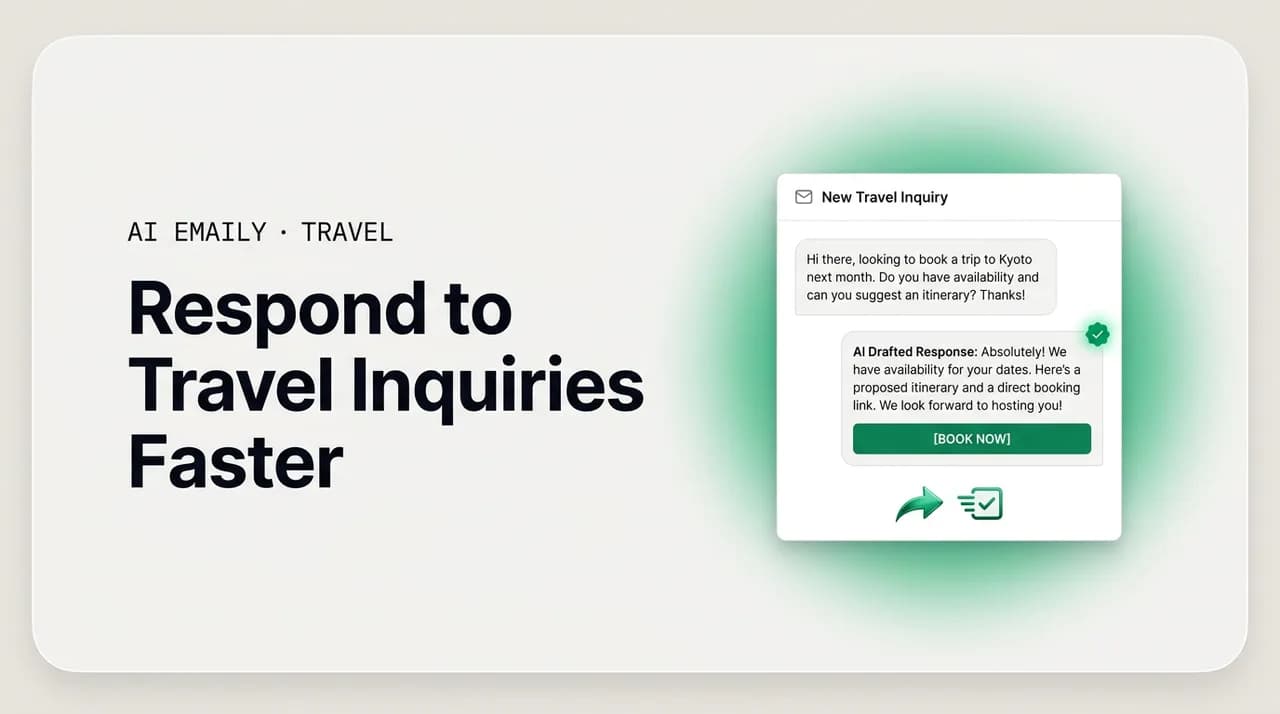
AI Emaily is an AI email client that connects to Gmail, Outlook, and any IMAP account and works like an autonomous chief of staff for your inbox. For travel inquiries, the highest-value thing it does is take over the instant acknowledgment entirely. The moment an inquiry lands, day or night, weekend or not, it can send a warm, on-brand acknowledgment in your voice that confirms a real advisor has it, sets the timeframe, and asks the right qualifying question, so a Sunday-night inquiry is greeted in minutes instead of going 36 hours cold. Because it learns how you actually write, that acknowledgment reads like you, not like a canned auto-reply.
It also does the triage and drafting that a solo advisor never has time for. It can sort new inquiries by heat, surface the hot, time-sensitive ones first, pull the dates, party size, and budget out of the client's message so they are ready when you sit down to design, and draft the follow-ups in your cadence so no quoted lead quietly drifts away. That turns your protected design block into pure design work, with the busywork already handled around it.
The part it deliberately does not take over is the part that should stay yours. The personal, priced reply, the one with real money, real availability, and your taste in it, is never something you want fired off automatically. AI Emaily is built for exactly this line. It runs in three modes: Manual, where nothing sends without you; Copilot, where it drafts and you approve every send before it goes; and Autopilot, where it can handle genuinely safe, repetitive messages on its own. Following the segment's autopilot angle, the safe automation for travel is the templated, low-risk layer, the instant acknowledgment, the deposit-due reminder, the pre-trip checklist, with light voice-matching, while the client-facing quotes and negotiations stay human-approved in Copilot. Every action comes with undo and a full audit trail, so you always see exactly what was sent and can pull it back.
The practical effect is the one the numbers point to. When a system absorbs the triage and the fast acknowledgments so you do not have to choose between designing and answering, you respond faster and convert more, the same shape as the roughly 33% faster response and 25% more conversions reported for CRM-using agencies, without the solo advisor having to be in two places at once. You keep the judgment, the relationships, and the pricing. The client stops waiting. You can try it free at app.aiemaily.com/signup, with a Free plan at no cost and Pro at $12.42 per month on the annual plan.
Fast where it's safe, human where it counts
Putting it all together#
If you take one idea from this guide, make it this: to respond to travel inquiries faster, stop trying to answer fast and start acknowledging fast. The booking is won or lost in the first hour, not because the client needs a full quote that quickly, but because they need proof that a real person has them before a competitor gives them that proof first. Time-sensitive cabins and promos raise the stakes, and comparison-shopping travelers punish silence, so the advisor who arrives first gets to frame the trip and keep it.
The system that makes this possible is a split. Acknowledge within minutes with a warm, templated note that asks one question and buys you time. Triage by heat so the hot, perishable inquiries jump the queue. Gather the details you need before you research, then do your trip design in a protected block instead of scattered between notifications. Send the personal, priced reply, recommending rather than listing, pricing honestly, and flagging real urgency without hype. Then follow up on a fixed cadence, not on a whim, so the leads that drift after a quote get recovered instead of lost.
You can run all of it by hand, and plenty of advisors do. But the reason the profession's own numbers reward a system, roughly 33% faster responses and 25% more conversions for advisors who adopt one, is that a solo advisor cannot design a trip and answer new leads in the same minute. Let a system take the fast, safe half, the acknowledgments, the triage, the reminders, in your voice and under your approval, and keep the craft, the pricing and the relationships, for yourself. The client stops waiting, and you book more of the trips that were already reaching out to you.
Frequently asked
See it in AI Emaily
Keep reading
Sources

Written by
Nafiul HasanNafiul Hasan is an entrepreneur and AI automation system builder with 10+ years of experience turning messy, manual workflows into reliable automated systems. He designs and ships AI enterprise solutions end-to-end — the agent logic, the data plumbing, and the product people actually use — and founded AI Emaily to give busy professionals their attention back. He writes here from the builder's seat: what works, what breaks, and how to put AI to work without giving up control.