Business Email Etiquette: The Complete Professional Guide for 2026

The short answer
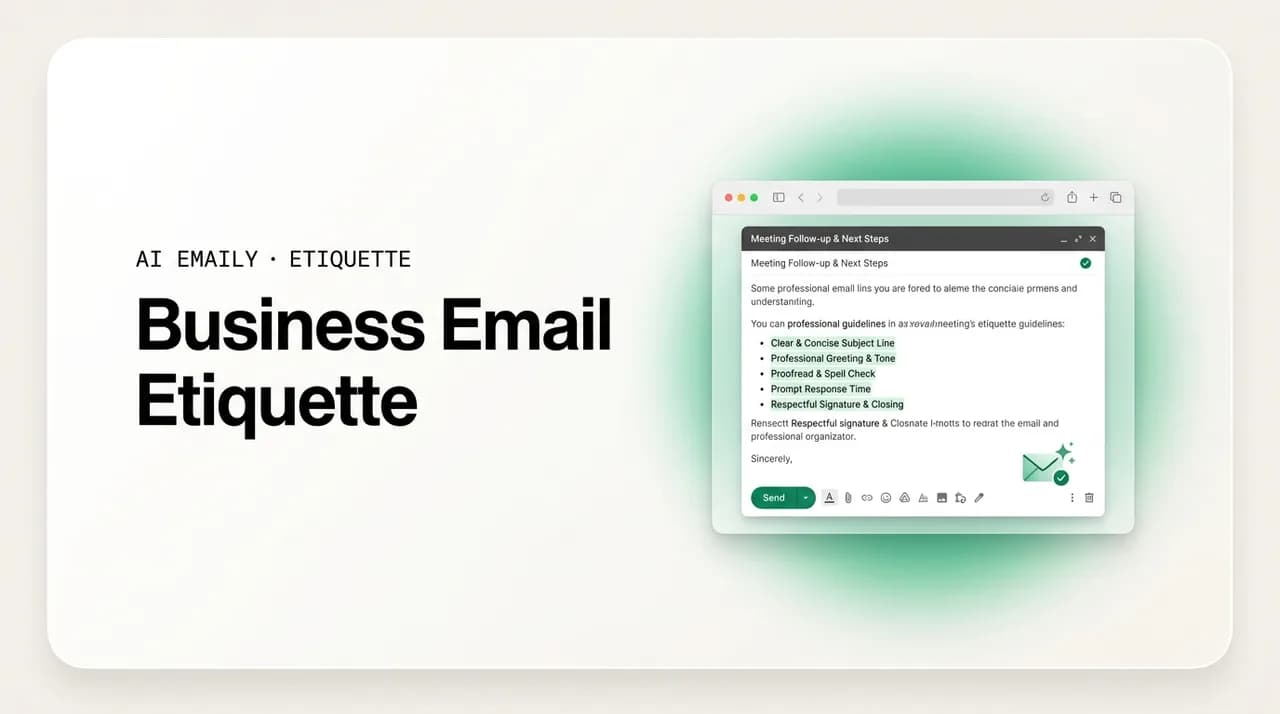
Business email etiquette is the set of norms that keep work email clear, respectful, and effective: a clean structure, tone matched to the relationship, replies inside one business day, tighter formality for seniors and external contacts, and cultural awareness on global teams. Get those right and your email reads as competent every time.
Business email etiquette for 2026: structure, tone by relationship, response-time norms, hierarchy, cultural rules, and the mistakes to avoid.
On this page
- 01Why does business email etiquette decide how people see you?
- 02What does a well-structured business email actually look like?
- 03Anatomy of a clean business email
- 04How do you match tone and formality to the relationship?
- 05Tone in practice: the same message at three registers
- 06How fast should you respond to a business email?
- 07How is internal email etiquette different from external?
- 08How does seniority and hierarchy change how you write?
- 09What changes when you email colleagues across cultures?
- 10What are the most common business email mistakes?
- 11A pre-send checklist for any business email
- 12How does AI Emaily keep your business email on-tone and on-time?
- 13What is the one habit that ties business email etiquette together?
Why does business email etiquette decide how people see you?#
Every business email you send is a small sample of your judgment. The reader cannot see your effort, your hours, or your intentions. They see a subject line, a greeting, a few paragraphs, and a sign-off. From that thin slice they decide, often in seconds, whether you are organized or scattered, considerate or careless, senior or junior. Business email etiquette is simply the practice of making that thin slice work in your favor on purpose, every time, instead of by luck.
This matters more in 2026 than it did a decade ago, not less. Most professionals now spend a meaningful share of every workday in their inbox, and the volume keeps climbing. The average knowledge worker sends and receives dozens of business emails a day, and each one competes for attention against everything else stacked in the recipient's inbox. An email that is hard to read, ambiguous about what it wants, or off in tone does not just fail; it costs the reader time and quietly lowers their estimate of you. Over months and years, those small impressions compound into your reputation.
The reassuring part is that good business email etiquette is learnable. It is not about personality, charm, or being a naturally gifted writer. It is a set of repeatable patterns: how you structure a message, how you calibrate tone to the person you are writing to, how fast you reply, how you behave inside the company versus outside it, how you handle people senior to you, and how you adjust for colleagues in other cultures. This guide walks through each of those patterns, with examples you can copy and adapt. Master them and your email will read as professional whether you are writing to a teammate, a director three levels up, or a client on the other side of the world.
It also pays to remember what email is competing with. The people you write to are not sitting idle waiting for your message. They are triaging a queue, switching between channels, and protecting whatever focus they have left. Research on knowledge work consistently shows that the cost of an interruption is not just the seconds it takes to read a message but the minutes it takes to get back into flow afterward. Every email you send is, in a small way, an interruption you are asking someone to absorb. Good etiquette is the discipline of making that interruption worth it: getting to the point, making the ask obvious, and respecting the reader enough that they are glad you wrote rather than mildly resentful that you did.
There is also a quieter, longer-term payoff. The people who write clean, considerate, well-timed email tend to be trusted with more, because email is one of the few things a manager or a client sees from you constantly. A polished deliverable lands once a quarter; your email lands several times a day. Over a year, the cumulative impression of hundreds of clear, on-time, appropriately-toned messages does more for how you are perceived than almost any single piece of work. That is why it is worth treating email not as an afterthought between the real work, but as a craft in its own right.
If you want the deeper principles behind every individual habit, our companion guide to email etiquette rules covers the full ruleset, our guide to professional email format breaks down the anatomy of a single message, and our piece on formal vs informal email helps you pick the right register. This guide focuses specifically on the business context: the workplace dynamics, the hierarchy, and the stakes that make work email its own discipline.
What does a well-structured business email actually look like?#
Before tone, hierarchy, or culture, there is structure. A business email has a predictable anatomy, and readers have been trained by years of inboxes to expect it. When your email follows that structure, the reader's eye knows exactly where to go and the message feels effortless. When it does not, even a smart message feels like work to read. Five parts do almost all of the heavy lifting: the subject line, the greeting, the body, the closing line, and the signature.
The subject line is the single most important line in any business email, because it is the only part many people read before deciding whether to open, reply now, or leave it for later. A strong business subject line is specific and front-loads the point. "Q3 budget approval needed by Friday" tells the reader the topic, the action, and the deadline in six words. "Quick question" or "Following up" tells them nothing and trains them to deprioritize you. Aim for roughly six to ten words, lead with the substance, and if there is a deadline or a clear ask, put it in the subject.
The greeting sets the tone for everything that follows. In 2026, "Hi [First Name]" is the safe default for the large majority of business email, warm without being casual, professional without being stiff. "Dear [Title] [Last Name]" is reserved for genuinely formal contexts: a first contact with a senior external party, a cover letter, a legal or HR matter. Skipping the greeting entirely reads as abrupt to many people, so even in a fast internal thread, a simple "Hi Sam" earns its place. We cover the full range in our guide to professional email greetings.
The body is where you make your point, and the rule is one email, one purpose. Lead with the most important sentence; do not bury the ask under three paragraphs of context. Keep paragraphs to three to five sentences, break multi-part requests into a short bulleted or numbered list, and make sure the reader can answer the question "what do you want me to do?" without re-reading. Most business emails should land under roughly 150 to 200 words. If yours is running longer, it is usually trying to be two emails or a document.
The closing line and sign-off seal the message. A short closing line that states the next step ("Happy to walk through this on a quick call if useful") is more effective than a generic "Thanks in advance." The sign-off should match the formality of your greeting: "Best" or "Thanks" for everyday business email, "Best regards" or "Kind regards" a step up, "Sincerely" for formal external messages. Our guide on how to end an email covers the full range. Finally, a clean signature block with your name, title, and the contact details a reader actually needs makes you easy to act on.
A word on the signature itself, since it is the part people set once and then forget. A business signature should give the reader the few facts they might need to act on your email and nothing more: your full name, your role, your company, and the one or two contact methods you actually want used. A signature that runs to eight lines of social links, legal boilerplate, and an inspirational quote does the opposite of what a signature should do; it adds visual noise to every message and buries the useful details. Keep it short, keep it consistent, and make sure it renders cleanly on a phone, where a growing share of your email is read. If your company mandates a legal footer, that is fine, but your personal signature above it should still be tight.
It is worth saying why this structure matters so much, because the reason is not aesthetic. Readers do not read business email; they scan it. The eye lands on the subject, jumps to the first line, hunts for the ask, and looks for the next step. A message that follows the expected anatomy lets that scan succeed in a couple of seconds. A message that does not, one where the ask is in the fourth paragraph, the subject is vague, and the next step is implied rather than stated, forces the reader to actually read, or worse, to write back asking what you meant. Structure is not about looking neat. It is about being scannable, because scannable is how email is actually consumed.
The 10-second skim test
Anatomy of a clean business email#
Notice what the example above does and does not do. The subject names the action and the deadline. The opening is one short line, not a paragraph of pleasantries. The ask is a single, specific question. The context explains the deadline without padding. The next step makes replying trivial: "approved" is a complete answer. The whole message is under sixty words and the reader can act on it from their phone in the hallway. That is the standard to aim for in everyday business email.
The same skeleton scales up for more formal or external messages: you add a touch more warmth in the greeting, a sentence of context where a stranger needs it, and a more measured sign-off. The bones do not change. Once this structure is automatic, you stop thinking about format and spend your attention on the thing that actually varies from message to message, which is tone.
How do you match tone and formality to the relationship?#
The most common reason a business email lands wrong is not bad grammar or a missing word. It is tone that does not match the relationship. The exact same sentence can read as friendly to a close colleague and presumptuous to a senior client. The skill is calibration: reading who you are writing to and dialing your formality up or down to fit. The reliable rule of thumb is that formality rises with three things: distance (how well you know the person), seniority (how far above you they sit), and stakes (how much you need from them or how external the relationship is).
When you are unsure, start slightly more formal and let the other person set the pace. It is easy to relax a tone once someone signs off as "Cheers, Dave"; it is awkward to claw formality back after you opened with a joke to a director you have never met. Tone-matching, mirroring the register the other person uses, is one of the subtlest and most valuable habits in business email. If a client writes in full sentences with "Dear" and "Kind regards," meet them there. If they fire back two casual lines, you have permission to loosen up.
Industry sets the baseline before you even consider the individual. A message in finance, law, or government starts further toward the formal end than the same message in a startup or a creative agency, where a relaxed register is the cultural norm and excessive formality can read as cold or out of touch. Read the room you are in. The fastest way to learn a company's email culture is to watch how people one or two levels above you write, and to notice how the people you respect strike their tone. You are not inventing the norms; you are matching the ones already in the air.
The table below maps common business relationships to the tone, greeting, and sign-off that fit them. Treat it as a starting point, not a law. Your company culture, your industry, and the individual all shift the dial, but the relative ordering, more formal for seniors and outsiders, more relaxed for close peers, holds almost everywhere.
| Relationship | Formality | Greeting | Sign-off | Tone notes |
|---|---|---|---|---|
| Close teammate | Casual-professional | Hi Sam / Hey Sam | Thanks / Cheers | Brief, warm, direct; contractions fine |
| Cross-team colleague | Professional | Hi Priya | Thanks / Best | A little more context; still friendly |
| Your manager | Professional, respectful | Hi [First Name] | Thanks / Best | Clear, concise, no rambling; respect their time |
| Senior exec / skip-level | More formal | Hi [First Name] / Dear [Name] | Best regards | Lead with the point; tight; no over-familiarity |
| New external client | Formal | Dear [Title] [Last Name] | Best regards / Sincerely | Polished, complete, slightly warmer than internal |
| Established client | Warm-professional | Hi [First Name] | Best regards / Best | Relationship-aware; match their register |
| Vendor / partner | Professional | Hi [First Name] | Best / Thanks | Cordial, clear on expectations and timelines |
Tone in practice: the same message at three registers#
Calibration is easier to feel than to define, so here is one request written three ways for three relationships. The underlying ask is identical, a request for a status update, but the register shifts to fit the reader.
Hi Sam, quick status check, where are we on the onboarding flow? Need to update the standup board before 11. Thanks!
Casual, contracted, no preamble. With someone you talk to daily, more would feel padded.
Formality is a dial, not a switch
How fast should you respond to a business email?#
Response time is etiquette that people feel even when they cannot articulate it. A reply that lands quickly signals that you are reliable and that the sender matters. A reply that vanishes for days, with no acknowledgment, signals the opposite, even if the eventual answer is excellent. In business email, when you reply is part of the message.
The widely held baseline in 2026 is that most professional emails deserve a response within one business day. Surveys of workplace expectations consistently land near this mark: a large majority of professionals expect a reply within one business day, and a meaningful minority expect something within a few hours. That does not mean you must drop everything. It means that if you cannot give a full answer the same day, the courteous move is a quick acknowledgment, which we will come back to.
Expectations tighten sharply based on context. The table below sets out the rough norms by situation. These are conventions, not contractual deadlines, but breaking them noticeably and repeatedly is what gets you a reputation as someone who is hard to reach.
There is a second, less obvious dimension to response time, which is managing the expectations you set rather than just hitting an arbitrary clock. The danger of always replying within minutes is that you train everyone around you to expect that pace, and you turn your inbox into a real-time chat that never lets you do deep work. The healthier approach for most roles is to be reliably prompt within a reasonable window rather than instantly reactive at all hours. Use your out-of-office and your status to set honest expectations when you are heads-down, on leave, or in a different time zone. A good out-of-office that says when you will respond is itself an act of etiquette: it stops the sender wondering and stops you feeling obligated to answer from a beach.
It also helps to separate urgency from importance. An email marked urgent is not automatically more important than one that is not, and treating your inbox as a strict first-in-first-out queue means the loudest sender, not the most important matter, sets your day. The professional move is to triage: scan for what is genuinely time-sensitive or blocking someone, handle those first, acknowledge anything that needs a longer answer, and batch the rest into focused blocks rather than reacting to each ping. Etiquette is not only about being fast; it is about being deliberate, so that the people who depend on you get the responsiveness they need without you sacrificing the focused work that is the actual point of the job.
| Situation | Expected response window | Why |
|---|---|---|
| Sales lead / new inquiry | Minutes to a couple of hours | Speed dramatically raises conversion; the lead is comparing you to others |
| External client (active project) | 2–4 hours, same business day | Clients read silence as risk; fast replies build trust |
| Your manager / a senior exec | Same business day, ideally a few hours | Signals reliability; they are often unblocking others on your reply |
| Cross-team internal request | Within one business day | Standard internal courtesy; same-day appreciated, not required |
| Non-urgent FYI / newsletter | When you can, or not at all | No action implied; replying for the sake of it adds noise |
| Anything marked urgent / outage | As fast as you realistically can | Acknowledge immediately even if the fix takes longer |
The acknowledgment beats the silence
How is internal email etiquette different from external?#
One of the clearest dividing lines in business email runs between messages that stay inside your company and messages that leave it. The audience, the stakes, and the permanent record are all different, and so the etiquette is different. Internal email can be more relaxed; external email should be more careful. Mixing the two up, treating a client like a teammate or a teammate like a stranger, is a common and avoidable mistake.
Internal email is the everyday traffic of getting work done with people who share your context. You can use shorthand, reference the systems and projects everyone knows, drop the elaborate pleasantries, and generally write faster and shorter. A "Hi Sam" and a "Thanks" are plenty. The goal is clarity and speed, not polish. That said, relaxed is not the same as careless. Internal email is still a record; it still gets forwarded, screenshotted, and read by people who were not in the original thread. Never write anything internally that would embarrass you if it were forwarded to the person it is about, or to your boss, or to the whole company.
External email represents not just you but your organization. To clients, partners, vendors, and anyone outside the walls, you are the company in that moment. That raises the bar: more complete sentences, fuller context (the reader does not know your internal acronyms), a more measured tone, a more careful sign-off, and a much lower tolerance for typos. Externally facing email is also more likely to carry legal, financial, or reputational weight, so the bar for accuracy and discretion is higher. When you are not sure whether a message is internal or external in character, default to the external standard. The cost of being slightly too polished internally is nothing; the cost of being too casual externally can be a lost client.
There is a particular failure mode worth naming, because it catches people out constantly: the internal aside that gets forwarded out, or the external thread that picks up an internal reply. You write a candid line to a colleague about a client, and then someone forwards the chain, or hits reply-all on a thread that the client is also on, and your private opinion is suddenly in front of the person it was about. The defense is a habit, not a rule: write every internal email as though the person you are discussing might one day read it, and double-check the recipient list before replying on any thread that touches an external party. The few seconds that check costs are nothing against the cost of an unrecoverable misfire.
Forwarding deserves its own moment of care for the same reason. When you forward an internal chain to someone outside the company, or up to a senior leader, scroll down and read what is actually in the history you are about to share. Threads accumulate, and the bottom of a long forward often contains an offhand remark, a half-formed number, or a tone that was fine among the original participants but reads badly to the new reader. Trim the history to what the recipient needs, or summarize it in a fresh line at the top. Forwarding without looking is one of the easiest ways to leak something you never meant to send.
- Internal: shorthand and shared context are fine; brevity is a virtue; tone is warm and direct.
- Internal: still a permanent, forwardable record; never vent, snipe, or share what you would not say openly.
- External: spell out context and avoid internal acronyms; the reader does not live in your systems.
- External: tighter on tone, typos, and discretion; you are speaking for the whole organization.
- When in doubt about which a message is: write it to the external standard.
Assume every email could be read by anyone
How does seniority and hierarchy change how you write?#
Hierarchy shapes business email whether or not anyone admits it. The general principle is straightforward: the more senior the recipient, the more hierarchical the organization, or the more you depend on the person, the more formal and more concise your email should be. Writing to your manager, a skip-level, or a C-suite executive is not the same as writing to a peer, and the people who advance tend to be fluent in the difference.
Writing upward, to anyone above you, rewards three things above all: respect for their time, clarity about what you need, and confidence without over-familiarity. Senior people read a high volume of email, often on a phone between meetings. Lead with the point in the first sentence. State your ask explicitly. If you need a decision, make the decision easy by laying out the options and your recommendation. Do not bury the request under context, and do not make them chase you for the part that matters. A common rookie error is treating an email to a director like a diary entry; another is being so deferential that the actual ask never surfaces.
Match formality to how well you know them and how senior they are. Most people address their manager fairly formally until told otherwise, and that formality increases the higher up the chain you go. A "Hi Maria" is right for a manager you work with daily; a first email to the CEO or to a senior leader you have never met leans toward "Hi [First Name]" or even "Dear [Name]," with a tighter, more polished body. The flip side also matters: when you write downward, to people who report to you or to juniors, keep your tone warm and your requests clear, and remember that your email carries extra weight simply because of your position. A curt one-liner from a leader can read as displeasure even when none was intended.
Make the senior reply a one-word reply
What changes when you email colleagues across cultures?#
Business is global, and your inbox almost certainly is too. A norm that reads as efficient and respectful in one culture can read as cold or even rude in another. On distributed teams, cultural fluency in email is not a nicety; it is the difference between a message that builds trust and one that quietly erodes it. The single most useful frame is the distinction between low-context and high-context communication cultures.
Low-context cultures, the United States, Germany, the Netherlands, and the Nordics among them, prize directness, efficiency, and getting to the point. In these cultures, a short email that states the ask and skips the small talk is read as considerate of the reader's time. High-context cultures, including much of East Asia, the Middle East, and parts of Latin America and Southern Europe, treat email as a relationship-building act. Here, opening straight into a request without warmth or acknowledgment can read as brusque or even disrespectful. The same three-line American-style email that a colleague in Berlin appreciates may land poorly with a partner in Tokyo or Riyadh.
This cuts both ways, and the lesson is not that one style is correct. The direct American style is not a universal model, and treating it as one is itself a cultural blind spot. Practical adjustments help: with high-context colleagues, open with a brief courtesy or relationship line before the ask, soften direct requests, and read between the lines of replies, since a non-committal answer may be a polite "no." Respect for seniority is especially pronounced in places like South Korea and Japan, where formal language and clear deference up the hierarchy are expected. Across the Middle East and North Africa, formality, courtesy, and warmth tend to matter more than brevity.
You do not need to memorize a rulebook for every country. A few habits travel well: keep your own writing clear and free of idioms and slang that may not translate; be a little more formal and structured with international contacts than you would be domestically until the relationship warms; allow more time for replies across time zones and holidays; and stay consistent so people learn what to expect from you. When you genuinely do not know a culture's norms, err toward warmth and formality, the same safe default as anywhere else.
Names and titles deserve special attention across cultures, because getting them wrong is a small mistake that can land as a real slight. In some cultures the family name comes first; in others, using a first name before you have been invited to is presumptuous; in still others, professional and academic titles carry weight that an American "Hi Bob" would casually flatten. When you are unsure how to address someone, the safe path is to mirror exactly how they signed their last message or how they appear in a formal introduction, and to use the more formal form until they signal otherwise. It costs nothing to write "Dear Dr. Tanaka" and be told "please, call me Hiro"; the reverse correction is far more awkward.
Time itself is cultural, and it shapes email more than people expect. In some cultures a same-day reply is the baseline of respect; in others, a considered response that takes a few days is normal and a hurried one looks careless. Public holidays, working weeks, and even the hours people expect to be contacted vary widely, and a message that demands an answer "by end of day" can read very differently to someone whose end of day is your 3 a.m. The courteous habit on a global team is to be explicit about timing in the reader's terms, give realistic windows that account for the gap between you, and avoid treating your own working hours as the universal clock. None of this requires deep expertise; it requires the assumption that the other person's normal is not necessarily your normal.
| Style | Examples | Email expectation | Adjust by |
|---|---|---|---|
| Low-context / direct | US, Germany, Netherlands, Nordics | Brevity and the ask are respectful; pleasantries optional | Getting to the point quickly and clearly |
| High-context / relational | Japan, China, much of MENA, parts of Latin America | Warmth and relationship first; bluntness can offend | Opening with courtesy, softening requests, reading between lines |
| Strong seniority emphasis | South Korea, Japan, many hierarchical firms | Formal language and clear deference up the chain | Using titles, formal greetings, and respectful framing |
Write so a translator could carry it cleanly
What are the most common business email mistakes?#
Most damage to your professional image in email comes not from rare blunders but from a short list of recurring, avoidable mistakes. None of them require a personality change to fix; they require a checklist and a habit of pausing before you hit send. Here are the ones that cost professionals the most credibility, and how to avoid each.
Typos and sloppy grammar are the quietest reputation killers. A message riddled with errors makes the sender, and the company, look careless, no matter how good the underlying thinking is. The fix is a thirty-second proofread before sending and, on important messages, reading the draft aloud once. The accidental reply-all is the loudest mistake: a reply meant for one person fired to an entire distribution list, sometimes carrying candid or confidential content. Before you reply, check whether you actually mean to reply to everyone, and never use reply-all unless every recipient genuinely needs the message. Our guide to reply all etiquette goes deeper on this.
Sending to the wrong recipient is a close cousin and is increasingly common as autocomplete guesses names for you. Always verify the names in your To, Cc, and Bcc fields before sending, especially when the content is sensitive. The classic "please see attached" with nothing attached wastes the reader's time and undercuts your credibility; attach the file first, or at least before you write the line. Vague or missing subject lines, "Important," "Meeting," "Quick question," cause your email to be deprioritized or lost. And overly long emails ask for time the reader does not have; if it runs long, split it, summarize it, or move it to a document or a call.
Beyond the mechanical errors, the subtler mistakes are about tone and clarity. Burying the ask so the reader cannot tell what you want; an aggressive or passive-aggressive line that reads worse than you meant ("per my last email," "as I clearly stated"); CC'ing someone's boss to apply pressure; firing off an emotional reply in the heat of the moment. The remedy for all of these is the same pause: if a message is emotionally charged, draft it, then wait an hour before sending, and ask whether you would be comfortable having it read back to you in a meeting.
A few more deserve a mention because they are so common they have become background noise. Overusing "urgent" and high-importance flags devalues them; if everything is urgent, nothing is, and people start ignoring your flags entirely. Replying to a long email without quoting or referencing the specific point you are answering leaves the reader scrolling to reconstruct the context. Continuing to use an old thread for a brand-new topic, so the subject line no longer matches the content, makes the message impossible to find later; start a fresh thread with a fresh subject when the topic changes. And the humble one-word "thanks" reply to a whole distribution list, while well-intentioned, just adds a notification to a dozen inboxes for no information; save the acknowledgment for the one person who needs it.
Humor and sarcasm are their own category of risk. Tone does not transmit reliably over text, and a line you meant as a light joke can read as a genuine criticism to someone who cannot hear your voice or see your face. This gets worse across seniority gaps and cultural lines, where the reader has less context for your intent and more reason to take you at your literal word. The rule is not to be humorless; it is to be careful with humor that depends on tone, and to avoid sarcasm in business email almost entirely. If a remark only works because the reader can tell you are not serious, email is the wrong medium for it.
- Typos and grammar errors: proofread for thirty seconds; read important emails aloud once.
- Accidental reply-all: confirm you mean everyone; never reply-all without a real reason.
- Wrong recipient: verify To, Cc, and Bcc before sending, especially on sensitive content.
- "Please see attached" with no attachment: attach the file before you write the sentence.
- Vague or missing subject line: name the topic and the action in the subject.
- Walls of text: lead with the point, use lists, split or summarize anything long.
- Buried ask: make what you want unmissable in the first two lines.
- Heat-of-the-moment replies: draft, wait an hour, then decide whether to send.
Never write angry, and never hit send angry
A pre-send checklist for any business email#
Run this list, or an internal version of it, until it becomes reflex. After a few weeks you will stop consciously checking each item; the habits will simply be how you write. That is the goal of business email etiquette: not a set of rules you laboriously apply, but a default standard you meet without thinking, so your attention is free for the actual content.
- 1
Right people, right fields
Confirm the To, Cc, and Bcc are exactly who you intend. No surprise reply-all, no wrong autocompleted name, no boss copied to apply pressure.
- 2
Subject does its job
Six to ten words, leads with the topic, names the action or deadline if there is one. A stranger should grasp the gist from the subject alone.
- 3
Ask is unmissable
The thing you want sits in the first two lines, stated plainly. The reader should never have to hunt for what to do next.
- 4
Tone fits the reader
Greeting and sign-off match the relationship and seniority. More formal for seniors and external contacts; warmer and briefer for close peers.
- 5
Attachments and links present
Anything you referenced is actually attached or linked, and the links open. No 'see attached' with nothing attached.
- 6
Clean and calm
Quick proofread for typos; no heat-of-the-moment lines. If you are annoyed, wait an hour before sending.
How does AI Emaily keep your business email on-tone and on-time?#
Knowing the rules is one thing; hitting them on every message, across dozens of relationships, deadlines, and time zones, all day, is another. That is the gap AI Emaily is built to close. It is an AI-native email client that helps you write business email that is correctly calibrated and replied to on time, without you having to consciously run the checklist on every single message.
Tone is where it earns its keep. AI Emaily learns how you actually write and helps you draft replies in your own voice, then lets you dial the tone for the reader in front of you, more formal for a first email to a client or an exec, warmer and shorter for a teammate you talk to daily. The same underlying message can be shaped to the right register in a click, so the calibration this guide describes happens as you write rather than after you have second-guessed yourself three times.
On-time is the other half. AI Emaily helps you stay inside the response windows that matter, surfacing the replies that are waiting on you and the threads going cold, so a client email does not sit unanswered into a second day and a request from your manager does not slip. It works with every email provider you already use, so you are not migrating your professional life to adopt it, and it is built privately, your mail is yours and is not used to train models. There is a Free plan at $0 to try it, and Pro is $12.42 per month billed annually when you want the full set. You can start at app.aiemaily.com/signup.
Etiquette you do not have to remember
What is the one habit that ties business email etiquette together?#
If you take a single idea from this guide, make it this: write every business email from the reader's point of view, not your own. Almost every rule here is a specific application of that one principle. A clear subject line respects the reader's time. Tone matched to the relationship respects who they are. A fast reply respects that they are waiting on you. Spelling out context for an external or international contact respects that they do not share your assumptions. Even the pre-send checklist is just a structured way of asking, "have I made this easy and pleasant to receive?"
You do not need to be a gifted writer to do this well. You need to be considerate and consistent. Structure your message so the point is obvious. Calibrate your tone to the person, leaning more formal for seniors and outsiders and more relaxed for close peers. Reply inside the window the situation expects, and acknowledge when a full answer will take longer. Treat internal email as relaxed but recorded, and external email as a representation of your whole organization. Adjust for the cultures you work across, defaulting to warmth and clarity when you are unsure. And run a quick check before you send so the avoidable mistakes never reach the reader.
Do those things and your email will quietly work for you, message after message, building a reputation as someone who is clear, considerate, and reliable. To go deeper, our guide to email etiquette rules covers the full ruleset, professional email format breaks down the anatomy of a single message in detail, and formal vs informal email helps you nail the register every time. And if you would rather have those habits built into the tool you write in, AI Emaily is designed to keep your business email on-tone and on-time by default. You can try it free at app.aiemaily.com/signup.
Frequently asked
See it in AI Emaily
Keep reading

Written by
Nafiul HasanNafiul Hasan is an entrepreneur and AI automation system builder with 10+ years of experience turning messy, manual workflows into reliable automated systems. He designs and ships AI enterprise solutions end-to-end — the agent logic, the data plumbing, and the product people actually use — and founded AI Emaily to give busy professionals their attention back. He writes here from the builder's seat: what works, what breaks, and how to put AI to work without giving up control.