Fastmail vs Zoho Mail for Custom Domains: Cost vs Craft

The short answer
For most business custom domains, Fastmail is the better host: cleaner DNS setup, IMAP on every custom-domain plan, and faster search. Zoho Mail wins on cost and on the suite around it — calendar, contacts and dozens of Zoho apps. Pick Zoho if budget or the suite decides; Fastmail if the mailbox itself does.
Fastmail vs Zoho Mail for custom domains: DNS setup, deliverability, IMAP and suite trade-offs — and which host actually fits your business domain.
On this page
- 01The verdict up front
- 02Fastmail vs Zoho Mail at a glance
- 03Which email host is easiest to set up DNS for?
- 04The Zoho step people miss
- 05Where Fastmail wins
- 06Where Zoho Mail wins
- 07Does Zoho Mail include calendar and contacts?
- 08Fastmail vs Zoho Mail deliverability
- 09Fastmail and Zoho IMAP and client support
- 10Pricing model: what to check on the vendor page
- 11Who each is genuinely for
- 12A third option, honestly
- 13How to decide in ten minutes
Choosing between Fastmail vs Zoho Mail for custom domains is really a choice between two philosophies. Fastmail sells one thing — mail, calendar and contacts — and sells it carefully. Zoho Mail sells mail as the front door to a business suite that keeps going long after your inbox stops.
Both will host [email protected] properly. Both publish SPF, DKIM and DMARC guidance and both expect you to edit DNS at your registrar. The differences show up in how much DNS work you do, whether you can use the mail client you already like, and what you are paying for that you will never open.
Everything below was checked against each vendor's own documentation in September 2026. DNS values and plan contents change; verify the records in your own admin console before you cut over a live domain.
The verdict up front#
Fastmail is the better host for a business custom domain in most cases. It hands you a working DNS setup faster, it includes IMAP on every plan that supports custom domains, and its search and client behaviour are the parts of the product it has spent two decades on.
Zoho Mail is the better host when price is the deciding constraint, when you already run other Zoho apps, or when you want more than five mailboxes without a per-seat bill that scales linearly from day one. That is not a small set of readers — it is most early-stage companies.
The one place people get burned is the Zoho free plan. It is genuinely free for up to five users on one domain, but IMAP, POP and ActiveSync are not included on it (Zoho's own pricing page, checked September 2026). If your plan is "free Zoho plus Apple Mail," that plan does not work.
Check the plan, not just the brand
Fastmail vs Zoho Mail at a glance#
| Dimension | Fastmail | Zoho Mail |
|---|---|---|
| Product focus | Mail, calendar, contacts, files — nothing else | Mail as the entry point to a large business suite |
| Custom domain support | Included on personal plans and on business tiers above the entry Basic tier | Included on the free plan (one domain) and on all paid tiers |
| DNS setup style | MX-only at your registrar, or delegate NS to Fastmail and let it manage records | Verify the domain first (Domain Connect, TXT, CNAME or HTML), then switch MX |
| MX records | in1-smtp.messagingengine.com (10), in2-smtp.messagingengine.com (20) | mx.zoho.com (10), mx2.zoho.com (20), mx3.zoho.com (50) — TLD varies by data centre |
| DKIM | Three CNAMEs Fastmail generates for you | You generate a key and selector in the admin console, then publish a TXT record |
| IMAP / POP / SMTP | Included wherever custom domains are | Paid plans only — excluded on the free plan |
| Calendar and contacts | Included, with CalDAV and CardDAV | Calendar and task tools included; contacts live in the Zoho apps |
| Wider suite | None by design | Writer, Sheet, WorkDrive, Cliq, Vault and more, depending on plan |
| Free tier | No free plan — a 30-day trial | Yes, capped at five users and one domain |
| Best for | People who want the mailbox itself to be good | People who want cheap, adequate mail plus the rest of the suite |
Which email host is easiest to set up DNS for?#
Fastmail, by a clear margin — and it has two paths rather than one. The MX-only path leaves DNS where it is and changes the mail records. The delegation path points your nameservers at ns1.messagingengine.com and ns2.messagingengine.com, after which Fastmail hosts your DNS and keeps the mail records correct itself.
That second option is the single biggest setup difference between the two products. If you do not want to think about SPF syntax again, delegation removes the whole category of problem. The trade-off is real: your DNS now lives with your mail provider, so a change of mail host becomes a change of DNS host too.
| Record | Fastmail (MX-only path) | Zoho Mail |
|---|---|---|
| MX | in1-smtp.messagingengine.com priority 10; in2-smtp.messagingengine.com priority 20 | mx.zoho.com priority 10; mx2.zoho.com priority 20; mx3.zoho.com priority 50 |
| SPF | v=spf1 include:spf.messagingengine.com ?all | v=spf1 include:zohomail.com -all (or include:one.zoho.com for multiple Zoho services) |
| DKIM | CNAMEs fm1._domainkey, fm2._domainkey, fm3._domainkey pointing at fmN.yourdomain.com.dkim.fmhosted.com | A TXT record at yourselector._domainkey, using a 1024- or 2048-bit key you generate in the admin console |
| DMARC | Fastmail's documented starting point is v=DMARC1; p=none; | Documented as part of the wider authentication setup; you author the policy |
| Verification | Not a separate step on the MX-only path | A separate step before mail flows: Domain Connect one-click, TXT, CNAME or an HTML file upload |
The Zoho step people miss#
Zoho splits setup into verification and delivery. You prove you control the domain first, and only then change MX. Zoho supports Domain Connect one-click verification for some providers — its documentation names GoDaddy, IONOS and Cloudflare — plus TXT, CNAME and an HTML file method it describes as not recommended because of the number of steps.
The other Zoho detail to get right is the data centre. Its documentation states that the TLD in your MX records varies by the data centre your data is hosted in, and tells administrators to take the exact values from Tools and Configurations in the admin console rather than from the generic examples. Copying mx.zoho.com when your account lives in the EU or India data centre is a self-inflicted outage.
Fastmail has no equivalent regional fork in its published records, which is part of why its setup reads as shorter.
One SPF record per domain
Where Fastmail wins#
Fastmail's advantages are the ones you feel daily rather than the ones that fit in a feature grid.
- Setup depth. MX-only or full DNS delegation, with DKIM keys generated for you as three CNAMEs you never have to rotate by hand.
- IMAP everywhere it matters. Every plan that supports custom domains also supports third-party clients, so Apple Mail, Outlook or Thunderbird stay on the table.
- Search. Fast, precise search over a large archive is the feature Fastmail is most consistently praised for, and it is the thing you notice at year three rather than week one.
- Open standards throughout — IMAP, SMTP, CalDAV, CardDAV, and JMAP, which Fastmail's own engineers drove through the IETF.
- Focus. There is no suite to upsell you into, no second product trying to become your CRM. For some buyers that absence is the feature.
Where Zoho Mail wins#
Zoho's case is not only price, although price is the headline. It is that the mail is competent and the surrounding software is already there when you need it.
- Cost. Zoho is consistently among the cheapest ways to put a business domain on hosted mail, and it has a genuine free tier — five users, one domain, 5 GB per user.
- The suite. Paid tiers and the Workplace bundles add Writer, Sheet, Show, WorkDrive, Cliq and Vault, which a small team would otherwise buy separately.
- Admin controls. Zoho's admin console is built for an administrator managing other people's mailboxes, not for one person managing their own.
- DKIM flexibility. You choose the selector and key length, and can run multiple selectors for different user groups or offices — useful if you segment sending.
- Domain Connect. Where your registrar supports it, verification is a login rather than a DNS ticket.
Does Zoho Mail include calendar and contacts?#
Yes for calendar — Zoho Mail's plans include a calendar, and shared calendars and collaborative task tools appear from the free tier upward. Contacts are handled inside the Zoho app ecosystem rather than as a single standalone address book with a documented sync standard the way Fastmail presents CardDAV.
The practical question is not whether the features exist but whether they sync to the device you actually use. On a paid Zoho plan with IMAP and ActiveSync enabled, they generally do. On the free plan, where IMAP, POP and ActiveSync are excluded, you are using Zoho's own web and mobile apps and nothing else.
Fastmail's position here is simpler: calendar and contacts are included, they speak CalDAV and CardDAV, and any client that speaks those protocols can read them.
Fastmail vs Zoho Mail deliverability#
This is the dimension where an honest answer disappoints people. Neither host will fix deliverability for you, and neither will break it either. Both publish SPF and DKIM configuration and both expect a DMARC policy you author yourself.
What decides whether your mail lands is mostly not the host. It is whether SPF, DKIM and DMARC align on the domain you send from, whether your sending behaviour looks like a person or a campaign, and whether your complaint rate stays low. Gmail's bulk-sender enforcement escalated from November 2025 to include rejections rather than spam-foldering, and Microsoft has run a separate Outlook.com regime for senders above roughly 5,000 messages a day since May 2025.
If you send marketing volume, neither of these products is the right tool for that traffic. Send it through a dedicated sending service on a subdomain and keep your business mail domain clean. That separation protects the domain reputation that your day-to-day mail depends on.
Start DMARC at p=none, then tighten
Fastmail and Zoho IMAP and client support#
If you intend to keep using a desktop or mobile client, this is the section that decides the comparison for you.
Fastmail supports IMAP, POP and SMTP on the plans that support custom domains. Its entry-level Business Basic tier is the exception — its pricing page lists both custom domains and third-party app access as not supported there, so Basic is not a custom-domain plan at all.
Zoho supports IMAP, POP and ActiveSync on paid plans. The free plan does not include them. That is the most consequential single fact in this comparison, because "free Zoho for the domain, Apple Mail for the reading" is exactly the setup most people imagine when they hear that Zoho is free.
Both hosts, once IMAP is available, work with any standards-compliant client. Neither locks you into its own app.
Pricing model: what to check on the vendor page#
We do not publish competitor prices here, because they change and a stale number in a blog post is worse than no number. What is stable is the shape of each offer, and the shape is what you should compare.
Fastmail has no free plan. It runs a 30-day trial across its tiers, with separate ladders for individuals and households (Individual, Duo, Family) and for businesses (Basic, Standard, Professional). Custom domains and third-party app access start at Standard on the business side.
Zoho has a free tier capped at five users and one domain, then paid Mail tiers (Lite, Premium) and Workplace bundles that add the rest of the suite. Storage per user is the main axis the tiers move along.
Check three things on each vendor's own page before you commit: what the entry tier actually includes, whether billing is monthly or annual, and what happens to storage when you outgrow the tier. All three have changed at both vendors within the last two years.
Who each is genuinely for#
| If this describes you | Pick | Why |
|---|---|---|
| One to five people, tight budget, happy in a web app | Zoho Mail | The free tier covers a custom domain at five users with no card, and the paid step up is small |
| You insist on Apple Mail, Outlook or Thunderbird | Fastmail | IMAP ships wherever custom domains do; Zoho's free tier excludes it |
| You already use Zoho CRM, WorkDrive or Cliq | Zoho Mail | Shared identity and admin across the suite is worth more than a better mailbox |
| A large archive you search constantly | Fastmail | Search quality over a big mailbox is its most durable advantage |
| You want to stop editing DNS forever | Fastmail | Nameserver delegation makes the mail records Fastmail's problem rather than yours |
| Many domains, many aliases, few humans | Fastmail | Alias and masked-address handling is mature across plans |
| Twenty-plus mailboxes and an administrator to run them | Zoho Mail | Admin console and per-seat economics are built for that shape |
A third option, honestly#
There is a category confusion worth clearing up before you decide. Fastmail and Zoho Mail are hosts — they own the MX records and store the mail. AI Emaily is a client that connects to a mailbox you already have. We build AI Emaily, so treat this as the interested party's account of where it fits.
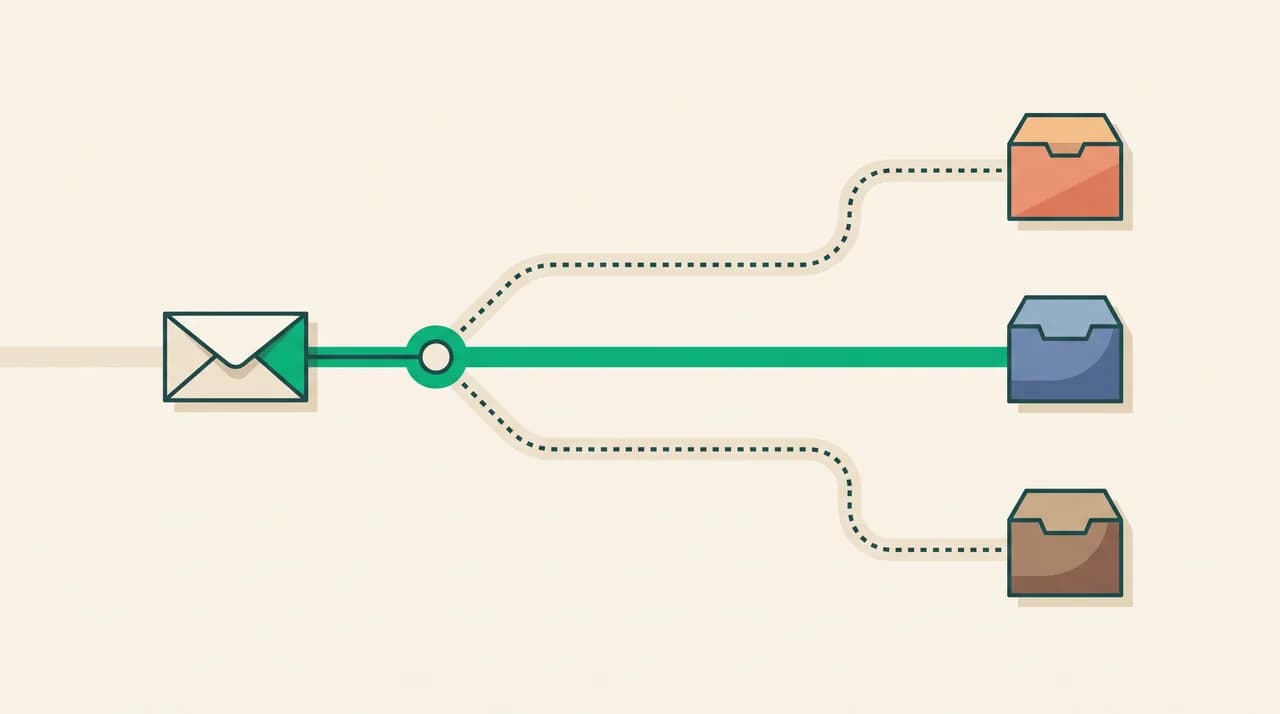
That means it is not an alternative to either product on this page. You still choose a host, still publish SPF, DKIM and DMARC, still point MX at Fastmail or Zoho. What changes is what happens after mail arrives. AI Emaily connects over IMAP and OAuth across Gmail, Outlook, Fastmail, Zoho and generic IMAP, and puts every mailbox in one place — which is the actual problem once a custom domain becomes your third or fourth account.
On top of that it runs triage, drafting and follow-up as an agent with three autonomy levels. Manual does nothing on its own. Copilot proposes and waits for you. Autopilot acts inside limits you set, with undo and a full audit trail of every action taken. Drafting voice comes from a Personal Context brain you write and per-client profiles you set — not from us reading your sent mail — and we do not train on your mail.
Two honest limits. If you are on Zoho's free plan, AI Emaily cannot connect, because that plan has no IMAP — that is a host-side constraint no client can work around. And AI Emaily has no permanent free tier: it is a 7-day free trial on Pro and Autopilot, card required, with nothing charged if you cancel before day seven. See the pricing page for the current tiers, or the Zoho connection guide if you want the setup steps.
How to decide in ten minutes#
- 1
Check whether you need IMAP
If any person on the domain will use a desktop or phone mail app rather than a web client, Zoho's free tier is out. That single question eliminates one option for a lot of readers.
- 2
Count the seats and the years
Model three years, not one month. A per-seat difference that looks trivial at three people is a real number at fifteen, and migrating mail later costs time you will not want to spend.
- 3
Decide who holds DNS
If you want Fastmail to manage records for you, delegation is the reason to pick it. If your DNS is deliberately at Cloudflare or your registrar, stay on the MX-only path with either host.
- 4
Open both admin consoles before you cut over
Take MX, SPF and DKIM values from the live console, not from any article — including this one. Zoho's MX TLD in particular depends on your data centre.
- 5
Set DMARC to p=none on day one
Publish the monitoring policy immediately, read the reports, then tighten. Do this before you migrate, so you can see what breaks against the old host too.
Frequently asked
See it in AI Emaily
Keep reading
Sources
- Fastmail — setting up your domain (MX only)
- Fastmail — setting up your domain (NS/MX delegation)
- Fastmail — plans and pricing
- Zoho Mail — domain verification methods
- Zoho Mail — configuring email delivery (MX records)
- Zoho Mail — SPF configuration
- Zoho Mail — DKIM configuration
- Zoho Mail — plan comparison
- Gmail — email sender guidelines
- Outlook.com Postmaster — sender requirements

Written by
Nafiul HasanNafiul Hasan is an entrepreneur and AI automation system builder with 10+ years of experience turning messy, manual workflows into reliable automated systems. He designs and ships AI enterprise solutions end-to-end — the agent logic, the data plumbing, and the product people actually use — and founded AI Emaily to give busy professionals their attention back. He writes here from the builder's seat: what works, what breaks, and how to put AI to work without giving up control.