How Many Recipients Can One Gmail Message Have?


The short answer
On a free Gmail account, you can address up to 500 recipients per message, across To, Cc, and Bcc combined. On a paid Google Workspace seat using the web interface, the cap rises to 2,000, but no more than 500 can be external addresses. Any third-party client sending over SMTP or IMAP is capped at 100, regardless of account.
Gmail caps one message at 100 recipients via SMTP and 2,000 via the web for Workspace. Here is what each cap means and what counts toward it.
On this page
How many recipients can you have in one Gmail email depends on three things at once: which account you hold, which send path your message takes, and whether the recipients sit inside or outside your domain. The number you find most easily — 2,000 — is real, but it applies only to a paid Google Workspace seat sending through the Gmail web interface or mobile app. On a free @gmail.com account, the per-message ceiling is around 500. And on any account submitting mail through a third-party client over SMTP or IMAP, Google enforces a cap of 100 recipients per message regardless of what the client's address field will accept.
This post separates those numbers by account and send path, explains how To, Cc, and Bcc are counted together toward the same ceiling, and covers what to do when a send fails because the list is too long. All figures are verified against Google's published limits documentation as of August 2026 — Google has adjusted these thresholds before, so check the primary source before planning a campaign against a specific number.
The short answer#
For a free @gmail.com account, the per-message recipient limit is approximately 500, counting every address in the To, Cc, and Bcc fields together. Google does not document this number with the same precision as its Workspace figures, but accounts are blocked at around this threshold in practice.
For a paid Google Workspace account, the per-message ceiling depends on how the message is sent:
- Web or mobile Gmail app: up to 2,000 recipients per message, with no more than 500 of those going to addresses outside your own domain.
- Third-party email client over SMTP, POP, or IMAP: 100 recipients per message, regardless of which account type you hold.
- Gmail API: 500 recipients per message.
Before you start: what counts as a recipient#
Every address in the To, Cc, and Bcc fields is a recipient, and all three fields draw from the same pool. If you put 50 people in To, 30 in Cc, and 20 in Bcc, that is 100 recipients and it counts as 100 toward the per-message cap. The field itself does not affect whether an address is counted — Bcc recipients are invisible to other recipients, but they are not invisible to Google's mail servers.
A contact group entered in the To field looks like one recipient, but Gmail expands it into its individual members at send time. If the group has 90 members, that message uses 90 of your per-message allowance, not 1. This is the most common reason a message to what looks like a short address list gets blocked — the group silently grew since you last checked it.
The external-recipient sub-limit on Workspace is a separate constraint from the total count. Even if your message has only 400 recipients, if all 400 are addresses outside your domain, you are at the 400-out-of-500-allowed external ceiling, not the 400-out-of-2,000 total ceiling. Both caps apply independently and the tighter one governs.
The send path matters as much as the account type
How to add multiple recipients to a Gmail message#
- 1
Open a new compose window
Click Compose in the Gmail sidebar or press C on the keyboard. A compose window opens with the To field active. If you are using the full-screen compose, the address fields behave the same way.
- 2
Type or paste addresses into the To field
Type each address and press Enter or Tab to confirm it as a chip. To add several at once, paste a comma-separated or newline-separated list and press Enter. Gmail converts each valid address into a pill and flags any it cannot resolve. If you type a contact group name, Gmail shows the group as a single entry until you hover over it or it resolves — the member count is visible in the expanded chip.
- 3
Expand Cc and Bcc for additional recipients
Click the Cc or Bcc links on the right side of the To field row to reveal those address lines. The same chip logic applies. Everyone in To and Cc can see each other's addresses; Bcc recipients see only themselves. All three fields count toward the same per-message limit.
- 4
Confirm the total count before sending
Gmail does not display a running recipient total in the compose window. Count To, Cc, and Bcc yourself if you are approaching a limit. On a free account, keep the total below 500. On Workspace via the web, keep the total below 2,000 and external addresses below 500. On any SMTP or IMAP client, keep the total below 100.
- 5
Split the send if you need to exceed the cap
If your list is longer than your per-message ceiling, divide it into batches and send a separate message to each one. A Workspace account reaching 3,000 external addresses can split into six sends of 500 each. Every batch counts toward your daily recipient totals for the rolling 24-hour window, so plan the split with the daily limit in mind as well.
Per-message recipient limits by account and send path#
The table below covers the per-message caps Google documents and enforces as of August 2026. The SMTP figure for free Gmail accounts is not published separately; the 100-per-message SMTP cap is documented for Workspace, and free accounts sending via SMTP are subject to their own account-level restrictions rather than a distinct published SMTP number. Figures are from Google's Workspace Admin Help and the Gmail consumer help documentation.
| Account type | Send path | Recipients per message | External address sub-limit |
|---|---|---|---|
| Free Gmail (@gmail.com) | Web or mobile Gmail app | ~500 total | Not separately documented |
| Free Gmail (@gmail.com) | SMTP / POP / IMAP client | Not separately documented; account-level limits apply | N/A |
| Google Workspace (paid, post-threshold) | Web or mobile Gmail app | 2,000 total | 500 maximum external |
| Google Workspace (paid, post-threshold) | SMTP / POP / IMAP client | 100 per message | Within the 100 total |
| Google Workspace (paid, post-threshold) | Gmail API | 500 per message | Not separately documented |
| Google Workspace (trial, pre-threshold) | Web or mobile Gmail app | 2,000 total (daily limits are restricted) | 500 maximum external |
What to do when the message is blocked#
Gmail does not always give a precise error when a send is rejected for exceeding the per-message recipient count. You may receive a generic delivery failure notice, an SMTP 5xx error code, or a send that stalls and eventually times out in the compose window. If the message goes through when addressed to a handful of people but fails as the list grows, the per-message cap is the most likely cause.
The fastest fix is to count the recipients in To, Cc, and Bcc before sending. If the total is over 100 and you are using a third-party SMTP client, send the same message from the Gmail web interface instead — that alone moves you to the 2,000-recipient ceiling on Workspace. If the total is over 500 on a free account, split the list into two or more sends. If you are on Workspace and your external addresses exceed 500, split the external portion across multiple sends.
When a contact group is involved, open the group in Google Contacts before composing, check the current member count, and confirm the expansion before you send. Groups accumulate members over time and the count you remember from six months ago may no longer be accurate.
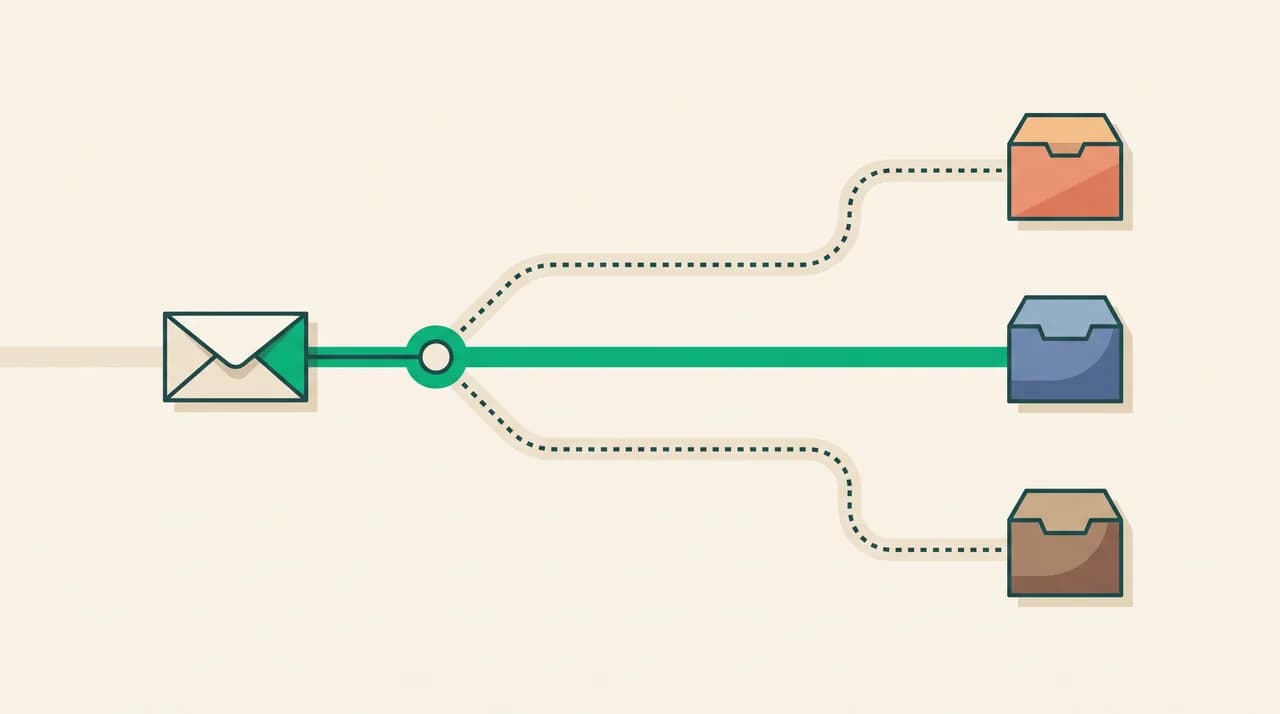
Sending via SMTP silently enforces a 100-recipient cap
A faster way to stay within limits on a busy day#
None of the per-message caps above can be raised by a third-party client — they are enforced by Google and apply to the underlying account regardless of which app you use. What a client can change is how much friction accumulates on a day when you are sending to many different groups in sequence and the total starts approaching both the per-message ceiling and the daily recipient quota at the same time.
We build AI Emaily, an AI-native email client that connects to Gmail and Google Workspace over OAuth. Copilot mode drafts every outgoing message and holds it for your one-tap approval before anything leaves your account. When you are composing a group message, that approval step is the moment to check the expanded recipient list and confirm the count before sending — which catches a contact group that has grown beyond the 100-recipient SMTP cap or the 500-recipient external sub-limit before it causes a bounce, not after. The same Copilot workflow naturally spaces out large days of individual replies rather than batching them into a single send, which keeps your daily pattern in the shape Google's sending infrastructure expects. There is a 7-day free trial on Pro or Autopilot on the AI Emaily pricing page; no charge if you cancel before day 7.
Frequently asked
See it in AI Emaily
Keep reading

Written by
Nafiul HasanNafiul Hasan is an entrepreneur and AI automation system builder with 10+ years of experience turning messy, manual workflows into reliable automated systems. He designs and ships AI enterprise solutions end-to-end — the agent logic, the data plumbing, and the product people actually use — and founded AI Emaily to give busy professionals their attention back. He writes here from the builder's seat: what works, what breaks, and how to put AI to work without giving up control.