How to Automate Insurance Renewal Reminder & Follow-Up Emails

The short answer
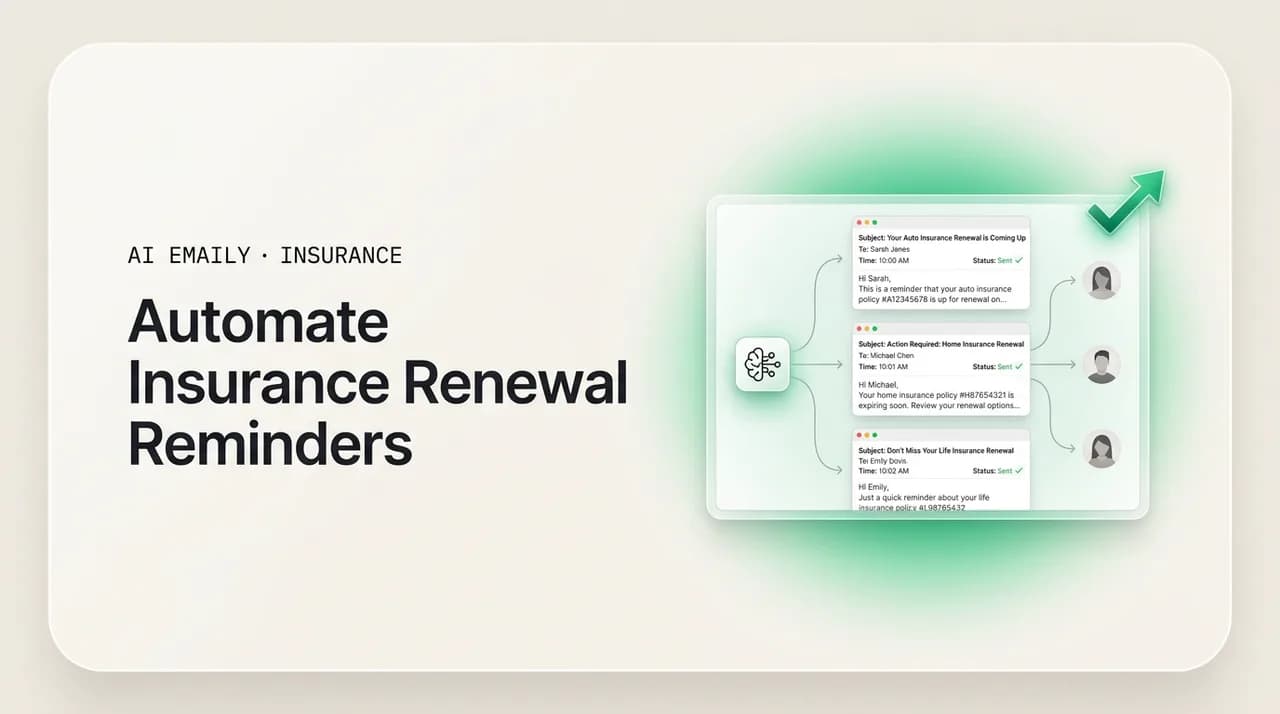
Insurance renewal reminder automation sends a scheduled sequence of reminders and follow-ups so no policy lapses through a missed email. A 60/30/15-day, at-expiry, and lapsed win-back cadence protects retention, while cross-sell notes at renewal grow accounts. Automate the routine reminders, keep a human on anything that quotes a premium.
A practical guide to insurance renewal reminder automation for independent agents: a 60/30/15/at-expiry/win-back cadence, copy-paste templates, cross-sell at renewal, and when to auto-send vs approve.
On this page
- 01Why renewals are where retention is won or lost
- 02What does a missed renewal follow-up actually cost?
- 03What is a good insurance renewal reminder cadence?
- 04Renewal reminder templates for each touch
- 05How do you cross-sell at renewal without being pushy?
- 06Automation versus personalization: where is the line?
- 07When should renewal emails auto-send, and when should a human approve?
- 08How to set up renewal automation step by step
- 09How does AI Emaily help with renewal reminder automation?
- 10Putting it all together
Why renewals are where retention is won or lost#
Every insurance agency runs two businesses at once. The loud one is new business: quotes, leads, comparative raters, the scramble to answer a prospect before the other agent does. The quiet one is renewals, and it is the one that actually pays the bills. A book of business is an asset that either compounds or leaks, and the difference between the two comes down to whether renewals are handled deliberately or handled whenever someone happens to notice the expiry date. Insurance renewal reminder automation is how you move renewals from the second category to the first.
The math is not subtle. Keeping an existing policyholder costs a fraction of what it costs to acquire a new one, and the returns on retention are outsized: research widely cited across customer-loyalty studies puts the cost of acquiring a new customer at roughly five times the cost of retaining an existing one, and small improvements in retention translate into large swings in profit. In insurance that leverage is even sharper, because a renewed policy carries almost no acquisition cost, the client is already underwritten and on the books, and each additional renewal year is where the relationship becomes profitable rather than merely paid-for.
A renewal is also the one predictable moment in the entire client relationship. You know, to the day, when a policy expires. Unlike a lead, which arrives when it arrives, a renewal is on the calendar twelve months in advance. That predictability is exactly what makes it automatable, and exactly what makes a missed renewal so avoidable and so frustrating. Nobody plans to let a policy lapse. It happens because the reminder lived in one person's head, the inbox was buried, and the date slipped past on a busy week.
For the independent personal-lines agent writing high volumes of auto and home policies, this is the core operational risk. The communication is repetitive and predictable, which is a gift, but the sheer count of policies means that doing it by hand guarantees some will fall through. The agencies that retain best are not the ones with the most charming producers. They are the ones where the renewal reminder goes out on schedule, every time, whether or not anyone remembered to send it.
It helps to separate two things that get lumped together. A renewal reminder is proactive: it tells the client their policy is coming due, confirms nothing has changed, and gives them a reason to stay. A follow-up is reactive: the client got a quote, a renewal notice, or a document request and did not respond, so you nudge them again. Both are repetitive, both are easy to forget under load, and both are what this guide means by automation. You are not automating the relationship. You are automating the reminders and the nudges that keep the relationship from dropping a stitch.
This guide covers the real cost of a missed renewal follow-up, a specific renewal-reminder cadence you can put in place this week, copy-paste templates for each touch, how to cross-sell at renewal without being pushy, where automation should stop and a human should take over, and an honest account of how AI Emaily handles this, including what it will do on its own and what it will always hand back to you first.
What does a missed renewal follow-up actually cost?#
It is tempting to treat a lapsed policy as a single lost commission and move on. The real cost is larger and compounds in three directions, which is why renewal follow-up deserves a system rather than a sticky note.
The first cost is the lifetime value of the account, not one year of it. A personal-lines household that renews auto and home year after year, adds a teen driver, buys an umbrella policy, and refers a neighbor is worth many multiples of a single premium. When that household lapses because a renewal reminder never went out, you do not lose a commission. You lose the entire future of the relationship, plus every cross-sell and referral that would have come with it. Retention research is consistent on this point: the profit from a retained customer grows the longer they stay, so the accounts you lose are disproportionately the ones you could least afford to lose.
The second cost is replacement. Because acquiring a new client costs several times what it costs to keep one, every lapse forces you to spend on the expensive side of the ledger just to stand still. A lapsed book is a treadmill: you write new business all year and end flat because the back door was left open. The agencies that grow are usually not writing dramatically more new business than their peers. They are simply losing less out the back.
The third cost is the quiet one, and it is reputational. A client whose policy lapses because they did not get a reminder does not blame themselves. They blame you, and often they are right to. In an era where people expect proactive communication from every service they pay for, silence around a renewal reads as neglect. That client is now primed to answer the next competitor's ad, and worse, to tell others their agent dropped the ball. A renewal reminder is not just a retention tool; it is a trust signal that you are watching their coverage even when they are not.
The lapse you never see
There is a volume dimension too. For an independent agent handling personal lines, renewal and quote follow-ups are, by the pain-point analysis, largely commoditized and repeatable, which is precisely why they get deprioritized when a fire breaks out elsewhere. Repeatable work is the first thing a busy human drops. It is also the easiest thing for a machine to hold. Commercial-lines agents feel a slightly different version of the same pressure: fewer accounts, but each one larger, more complex, and more costly to lose, so a single missed commercial renewal can outweigh a dozen personal-lines lapses. In both cases the fix is the same in shape: put the reminders on a schedule that does not depend on anyone remembering.
What is a good insurance renewal reminder cadence?#
A renewal cadence is a fixed sequence of touches, each with a job, timed against the policy expiry date. The point is to start early enough that the client has time to act, stay present without becoming noise, and keep going past the expiry so a lapse becomes a win-back opportunity rather than a dead end. Below is a cadence that works for most personal-lines and small-commercial books. Treat it as a default to adapt, not a law.
The five anchor touches are: sixty days out, thirty days out, fifteen days out, at expiry, and a lapsed win-back after the policy has ended. Each has a distinct purpose and tone, moving from informational and relaxed early on to direct and time-sensitive near the deadline.
| Timing | Touch | Purpose | Tone | Auto-send vs approve |
|---|---|---|---|---|
| 60 days before expiry | Early heads-up + review offer | Confirm the renewal is coming, invite a quick coverage review, surface any life changes (new car, home improvement, teen driver). | Warm, no urgency | Safe to auto-send — informational, no premium quoted |
| 30 days before expiry | Renewal confirmation + any premium change | Confirm the renewal terms, flag a rate change if there is one, reassure or explain. | Clear, reassuring | Approve if a premium or rate change is stated; auto-send if terms are unchanged |
| 15 days before expiry | Action reminder | Prompt any payment, signature, or document still needed before the policy renews. | Direct, helpful | Auto-send the reminder; approve if it contains a quote or coverage recommendation |
| At expiry | Renewal day confirmation / last call | Confirm the policy has renewed, or issue a final notice if action is still outstanding. | Firm but supportive | Auto-send confirmations; approve any last-call that quotes a re-rate |
| 7–30 days after lapse | Lapsed win-back | Re-engage a client whose policy ended, offer to re-quote and reinstate, understand why they left. | Sincere, low-pressure | Approve — this is a save attempt and usually involves new terms |
A few principles hold this cadence together. Start the first touch early, at sixty days, because that is when a client still has room to shop deliberately with you rather than react to a competitor's ad in the final week. Space the touches so each one has a new reason to exist; a reminder that just repeats the last one trains people to ignore you. Change the tone as the deadline approaches, from a relaxed heads-up to a clear call to act. And never let expiry be the end of the sequence, because a lapsed client is not a lost client until you have made at least one genuine attempt to bring them back.
For commercial lines, widen the window. A business policy with a complex renewal, multiple decision-makers, and a required application update often needs a ninety-day or even one-hundred-twenty-day first touch, because gathering updated exposures, loss runs, and signatures takes weeks, not days. The shape of the cadence is the same; the runway is longer. The AgencyBloc guidance on the policy renewal process makes the same point: a structured, calendared renewal workflow, started well ahead of expiry, is what separates agencies that renew smoothly from those that scramble.
Anchor the cadence to the expiry date, not the send date
Renewal reminder templates for each touch#
Templates are the raw material for automation, but they are only a starting point. The goal is a message that reads like you wrote it, not like a form letter, so keep the merge fields specific and the tone in your own voice. Below is one template per anchor touch. Swap in your details, and where you can, personalize beyond the merge fields with something only you would know about the account.
Start with the sixty-day heads-up. It is the friendliest of the sequence and does the most retention work, because it invites a conversation before price ever enters the picture.
At thirty days out, the job shifts to confirming terms. If the premium is holding steady, this is a reassuring note. If the rate has moved, this is where you get ahead of the shock, explain it plainly, and offer to look at options, because a rate increase discovered on the renewal invoice is one of the top reasons clients shop away.
The fifteen-day touch is a clean action reminder. Keep it short and specific: what is due, by when, and how to do it. This is the message that most often prevents a lapse caused by a missed payment or an unsigned form.
At expiry, you either confirm the renewal went through, which is a nice, low-cost trust touch, or you send a final notice if action is still outstanding. Confirmation messages are the safest thing in the whole sequence to automate, because they simply report a fact.
Finally, the lapsed win-back. If a policy ends without renewing, one sincere, low-pressure message can recover a meaningful share of those accounts. Do not scold and do not oversell; ask what happened, and offer to fix it.
One template, many voices
How do you cross-sell at renewal without being pushy?#
Renewal is the single best moment to grow an account, because the client is already thinking about their coverage and already trusts you enough to have stayed. A monoline household, someone with auto but not home, or home but no umbrella, is both a retention risk and a growth opportunity: multi-policy clients retain far better than single-policy ones, so rounding out an account protects it as much as it grows it. The trick is to make the cross-sell feel like care, not a sales pitch.
The move is to attach the cross-sell to the review, not the invoice. The sixty-day heads-up already asks whether anything has changed; that is your natural opening. "Since we are reviewing your auto anyway, it is worth a quick look at whether bundling your home would lower your total," reads as helpful because it is framed around the client's benefit and the moment they are already in. A cross-sell that shows up out of nowhere feels like an upsell. One that rides along with a genuine coverage review feels like an agent doing their job well.
- Lead with a gap, not a product. "You have auto with us but your home is elsewhere" identifies a real gap the client can act on. "Have you considered life insurance?" is a cold pitch.
- Tie it to a change. New car, new house, new baby, new business location, a teen turning sixteen. A life event is a coverage event, and clients understand that intuitively.
- Quantify the benefit when you can. A multi-policy discount, a coverage gap closed, a deductible that no longer makes sense. Concrete beats aspirational.
- Offer, do not push. One mention per renewal cycle, framed as an option. If they pass, drop it until the next natural trigger. Pressure erodes the trust that makes the next renewal easy.
- Keep the review the point. The cross-sell is a byproduct of a good renewal review, not the reason for the email. If it ever starts to feel like the reverse, pull back.
One caution: cross-sell messaging is where automation should tread carefully. A reminder that a policy is up for renewal is safe to send unattended. A message recommending a specific additional product, quoting a bundle price, or making a coverage recommendation is one that should pass a human first, because it is advice, and advice tied to a number carries both relationship risk and, in some lines, compliance weight. The next section draws that line more precisely.
Automation versus personalization: where is the line?#
The fear that keeps most agents from automating renewals is that automation will make their communication feel robotic, and that the personal touch, which is genuinely the product in insurance, will be lost. It is a legitimate fear, and the answer is not to automate less. It is to automate the right layer.
Think of a renewal message as having two layers. The bottom layer is timing and structure: which client, which policy, which expiry date, which touch in the cadence, what needs to happen. That layer is pure logistics, it is identical across your whole book, and a human handling it by hand adds no value while introducing the risk of forgetting. Automate all of it. The top layer is voice and judgment: the specific detail you mention about this household, the way you explain a rate increase to a nervous client, the decision to re-shop a policy or reassure the client to stay put. That layer is where your value lives, and it is what should feel personal.
The mistake agencies make is automating the wrong layer, or refusing to automate at all and losing both. Old-style automation sends the same block of template text to everyone, which nails the timing but flattens the voice, and clients feel it. Doing everything by hand preserves the voice but guarantees missed touches under load. The modern answer, and the reason AI matters here, is that you can now automate the timing and structure while keeping the voice personal, because an AI email client can draft each reminder in your own writing style and pull in a real detail about the account, rather than mail-merging the same paragraph to a thousand people.
So the line is not automation versus personalization. It is: automate the logistics completely, personalize the language every time, and keep human judgment on anything that involves advice, a number, or a delicate relationship. A renewal-day confirmation is all logistics; send it unattended. A message telling a client their premium jumped 22 percent and here is what I recommend is all judgment; write it, or at least approve it, yourself.
When should renewal emails auto-send, and when should a human approve?#
This is the most important operational decision in renewal automation, and it maps cleanly onto the type of message. The dividing question is simple: does this message quote a number, give advice, or touch a sensitive relationship? If yes, a human approves before it sends. If no, let it go on its own. The personal-lines ICP is the strongest fit for full auto-send precisely because so much of its renewal communication is templated and low-risk; commercial and life lines lean more toward the approve side because the stakes and the customization per message are higher.
Here is how the categories break down in practice.
- Safe to auto-send: renewal heads-ups with no premium, action reminders (pay, sign, confirm), renewal-day confirmations, document-available notices, and "nothing has changed" reassurances. These state facts or prompt routine actions and carry little downside if they go unattended.
- Approve before sending: any message that quotes a premium or rate change, recommends coverage, proposes a cross-sell with a price, re-quotes after a lapse, or explains a non-renewal. These involve a number or a judgment call, and a wrong or tone-deaf one damages trust.
- Always human, sometimes fully manual: emotionally loaded or high-stakes situations — a large commercial account at risk, a claim in progress, a client who is upset, a life policy conversation. Automation can draft, but the send is yours, and often the whole message should be.
Start on approve, graduate to auto-send
For agents in regulated lines, this line is not just good practice; it is a requirement. Medicare and health agents operate under CMS marketing rules that govern what automated content can say, including disclaimer and restricted-language requirements, and the agent remains responsible for the compliance of anything that goes out. In those lines, mandatory human approval on client-facing messages is the default, and automation earns its keep by drafting compliant messages fast rather than by sending them unattended. The principle generalizes: the more a message can harm if it is wrong, the more a human belongs in the loop before it leaves.
How to set up renewal automation step by step#
You do not need a large tech project to put a reliable renewal cadence in place. You need a clean list of policies with expiry dates, a defined sequence, templates in your voice, and a rule for what sends automatically versus what you approve. Here is the order that works.
- 1
Get every policy's expiry date into one place
Renewal automation lives or dies on clean expiry dates. Pull them from your agency management system or carrier downloads into a single source, and make sure each record has the client, the line, the carrier, and the exact renewal date. This is the foundation the whole cadence is offset from.
- 2
Define your cadence as offsets from expiry
Encode the sequence as expiry minus 60, minus 30, minus 15, expiry day, and expiry plus 14 (or a longer runway for commercial). Anchoring to the expiry date means every policy in the book gets the right sequence automatically, and it self-adjusts if a renewal date moves.
- 3
Write one template per touch, in your voice
Use the templates above as a base, then rewrite them so they sound like you. Keep merge fields specific (policy type, carrier, expiry date, premium) and leave room for one personal detail per account. The more your templates sound human, the less your automation feels automated.
- 4
Set the auto-send versus approve rule per touch
Decide, for each touch, whether it sends on its own or waits for your review, using the categories above: facts and reminders auto-send, anything with a premium or a recommendation gets approved. Start conservative and loosen as you build trust in the drafts.
- 5
Handle replies and exceptions
A cadence must stop or branch when a client responds, pays, or lapses. Make sure a reply pauses the sequence and routes to you, a completed payment ends the reminder chain, and a lapse triggers the win-back rather than another renewal reminder. Automation that keeps nagging someone who already acted is worse than no automation.
- 6
Review the drafts, then measure
For the first few cycles, read what goes out. Watch which touches drive replies and renewals, tighten the ones that fall flat, and track your renewal rate before and after. The cadence is a living thing; the point is fewer lapses each quarter, not a perfect sequence on day one.
How does AI Emaily help with renewal reminder automation?#
Everything above is doable with discipline, a spreadsheet, and a lot of manual sending. What changes with an AI-native email client is that the discipline stops depending on you remembering, and the personalization stops trading off against scale. AI Emaily is an AI email client built to act as an autonomous chief of staff for your inbox, and renewal reminders are exactly the kind of predictable, repetitive, high-stakes work it is designed to hold.
The core of it is renewal-reminder automation that runs on your cadence. You tell it the sequence, sixty days out, thirty, fifteen, at expiry, and a lapsed win-back, anchored to each policy's expiry date, and it drafts and schedules every touch across your whole book. Because the touches are offset from the expiry date rather than hand-scheduled, the sequence self-adjusts for every policy and never depends on anyone noticing a date on a busy week. The renewal that used to slip through when the office was slammed simply goes out on time.
What keeps it from feeling robotic is that the drafts come back in your voice. AI Emaily learns how you actually write, so a renewal reminder reads like you sent it, not like a mail-merge, and it can weave in a real detail about the account rather than the same block of template text. That is the automation-versus-personalization line, resolved in your favor: the logistics are fully automated, and the language stays personal on every message.
Control is the part agents care about most, and it is built around the auto-send-versus-approve distinction this guide has drawn. AI Emaily runs in three modes. In Manual, nothing sends without you. In Copilot, it drafts every reminder and follow-up and waits for your approval, so you glance, tweak if needed, and send, which is where most agents will want the renewal touches that quote a premium or make a recommendation. In Autopilot, you let it send the genuinely routine touches on its own, the heads-ups, the action reminders, the renewal-day confirmations, within rules you set: which touches, which clients, what it is never allowed to send unattended. You draw the line; it stays on your side of it.
And because handing any of this to software requires trust, every action is reversible and logged. Autopilot sends come with undo, and there is a full audit trail of what was drafted, what was sent, when, and to whom. If a message went out that should not have, you can see it and reverse it. For agents in regulated lines, that audit trail and the mandatory-approval option on client-facing messages are the difference between automation you can defend and automation you have to worry about. You get the retention benefit of never missing a renewal without giving up the oversight your book, and in some lines your regulator, requires.
The honest version
Putting it all together#
Renewals are the quiet engine of an insurance book, and they are lost the same boring way every time: a reminder that lived in someone's head, an expiry date that slipped past on a busy week, a client who quietly shopped away because nobody gave them a reason to stay. Insurance renewal reminder automation fixes that by turning a predictable calendar event into a reliable sequence that does not depend on anyone remembering.
The playbook is not complicated. Anchor a cadence to each policy's expiry date, sixty, thirty, and fifteen days out, at expiry, and a lapsed win-back afterward. Write each touch in your own voice, personalize beyond the merge fields, and use renewals as the natural moment to round out an account with a cross-sell framed as care. Automate the logistics completely, keep human judgment on anything that quotes a number or gives advice, and start conservative on what sends unattended.
Do that by hand and it works until the week you are too busy. Let an AI email client hold the cadence, draft in your voice, and keep the routine touches flowing within rules you set, always with approval where it matters and undo when it does not go as planned, and the back door to your book finally stays closed. You can try it free at app.aiemaily.com/signup.
Frequently asked
See it in AI Emaily
Keep reading
Sources

Written by
Nafiul HasanNafiul Hasan is an entrepreneur and AI automation system builder with 10+ years of experience turning messy, manual workflows into reliable automated systems. He designs and ships AI enterprise solutions end-to-end — the agent logic, the data plumbing, and the product people actually use — and founded AI Emaily to give busy professionals their attention back. He writes here from the builder's seat: what works, what breaks, and how to put AI to work without giving up control.