Speed to Lead for Insurance Agents: Why 5 Minutes Wins the Quote

The short answer
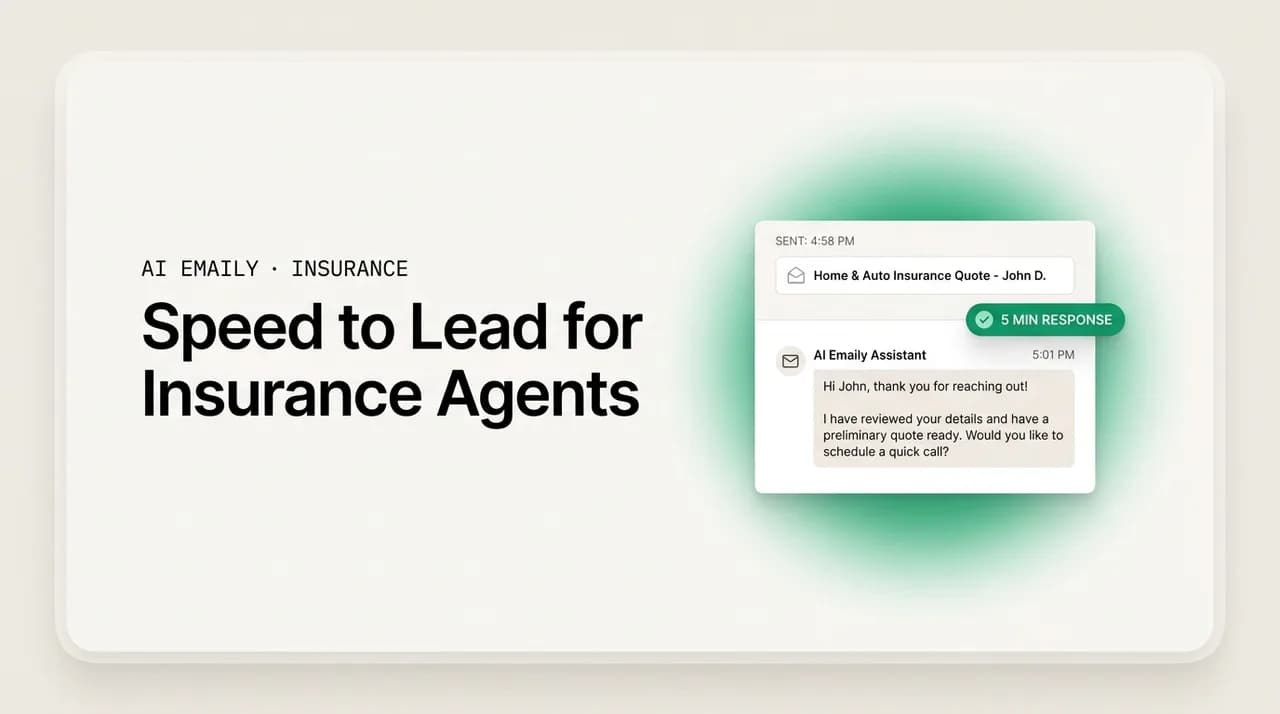
Speed to lead insurance wins on minutes, not hours. Research shows contacting a web lead within five minutes makes it far likelier to qualify, and odds fall sharply after that. Since insurance shoppers request several quotes at once, the first agent to reply usually frames the sale. Auto-acknowledge instantly, then send a personal quote follow-up fast.
Speed to lead in insurance decides who binds the policy. The research, the numbers, why agents are slow, and a sub-5-minute response system with templates and AI to respond to insurance leads faster.
On this page
- 01What is speed to lead, and why does it decide who binds the policy?
- 02What does lead-response research actually say about the five-minute window?
- 03What do the numbers look like for insurance specifically?
- 04Why are insurance agents slow to respond, even when they know speed matters?
- 05How do you build a sub-five-minute response system?
- 06Auto-acknowledge versus personal quote follow-up: where's the line?
- 07What should your instant first-touch template say?
- 08What should your after-hours and weekend template say?
- 09How can you keep the follow-up personal at scale?
- 10How does AI Emaily help insurance agents win on speed to lead?
- 11Putting it all together
What is speed to lead, and why does it decide who binds the policy?#
Speed to lead is the time between a prospect raising their hand, submitting a quote form, replying to an ad, filling out a comparison-site request, and the moment a real person actually responds to them. In insurance it is not a soft metric or a nice-to-have. It is often the single biggest factor separating the agent who binds the policy from the two or three agents who spend time quoting a prospect who has already gone somewhere else.
The reason is structural. An insurance shopper almost never contacts one agent. They fill out a comparison-rater form, or a lead aggregator sells the same record to several agencies, or they simply email three or four names off a search. Within minutes, that one prospect is a shared lead sitting in multiple inboxes at once. Everyone is quoting the same person. The question is no longer whether you can win the business on price or coverage. It is whether you are still in the conversation by the time the prospect makes up their mind, and that window is measured in minutes.
This is why speed to lead insurance strategy matters more here than in almost any other industry. The product is commoditized enough that a prospect can get a comparable auto or home quote from several carriers, the buying intent is high and time-boxed, and the shopper is actively fielding responses from your competitors in real time. The first agent to reply gets to set the frame: they explain the coverage, build the rapport, and become the default the prospect measures everyone else against. Being second is often the same as being last.
There is a hard version of this claim and a soft version, and both are true. The hard version: for time-sensitive shared leads, responding late frequently means the prospect has already bound elsewhere, so your quote is dead on arrival no matter how good it is. The soft version: even when the prospect is still available, the agent who responded first has an anchoring advantage, a rapport lead, and a psychological head start that a later, better quote has to overcome. You are not just racing to be available. You are racing to be the person the prospect already trusts.
This guide covers the research behind the five-minute window, the specific numbers that make the case for insurance, the real reasons agents are slow even when they know speed matters, and a practical sub-five-minute response system you can run without hiring anyone. It includes the split between an instant automatic acknowledgement and the personal quote follow-up that has to come from you, copy-paste templates for the first touch, after-hours coverage, and a plain, honest account of where an AI email client like AI Emaily fits, what it does for you, and the guardrails that keep it from ever sending something you would not.
The one number to remember
What does lead-response research actually say about the five-minute window?#
The five-minute rule is not marketing folklore. It comes from a large body of lead-response research, and the findings are consistent enough that they have become industry canon. The most-cited work is the Lead Response Management study, which analyzed hundreds of companies and millions of contact attempts to find out how the timing of the first response changes the odds of ever reaching and qualifying a web lead.
The headline findings are stark. The odds of making meaningful contact with a lead drop off a cliff as minutes pass. Calling or replying within the first five minutes, versus waiting even thirty, produces a dramatic difference in the likelihood of ever connecting with that prospect, and an even larger difference in the likelihood of qualifying them. The study also found that the difference between responding in five minutes and responding in ten is itself significant. This is not a gentle downward slope. It is a steep one, front-loaded into the first few minutes.
Harvard Business Review reinforced the point in a widely cited audit of thousands of US companies. In "The Short Life of Online Sales Leads," the authors found that firms responding to a web inquiry within an hour were far more likely to have a meaningful conversation with a decision-maker than firms that waited longer, yet a large share of companies took far longer than an hour to respond at all, and many never responded. The gap between what the research says and what most businesses actually do is enormous, and that gap is exactly where a fast agent wins.
Two mechanisms drive these numbers, and both apply directly to insurance. The first is availability. A prospect who just submitted a form is, right now, sitting at their desk or on their phone thinking about insurance. Five minutes later they still are. An hour later they are back in a meeting, picking up kids, or watching television, and reaching them takes several more attempts across several days. You are not just slower; you have to work much harder to make contact at all.
The second is intent decay and competition. The prospect's urgency fades, and, more importantly for insurance, other agents are filling the vacuum you left. On a shared or aggregated lead, the shopper is fielding responses in real time. Every minute you wait is a minute a competitor is on the phone building rapport and quoting. By the time you call, the prospect may already have a quote they like, a person they trust, and a reason to say "I think I'm all set." The research measures the raw contact and qualification odds; in insurance, the competitive layer on top makes speed matter even more than the base numbers suggest.
Contact rate versus bind rate
What do the numbers look like for insurance specifically?#
Insurance sits at the intersection of three factors that make speed to lead unusually decisive: high, time-boxed buying intent; a shared-lead distribution model where the same prospect reaches several agents at once; and a product comparable enough that the shopper genuinely can bind with whoever responds first and quotes fairly. Layer that on top of the general lead-response research and the case for a five-minute response gets even stronger.
Demand is also surging, which raises the stakes on every lead. Insurance-related search activity hit record highs recently: auto insurance searches rose about 38 percent year over year, home insurance searches jumped roughly 45 percent, and business insurance searches recorded the largest increase of any category at around 89 percent. More shoppers are actively hunting for coverage than ever, which means more inbound leads, more shared leads, and more competitors racing you to the reply. A faster response is how you convert that rising demand instead of watching it flow to whoever answered first.
The distribution structure matters too. Independent agents write roughly 57 percent of all US property-casualty premium, which means the bulk of personal and commercial lines flows through exactly the kind of multi-carrier, relationship-driven agent for whom speed to lead is the core competitive weapon. You are not competing against a single carrier's call center on price alone; you are competing against other independent agents on responsiveness, and that is a race you can actually win with a system rather than a bigger budget.
The table below translates the lead-response research into the pattern insurance agents see in practice. The exact figures depend on your lead source, your lines of business, and your close skill, so treat the direction as the lesson rather than any single cell. The shape is what matters: bind odds are front-loaded into the first few minutes and decay fast, because both reachability and competitive position collapse together as time passes.
| First-response time | What is happening to the prospect | Relative position to bind |
|---|---|---|
| Under 5 minutes | Still at their device, still thinking about insurance, often before competitors reply. | Strongest — you frame the quote and anchor the relationship. |
| 5 to 30 minutes | Still reachable, but competitors are now responding too; you are one of several. | Good, but no longer the default; you are competing on the merits. |
| 30 minutes to 1 hour | Attention drifting; likely already talking to a faster agent. | Slipping — you are chasing a conversation someone else started. |
| 1 to 24 hours | Back to their day; reaching them now takes several attempts across days. | Weak — many are already quoted, some already leaning toward a choice. |
| Over 24 hours | Intent has cooled; a share have already bound elsewhere. | Poor — your quote often arrives after the decision is effectively made. |
Read the table as a warning about the shape of the curve, not a promise of specific percentages. The practical takeaway is that the difference between five minutes and an hour is not incremental, it is categorical. An agent averaging a four-minute first response and an agent averaging a four-hour first response are running different businesses off the same leads, and the fast one is quietly binding policies the slow one paid the same lead cost for and never had a real shot at.
There is a cost angle here too that agency owners feel directly. If you are buying shared or aggregated leads, you are paying per lead regardless of whether you reach the prospect. A slow first response does not just lower your close rate; it wastes lead spend on records you were never in a position to win. Speeding up your first touch raises the return on money you are already spending, which is often a faster lever than buying more leads.
Shared leads punish slowness twice
Why are insurance agents slow to respond, even when they know speed matters?#
Almost every agent knows, in the abstract, that fast follow-up wins. Very few actually respond within five minutes, and the reasons are structural, not a lack of effort or care. Understanding why you are slow is the first step to building a system that is fast by default instead of fast only when you happen to be watching your inbox.
The core problem is that a producer's job is fundamentally interrupt-driven, and leads arrive at the worst possible moments. Here are the real reasons the five-minute window gets missed, over and over, at agencies that genuinely want to be fast.
- You are already on the phone. The most common reason: a lead lands while you are quoting or servicing another client, and by the time you are free, twenty minutes have passed and the moment is gone.
- Leads arrive across a dozen inboxes. Comparison raters, aggregators, your website form, carrier portals, and referral emails all land in different places. Nobody is watching all of them at once, so leads sit unseen.
- After hours and weekends. A large share of insurance shopping happens evenings and weekends, exactly when the office is closed. A lead that comes in at 8 p.m. Friday and gets a Monday-morning reply is, for speed-to-lead purposes, a lost lead.
- Triage takes time. Before you can respond well, you often want to pull the record, check the carrier appetite, and glance at prior history. That research is real work, and it delays the first touch even when you saw the lead immediately.
- Context-switching cost. Every interruption to answer a new lead pulls you off whatever you were doing. Agents protect their focus by batching, and batching is the enemy of a five-minute response.
- No system, only willpower. When speed depends on an individual remembering to check email constantly, it fails the moment that person is busy, sick, at lunch, or simply having a heavy day. Willpower is not a response-time strategy.
Notice that none of these are solved by trying harder. Telling a busy producer to "just respond faster" ignores the fact that they are slow precisely because they are busy doing the revenue work only they can do. The fix is not more discipline; it is separating the two jobs that a fast response actually requires. The first job is an instant acknowledgement that reaches the prospect in seconds and holds the window open. The second job is the personal, substantive quote follow-up that genuinely needs the producer. Conflate the two and you get neither. Separate them and you can be instant and personal at the same time.
Speed is a system problem, not a willpower problem
How do you build a sub-five-minute response system?#
A reliable sub-five-minute response system rests on one core idea: the first touch and the real follow-up are two separate actions with two different owners. The first touch is automatic, fires in seconds, and its only job is to reach the prospect while they are still there and hold the window open. The real follow-up is human, comes shortly after, and does the substantive work of quoting and building rapport. Here is how to build it, step by step.
- 1
Consolidate every lead source into one inbox
You cannot respond fast to leads you cannot see. Route comparison raters, aggregators, your website form, and referral emails into a single inbox or client so every new lead surfaces in one place. A lead scattered across five portals is a lead nobody answers in five minutes.
- 2
Fire an instant auto-acknowledgement on every new lead
The moment a lead arrives, an automatic reply should go out confirming you received their request, telling them a real quote is coming shortly, and setting a clear next step. This is what actually holds the five-minute window; it reaches the prospect in seconds even when you are on another call.
- 3
Route the lead to a producer with full context attached
Behind the scenes, the lead should land in front of the right producer with the record, the requested coverage, and any prior history already pulled, so the human does not lose minutes on triage before they can respond substantively.
- 4
Send the personal quote follow-up fast, ideally within the hour
The producer follows the auto-acknowledgement with the real reply: a specific quote or a short note plus a call to gather what is needed. Because the acknowledgement already bought goodwill and held the window, this human touch does not have to be instant, but the faster the better.
- 5
Attempt a call, not just an email
Email holds the window; a call closes it. The lead-response research is clearest about phone contact, so pair the fast email with a prompt call attempt. The instant email makes the call warmer, because the prospect already knows your name when the phone rings.
- 6
Set an automated follow-up cadence for no-answers
Most leads are not reached on the first attempt. Build a short, persistent sequence, a mix of calls and emails over the first several days, so leads that do not respond immediately are worked systematically instead of forgotten after one try.
- 7
Cover after hours automatically
Since much insurance shopping happens nights and weekends, the auto-acknowledgement has to work when the office is closed. An after-hours lead that gets an instant, warm acknowledgement and a next-morning personal reply beats a competitor who simply went dark until Monday.
- 8
Measure your median first-response time
You cannot improve what you do not track. Watch the median time from lead arrival to first human touch, and the share of leads acknowledged within five minutes. If those numbers are not where you want them, the system, not the people, needs adjusting.
Auto-acknowledge versus personal quote follow-up: where's the line?#
The most important design decision in a speed-to-lead system is knowing which part to automate and which part to keep human. Get this line wrong in either direction and the system fails: automate too much and you send tone-deaf, generic quotes that damage the relationship; automate too little and you are back to depending on a busy producer noticing an email in five minutes, which does not happen. The right split is clean, and it maps to the two jobs a fast response has to do.
The auto-acknowledgement is safe to fully automate because its job is narrow and low-risk. It does not quote a price, promise coverage, or commit to anything. It confirms receipt, sets expectations, and holds the window. It is the insurance equivalent of a receptionist saying "thanks, someone will be right with you" the instant you walk in. Nothing about that message needs a human to compose it in the moment, and the cost of it being slightly generic is near zero, while the cost of it being late is the whole lead.
The personal quote follow-up is where the human belongs, because that is where judgment, coverage details, carrier appetite, tone, and rapport all live. A real quote can involve numbers, exclusions, and trade-offs that are wrong to automate blindly, and in regulated lines like Medicare there are compliance rules governing exactly what can be said and what disclaimers must appear. This is the moment the producer earns the commission, and it should read like it came from a person who understands the prospect's situation, because it did.
The table below draws the line explicitly. When you design your own system, sort every message you might send into one of these two columns, and you will rarely go wrong.
| Fully automatic (auto-acknowledge) | Human-owned (personal follow-up) |
|---|---|
| Instant confirmation that the request was received. | The actual quote, premium, and coverage recommendation. |
| Setting expectations: "a real quote is coming shortly." | Coverage trade-offs, exclusions, and carrier-specific detail. |
| A clear next step or a link to book a call. | Rapport, tone, and anything tailored to the prospect's situation. |
| After-hours coverage so nobody hits a wall of silence. | Anything touching regulated lines that needs disclaimers or review. |
| Basic details the prospect already gave you, echoed back. | Judgment calls, price negotiation, and the close. |
Automate the acknowledgement, never the promise
What should your instant first-touch template say?#
The instant first-touch is the highest-leverage message in the whole system, because it is the one that actually fires inside the five-minute window. Its job is not to sell or quote. Its job is to confirm you exist, reassure the prospect that a real response is coming, and set a concrete next step so they wait for you instead of clicking the next agent's reply. Keep it short, warm, human, and specific. Here is a clean version for a personal-lines lead.
A few things make that template work. It names the prospect and the coverage they asked about, so it does not read like a mass autoresponder. It promises a real reply "shortly" without committing to an exact time you might miss. It offers two easy next steps, book a call or send a number, so the prospect can move the conversation forward while your interest is fresh. And it signs off with a real name and agency, so the follow-up call feels like a continuation, not a cold call. Swap the coverage line for commercial or life as needed, but keep the structure.
For a commercial-lines lead, where the shopper is a business owner and the sale is more complex, the acknowledgement can gently ask for the one or two details that will speed the real quote, without turning into a form.
What should your after-hours and weekend template say?#
After-hours coverage is where a lot of leads quietly die, and where a good system quietly wins. A large share of insurance shopping happens in the evenings and on weekends, precisely when the office is closed and no producer is watching the inbox. The competitor who lets those leads sit until Monday is handing them to whoever sends an instant, warm acknowledgement instead. Your after-hours message should do the same job as the daytime one, hold the window, but be honest about timing so you set expectations you can keep.
The after-hours version trades the daytime "shortly" for an honest "first thing in the morning," because promising an instant human reply at 10 p.m. and then not delivering it is worse than setting the right expectation. The prospect gets an immediate signal that they were heard, a clear time for the real answer, and an option to book a slot on their own terms. That combination is usually enough to keep them from binding with a competitor overnight, and it costs you nothing because it fires automatically while you are asleep.
One refinement worth adding: let the after-hours message offer the prospect a way to self-serve the next step, a booking link or a short intake, so a motivated evening shopper can keep moving instead of waiting. The goal is never to fully automate the sale after hours; it is to make sure the prospect ends the night feeling attended to and with a concrete reason to wait for you rather than clicking the next result.
Match the promise to the hour
How can you keep the follow-up personal at scale?#
The tension at the heart of speed to lead is that the two things that win, instant response and a genuinely personal follow-up, pull in opposite directions. Instant means automatic and generic; personal means human and slow. Most agencies pick one: they either automate everything and send robotic quotes, or they keep everything human and lose the five-minute window. The way out is not to pick one but to automate the instant part and accelerate the human part, so the producer spends their limited minutes only on the message that actually needs judgment.
In practice, accelerating the human part means removing the friction that makes a producer slow even when they are trying to be fast. That friction is usually one of three things: hunting for the lead across inboxes, gathering context before they can reply, and composing the message from a blank page. Strip those out, surface the lead with its context attached, and give the producer a strong draft they can adjust and send, and a personal follow-up that used to take fifteen minutes takes two. Speed at scale is not about typing faster; it is about deleting the steps between seeing a lead and sending a good reply.
This is where the follow-up can stay personal even as volume rises. The draft the producer starts from should sound like them, not like a template, because a follow-up that reads like a form letter undoes the goodwill the instant acknowledgement earned. The producer's job shrinks to the part only they can do, checking the coverage logic, adjusting the tone, confirming the quote is right, and hitting send, while the mechanical work of finding, contextualizing, and drafting happens for them.
How does AI Emaily help insurance agents win on speed to lead?#
AI Emaily is an AI-native email client that acts as an autonomous chief of staff for your inbox, and speed to lead is one of the clearest places it earns its keep for insurance agents. This section is deliberately concrete about what it does and, just as important, what it does not do, because in a regulated, relationship-driven business you should know exactly where the automation stops and your judgment begins.
The first thing it does is the instant acknowledgement. Connect the inboxes your leads come into, comparison raters, aggregators, your website form, referral email, and AI Emaily can recognize a new lead and fire an immediate, human-sounding acknowledgement in seconds, day or night. That is the message that holds the five-minute window, and because it never quotes a price or promises coverage, it is safe to send automatically. The prospect hears back instantly even when you are on another call or asleep, which is exactly when most leads are lost.
The second thing it does is prepare the personal quote follow-up for you. When a lead lands, AI Emaily surfaces it with its context and drafts a follow-up in your voice, not generic boilerplate, because it learns how you actually write. You are not staring at a blank page or copying a stiff template; you are reviewing a draft that already sounds like you and adjusting the coverage detail, the price, and the tone. The mechanical part that made you slow, finding the lead, gathering context, composing from scratch, is done, so your fast human reply gets faster without getting less personal.
How much autonomy you grant is your call, and this is where AI Emaily's three modes matter for a business with real compliance stakes. In Manual mode, nothing sends without you; the tool drafts and organizes, and you send everything yourself. In Copilot mode, AI Emaily prepares the acknowledgement and the follow-up draft and waits for your approval before anything goes out, which is the right default for the substantive quote reply where a human should always be in the loop. In Autopilot mode, you can let it handle the parts you have decided are safe to run on their own, the instant acknowledgement being the obvious candidate, within rules you set, so the routine, low-risk touches fire automatically while the quote itself still waits for you.
Crucially, this maps onto the line we drew earlier. Personal lines, where auto and home communication is templated enough that most of it can run with minimal review risk, is the strongest fit for letting the acknowledgement, and eventually more, run on Autopilot. Regulated lines like Medicare, where CMS rules govern disclaimers and phrasing, and high-touch lines like life insurance, where a misjudged automated message can damage a relationship, are where you keep more in Copilot and let the tool draft while you review. You are not forced into one setting for everything; you tune the autonomy per lead type to match the risk.
And because giving software the ability to send email on your behalf is a real trust decision, every action AI Emaily takes is reversible and logged. There is undo on the things it does, and a full audit trail of what was sent, when, and why, so you can see exactly what went out under Autopilot and reel anything back that should not have. That combination, instant automatic acknowledgement, a voice-matched quote follow-up draft you approve, Manual, Copilot, and Autopilot modes tuned to the risk of each line, and undo plus audit on everything, is how an agent responds to insurance leads faster without handing away control of what gets said to their prospects.
Start in Copilot, earn your way to Autopilot
Putting it all together#
Speed to lead is the closest thing insurance has to a free lever. It does not require better carriers, lower prices, or a bigger lead budget; it requires being the first real voice a shopper hears while they are still deciding. The research is consistent across industries, contacting a web lead within five minutes dramatically raises the odds of reaching and qualifying them, and the odds fall fast after that, and insurance amplifies it further because the same prospect is usually being quoted by several agents at once. The first agent to respond frames the sale and becomes the default everyone else is measured against.
The reason most agents are slow is not effort; it is that a producer's day is interrupt-driven and leads arrive across a dozen inboxes at the worst moments, including nights and weekends. Willpower does not fix that. A system does, and the system's key move is to split the response into two jobs: an instant, automatic acknowledgement that holds the window and never quotes or promises, and a personal, human quote follow-up that carries the judgment, the coverage detail, and the rapport. Automate the first completely; accelerate the second by removing the friction between seeing a lead and sending a good, on-brand reply.
That is exactly the shape of what AI Emaily does for insurance agents: an instant acknowledgement that reaches the prospect in seconds, a voice-matched follow-up draft that keeps your reply personal without keeping it slow, Manual, Copilot, and Autopilot modes you tune to the risk of each line of business, and undo plus a full audit trail so you never lose control of what goes out. Build the system, keep the quote in a human's hands, and let the instant touches fire on their own, and you stop losing binds you already paid for the leads to win.
Frequently asked
See it in AI Emaily
Keep reading
Sources

Written by
Nafiul HasanNafiul Hasan is an entrepreneur and AI automation system builder with 10+ years of experience turning messy, manual workflows into reliable automated systems. He designs and ships AI enterprise solutions end-to-end — the agent logic, the data plumbing, and the product people actually use — and founded AI Emaily to give busy professionals their attention back. He writes here from the builder's seat: what works, what breaks, and how to put AI to work without giving up control.