How to Write Recruiter Emails to Candidates and Clients That Get Replies

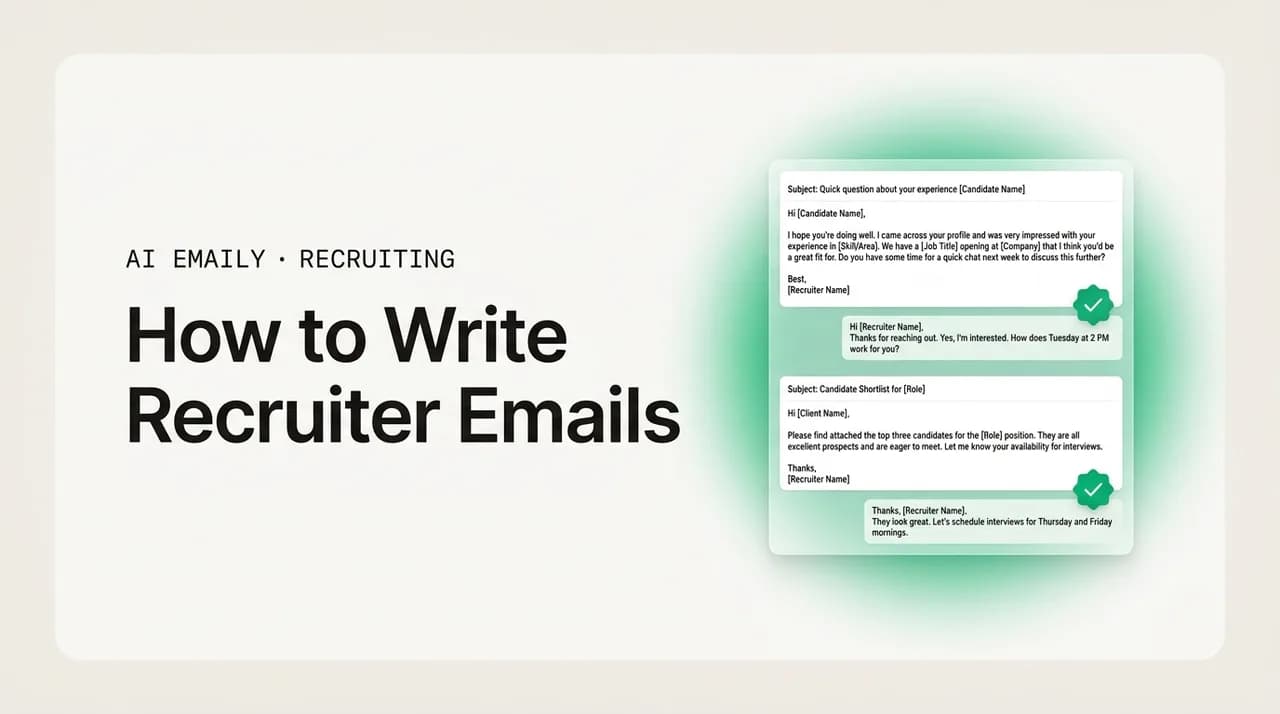
The short answer
Learning how to write recruiter emails to candidates comes down to a specific subject line, one line of real personalization, a single clear ask, and respect for the reader's time. Candidates want relevance and honesty; clients want proof and progress. Keep both short, follow up on a schedule, and never let an email sit unanswered.
Learn how to write recruiter emails to candidates and clients that get replies: subject lines, personalization, one clear ask, plus copy-paste examples for cold outreach, follow-up, offers, rejections, and client updates.
On this page
- 01Why recruiter emails live or die on the details
- 02What are the principles behind every good recruiter email?
- 03How is writing to candidates different from writing to clients?
- 04How do you write a cold outreach email to a candidate?
- 05How do you write a follow-up email to a candidate?
- 06How do you write an interview prep or confirmation email?
- 07How do you write an offer email to a candidate?
- 08How do you write a candidate rejection email that keeps the door open?
- 09How do you write a candidate submittal email to a client?
- 10How do you write a client status update email?
- 11How do you write a business development email to a prospective client?
- 12What is proper recruiter email etiquette, and how do you avoid looking spammy?
- 13What are the most common recruiter email mistakes?
- 14How can AI Emaily help you write better recruiter emails?
- 15Putting it all together
Why recruiter emails live or die on the details#
Every recruiter runs on email, and yet most recruiter email quietly underperforms. A sourcing note gets opened and ignored. A candidate update goes out a day too late, and the candidate has already accepted somewhere else. A client submittal buries the one detail the hiring manager actually cares about under three paragraphs of preamble. None of these are dramatic failures. They are small leaks, and across a desk that sends dozens of messages a day, small leaks add up to lost placements and lost fees.
The stakes are real and they are measured in days. In most desks, the best candidates are off the market in roughly ten days, and the national average time-to-fill sits around forty-four days. That gap is the whole game. The recruiter who writes the clearest email, sends it first, and follows up without dropping the thread is the one who presents the shortlist while the candidate is still available and the client is still paying attention. Speed matters, but speed without clarity just means you send a confusing message faster. This guide is about both.
Learning how to write recruiter emails to candidates and clients is not about clever copywriting or manufactured urgency. It is about a handful of principles applied consistently: a subject line that earns the open, a first line that proves you did your homework, one ask per message, and a tone calibrated to who is reading. Get those right and your reply rate climbs, your candidates stop ghosting, and your clients start treating you like a partner instead of a vendor. Get them wrong and even a perfect match sits unread in a full inbox.
There is a second reason the details matter more than they used to. Candidates, especially in scarce fields like tech and healthcare, are drowning in recruiter outreach. A software engineer with the right stack might get a dozen near-identical messages a week, all opening with "I came across your profile" and all asking for "fifteen minutes to connect." The default recruiter email has become invisible through sheer repetition. Standing out is no longer about being louder; it is about being unmistakably relevant and refreshingly human in a channel that has been flooded with templated noise.
This post walks through the principles first, then splits into the two audiences that behave completely differently, candidates and clients, before working through the specific scenarios you actually send: cold outreach, follow-ups, interview prep, offers, rejections, client submittals, status updates, and business development. Every scenario comes with an example you can adapt. Near the end there is a section on etiquette and avoiding the spammy patterns that get you filtered, the mistakes that cost replies, and an honest look at how an AI email client can draft all of this in your voice without turning your desk into a spam cannon.
What are the principles behind every good recruiter email?#
Before the templates, the fundamentals. These principles hold whether you are writing to a passive senior engineer or a hiring manager who has ghosted your last two updates. They are simple, which is exactly why they are so often skipped when you are firing off the fortieth message of the day.
Master these six and every specific email in the rest of this guide becomes a matter of filling in the blanks.
- 1
Write a subject line that earns the open
The subject line is the whole email if it fails, because nothing else gets read. Be specific and human, not clever or vague. "Senior Backend role at Stripe, remote, $200k+" beats "Exciting opportunity!" every time. For candidates, lead with the concrete detail that makes it worth opening: the company, the role, the comp, or a genuine reason you reached out. For clients, name the search and the update: "Two finalists ready for the VP Sales role." Avoid all-caps, exclamation points, and words like "free" or "urgent" that trip spam filters and read as mass mail.
- 2
Personalize the first line, for real
The opening line decides whether the reader keeps going or files you under generic recruiter spam. One sentence of specific, provable personalization is worth more than a paragraph of flattery. Reference the actual project on their GitHub, the talk they gave, the credential they just earned, the mutual connection, the reason this role fits their trajectory. "I saw you led the migration to Kubernetes at your last company" tells them you are a person who read their profile. "I came across your impressive background" tells them you pasted their name into a template.
- 3
Be clear and get to the point fast
Busy people skim. Put the point in the first two lines, not the last. State who you are, why you are writing, and what you are offering or asking before the fold. Cut throat-clearing like "I hope this email finds you well" and "I wanted to reach out to see if." Short paragraphs, plain words, and generous white space make an email feel answerable rather than like a chore. If the reader has to scroll to figure out what you want, you have already lost most of them.
- 4
Make one clear ask
The single most common recruiter email mistake is stacking asks: read the job description, and tell me your salary, and send your resume, and pick a time to chat. Each additional ask cuts your reply rate. Decide the one action you want from this specific message and make it obvious and easy. Usually the smallest yes is best: "Open to a quick chat this week?" is easier to say yes to than "Apply here." Save the resume and the salary question for after they have said they are interested.
- 5
Respect the reader's time
Every candidate and client is doing you a favor by reading. Honor that. Keep messages short, offer to work around their schedule, propose specific times so they do not have to think, and never make them chase you for information you promised. Respecting time also means honesty: if a role is not remote, say so; if the process has five rounds, say so. Wasting someone's time with a bait-and-switch is the fastest way to burn a relationship you will want again on the next req.
- 6
Follow up on a schedule, not a whim
Most replies come from the second or third message, not the first, yet many recruiters send once and give up. The fix is a light, spaced cadence: a first note, a short bump a few days later, and a final "still interested?" a week after that, then stop. Follow-ups should add something, a new angle, a reason, a nudge, not just "just checking in." And the moment someone replies, reply back fast; a warm lead cools quickly, and the fastest responder usually wins the placement.
One more principle sits underneath all six: the medium of your first line is you, not your agency. Candidates and clients reply to people, not to "the recruiting team." Write in a normal human voice, use your own name, and sound like someone they would actually want to talk to. The irony of high-volume recruiting is that the way to scale replies is to make each message feel un-scaled. The rest of this guide shows how to do that consistently, one scenario at a time.
The five-second test
How is writing to candidates different from writing to clients?#
The single biggest upgrade to your recruiter email is realizing that candidates and clients are not the same audience and should never get the same voice. A candidate is a person you are trying to attract, reassure, and guide through a stressful life decision. A client is a business buyer paying you a fee and judging you on results and professionalism. Use a candidate's warm, encouraging tone on a client and you sound junior; use a client's crisp, transactional tone on a candidate and you sound like a robot who sees them as inventory.
The goals differ too. With a candidate, you are selling the opportunity and the relationship: you want them to feel that this role and this recruiter are worth their limited attention, and you want them to keep talking to you rather than ghosting for the next shiny message. With a client, you are selling your judgment and your speed: you want them to trust that you understand the role, that the people you send are pre-vetted, and that you will keep them informed without being managed. One relationship runs on empathy; the other runs on proof.
Here is how the two break down side by side, so you can calibrate every email before you write it.
| Dimension | Writing to candidates | Writing to clients |
|---|---|---|
| Primary goal | Attract, reassure, and guide; keep them engaged through the process. | Demonstrate judgment, speed, and pre-vetted quality; earn repeat business. |
| Tone | Warm, human, encouraging, honest; a trusted advisor for their career. | Professional, confident, concise; a reliable partner and consultant. |
| What they care about | Relevance, compensation, growth, culture, respect for their time. | Fit to the brief, speed to shortlist, quality of candidates, results. |
| Length | Short, but room for one warm human line and clear next steps. | Short and scannable; lead with the outcome, details below. |
| The ask | Low-friction: "open to a quick chat?" rather than "apply now." | Decision-oriented: "can you review these two by Thursday?" |
| Personalization hook | Their work, projects, trajectory, and what is in it for them. | Their business, the specific role, and the pain of the vacancy. |
| Cadence when quiet | Gentle nudges; over-chasing reads as desperate and pushes them away. | Proactive updates on a schedule; silence reads as you dropping the ball. |
| Biggest risk | Sounding generic and templated, so they ghost you. | Sounding vague or slow, so they doubt your value and go elsewhere. |
Keep this table in your head as a switch you flip before every message. Notice that silence means opposite things to each audience. A candidate who has not replied usually wants space, and hammering them looks desperate; a client who has not heard from you usually assumes you have gone quiet on their search, and silence there reads as neglect. So you chase candidates gently and update clients proactively. Getting that one asymmetry right prevents a huge share of recruiter email misfires.
The rest of this guide is organized around these two audiences. First the candidate-facing scenarios, cold outreach through offer and rejection, then the client-facing ones, submittal through business development. Each is short enough to adapt in a minute, and each is built on the six principles above.
How do you write a cold outreach email to a candidate?#
Cold candidate outreach is the hardest email you send, because you are interrupting someone who did not ask to hear from you, in a channel already saturated with recruiter messages. The passive candidate who is quietly good at their job and not looking is exactly the person worth reaching, and exactly the person most numb to generic outreach. The whole email hinges on the first two lines proving, instantly, that this is not a mass blast.
The winning structure is short: a specific subject, a personalized hook that shows you know their work, a one-sentence reason this role fits them specifically, the two or three concrete details that matter (company, comp range, remote or not), and a single low-friction ask. Do not attach a job description, do not ask for a resume, and do not request their salary yet. You are asking for a conversation, nothing more.
Notice what that email does and does not do. It leads with something only a human who read her work could say, ties the role to her actual interests rather than her job title, gives the two numbers a candidate cares about most, and asks for fifteen minutes, not a commitment. It also explicitly lowers the pressure, which paradoxically raises reply rates, because passive candidates are more willing to talk when they do not feel like they are being recruited.
For high-volume desks where you are contacting many candidates for near-identical roles, the same structure applies, you just template the reusable middle and keep the personalized top and bottom genuinely custom. The danger at volume is that the personalization line quietly becomes generic and every email starts sounding the same. If you cannot say something specific and true about a given candidate, that is a signal the match may be weak, not a cue to fall back on "impressive background."
Lead with the number when you can
How do you write a follow-up email to a candidate?#
Most placements are won on the follow-up, not the first message, yet the follow-up is where most recruiters get lazy. The classic mistake is the empty "just checking in" or "bumping this to the top of your inbox," which adds nothing and reads as pestering. A good follow-up gives the reader a fresh reason to reply: a new detail, a deadline, a gentle acknowledgment that they are busy, or a genuinely easy out.
Keep the cadence light and finite. A reasonable rhythm for cold outreach is: initial message, a short bump three to four days later, and a final "still interested?" note about a week after that, then stop and move on. Three touches, spaced, is plenty; beyond that you are training them to ignore you. Here is a follow-up that adds value instead of just nagging.
The "reply not now and I will stop" line does real work. It respects the reader's time, it gives them a frictionless way to close the loop, and it often surfaces a "actually, tell me more" you would never have gotten from another guilt-driven nudge. Candidates ghost partly because saying no feels awkward; make the no easy and you either get a clean close or an honest yes.
For candidates already in your pipeline, the follow-up shifts from re-engagement to keeping them warm. The cardinal sin here is silence between stages. A candidate who has interviewed and heard nothing for a week assumes rejection and starts entertaining other offers. Even a two-line "no news yet, but you are still very much in it, expecting an update by Friday" keeps them engaged and dramatically cuts ghosting. When you have nothing to report, reporting that you have nothing to report is still the move.
How do you write an interview prep or confirmation email?#
The interview prep email is where good recruiters separate themselves, because it is pure value to the candidate and it directly improves your submittal's odds. A candidate who walks in prepared performs better, which reflects well on you with the client. This email should confirm the logistics with zero ambiguity and then arm the candidate with everything they need to succeed.
Cover the essentials so nobody is guessing: date, time with timezone, format and link or address, who they will meet and their roles, how long it will run, and what to prepare or bring. Then add the insider value: what the interviewer tends to focus on, the two things this client cares most about, and a note of genuine encouragement. Precision here prevents the missed-timezone, wrong-link disasters that make you look disorganized in front of your client.
Confirm the timezone explicitly
How do you write an offer email to a candidate?#
The offer email is the payoff, and it deserves care because a fumbled offer can lose a placement at the finish line. This is a moment of genuine good news, so the tone should be warm and celebratory, but it also has to be crystal clear on the terms and the next steps, because the candidate will read it several times and forward it to their partner. Ambiguity here creates anxiety exactly when you want confidence.
State the headline clearly, then lay out the concrete terms: title, base compensation, any bonus or equity, start date, location or remote arrangement, and reporting line. Point to the formal offer document, give a clear window for their decision without high-pressure tactics, and make yourself available for questions. Enthusiasm is welcome; artificial urgency is not, a candidate pressured into an offer often reneges later.
How do you write a candidate rejection email that keeps the door open?#
Rejection emails are where recruiter reputations are quietly made or destroyed. The candidate you reject today may be the perfect placement next quarter, and they will absolutely remember whether you treated them like a human or ghosted them into silence. The rejected-candidate experience is one of the strongest, and most neglected, sources of future pipeline and referrals. A prompt, respectful, specific rejection is a competitive advantage, because so few recruiters bother to send one.
The formula is short and sincere: thank them genuinely, deliver the decision clearly and without burying it, offer one piece of specific and kind feedback if you can, and leave a warm door open for the future. Do not over-explain, do not offer false hope, and never let a rejection drag out or, worse, never arrive. Silence after an interview is the single most damaging thing you can do to a candidate relationship.
Send the rejection fast, and always send it
How do you write a candidate submittal email to a client?#
Now we switch audiences. The submittal, presenting a shortlisted candidate to your client, is the most important client email you send, because it is where your judgment is on display. A hiring manager receives many resumes; your job is to make yours the one they act on, by doing their thinking for them. The submittal is not a resume forward with "see attached." It is a tight sales case for why this specific person solves their specific problem.
Lead with the punchline: who they are and the one reason they fit. Then give three or four crisp bullets mapping the candidate's experience to the client's actual requirements, not a full career history. Note the practical facts a hiring manager needs to move, availability, comp expectations, work authorization, notice period, and close with a clear ask and a proposed next step. Make saying yes as frictionless as possible.
The difference between that submittal and a forwarded resume is the difference between a placement and a maybe. The hiring manager can read four bullets and make a go decision in thirty seconds, which is exactly what a busy client wants. Every bullet ties directly back to something they told you they needed, which signals that you listened at the intake, the single most important trust-builder with a client. And the close gives them one easy action with a soft deadline, keeping the search moving on your timeline rather than theirs.
A note on volume: even on high-throughput staffing desks where you are submitting many candidates a day, the structure holds, you just tighten it. The temptation at volume is to blast resumes and let the client sort them, but that erodes the exact judgment you are being paid for. A shortlist of two well-argued submittals beats a pile of ten unfiltered ones, and it is what turns a one-off client into a repeat account.
How do you write a client status update email?#
Client update emails are the unglamorous work that separates trusted partners from vendors clients forget about. A hiring manager's biggest anxiety with an external recruiter is not knowing whether anything is happening. Silence, even when you are working hard behind the scenes, reads as neglect. Proactive, scheduled updates, sent before the client asks, are the single most effective thing you can do to build the trust that leads to repeat and exclusive business.
A good status update is short, structured, and honest. Lead with where the search stands, give a quick pipeline snapshot in numbers, flag anything that needs a client decision, and state what happens next and when. Send them on a predictable cadence, weekly is standard for an active search, so the client never wonders. And when the news is not great, say so plainly with a plan, an honest "the market is tighter than we hoped, here is how I am adjusting" builds more trust than false cheer.
Update on a schedule, even with no news
How do you write a business development email to a prospective client?#
Business development email, cold outreach to a company that might become a client, is the recruiter equivalent of cold candidate outreach, and it lives or dies on the same principles: relevance, a single ask, and respect for a busy person's time. Hiring managers and founders get pitched by agencies constantly, almost all with the same "we have great candidates" opener. To stand out, lead with a specific, provable observation about their business and hiring, not a generic capability pitch.
The strongest BD emails demonstrate that you already understand their world. Reference the specific role they have had open for months, the team they are visibly scaling, the funding they just raised, or a candidate profile in your network that fits a gap you can see. Then make one small ask, a fifteen-minute conversation, not "send us your reqs." You are selling a conversation and a signal that you get their space, not a signed contract.
That email works because it opens with something only someone who researched Vantail could say, offers immediate value (a real candidate) before asking for anything, and requests a small, specific slice of time. It sells outcomes and understanding, not agency features. The generic version, "We are a leading recruitment agency with access to top talent, can we set up a call to discuss your hiring needs?" gets deleted precisely because it could have been sent to any company on earth.
As with candidate outreach, follow-up is where BD is won. A single unanswered BD email means nothing; a light three-touch sequence, with each touch adding a new angle or candidate, is how conversations actually start. And the same honesty rule applies: do not overpromise a bench of candidates you do not have. The fastest way to lose a client you just won is to submit weak profiles after a strong pitch.
What is proper recruiter email etiquette, and how do you avoid looking spammy?#
Everything above assumes your email actually reaches the inbox and reads as a human wrote it. That is not guaranteed. Recruiters send high volumes of similar messages, which is exactly the pattern spam filters and jaded readers are trained to catch. A few etiquette habits keep you on the right side of both the algorithm and the human.
The biggest risk is looking like mass mail, in the eyes of both filters and people. Spammy signals compound: identical templated bodies sent to hundreds of addresses, spammy subject-line words, image-heavy layouts, misleading subjects, no clear unsubscribe or opt-out on true bulk sends, and sending from a freshly-created domain with no reputation. You avoid the filter the same way you win the reply: by making each message specific, plain-text, personal, and genuinely relevant.
- Personalize enough to be un-template-able. A first line that could only have been written to this one person is both your best reply-rate lever and your best deliverability signal, because it breaks the identical-mass-mail pattern filters look for.
- Watch your subject lines. Avoid all-caps, multiple exclamation points, and trigger words like "free," "guarantee," "act now," or "urgent." Write subjects that describe the actual content, misleading subjects tank both trust and deliverability.
- Prefer plain text and light formatting. Heavy images, huge signatures, and lots of links look like marketing blasts. A mostly-text email from a real person is more likely to land in the inbox and to feel personal.
- Respect opt-outs and the law. If someone says stop, stop, immediately and permanently. For genuine bulk outreach, follow the rules that apply to you (such as CAN-SPAM in the US or GDPR-based consent rules in the EU), including honest headers and a real way to opt out.
- Do not over-follow-up. Three well-spaced touches is assertive; seven is harassment. A light finite cadence protects your reputation and your sender score; relentless nudging gets you marked as spam and blacklisted from a candidate's mind.
- Send from a warmed, reputable domain and mind your volume. Blasting hundreds of cold emails from a brand-new domain in a day is the fastest way into the spam folder. Ramp volume gradually and keep your bounce rate low by cleaning bad addresses.
- Never bait and switch. A subject or opener that promises one thing and delivers another might get the open, but it destroys trust the moment they read on, and trust is the entire recruiter relationship.
Volume without personalization is a reputation risk
What are the most common recruiter email mistakes?#
Most recruiter email failures are not exotic, they are the same handful of habits repeated across thousands of desks. Here are the ones that cost the most replies and placements, with the fix for each.
- Generic, template-obvious openers. "I came across your impressive profile" signals mass mail instantly. Fix: one specific, provable line about their actual work or the client's actual business before anything else.
- Stacking multiple asks in one email. Asking for a resume, salary, availability, and a call at once tanks reply rates. Fix: one clear, low-friction ask per message, usually just a short conversation.
- Vague or clickbait subject lines. "Exciting opportunity!" and "Quick question" get ignored or filtered. Fix: describe the actual content, the role, company, comp, or the specific update.
- Going silent between stages. A candidate or client who hears nothing assumes the worst and moves on. Fix: send a short holding update even when you have no news, on a predictable cadence.
- Confusing candidate tone with client tone. Warm-and-fuzzy reads as junior to a client; crisp-and-transactional reads as robotic to a candidate. Fix: flip the switch consciously before every email.
- Burying the point. Making the reader scroll to learn what you want loses skimmers. Fix: put who you are, why it is relevant, and the ask in the first two lines.
- Overpromising to win the deal. Pitching a bench you do not have or a role that is not really remote wins the open and loses the relationship. Fix: be honest about comp, model, and process up front.
- Never following up, or following up forever. Sending once wastes most leads; nagging seven times burns the relationship. Fix: a light, finite three-touch cadence that adds value each time.
- Typos in names, dates, and links. A misspelled candidate name or a wrong interview link undoes all your careful personalization. Fix: proofread the variable fields every single time, especially in templated sends.
- Slow replies to warm leads. The fastest responder usually wins the placement; a day's delay can cost a candidate who is off the market in ten. Fix: reply to engaged candidates and clients fast, even briefly.
How can AI Emaily help you write better recruiter emails?#
Everything in this guide is doable by hand. The problem is not knowing what to write, it is writing it, personalized and on time, across the dozens of candidate and client threads a real desk runs at once, on the day the best candidates are already halfway out the market. That gap between knowing and doing, at volume, without dropping anyone, is exactly where an AI email client earns its place. AI Emaily is an AI-native email client that connects to Gmail, Outlook, and any IMAP account and acts as an autonomous chief of staff for your inbox, and it is built for precisely this kind of relationship-heavy, high-volume email.
The core idea is that it drafts in your voice, per relationship, not from a generic template pool. Because it learns how you actually write and can see the history of a given thread, an outreach draft to a passive engineer comes back warm and human, a submittal to a hiring manager comes back crisp and evidence-led, and a client status update comes back structured and honest, each calibrated to the audience the way this guide describes, rather than one flat template blasted to everyone. That is what keeps personalization real as your volume climbs, the exact failure point that turns recruiter email into spam.
It also closes the follow-up gap that costs the most placements. Outreach follow-ups, "still interested?" nudges, interview confirmations, and scheduling back-and-forth are the highly repetitive, highly templated work that eats a recruiter's day, and it is exactly the work an agent can carry. AI Emaily can draft the follow-up on the right cadence, keep candidates warm between stages so they stop ghosting, and handle the interview-scheduling volleys, so no candidate or client ever falls through a missed follow-up.
Crucially, you stay in control, because these are relationships you cannot afford to get wrong. It runs in Manual, Copilot, and Autopilot modes: draft and review everything yourself, let Copilot prepare each message for a quick approve-and-send, or let Autopilot handle the safe, repetitive categories like scheduling confirmations and routine nudges on its own, always with undo and a full audit trail of every action it took. The judgment stays yours; the busywork does not. You can try it free at app.aiemaily.com/signup, with a Free plan at no cost and Pro at $12.42 per month on the annual plan.
Putting it all together#
Knowing how to write recruiter emails to candidates and clients is really about internalizing a small set of principles and then flipping between two voices. The principles never change: a specific subject line that earns the open, one line of real personalization that proves you did the work, clarity that puts the point up front, a single low-friction ask, genuine respect for the reader's time, and a light, finite follow-up cadence. Apply those six to any message and it will outperform the generic recruiter email flooding every inbox.
The two voices are the other half. Candidates want warmth, relevance, honesty, and a reason this matters to them; clients want proof, speed, structure, and the reassurance that you understand their business and will not go dark. Cold outreach, follow-ups, prep, offers, and rejections lean on the candidate voice; submittals, status updates, and business development lean on the client voice. Silence hurts you with both, but you chase candidates gently and update clients proactively, that one asymmetry, done right, prevents most misfires.
Grab whichever example above matches the email in front of you, swap in the real details, and send it before the ten-day window closes. And if doing that consistently across a full desk, personalized and on time, is the part that keeps slipping, let your email client draft it in your voice and carry the repetitive follow-ups, so you spend your time on the judgment calls and the closing, and never lose a candidate to a message you meant to send.
Frequently asked
See it in AI Emaily
Keep reading
Sources

Written by
Nafiul HasanNafiul Hasan is an entrepreneur and AI automation system builder with 10+ years of experience turning messy, manual workflows into reliable automated systems. He designs and ships AI enterprise solutions end-to-end — the agent logic, the data plumbing, and the product people actually use — and founded AI Emaily to give busy professionals their attention back. He writes here from the builder's seat: what works, what breaks, and how to put AI to work without giving up control.