How to Write Travel Advisor Client Emails: Examples, Etiquette & AI Shortcuts

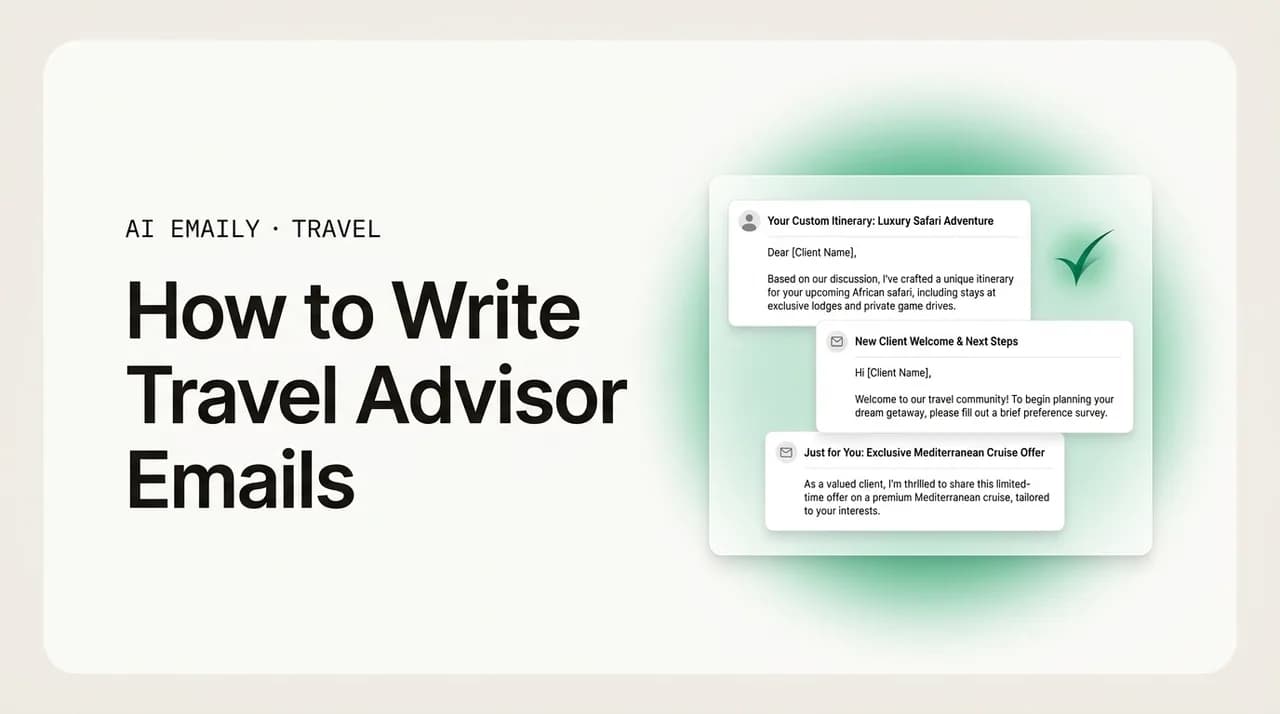
The short answer
Great travel advisor client emails are personal, clear, and warm: use the client's name and trip details, set expectations for what happens next, write a specific subject line, and let one line evoke the trip itself. Match the tone to the moment, keep bookings and money unambiguous, and draft fast with AI while you approve every send.
Learn how to write travel agent client emails that feel warm and white-glove: principles, etiquette, and ten annotated examples for every touchpoint from inquiry to referral, plus how AI drafts them in your voice under your approval.
On this page
- 01Why learning how to write travel agent client emails is your real product
- 02What makes a travel advisor client email feel white-glove?
- 03How should you reply to a new travel inquiry?
- 04What do you send after a consultation call?
- 05How do you present a proposal or quote?
- 06What should a booking confirmation email say?
- 07How do you write a pre-trip email?
- 08Should you check in with clients during their trip?
- 09What do you send after a client returns home?
- 10How do you ask for a review or referral?
- 11How do you handle a difficult conversation like a price change?
- 12Which tone fits which client email?
- 13What etiquette separates luxury communication from ordinary service?
- 14What are the most common mistakes in travel advisor client emails?
- 15How does AI Emaily help you write client emails?
- 16Putting it all together
Why learning how to write travel agent client emails is your real product#
When you strip a travel advisory business down to what the client actually experiences, most of it is email. They meet you in the inbox, decide whether to trust you in the inbox, hand over deposits from the inbox, and rave about you afterward because of how you made them feel there. Learning how to write travel agent client emails well is not a soft skill you get to eventually; it is the product. The itinerary is what you sell, but the emails are how the client feels the care you put into it, and for a service business that runs on referrals and repeat trips, that feeling is the whole moat.
This matters more for advisors than for almost any other profession, because your clients are not buying a commodity. They are buying reassurance. Someone spending five figures on a milestone anniversary, a multigenerational reunion, or a once-in-a-lifetime safari is quietly anxious the entire way through, and every email you send either calms that anxiety or feeds it. A confirmation that lands the same afternoon says "I have you." A vague reply three days later says "I might be juggling too much." The words are doing emotional work whether you intend them to or not, so you may as well intend them to.
There is a business case underneath the craft, too. Agencies that respond faster and communicate more consistently convert more of the leads they get and keep more of the clients they win. The advisors who feel perpetually behind on email are usually the same advisors leaving money on the table, not because they are bad at travel but because a good inquiry went cold while they were mid-itinerary for someone else. Writing better client emails, faster, is one of the highest-leverage things a solo or hosted advisor can do, and it is entirely learnable.
This guide is built for the way independent and hosted advisors actually work: as a one-person business where you are the designer, the salesperson, and the person who personally types every deposit reminder and pre-trip checklist. We will start with the principles that make a client email feel white-glove rather than transactional, then walk through ten real scenarios with annotated example emails you can adapt, from the first inquiry reply to the delicate price-change conversation nobody enjoys. After the examples you will find a tone-by-scenario reference table, the etiquette that separates luxury communication from ordinary customer service, the mistakes that quietly cost you bookings, and an honest look at where AI genuinely helps and where it must never be let loose.
Throughout, the throughline is this: the goal is not to sound like a brochure or a chatbot. It is to sound like you, on your most attentive day, for every client, even the twentieth email of an exhausting Tuesday. That consistency is what clients remember, and it is exactly the thing that slips when you are tired and rushing.
Who this guide is for
What makes a travel advisor client email feel white-glove?#
Before any template, it helps to name the qualities that make a message feel like it came from a trusted advisor rather than a booking engine. These are the levers you pull on every email, and once you internalize them you can write a warm, on-brand note for any situation without a script. There are six of them, and they compound: an email that hits all six feels genuinely luxurious even when it is three sentences long.
- 1
A genuine personal touch
Reference something only this client would recognize — the anniversary the trip celebrates, the fact that they mentioned their daughter is a nervous flyer, the wine region they loved last time. One specific, human detail early in the email tells the reader you see them as a person, not a booking reference. Generic warmth ("Hope you're doing well!") does the opposite; it signals a template.
- 2
Clarity above cleverness
Say exactly what you mean in plain language. The client should never have to reread a sentence to understand what is confirmed, what they owe, or what happens next. Precision is a form of respect for their time, and in email especially, unambiguous writing is what separates a professional from an amateur.
- 3
Expectations set every time
End almost every email by telling the client what happens next and by when: "I'll send the full proposal by Thursday," or "You'll get your final documents about a week before departure." Unset expectations are the single biggest source of client anxiety and follow-up chasing. When you set them, the client relaxes and stops emailing you to ask.
- 4
A subject line that does its job
The subject line is a promise about what is inside. "Your Amalfi Coast proposal is ready" or "Action needed: deposit due Friday to hold your cabin" tells the client what the email is and whether it needs them, before they even open it. Vague subjects like "Update" or "Following up" get buried; specific ones get opened.
- 5
A moment that evokes the trip
One sensory line — "picture your first morning coffee on the terrace overlooking the caldera" — reminds the client why they hired you and what they are buying. You are not just booking logistics; you are selling the anticipation of the trip. A single evocative sentence, used sparingly, turns an admin email into a small thrill.
- 6
A tone matched to the moment
The right register shifts with the situation: celebratory for a booking confirmation, calm and precise for a payment reminder, gracious and solution-first for a problem. Reading the moment correctly — and not sending a chirpy note when the client needs reassurance — is what makes clients feel truly looked after.
Notice that none of these require flowery language or long paragraphs. A white-glove email is often shorter than an ordinary one, because it is confident about what matters and cuts the rest. The advisor who writes three tight, warm sentences that answer the client's real question feels more premium than the one who sends five padded paragraphs of hedging. Luxury, in writing, is precision plus warmth, not volume.
The other thing these six have in common is that they are repeatable. You do not need inspiration to hit them; you need a habit. That is good news, because it means the quality of your client communication does not have to depend on how you happen to feel that day. And it is exactly why this is a task that pairs so well with a tool that can carry your voice across every message, which we will come to at the end.
The one-detail rule
How should you reply to a new travel inquiry?#
The inquiry reply is the most important email you will ever send a prospective client, because it is the one that decides whether they become a client at all. A well-qualified traveler who fills out your inquiry form or emails a friend's referral is, at that moment, contacting other advisors too. The speed and warmth of your first reply is often the entire basis on which they choose. Aim to respond the same day, even if the full answer has to come later; a fast, human acknowledgment beats a perfect reply that arrives on day three.
The job of this email is not to answer every question or price the trip. It is to make the person feel heard, establish that you are a real, attentive human, and move the conversation to a proper consultation where you can actually do your work. Resist the urge to quote or over-deliver here; that comes later. Confirm you received their note, reflect back what you heard so they know you were paying attention, and propose a clear next step.
A few things are doing the heavy lifting there. The subject line reuses their words ("Honeymoon in Italy") so the reply is unmistakable in a crowded inbox, and adds warmth. The second paragraph reflects back the specifics they gave — the timeframe, the regions, the budget range — which proves you read their note rather than firing off a canned reply. And it ends with one clear next step and two concrete time options, which removes the friction of scheduling and dramatically raises the odds they actually book the call.
If you charge a planning or consultation fee, this is also where you introduce it — gently, and framed as the value it buys, not as a toll. Something like: "I work on a planning-fee basis, which lets me design around you rather than around commissions; I'll walk you through exactly what that includes on our call." Naming it early prevents an awkward surprise later and pre-qualifies the people who value your expertise.
Same-day beats perfect
What do you send after a consultation call?#
The post-consultation follow-up is where a promising conversation either becomes a project or quietly evaporates. You have just spent thirty or sixty minutes learning what the client wants; the follow-up email captures that momentum, confirms you understood, and tells them exactly what happens next. Send it the same day while the conversation is fresh, because the client's excitement is highest right after they hang up and cools with every hour of silence.
The structure is simple: thank them, summarize what you heard so they can correct any misunderstanding before you build the wrong trip, and state clearly what you will deliver and by when. That summary is not busywork — it is a small contract that protects both of you from a mismatch, and clients find it genuinely reassuring to see their scattered wishes reflected back as a coherent brief.
The line that earns the most goodwill here is "tell me if I've missed anything." It invites correction, which both prevents costly rework and signals humility — you are collaborating, not dictating. The other quiet win is the explicit deliverable and date ("a first proposal... by Tuesday"). The client now knows they do not need to chase you, and you have given yourself a clear, self-imposed deadline that keeps the project moving.
For group and destination-wedding advisors, the same email does extra duty: it is where you confirm the headcount you are planning around, the event date that anchors everything, and who your point of contact will be for the group. Nailing those three facts in writing, right after the call, prevents the slow-motion chaos that unravels group trips when assumptions go unstated.
How do you present a proposal or quote?#
The proposal email is your showcase, and it is where advisors most often undersell themselves. The instinct is to dump the itinerary and the price and let them speak for themselves, but a bare quote invites the client to shop it around or fixate on the number. Your job in this email is to frame the trip as an experience you have designed for them specifically, make the value visible, and guide them toward a clear yes.
Lead with the vision, not the logistics. Open by painting the trip in a sentence or two — this is where you evoke the experience — then present the plan clearly, and only then get to price, always tied to what it includes. Make the next step obvious: what should they do if they love it, and how long is this held. Where possible, put the detailed day-by-day itinerary in an attached document or a shared itinerary link and keep the email itself warm and orienting, so the client is not drowning in specifics before they have felt the excitement.
Study the order there: vision, then plan, then price, then next step. By the time the client reaches the number, they have already pictured the trip and seen everything it includes, so the price reads as the cost of something they want rather than an abstract figure to negotiate down. The gentle hold ("through Monday") creates a real, honest reason to decide without resorting to fake urgency, which luxury clients can smell instantly and resent.
One discipline worth keeping: never bury the price or make the client hunt for it. Coyness about money reads as either amateurish or manipulative, both of which erode trust. State it plainly, tie it to the value, and move on. Confident clarity about price is itself a mark of a premium advisor; hedging is the tell of an anxious one.
Don't let the itinerary swallow the email
What should a booking confirmation email say?#
The booking confirmation is a moment to celebrate with the client and, just as importantly, to remove any lingering doubt that everything is truly locked in. The client has just committed money; a warm, precise confirmation the same day tells them they made the right choice and that they are in careful hands. This is one of the most repeatable emails you send — the structure barely changes booking to booking — which is exactly why it is so easy to let it become cold and mechanical. Resist that.
A great confirmation does three things: it celebrates, it confirms the concrete facts (what is booked, the dates, the key reference numbers), and it sets the very next expectation so the client knows what is coming and when. Clarity about money is non-negotiable here — if a deposit has been taken and a balance remains, state both plainly, including the balance-due date.
The phrase "nothing more for you to do right now" is doing quiet, valuable work: it preempts the client's low-grade worry that they have forgotten a step. Telling clients explicitly when there is nothing to do is as reassuring as telling them what to do, and it stops a stream of anxious "do I need to...?" emails before they start.
For cruise and group specialists, this is the email that repeats most and rewards standardization most. The bones — celebration, confirmed sailing or event dates, cabin or room category, deposit received, balance and final-payment date, and "here's what's next" — are identical booking to booking, with only the details swapped. That repeatability is precisely why this touchpoint is such a strong candidate for AI drafting and even light automation: the message must go out consistently and warmly on every single booking, and doing that by hand is the kind of work that eats an advisor's evenings.
Money is never the place for vagueness
How do you write a pre-trip email?#
The pre-trip email lands roughly a week or two before departure and is where your service becomes tangible. The client is now genuinely excited (and a little nervous), and a thorough, calm pre-trip note is one of the clearest signals of a professional advisor. It gathers everything they need in one place, answers the questions they were about to ask, and reassures them that you have thought of the details they haven't.
The trick is to be comprehensive without being overwhelming. Group the essentials clearly — documents, timings, what to know, how to reach you — and lead with reassurance rather than a barrage of instructions. Attach or link the formal documents and use the email to orient rather than to dump. And always, always include how to reach you if something goes sideways while they are away; that single line is worth more than any brochure.
The emotional core of that email is the reassurance that you are on call. Clients pay a premium precisely so that a problem abroad becomes your problem, not theirs, and saying so explicitly — with a real number and an open invitation to use it — is what converts a good trip into a client for life. The practical checklist matters, but the line that gets remembered is "text or call me for anything at all."
For cruise specialists, the pre-trip email carries specific, high-stakes items: online check-in windows, boarding and terminal details, required documents, and cabin logistics. For destination weddings and groups, it often goes to many travelers at once and must be crisp about arrival timing, dress codes, and group transfers. In both cases the content is largely templated per trip type, which is what makes this touchpoint another strong fit for drafting assistance — the structure is stable, only the specifics change.
Should you check in with clients during their trip?#
A brief in-trip check-in is a small gesture that clients remember out of all proportion to the effort it takes. A single warm message a day or two into the trip — "just thinking of you, hope Rome is everything you hoped" — does two things: it makes the client feel cared for beyond the transaction, and it opens a low-pressure door for them to flag anything that isn't quite right while there is still time to fix it. Many advisors skip this, which is exactly why doing it sets you apart.
Keep it light and genuinely optional to answer. The client is on holiday; the last thing they want is homework. The message should communicate warmth and availability, not demand a response. Read the moment, too — a check-in is lovely; three check-ins is intrusive.
The explicit "no need to reply" is what makes this gracious rather than needy. It gives the client permission to ignore the message guilt-free while still knowing you are there — which is the entire point. And by naming a small, useful offer ("a last-minute dinner idea"), you remind them, in a natural way, that your value continues throughout the trip, not just at the booking.
This is the one touchpoint on the list to be most careful about automating. A check-in that is obviously generic — that could have gone to any client on any trip — undermines the very intimacy it is trying to create. If you draft it with help, personalize it heavily, or reserve it as one of the messages you always write by hand. Warmth that reads as automated is worse than no message at all.
Never let a personal touch feel automated
What do you send after a client returns home?#
The welcome-home email closes the loop and, handled well, quietly opens the door to the next trip. The client is back, glowing from the experience you designed, and this is the warmest they will ever feel toward you. A thoughtful welcome-home note both honors that feeling and, without any hard sell, plants the seed for the future — repeat business and referrals, which are the lifeblood of an advisory practice.
Lead with genuine interest in how it went, not with a request. Ask about the trip, mention a specific detail you're curious about, and let them relive it a little. Only after that warmth do you gently gesture at the future or, separately, ask for the review — and even then, lightly.
That email sells nothing and yet does more for future revenue than any promotion could, because it makes the client feel that you cared about the experience itself, not just the transaction. The reference to future occasions is soft and generous ("it would be a privilege"), which is exactly the register that keeps a luxury client. Anything pushier here would cheapen the relationship you just spent a whole trip building.
Time this one for a few days after they land — long enough that they have unpacked and slept, soon enough that the glow hasn't faded. And keep the review ask separate from, or very gentle within, the welcome-home note, so the reconnection doesn't feel like a setup for a favor.
How do you ask for a review or referral?#
Reviews and referrals are how advisory practices grow, yet many advisors never ask, because asking feels awkward. The fix is to make the request specific, easy, and gracious, and to time it when goodwill is highest — right after a trip they loved. Framed well, a review ask is not an imposition; it is an invitation to help other travelers find someone who will take care of them the way you took care of them.
The keys are to make it effortless (give them the exact link or the exact thing you need), to keep it low-pressure, and to be genuinely grateful. For referrals specifically, name the kind of person you love working with, so they know who to think of — a vague "tell your friends" gets nothing; "if you know anyone planning a big anniversary trip" gives them a hook.
The parenthetical "only if you have a minute" in the subject line lowers the stakes before the client even opens the email, which paradoxically makes them more likely to help. The direct link removes the friction that kills most review requests — if the client has to go find the right page, they won't. And the referral ask is specific about the occasion, giving the client a concrete pattern to match against people in their life.
Send this once, gracefully, and do not nag. A single well-crafted ask converts far better than repeated reminders, which sour the relationship. If they don't respond, let it go; the goodwill from the trip itself will keep working for you regardless.
How do you handle a difficult conversation like a price change?#
Sooner or later a supplier raises a rate, a held price expires, a cabin category sells out, or an exchange rate moves against the client. These difficult emails are where advisors earn their trust or lose it, and the instinct to soften, delay, or bury the bad news is exactly the wrong one. Clients forgive problems handled with honesty and a plan; they do not forgive feeling misled or kept in the dark.
The pattern for any hard conversation is the same: be prompt, be honest, take ownership of communicating it clearly, and lead with the solution. Do not open with an apology paragraph that makes the client anxious before they even know what happened; state the situation plainly, explain briefly why, and immediately present options. Your calm competence in a bad moment is more memorable than a dozen smooth confirmations.
The reason that email works is that it never leaves the client stranded in the problem. Within two sentences of hearing the bad news they are looking at three concrete ways out, each with the tradeoff made plain. The advisor takes responsibility for communicating clearly and for fixing it, without either grovelling or making excuses. That combination — candor plus a plan — is the single most trust-building thing you can do, and it is the exact opposite of the vague, delayed, over-apologetic email most people send when they are dreading a conversation.
Note also what is not there: no long chain of blame, no defensive over-explanation, no pretending it isn't a hassle. A brief, sincere acknowledgment ("I'm sorry for the wrinkle") is enough. Dwelling on the apology makes it about your discomfort; leading with the solution keeps it about the client's trip, which is where their attention actually is.
Lead with the fix, not the apology
Which tone fits which client email?#
Matching tone to the moment is one of the six white-glove levers, and it is worth making explicit because the wrong register can undo an otherwise perfect email. A chirpy, exclamation-heavy note is delightful on a booking confirmation and jarring on a price change. The table below maps each scenario to the tone that fits, the one job that email must accomplish, and the trap to avoid. Use it as a quick gut-check before you hit send.
| Scenario | Tone | The one job | Avoid |
|---|---|---|---|
| Inquiry reply | Warm, prompt, curious | Make them feel heard and book the call | Quoting or over-answering before you understand the trip |
| Consultation follow-up | Attentive, organized | Reflect back the brief and set the deliverable | Vagueness about what you'll send and when |
| Proposal / quote | Evocative, confident | Sell the experience, then the price | Dumping logistics and burying the value |
| Booking confirmation | Celebratory, precise | Celebrate and lock in the facts and money | Cold, mechanical repetition; fuzzy on the balance |
| Pre-trip | Calm, reassuring, thorough | Everything they need + how to reach you | Overwhelming them with an undifferentiated data dump |
| In-trip check-in | Light, caring, optional | Show care and open a door, expecting no reply | Anything generic or demanding a response |
| Welcome home | Warm, curious, unhurried | Reconnect and gently open the future | Turning it into a hard sell or a favor request |
| Review / referral ask | Gracious, specific, low-pressure | Make helping effortless and named | Nagging, or a vague "tell your friends" |
| Difficult conversation | Honest, calm, solution-first | State it plainly and lead with options | Delay, a long apology, or burying the news |
What etiquette separates luxury communication from ordinary service?#
Beyond the scenario-by-scenario craft, a handful of etiquette habits quietly signal to clients that they are working with a true professional rather than an order-taker. These are the things high-end clients notice — often unconsciously — and they are what let a solo advisor feel as polished as a luxury brand's concierge desk.
- Respond faster than expected. In a premium service, speed is a form of respect. Even a quick acknowledgment within hours tells the client they are a priority; a same-day full reply feels like a gift. The lag between message and reply is one of the loudest signals of how much you care.
- Anticipate the next question. The best advisors answer the question the client hasn't asked yet — the dress code, the transfer detail, the "is there anything I need to do?" Anticipation is the essence of white-glove service, and it dramatically cuts the back-and-forth.
- Be impeccably clear about money and logistics. Never make a client guess what they owe or when. Plain numbers, plain dates, stated every time. Precision here is not cold; it is the deepest form of reassurance.
- Personalize beyond the name. Anyone can merge a first name. Referencing the occasion, a preference they mentioned, or a detail from last time is what proves the personalization is real and the relationship is remembered.
- Keep your voice consistent. A client should feel the same warmth in your twentieth email as your first. Consistency of voice across every touchpoint is what builds a recognizable, trusted personal brand — and it is exactly what slips when you're tired.
- Proofread as if it matters, because it does. A typo in a client's name, a wrong date, or a broken sentence undercuts the premium impression instantly. In luxury communication, the details are the message.
- Match their formality, then lean slightly warmer. Mirror how the client writes to you — some want breezy, some want polished — and add a touch more warmth than strictly necessary. Reading the client's register and meeting it is a subtle mark of attentiveness.
- Close the loop, always. Every promise you make in an email — "I'll check on that," "I'll send it Tuesday" — must be kept and confirmed. Reliability, demonstrated over and over in small ways, is the entire foundation of trust.
None of these are expensive or complicated. They are habits, and habits are exactly the thing that erode when an advisor is buried in email and racing to keep up. That is the real tension at the heart of this profession: the communication standards that win and keep premium clients are the first casualties of being overwhelmed. Solving the overwhelm without lowering the standard is the whole game.
Consistency is the luxury
What are the most common mistakes in travel advisor client emails?#
Most client-email failures are not dramatic; they are small, repeated lapses that quietly cost bookings and dull the premium impression. Here are the ones that come up again and again, with what to do instead.
- Replying too slowly to inquiries. The most expensive mistake in the business. A great lead goes cold in a day. Acknowledge fast, even if the full reply comes later, and never let an inquiry sit overnight without a human touch.
- Sending cold, templated-feeling messages. A confirmation or check-in that could have gone to anyone reads as indifference. Personalize with a real detail; the moment an email feels generic, the white-glove feeling evaporates.
- Being vague about money or logistics. "The balance is due later" or "we'll sort the details closer to the time" creates anxiety and missed deadlines. State amounts and dates plainly, every time.
- Failing to set expectations. Not saying what happens next leaves the client to imagine the worst and chase you. End emails by stating the next step and its timing.
- Weak or vague subject lines. "Update" and "Following up" get buried. Make the subject a clear promise of what's inside and whether it needs the client.
- Overwhelming the client with detail. A proposal or pre-trip email that dumps every time and confirmation number buries the signal. Lead with orientation; put granular detail in an attachment or itinerary tool.
- Over-apologizing or delaying bad news. Sitting on a price change or opening with a long apology deepens client anxiety. Be prompt, be honest, lead with options.
- Automating the emails that must feel personal. Visible automation on a warm check-in or a welcome-home note reads as a downgrade in attention, especially for luxury clients. Keep the emotional touches human.
- Inconsistent voice and dropped follow-through. Warm one week, curt the next, or promising to send something and forgetting. Reliability and a steady voice are the foundation; letting them slip when busy is what breaks trust.
- Typos in names, dates, and details. In premium communication, small errors read loud. Proofread the client's name, the dates, and the money before every send.
The overwhelm is the root cause
How does AI Emaily help you write client emails?#
Here is the honest tension this whole guide circles around. The emails that win and keep clients are personal, clear, warm, and consistent — and writing them to that standard, one at a time, on top of designing trips and running a business, is exactly what buries a solo or hosted advisor. You know the confirmation should feel celebratory and the pre-trip note should feel thorough, but at 9pm on your busiest Tuesday, the twentieth of the day, the standard slips. That gap between what good communication requires and what a single person can sustain is the real problem, and it is the one AI Emaily is built to close.
AI Emaily is an AI-native email client that connects to Gmail, Outlook, and any IMAP account and learns how you actually write — your warmth, your phrasing, your sign-offs — so the drafts it produces come back in your voice, not in generic assistant boilerplate. You point it at an inquiry, a booking, or a returning client, and it drafts the reply for you: the same-day acknowledgment, the confirmation with the deposit and balance stated plainly, the pre-trip checklist, the gracious review ask, even a first pass at the delicate price-change email. What would have been a cold-start blank page becomes a thirty-second review.
Crucially, you stay in control of every send, which is exactly what tone-sensitive client work demands. AI Emaily runs on three modes — Manual, Copilot, and Autopilot — so you decide how much the assistant does. In Copilot, it drafts and you approve every message before it goes out, so nothing reaches a client without your eyes on it. That is the right default for the white-glove, high-touch messages where your judgment and warmth are the product; the AI does the heavy lifting of the first draft in your voice, and you add the personal detail and hit send.
For the genuinely repeatable, low-risk touchpoints — the booking confirmation whose bones never change, the deposit-due reminder, the pre-trip checklist for a given trip type — you can let more run on Autopilot with light voice-matching, always with undo and a full audit trail of everything the assistant did. And for the emails whose entire purpose is intimacy, like a warm in-trip check-in, the sensible pattern is draft-and-review or writing them by hand: the tool respects that some messages must stay human, and never forces automation where it would read as a downgrade in attention. The result is that your inbox keeps your standard even when you can't — fast, consistent, and unmistakably you, with a human always on the approval for anything that touches a client's trust.
Draft with AI, approve with judgment
Putting it all together#
Knowing how to write travel agent client emails well is not a nicety layered on top of the real work — for an advisory business, it is the real work, because email is where clients feel the care you put into everything else. The principles are few and they repeat across every scenario: open with a specific personal detail, write with clarity over cleverness, set expectations for what happens next, make your subject line a clear promise, let one line evoke the trip, and match your tone to the moment. Hit those six, and any email you send will feel white-glove.
The scenarios change the register but not the fundamentals. Reply to inquiries fast and warmly; follow up after a call by reflecting the brief and naming the deliverable; present proposals vision-first and price-plain; confirm bookings with celebration and precise money; send pre-trip notes that are thorough and reassuring; check in during the trip lightly; welcome clients home with genuine curiosity; ask for reviews and referrals graciously and specifically; and handle hard conversations promptly, honestly, and solution-first. Keep your voice consistent and your follow-through reliable, and the trust compounds trip after trip.
The hard part was never knowing what a good email looks like; it is sustaining that standard across every message while you're also designing trips and running a business alone. That is the friction worth removing — draft fast in your own voice, keep a human on the approval for anything tone-sensitive, and reserve automation for the confirmations and reminders that truly repeat. Do that, and your clients get the attentive, premium advisor they hired, in every single email, on your busiest day and your best one alike.
Frequently asked
See it in AI Emaily
Keep reading
Sources
- Host Agency Reviews — Travel Agent Email Templates for Client Communication
- Travel Market Report — Advisor news and client communication trends
- Harvard Business Review — How to Write Email with Military Precision
- Forbes Travel Guide — Standards of luxury hospitality service
- ASTA — American Society of Travel Advisors

Written by
Nafiul HasanNafiul Hasan is an entrepreneur and AI automation system builder with 10+ years of experience turning messy, manual workflows into reliable automated systems. He designs and ships AI enterprise solutions end-to-end — the agent logic, the data plumbing, and the product people actually use — and founded AI Emaily to give busy professionals their attention back. He writes here from the builder's seat: what works, what breaks, and how to put AI to work without giving up control.