iCloud.com vs me.com vs mac.com: What's the Difference?

The short answer
For a long-standing Apple ID that has all three, @icloud.com, @me.com and @mac.com deliver to the same mailbox — anything sent to one address arrives in the same inbox. You can send from any address you own. New Apple IDs today can only create @icloud.com addresses; @me.com and @mac.com are closed to new signups.
Difference between iCloud, me.com and mac.com addresses: same mailbox for long-standing Apple IDs, and how to pick which one goes on outgoing mail.
On this page
- 01The verdict up front
- 02At a glance: the three domains side by side
- 03Where @icloud.com is the practical pick
- 04Where @me.com or @mac.com are the better address
- 05How to control which address appears on outgoing mail
- 06Pricing model: what iCloud+ actually gates
- 07Who each address is genuinely for
- 08A third option: Hide My Email — and the adjacent thing an AI email client does
If your Apple ID has all three addresses — @icloud.com, @me.com and @mac.com — they usually resolve to the same mailbox, and the question stops being which one is real and starts being which one you hand out. That is the useful question, and Apple's own settings answer it in about two clicks.
The confusing part is the history: three domain names, three eras of the same product, and a settings path that changed with every macOS release. This post covers the difference between iCloud.com, me.com and mac.com addresses, which ones you can still create in 2026, and how to control which one appears on outgoing mail — verified against Apple's live iCloud documentation as of August 2026.
The verdict up front#
For long-standing Apple IDs, all three addresses are aliases of one mailbox. Mail sent to [email protected], [email protected] and [email protected] lands in the same inbox — the same Sent folder, the same threads, the same read state. Nothing is being routed twice, and there is no separate mac.com account to log into.
What matters is which one you send from, because that is what your contacts see, save in their address book, and reply to for the next decade. The @icloud.com form is the current one; it has been the default since 2011 and it is the only one still open to new signups. @me.com is the MobileMe-era address, closed to new signups since 2011 but still working for anyone who had one at the switchover. @mac.com is the oldest — the iTools and .Mac era — closed to new signups since 2008 and still working for anyone who kept one through both migrations.
For most long-standing users the practical answer is: keep whichever address your contacts already know as your primary Send from, and treat the other two as inbound aliases. Do not migrate your printed cards, bank records and every login you have simply because a newer domain exists — Apple has kept the older domains working for over a decade and has published no retirement plan for them. For new Apple ID users, there is no decision to make: @icloud.com is the only option, and Hide My Email is the tool if you want disposable aliases on top of it.
We build AI Emaily, a native AI email client that connects iCloud alongside Gmail, Outlook and IMAP. It is not an alias service or a replacement for any of these three addresses — see the third-option section below for the honest scoping.
At a glance: the three domains side by side#
The table below is descriptive, not evaluative. All three route to the same mailbox for the people who have them — the differences are about who can still get one, when it was introduced, and what happens if you send from it today.
| Dimension | @icloud.com | @me.com | @mac.com |
|---|---|---|---|
| Introduced | October 2011, with iCloud | July 2008, with MobileMe | January 2000, with iTools (later .Mac) |
| Can new Apple IDs create one? | Yes — the default and only current option | No — closed to new signups since 2011 | No — closed to new signups since 2008 |
| Who has one today | Anyone with an Apple ID created since 2011 | Anyone who signed up before Sept 19, 2012 or migrated from MobileMe | Anyone with a working @mac.com as of July 9, 2008 who moved to iCloud |
| Delivers to the iCloud mailbox? | Yes | Yes — same mailbox as the matching @icloud.com | Yes — same mailbox as the matching @me.com and @icloud.com |
| Available as a Send from address? | Yes | Yes, if the account has one | Yes, if the account has one |
| Usable as an Apple ID? | Yes | Yes | Yes |
| Storage separate from iCloud? | No — shares iCloud storage | No — shares iCloud storage | No — shares iCloud storage |
Where @icloud.com is the practical pick#
The @icloud.com form is the safest default for anything you write down once and cannot easily change — a new business card, a domain registrar, the bank, tax records, two-factor recovery. Three reasons.
It is the current, still-issued form. When someone types your address into a contact record or an email client, they are far more likely to recognise the @icloud.com suffix than the @me.com one. That reduces the odds of a mistyped address ending up with a stranger.
It is the form Apple leads on in every current product surface. The Mail app onboarding, iCloud.com sign-in and Apple ID settings all show @icloud.com; @me.com and @mac.com appear only if you dig into email aliases or Send from settings. If you file a support request or hand your address to a call centre agent reading it back, the current form is the one they expect.
It generalises the best if you ever move providers. If you eventually forward or migrate off iCloud, the @icloud.com suffix is the one third-party tools, DNS lookups and email deliverability guides assume. A tool that recognises @icloud.com as an iCloud mailbox may not recognise a rare @mac.com one.
None of this makes @me.com or @mac.com wrong — they still deliver. It only means that if you are picking a new default, the current form has the fewest downstream surprises.
Where @me.com or @mac.com are the better address#
The older addresses are not consolation prizes. There are three real cases where keeping one as your primary is the correct call.
Your contacts already have it. The whole point of an email address is that people can send you mail. If your circle has been writing to [email protected] for fifteen years, switching your outgoing address to @icloud.com trains no one — mail still arrives at @mac.com and there is no reason to force a rewrite of every address book you touch. Change what people see on outgoing mail only if you have a reason beyond wanting the newer suffix.
The @icloud.com form is taken by someone else. Apple only reserved the @icloud.com version of your existing address if you were an active MobileMe user during the specific migration windows Apple documents on its support page. If your [email protected] is a common one, the matching [email protected] may already belong to a different user, and sending from that address is not an option. In that case @mac.com or @me.com is not a preference — it is what you actually own.
You value the signalling. An @mac.com address is a badge that you have been on Apple's platform since the year 2000 or thereabouts, and some readers will notice. That is not a technical argument but it is a real one, and it costs nothing.
One thing that is not a reason: nostalgia for a separate MobileMe or .Mac mailbox. There is no such mailbox to preserve. The @me.com and @mac.com addresses are aliases into iCloud Mail — the storage, the sync layer and the app are all the current iCloud product.
How to control which address appears on outgoing mail#
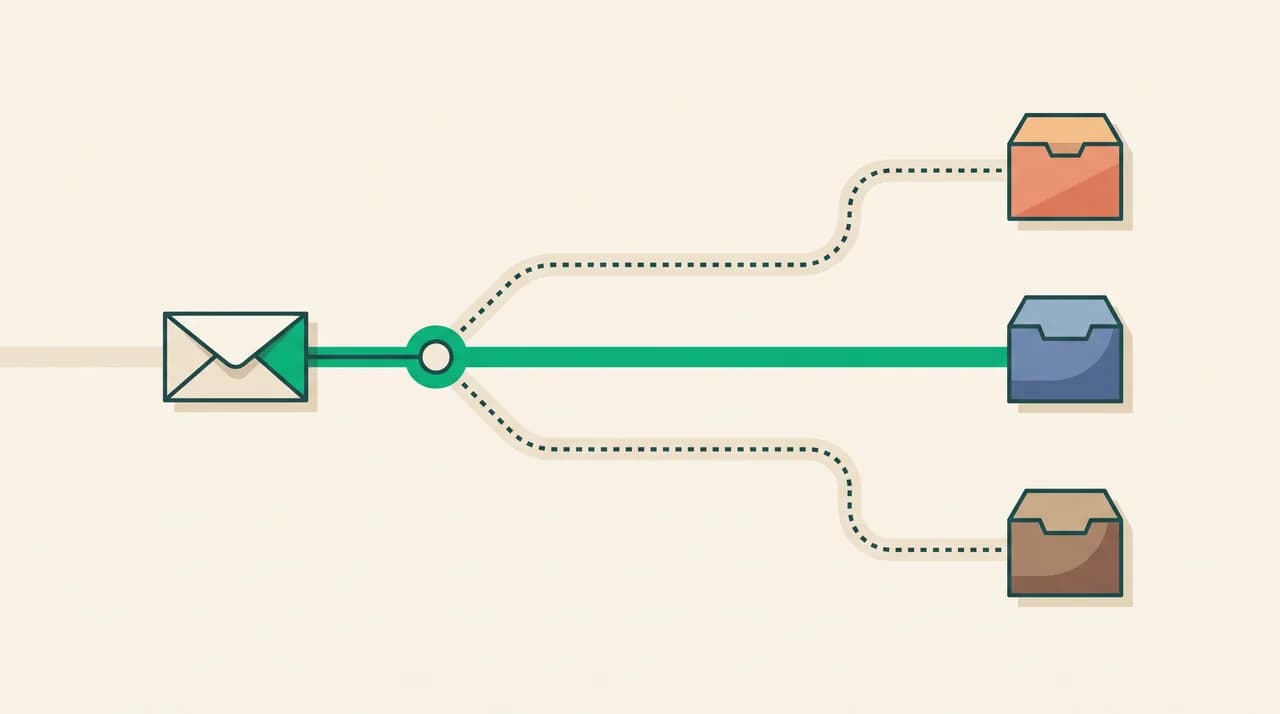
The mechanic is the same on every Apple surface: your mailbox lists every address it owns, and you pick which one is the default for new messages. What changes between surfaces is where the setting lives. Apple has moved this menu across macOS releases; the descriptions below stay at the concept level so they age less quickly. If your screen does not match exactly, look for a heading with the word Aliases, Addresses, or Send from.
- 1
On iCloud.com
Sign in to iCloud.com and open Mail. Open the settings or preferences pane and find the Accounts, Aliases or Addresses section. Every address on the mailbox is listed. Choose the one you want as your default for new outgoing mail — this changes what recipients see as the From address on messages you compose on the web.
- 2
On the Mail app for Mac
Open Mail, then Settings (or Preferences on older macOS). Under Accounts, select your iCloud account. The Email Address field is a dropdown listing every alias the mailbox owns. Set the default From by choosing the address you want to send from — the composer respects this on every new message unless you override it in the message header dropdown.
- 3
On the Mail app for iPhone or iPad
Open Settings, then Mail (in newer iOS versions, Apps then Mail). Tap Default Account and select the iCloud account, then go to Signature or Composing — or, if present, Send from Address — to pick which alias is the default for new mail. Per-message overrides are available in the composer by tapping the From field.
- 4
Per-message override
On any surface, the From field in the composer is a picker. If you want to reply from a different address than your default, tap or click the From field, choose the alias, and send. The choice does not change your default; it only applies to this message.
Replies inherit the address you were written to
Pricing model: what iCloud+ actually gates#
There is no per-domain pricing here. Whether you send from @icloud.com, @me.com or @mac.com, the mailbox is the free iCloud Mail included with any Apple ID and 5 GB of iCloud storage. You do not pay Apple to keep the older domains alive.
What Apple sells as iCloud+ is a paid storage-and-privacy tier: more iCloud storage, Hide My Email, Private Relay and Custom Email Domain. iCloud+ is packaged as a monthly subscription across a few storage sizes, sometimes bundled into Apple One. Check the current tiers and prices on apple.com/icloud or in the Settings app on your device — Apple has repriced iCloud+ and rearranged the Apple One bundle more than once, and any figure printed on a blog post ages quickly.
The two features that matter for the email question are Custom Email Domain (send and receive from your own domain through iCloud Mail) and Hide My Email (generate throwaway aliases that forward to your inbox and can be turned off individually). Neither replaces your @icloud.com, @me.com or @mac.com address — they sit alongside them.
Who each address is genuinely for#
The right answer depends less on the domain and more on what you already have and what your contacts already use. The table narrows it.
| If this is you | Send from | Why |
|---|---|---|
| You created your Apple ID in the last decade | @icloud.com | It is the only address you have — no decision to make |
| Long-standing user, contacts write to @me.com or @mac.com | The address they already use | Do not force a rewrite of every address book that reaches you |
| Long-standing user, no strong contact preference | @icloud.com | The current form ages the best across third-party tooling |
| You want a scarce-suffix signal | @mac.com if you have one, otherwise @me.com | Both signal a long-tenured Apple account |
| You need disposable per-service aliases | Hide My Email (iCloud+) | Turn individual aliases off without losing your primary |
| You want to send from your own domain | Custom Email Domain (iCloud+) | iCloud Mail handles delivery for [email protected] |
A third option: Hide My Email — and the adjacent thing an AI email client does#
If the reason you are asking about @me.com versus @icloud.com is that you want to give a different address to different services and stop the spillover when one of them leaks, the answer is not to pick between the three domains — it is Hide My Email, part of iCloud+. It generates a unique random address per service, forwards to your primary mailbox, and lets you turn any single alias off without affecting anything else. That is a different job from choosing a primary domain, and it is the one people usually mean when they ask.
AI Emaily is a different tool that operates on the same mailbox. We build a native AI email client that connects iCloud alongside Gmail, Outlook and IMAP in a single inbox — the disclosure is that we build it, so this section is honest scoping rather than a top-ranked recommendation. AI Emaily is not an alias service, does not issue email addresses, does not replace @icloud.com, @me.com or @mac.com, and does not stop mail from reaching any address you own. What it does is triage the mail that does reach your iCloud mailbox: an AI agent that categorises, drafts and — in Copilot mode — waits for your approval before sending, with an audit trail and full undo. If your @icloud.com inbox is loud and Hide My Email only fixes the future, that is where an AI client sits. See aiemaily.com/pricing for the current shape.
For the specific question this post answers — which of your three Apple addresses to send from — the tool that changes the outcome is Apple's own aliases settings, not any third-party product. Everything above is what the settings do.
Frequently asked
See it in AI Emaily
Keep reading
Sources

Written by
Nafiul HasanNafiul Hasan is an entrepreneur and AI automation system builder with 10+ years of experience turning messy, manual workflows into reliable automated systems. He designs and ships AI enterprise solutions end-to-end — the agent logic, the data plumbing, and the product people actually use — and founded AI Emaily to give busy professionals their attention back. He writes here from the builder's seat: what works, what breaks, and how to put AI to work without giving up control.