Stop Paying for 6 Tools: Email Consolidation for Insurance Agency Owners

The short answer
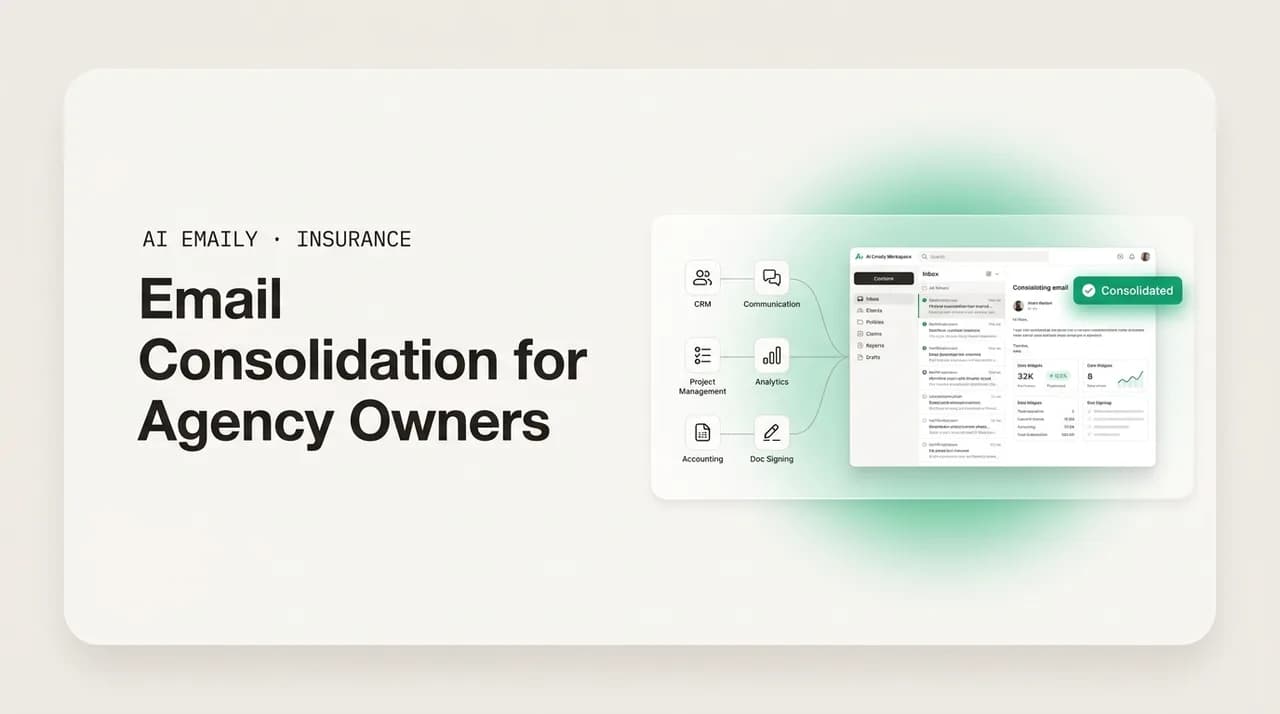
The average independent agent spends around $247 a month on fragmented software that doesn't talk. Insurance agency software consolidation is about replacing that sprawl, not adding to it: keep your AMS and comparative rater as the systems of record, then collapse the drafting, follow-up, and triage tools scattered around your inbox into one AI-native email layer. Audit the stack, map overlaps, and consolidate the connective tissue first.
A practical guide to insurance agency software consolidation: why the average agency pays for six tools that don't talk, what the fragmented stack really costs, and a framework to audit and consolidate it — with communication as the connective layer.
On this page
- 01Why insurance agency software consolidation is the real problem, not another tool
- 02What does the typical fragmented insurance agency stack actually look like?
- 03What does the fragmented stack really cost an agency?
- 04A framework to audit your agency's tool stack
- 05What to centralize versus what to keep
- 06Why email and communication are the connective layer
- 07How AI Emaily helps consolidate the communication layer
- 08Putting it all together
Why insurance agency software consolidation is the real problem, not another tool#
Walk into almost any independent agency and count the browser tabs open on a producer's screen. There is the agency management system. A comparative rater. A CRM that overlaps with the AMS in ways nobody has fully mapped. An email marketing platform for drip campaigns. A texting app for the clients who never open email. A scheduling link for reviews. An e-signature tool for applications and ACORD forms. A separate inbox, or three, for each carrier's underwriting correspondence. None of them share a contact record cleanly, so the same client lives in six places under six slightly different spellings.
This is the quiet tax on running an agency in 2026. Industry surveys put the average independent agent's software spend at roughly $247 per month on fragmented tools that a more unified stack could replace. Multiply that by every seat in a five-, ten-, or twenty-producer shop and you are carrying a five-figure annual line item for software that, on its worst days, actively makes the work slower. The problem was never that agencies underinvest in technology. It is that they have accreted it one point solution at a time, each bought to solve a single sting, none designed to know about the others.
So the goal of this guide is not to sell you a seventh tool. It is to give agency owners a clear framework for insurance agency software consolidation: how to audit the stack you already pay for, decide what to centralize versus keep, and understand why email and client communication — not the AMS — is usually the layer where the fragmentation hurts most and where consolidation returns the most. We will be honest throughout about what can be collapsed and what genuinely cannot. Your AMS is not going anywhere. Your rater is not going anywhere. But the sprawl of drafting, follow-up, and triage tools scattered around your inbox almost certainly can.
It helps to name why this segment feels the pain more sharply than a captive agent down the street. Independent agents write a large share of U.S. property-casualty premium and, unlike captive agents whose carrier hands them a pre-approved tech stack, independent agency owners buy their own software and own every one of those decisions. That autonomy is the whole appeal of the model — you shop across carriers, you tailor coverage, you control the client relationship. But it also means every fragmented tool is a fragmented tool you chose and you pay for. Nobody is going to consolidate the stack for you. The upside is that nobody can stop you from doing it either.
There is a growth angle here too, and it is the one that should get an owner's attention. An agency's enterprise value — what it sells for when you eventually exit, and what it borrows against to acquire another book along the way — is a function of retention, organic growth rate, and how much the operation depends on any single person's memory. Every one of those is quietly degraded by a fragmented stack. Retention slips when renewal reminders go to dead addresses. Organic growth slows when producers spend afternoons copying data between tabs instead of quoting and cross-selling. Key-person risk climbs when the only person who knows which tool holds which thread is a producer you cannot afford to lose. Consolidation is usually pitched as a cost story, but for a serious owner it is a valuation story. Tighter operations, cleaner data, and fewer single points of failure are exactly what a buyer or a lender pays a premium for.
Who this guide is for
What does the typical fragmented insurance agency stack actually look like?#
Before you can consolidate anything, you have to see the whole picture at once, which almost no agency ever does because the tools were bought in different years for different reasons. Here is the stack most independent agencies converge on, grouped by the job each tool was hired to do. Read it less as a shopping list and more as an inventory of everywhere your client data currently lives.
The systems of record sit at the bottom: the agency management system (AMS) that holds policies, downloads, and the book of business, and the comparative rater that pulls quotes across carriers. These are load-bearing. Above them sits a layer of communication and workflow tools that is where the real fragmentation — and the real consolidation opportunity — lives.
- Agency management system (AMS) — the book of business, policy data, carrier downloads, commissions. The system of record. Examples in the market include Applied Epic, Vertafore AMS360, HawkSoft, and EZLynx.
- Comparative rater — pulls and compares quotes across appointed carriers. Often bundled with or adjacent to the AMS.
- CRM / sales pipeline — leads, opportunities, and touch tracking, frequently overlapping the AMS's own activity log.
- Email marketing platform — newsletters, renewal campaigns, and drip sequences, with its own separate contact list that drifts out of sync with the AMS.
- Texting / SMS tool — a second messaging channel for clients who never open email, with its own thread history nobody else can see.
- Scheduling tool — booking links for annual reviews and coverage calls.
- E-signature — signing applications, ACORD forms, and disclosures.
- Email itself — often several inboxes, one per carrier portal plus the agency's own domain, none of them talking to the CRM or the AMS.
Count those and you are already at six to eight distinct subscriptions before anyone has added the nice-to-haves — the call-tracking tool, the review-request service, the social scheduler. Each was a reasonable purchase in isolation. The trouble is the seams between them. A lead comes in through a web form, lands in the CRM, gets quoted in the rater, is bound in the AMS, gets a welcome email from the marketing platform, a reminder text from the SMS tool, and a review link from the scheduler — and not one of those systems automatically knows what the others did. The producer becomes the integration. They are the human API copying a phone number from one tab to the next, and every copy is a chance to fat-finger a policy number or email the wrong renewal notice to the wrong client.
What does the fragmented stack really cost an agency?#
The subscription total is the cost everyone sees, and it is the least of it. The $247-a-month figure is real and worth cutting, but if that were the whole story you would just downgrade a few plans and move on. The expensive costs are the ones that never show up on an invoice.
Start with context-switching. Every time a producer jumps from the AMS to the rater to the inbox to the texting app, there is a small reload tax — finding their place, re-reading the thread, remembering what they were about to do. Do that a few hundred times a day across a team and you are quietly spending hours of producer time not on selling or serving, but on being the connective tissue between tools that refuse to talk. That time has a direct revenue cost in an industry where the agency that quotes and follows up fastest usually wins the account.
Then there are the data silos. When the CRM's contact list, the email platform's list, and the AMS's book all drift apart, you no longer have one true record of a client. You have three partial ones. A renewal reminder goes to an address the client abandoned two years ago. A cross-sell campaign hits someone who already bought the policy. A producer preps for a review call with stale coverage data because the fresh version was in a system they did not think to open. None of these are catastrophic on their own. In aggregate they are a slow leak in retention and reputation — the two things an agency's enterprise value is actually built on.
The third cost is the one owners feel most and articulate least: cognitive load and onboarding drag. Every tool in the stack is something a new producer has to learn, something that breaks, something with its own login, its own support queue, its own renewal date and price increase. When a key producer leaves, their knowledge of which tool holds which thread walks out the door with them. When you hire, ramp time balloons because the job is not just insurance — it is insurance plus the operation of eight disconnected apps. Consolidation is partly a cost play, but for a growing agency it is at least as much an operational-resilience play. Fewer moving parts means fewer places for the work to fall through.
The question that reframes the spend
A framework to audit your agency's tool stack#
You cannot consolidate what you have not measured. Before comparing any new platform, spend a focused hour building an honest inventory of what you run today, what it costs, and — the part everyone skips — what each tool actually does that no other tool does. Most agencies discover two or three subscriptions that are 80% redundant with something they already pay for. Here is the audit, step by step. Do it as the owner, or hand it to your operations lead, but do it with the invoices open in front of you.
- 1
List every subscription and its true monthly cost per seat
Pull the actual billing, not the plan you think you're on. Include per-seat pricing, annual commitments amortized to monthly, add-on modules, and anything auto-renewing on a card you forgot about. Total it across all producers. This is your real number — usually higher than the $247-per-agent average once you count the whole team.
- 2
Map each tool to the job it was hired to do
For every subscription, write one sentence: the specific job it does that justifies it existing. AMS: 'holds the book and carrier downloads.' Rater: 'compares quotes across carriers.' If you can't write a crisp, non-overlapping sentence, flag it — that's a consolidation candidate.
- 3
Highlight the overlaps
Draw lines between tools that touch the same job. Your CRM's activity log and your AMS's activity log. Your email platform's contact list and your AMS's book. Your texting app and your inbox. Overlap isn't automatically waste, but every overlap is a place data can drift and a candidate for collapse.
- 4
Mark each tool as a system of record, a channel, or connective tissue
Systems of record (AMS, rater) hold authoritative data and are hard to replace — keep them. Channels (email, SMS, scheduling) are how you reach clients. Connective tissue (drafting, follow-up chasing, triage, copy-pasting between tabs) is the manual glue producers apply by hand. Connective tissue is the highest-return thing to automate and consolidate.
- 5
Score each tool on how much it fragments your client record
For each channel and CRM-like tool, ask: does this create a separate copy of the client that drifts out of sync with the AMS? The more copies of the truth you maintain by hand, the more this tool is costing you in silent data-quality decay, regardless of its sticker price.
- 6
Decide what to centralize versus keep — then sequence the change
You won't rip everything out at once, and you shouldn't. Rank consolidation candidates by return and by risk. The communication layer — inbox, follow-up, drafting, triage across carrier inboxes — is usually the highest return and lowest risk to consolidate first, because it doesn't require migrating your book of business.
When you finish that audit, a pattern almost always emerges. The bottom of the stack — the AMS and the rater — is genuinely irreplaceable and probably fine. The middle and top — the CRM overlap, the standalone texting app, the separate email marketing tool, the scheduling link, and above all the manual labor of drafting and chasing every client email by hand — is where three or four subscriptions and dozens of producer-hours are hiding. That is the consolidation target. Not the systems of record. The connective tissue wrapped around them.
What to centralize versus what to keep#
Consolidation done badly means ripping out a load-bearing system to save a few dollars and spending the next quarter regretting it. Consolidation done well means being ruthless about the connective tissue and conservative about the systems of record. The dividing line is simple: keep the tools that hold authoritative data and are deeply integrated with your carriers; collapse the tools that exist mainly to move information between the systems of record and your clients.
Keep your AMS. It is the book of business, the source of carrier downloads, the record regulators and E&O carriers expect you to maintain. No email tool replaces it, and any vendor who claims to is either misunderstanding the category or misleading you. Keep your comparative rater for the same reason — it is wired into carrier quoting in a way a general-purpose tool cannot replicate. These are the foundation. Consolidation is about everything you built on top of them.
| Layer / tool | Typical today | After consolidation |
|---|---|---|
| Agency management system (AMS) | Standalone — system of record | Keep. The book of business, carrier downloads, and compliance record. Not replaceable by an email tool. |
| Comparative rater | Standalone or AMS-bundled | Keep. Deeply wired into carrier quoting. |
| CRM / pipeline | Separate subscription overlapping the AMS | Consolidate or retire where the AMS already tracks activity; keep only the unique pipeline value it adds. |
| Email marketing platform | Separate tool, separate drifting contact list | Consolidate. Renewal and follow-up sequences move into the unified communication layer, synced to the real book. |
| Texting / SMS app | Separate thread history nobody else sees | Consolidate into one client-communication surface where the whole team sees the full history. |
| Scheduling tool | Standalone booking link | Often collapsible into the communication layer's send-and-schedule flow. |
| E-signature | Standalone | Keep if forms-integrated; otherwise a candidate to fold in. Lower priority than the inbox. |
| Email + drafting + follow-up + triage | Multiple inboxes, all manual, all by hand | Consolidate. This is the biggest return: one AI-native inbox that drafts, triages, and follows up across every carrier inbox. |
Notice where the largest change sits: the bottom row. The single most fragmented, most manual, most producer-hour-hungry part of the whole stack is not any one named app — it is the drafting, chasing, and triaging of email that gets done by hand, across several inboxes, all day, every day. It rarely shows up as a line item because it is labor rather than software. That is precisely why it is the highest-return consolidation target. You are not just cancelling a subscription; you are removing hours of repetitive human work and the errors that come with it.
Why email and communication are the connective layer#
Here is the insight that reorders the whole consolidation project: almost everything in the fragmented stack is, at bottom, a communication problem wearing a different hat. The email marketing tool exists to communicate at scale. The texting app exists to communicate on a channel clients prefer. The scheduling tool exists to communicate availability. The CRM's activity log exists to remember what you communicated. Even the follow-up chasing that eats producer afternoons is communication that didn't happen on time. When you see the stack this way, the leverage point becomes obvious. Unify the communication layer and a surprising number of the surrounding tools lose their reason to exist as separate subscriptions.
Email specifically is the connective tissue because it is where the client relationship actually happens. The AMS knows the policy; the inbox knows the person. Quote follow-ups, renewal reminders, coverage questions, claims hand-holding, cross-sell conversations, the reassuring note after a rate increase — all of it flows through email and its adjacent channels. That is the surface producers spend the most time on and the surface where fragmentation costs the most, because every carrier portal, every marketing tool, and every texting app carves off a slice of the conversation and hides it from the rest.
Consolidating communication does not mean forcing every client onto email. It means having one place where the whole conversation lives, one contact truth that stays synced, and one workflow for the repetitive drafting and follow-up that currently spans four tools. When the connective layer is unified, the systems of record underneath it get more valuable, not less — the AMS stays clean because the communication layer feeds it accurate activity instead of leaving it to a producer's memory. This is the opposite of adding a tool. It is removing the seams between the tools you keep.
It is worth being concrete about what "a communication problem wearing a different hat" means in a working week, because the abstraction hides the size of the prize. A personal-lines producer's Tuesday is largely the same handful of messages repeated with different names in them: the quote follow-up two days after a rate was delivered, the thirty-day and seven-day renewal nudges, the request for the missing document before an application can bind, the check-in after a claim, the polite explanation when a carrier pushes a rate up. None of those require original thought. All of them require timing, accuracy, and the right tone — and today each is handled by hand, or half-automated in a separate drip tool whose list has quietly drifted away from the real book. That repetition is exactly the shape of work that consolidates well. Unify where it happens, and you are not sacrificing the personal touch; you are freeing producers to spend their judgment on the conversations that actually need a human, like a complex commercial renewal or a delicate coverage-gap call, instead of retyping the same reminder for the two-hundredth time.
Consolidation is a sequence, not a switch
How AI Emaily helps consolidate the communication layer#
This is the part where we tell you honestly what AI Emaily is and is not, because a consolidation guide that oversells its own product would defeat its own point. AI Emaily is not an agency management system. It does not replace Applied Epic, AMS360, HawkSoft, or EZLynx, and it does not pull carrier downloads or hold your book of business. If a vendor tells you an email tool can be your AMS, close the tab. What AI Emaily is: an AI-native email client that consolidates the drafting, follow-up, and triage sprawl scattered around your inbox into one place — the connective communication layer we just spent the last section describing.
In a fragmented agency stack, the inbox is where the manual labor concentrates. Producers hand-draft the same quote follow-up for the hundredth time, chase renewals they hope they didn't forget, and triage a flood across several carrier inboxes by hand. AI Emaily connects to Gmail, Outlook, and any IMAP account — including the separate inboxes each carrier portal forces on you — and gives you one unified surface across all of them. It triages incoming mail so leads and time-sensitive renewals surface first, drafts replies in your agency's voice rather than generic boilerplate, and handles the routine follow-up sequences that today live in a separate email marketing tool. That is three or four fragmented jobs collapsing into one.
Because it is built for a team, not a solo user, it fits the agency-owner reality: multi-seat from day one, so the whole roster works from one consolidated communication layer instead of each producer maintaining their own private thicket of tools and thread histories. The point, per the consolidation logic of this guide, is that this is replacing spend and manual work you already carry — the standalone email marketing subscription, the texting app's siloed history, the hours of by-hand drafting and chasing — not stacking a new cost on top of the six you already have.
And because it acts on your email, it is built to be trusted with that access. AI Emaily runs in Manual, Copilot, and Autopilot modes, so you decide how much autonomy to grant: review and approve every draft yourself, let it prepare replies for one-click send, or let it handle the most routine, templated communication on its own. Every mode carries undo and a full audit trail, so nothing the agent does is a black box — you can see exactly what was sent, on whose behalf, and reverse it. For an agency owner accountable for E&O exposure and carrier compliance, that undo-and-audit guarantee is not a nice-to-have; it is the precondition for letting any automation near client communication at all.
The honest scope
So the consolidation move for an agency owner is not "switch everything." It is: keep the AMS and rater as your systems of record, then let one AI-native email layer absorb the drafting-and-follow-up sprawl that today is split across a marketing platform, a texting app, a scheduling link, and the raw manual labor of a producer's inbox. You cut real subscription spend, you reclaim producer hours, and you get one synced record of every client conversation instead of six drifting copies. You can try it free at app.aiemaily.com/signup, with a Free plan at no cost and Pro at $12.42 per month on the annual plan, and see whether the communication layer consolidates the way this guide argues it should before you touch anything deeper in the stack.
Putting it all together#
Insurance agency software consolidation is not a cost-cutting exercise you do once and forget. It is a discipline: seeing the whole stack at once, naming what each tool truly does, and being ruthless about the seams while staying conservative about the foundation. The average agency's $247-a-month spend is the visible symptom, but the real disease is fragmentation — the producer time lost to being a human integration, the client record that has quietly split into three drifting copies, the onboarding drag of eight disconnected logins.
Run the audit with your invoices open. Keep the systems of record — the AMS and the rater earn their place. Consolidate the connective tissue — the drafting, the follow-up, the triage, the standalone communication tools that exist mostly because your inbox and your book don't talk. Start with the communication layer, because it returns the most manual work at the lowest migration risk, and because email is where the client relationship actually lives. Do that, and the seventh tool you add is the one that lets you cancel three of the first six.
Frequently asked
See it in AI Emaily
Keep reading
Sources
- Insurance Information Institute — Facts + Statistics: Distribution channels (independent agent share of P&C premium)
- Independent Insurance Agents & Brokers of America (Big "I") — agency resources and technology
- Insurance Journal — Technology news and agency-tech coverage
- Insurance Information Institute — How to shop for insurance (independent agent model)

Written by
Nafiul HasanNafiul Hasan is an entrepreneur and AI automation system builder with 10+ years of experience turning messy, manual workflows into reliable automated systems. He designs and ships AI enterprise solutions end-to-end — the agent logic, the data plumbing, and the product people actually use — and founded AI Emaily to give busy professionals their attention back. He writes here from the builder's seat: what works, what breaks, and how to put AI to work without giving up control.