Is Superhuman Free? Trial Length and Free Plan Answered


The short answer
No — Superhuman Mail is a paid, per-seat subscription with no permanent free plan. It offers a time-limited free trial you can start on their site, with terms that have shifted since Grammarly acquired the product in July 2025. Check Superhuman's own pricing page for the current trial length before you commit.
Is Superhuman free? No — it is paid per seat with no free plan. There is a time-limited trial; here is how to check the current terms and what happens after.
On this page
- 01Which Superhuman are you asking about?
- 02Criteria that actually matter
- 03Free-plan and trial structure, at a glance
- 04The shape of the decision, not the length of the trial
- 05What happens when the trial ends
- 06Red flags on pages that promise a free plan
- 07Worked example: budgeting a Superhuman trial that will end
- 08What we'd pick, and why — honestly
- 09The short answer, one more time
Is Superhuman free? Short answer: no. Superhuman Mail is a paid, per-seat email client with no permanent free plan — the only way to use it without paying is a time-limited trial you start from their site.
The trial length itself has changed at least once since the product was acquired by Grammarly in July 2025 and the parent company was renamed Superhuman in October 2025. Any blog post that names a specific number of days without a check-date is guessing on your behalf.
This page will not print a trial figure we cannot stand behind. Instead it will give you the shape of the offer, the criteria that decide whether the trial actually tells you anything useful, a scoring table you can walk into your budget conversation with, and a red-flag list for the pages that confidently print a number.
Which Superhuman are you asking about?#
This is where a lot of the confusion in this query lives. Since October 2025 the word Superhuman names two distinct things: Superhuman Mail, the email client, and the Superhuman Suite, the bundle from the renamed parent that includes Grammarly's writing tools, a docs workspace and a cross-app assistant called Go.
A trial for the suite is not a trial for Mail, and a free tier that exists in one product does not carry over to the other. The quickest test: if a page or a signup flow mentions Grammarly, Docs or Go, you are inside the suite offer. If it only ever talks about an inbox, triage and drafting, you are on the standalone Mail offer.
One name, two products, two different trial pages
Criteria that actually matter#
The internet is not short on people telling you whether a trial is generous. What decides whether a trial is worth your time is more specific than that. Six questions, in the order they hit your calendar.
- How many days do you get, and does the clock start when you sign up or when you first connect a mailbox? Trials that count from signup punish you for waiting until Monday to start.
- Does starting the trial require a credit card, and does it auto-convert to a paid plan when it ends? A card-required trial with silent auto-conversion is the most common surprise on this whole category.
- Which tier are you trialling? If AI features sit in a higher tier, a trial on the entry tier tells you nothing about whether the AI is worth the higher price.
- Which mail providers are supported? Gmail and Microsoft 365 are the documented supported accounts for Superhuman Mail. Generic IMAP or a self-managed server means a trial you cannot even start.
- What happens to your mail, your drafts and your snippets when the trial ends? The mail lives with your provider, but client-side artefacts are a separate question and rarely spelled out.
- Are there discounts you would qualify for — student, startup, non-profit, education — that change the price you convert to and therefore the point of the trial?
Free-plan and trial structure, at a glance#
Here is the packaging shape of Superhuman Mail as documented on the vendor's own help center and pricing page, as of writing. It is deliberately structural — the specific trial length and price figures belong to Superhuman's own pages, which move.
| Access question | Superhuman Mail (as documented) | What it means for you |
|---|---|---|
| Permanent free plan | None — there is no forever-free tier | You will pay after the trial or lose access. Plan the budget before you start the clock |
| Free trial | A time-limited trial, started from the vendor site — length has changed and is subject to change | Read the current trial length on Superhuman's own pricing page and screenshot the date |
| Card required to start | Not consistently documented as no-card — confirm on the current signup flow | If a card is required, set a calendar alert one day before the trial ends |
| Auto-convert at end | Trials in this category commonly auto-convert to the paid plan | Cancel before day X if you are not continuing — do not rely on grace periods |
| Trial tier | Confirm which tier the trial exposes — AI features live in the higher business tier after the Grammarly acquisition | A trial that hides the AI capability tells you nothing about the plan you would actually buy |
| Discounts | Historic student pricing has existed; startup and non-profit paths vary and are not universally published | If you might qualify, ask before you convert — a discount changes the price you land on |
| Supported accounts | Gmail and Microsoft 365 have been the documented supported providers | IMAP-only mailboxes, self-hosted servers and less common providers may not be trialable at all |
| What survives cancellation | Mail stays with your provider (Gmail or Microsoft 365); client-side settings are a separate question | Ask what happens to snippets, splits and shortcuts if you leave. This is rarely printed |
The shape of the decision, not the length of the trial#
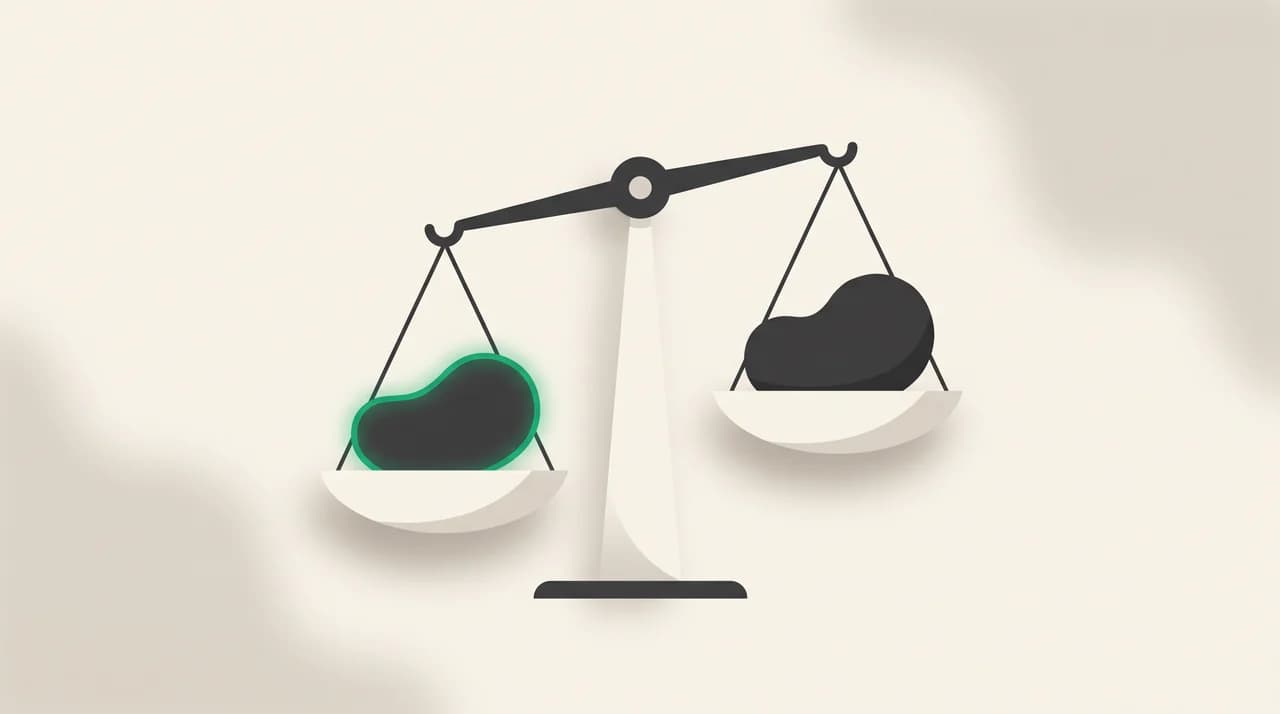
Whether a trial is fourteen days or thirty is the least interesting question on this page. What decides your outcome is the tier it exposes, whether it auto-converts, and whether you can even connect the mailbox you actually use.
The figure below is how we think about it internally when we look at competing trials in this category — including our own. It is the picture behind the criteria list above.
What happens when the trial ends#
This is the single most-searched follow-up to the trial question, and it has three possible answers depending on which sign-up path you used. Understand which one applies to you before day zero.
- 1
If you gave a card at signup
Assume the trial converts to the paid plan on the tier and cadence you selected. That is the default in this category. If you do not want to continue, cancel before the trial's last day inside your Superhuman account settings.
- 2
If the trial was card-free
Access to the client stops at the end of the window. Your mail remains where it always was — inside your Gmail or Microsoft 365 mailbox — but you lose the Superhuman interface until you subscribe.
- 3
If you were on an invite or waitlist path historically
The invite-only model was the product's original story pre-acquisition; that path may or may not still exist. Do not build a plan around finding an old invite link — verify the current sign-up flow directly.
- 4
If you had a team trial
Team-scoped trials tend to convert per seat. Check what happens to seats added mid-trial specifically, because that is where the bill usually surprises the person authorising the purchase.
- 5
If you want to try again later
Repeat trials are usually not offered on the same email address. If you close the trial and want a second look in six months, expect to pay for that look rather than restart the free window.
The one thing worth putting on the calendar
Red flags on pages that promise a free plan#
A lot of what ranks for is superhuman free was written before the acquisition, or repeats a claim from a review the author never re-verified. The tells are consistent.
- A confident claim that Superhuman has a free plan. It does not, and it has never had a permanent free plan. Anyone who says otherwise is either describing a trial or has confused Mail with a bundled Grammarly free tier.
- A trial length quoted without a check-date. This has changed at least once and can change again. A number without a date is a number you cannot verify.
- No mention of the July 2025 acquisition or the October 2025 rename. That page has not been updated in over a year and its facts have decayed accordingly.
- It confuses Mail with the Suite. If the page discusses Grammarly's writing tools or the Go assistant, its trial claim is probably about the bundle and not the email client.
- It promises no credit card required as a universal fact rather than a screen on today's signup. Vendors change trial gates without changelogs; a screenshot ages in weeks.
The thirty-second credibility test
Worked example: budgeting a Superhuman trial that will end#
Treat the trial as a decision-forcing exercise rather than a period of free use. The template below is how we would set it up for a five-person team evaluating Superhuman Mail in parallel with another client. Fill each line from the vendor page on the day you start the trial.
What we'd pick, and why — honestly#
We build AI Emaily. Take this as an interested party's summary, with limits stated.
For the specific question this page answers — is it free — the honest picture is that neither Superhuman Mail nor AI Emaily is free forever. Superhuman Mail is paid per seat with a time-limited trial you start on their site. AI Emaily is paid per seat with a 7-day free trial on the Pro or Autopilot plan; a card is required at signup and you are charged nothing if you cancel before day seven. There is no permanent free plan on either product.
Where Superhuman Mail is ahead, it is ahead. Its keyboard fluency, its command palette, its split-inbox model and the sheer speed of the client are the reason the product has a name in the first place, and a seven-year head start on that specific axis is not something we would pretend to have caught. If raw keyboard speed inside an already-tidy Gmail workflow is your top criterion, buy accordingly.
Where we differ, and where we would encourage you to run both trials in parallel: AI Emaily is built around an agent with explicit authority modes — Manual, Copilot and Autopilot — where nothing sends without your approval in Copilot, and every agent action is undoable and written to an inspectable audit log. Drafting voice comes from a Personal Context brain you write yourself plus per-client profiles you set, rather than a model reading your archive. We do not train on your mail.
We also connect Gmail, Outlook and standard IMAP accounts in one inbox, which matters if your team is not all on Gmail and Microsoft 365.
- Our limits, plainly: the desktop app is a downloadable app on macOS (Apple Silicon only) and Windows, built as an Electron shell around the web interface rather than a hand-built native binary.
- There is no native Linux build. Android is a PWA today, with the native app on the roadmap rather than shipped.
- Offline is partial by design — read and draft offline, but this is not a complete local mail archive.
- The trial is 7 days. That is short by category standards, and deliberate: it is long enough to run a real week of mail through the agent, not long enough to install the app and forget about it.
- You can find our current per-seat rates and the trial terms on our own pricing page, and the head-to-head against Superhuman on the compare page — both linked below.
The one placement line, in the one place it belongs
The short answer, one more time#
Superhuman Mail is not free and does not have a permanent free plan. It has a time-limited trial, its length has changed at least once since the acquisition, and it will almost certainly change again as the product settles under the renamed parent. Read the current trial length on the vendor's own pricing page, put the auto-convert date on your calendar the same afternoon, and confirm which tier the trial actually exposes before you decide it told you anything.
Frequently asked
See it in AI Emaily
Keep reading
Sources

Written by
Nafiul HasanNafiul Hasan is an entrepreneur and AI automation system builder with 10+ years of experience turning messy, manual workflows into reliable automated systems. He designs and ships AI enterprise solutions end-to-end — the agent logic, the data plumbing, and the product people actually use — and founded AI Emaily to give busy professionals their attention back. He writes here from the builder's seat: what works, what breaks, and how to put AI to work without giving up control.