SaneBox Review (2026): Does Filtering Still Earn Its Keep?


The short answer
SaneBox still works in 2026. It filters mail server-side using IMAP folders, so it runs behind Gmail, Outlook, iCloud, Fastmail or almost any provider without changing your client. What it does not do: draft replies, act as an agent, or replace your inbox — it triages and stops there.
SaneBox review 2026: how a server-side IMAP filter holds up next to AI email tools, what its four features actually do, and where it stops.
On this page
SaneBox has been shipping since 2010, which in this category is an eternity. It sits in an odd place in 2026: newer AI-email tools promise to draft, decide and act, and SaneBox does none of that. It sorts. It sorts server-side, using IMAP folders your existing client already understands, and it does that job well enough that a lot of people who tried it a decade ago are still paying.
This SaneBox review asks the question that actually decides the purchase: with AI email assistants now writing replies and taking actions, does a filter-only service still earn its keep? The short answer is yes, for a specific reader — and the longer answer is why, and who should stop reading this and go buy something else.
The short answer#
SaneBox is a server-side triage service that files less-important mail into folders like @SaneLater, kills unwanted senders through @SaneBlackHole, and summarises the low-value stuff in a Daily Digest. It works with Gmail, Outlook, iCloud, Fastmail, Yahoo, AOL, Mail.com and — per its own page — any IMAP, Exchange or ActiveSync server. That last part is the whole reason to consider it in 2026.
It does one thing well: getting non-urgent mail out of the way while you keep using whatever mail client you already use. There is nothing to install on your device. The filtering happens on SaneBox's side, and your client just sees the folders move. Cancel and the folders remain as ordinary IMAP folders on your account — nothing is destroyed, but nothing is sorted anymore either.
What it does not do is more interesting. SaneBox does not draft replies. It does not act as an agent. It does not run rules with conditions and actions the way a modern rules engine does. It does not read the body of your mail for classification — the vendor states it analyses headers, and only fetches bodies for a few optional features without storing them. If you want an assistant that writes for you or takes action on your behalf, SaneBox is not that product and never claimed to be.
Criteria that actually matter#
Most SaneBox reviews list every feature and call it a day. The four criteria below are the ones that actually decide whether it is the right tool in 2026, because if any one of them is wrong for your setup, no amount of feature depth saves the purchase.
Ignore anything that scores SaneBox against tools in a different category. It is not an AI drafting product, it is not a client, it is not a rules engine. Judge it against what it is: a provider-agnostic triage layer that runs in the background.
- Filter accuracy on your kind of mail. SaneBox learns from where you move messages — drag a thread out of @SaneLater and it recalibrates. The interesting question is not the demo accuracy; it is what week three looks like on your mix of senders. Newsletters you actually read, personal mail on a work account, industry-specific correspondence the model has never seen: these are where triage tools fail quietly.
- Whether it fits behind the client you already use. SaneBox's core advantage is architecture — it moves mail into IMAP folders, so any client that speaks IMAP (Apple Mail, Thunderbird, Outlook, Spark, Mimestream, mobile clients) sees the sorted state. If you love your current client and only want the noise dealt with, this is the axis that matters most.
- What happens when you do nothing. SaneBox does not draft, does not send, does not act. It moves mail between folders and lets you read a digest. That is either exactly what you want (safe, boring, invisible) or exactly not (you wanted an assistant, not a filing clerk). Be honest about which reader you are before comparing on any other axis.
- Cost shape at your mailbox count. Packaging is per-mailbox subscription — you pay by how many accounts SaneBox is filtering, on a plan whose ceiling determines which features you get. Not per seat in a team sense, not per volume. That matters for a solo user with three mailboxes and it matters for a small team where each person has one mailbox.
Scoring table#
The table below scores SaneBox against the four criteria that matter, plus two implementation dimensions buyers get burned on. Scores are qualitative — good, mixed, weak — because a numeric rating on subjective axes is false precision. Anything volatile (feature list per tier, current trial length, provider coverage) should be verified on SaneBox's own page before you commit; this category still changes.
| Dimension | SaneBox | What it means for you |
|---|---|---|
| Filter accuracy on real mail | Good on high-volume business mail once it has had a week or two to learn from your moves; mixed on subscribed newsletters you actually want to read, which sometimes get filtered to @SaneLater. | The training loop is you dragging messages out of @SaneLater when it gets one wrong. If you will not do that for the first two weeks, the accuracy stalls where it started. |
| Client coverage | Any IMAP, Microsoft Exchange or ActiveSync server, per SaneBox's own page — including Gmail, Outlook, iCloud, Fastmail, Yahoo, AOL and Mail.com. Nothing to install on your device. | Widest provider coverage in this category, by a distance. If you are on Fastmail or iCloud and priced out of AI-native clients that only speak Gmail and Outlook, SaneBox is one of the few tools that will filter your mail at all. |
| What happens on autopilot | Files mail into folders (SaneLater, SaneBlackHole, Daily Digest, custom SaneFolders). Does not draft, send or take actions. @SaneBlackHole is the only destructive default and it is reversible. | The right shape if you want triage and nothing else. The wrong shape if you want an assistant that answers routine mail for you. |
| Named features that actually matter | @SaneBlackHole (permanent unsubscribe by dropping), Daily Digest (single summary of low-value mail), SaneReminders / SaneNoReplies (flag when a thread goes silent), SaneSnooze (defer to a later time). | This is essentially the complete SaneBox surface. It is deliberate and small. If you are looking at it hoping to find drafting or Copilot-style actions, they are not there. |
| Privacy shape | Analyses headers only for classification; optional features that read bodies do not store them, per the vendor's security page. OAuth or app-password auth; credentials encrypted, kept off the public internet. | Better than most people assume from the outside. Not zero-access — it still logs into your mailbox — but it is not indexing your body content for AI training. |
| Cost shape | Per-mailbox subscription with a trial. Tiers unlock feature ceilings (more custom folders, more features) rather than volume. Education / non-profit / government discount published on the vendor page. | Predictable, stable, does not spike with mail volume. Verify the current tier layout and trial length on SaneBox's own pricing page — that is where the number lives. |
On prices and ratings
How the folders actually behave#
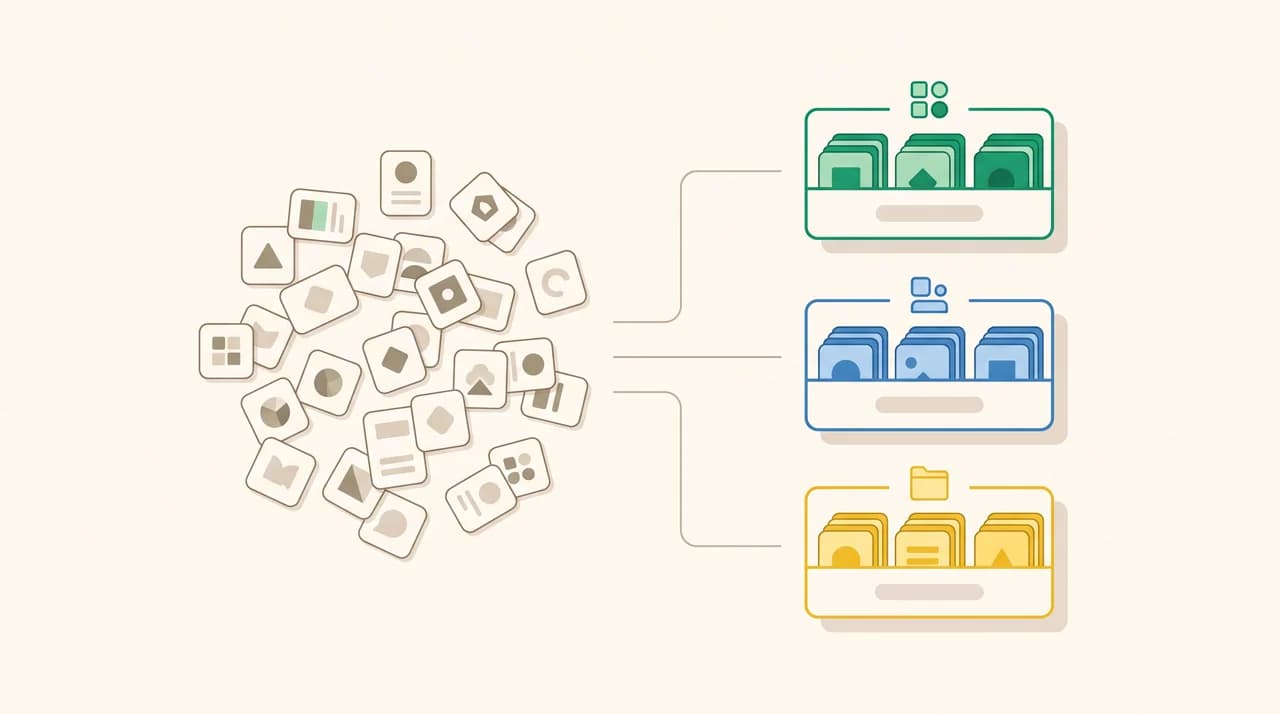
Because SaneBox is a folder-based service rather than an app you open, the interesting behaviour lives in what happens to messages after they arrive. The picture below is the mental model to hold: incoming mail is scored, and only the mail SaneBox is confident matters lands in your Inbox. The rest goes to a folder you check on your own schedule.
A worked example: two weeks on a Fastmail account#
Consider a two-person consultancy running on Fastmail — a provider most AI-native email tools do not support at all. Each partner gets around 90 external emails a day: client threads, vendor notices, industry newsletters they actually read, a steady drip of cold outreach. Before SaneBox, both spent the first hour of the day skimming everything.
In week one, SaneBox filed roughly the right proportion into @SaneLater. A few real customer newsletters they wanted to read got sent to @SaneLater too, and both partners moved those back to the Inbox once. Cold outreach mostly landed in @SaneLater correctly. The Daily Digest summarised the noise into a single morning email, and @SaneBlackHole handled the newsletter unsubscribes they had been meaning to do for months — you drag the message in and that sender is gone for good.
In week two, the filter had calibrated on their corrections and misfires dropped. The morning triage collapsed from about an hour to about fifteen minutes: check Inbox, glance at Digest, spot-check @SaneLater once a day. On threads that needed a reply, both partners wrote the reply themselves — SaneBox does not draft, so this workload was unchanged.
The honest verdict from the example: SaneBox took roughly 40 minutes a day off the top for each partner, and it did so on Fastmail, which most 2026 AI-email tools cannot connect to at all. That is the axis where SaneBox is genuinely hard to beat.
Red flags to know before you subscribe#
None of these are hidden — most are visible on SaneBox's own pages or obvious after a week — but they are the ones that turn a promising trial into a cancellation, so they belong in a review.
- Training requires moving mail, not clicking a button. SaneBox learns from your drags. If you leave everything in @SaneLater without correcting the ones it got wrong, the accuracy stalls. This is the opposite of a tool that classifies well out of the box; it needs a fortnight of light attention.
- There is no rules engine in the modern sense. You cannot say "if from this domain and subject contains X, apply label Y and forward to Z". SaneBox is training-based, not rule-based. If you already run a serious rules setup in Gmail or Outlook, SaneBox is not a replacement for it — it is a layer next to it.
- It does not draft, send, summarise threads with AI, or take actions. Some third-party writeups still describe it as an AI email tool, which in 2026 sets the wrong expectation. It is a filter with a good product name and a long track record, not an assistant. Read the vendor's own feature list before comparing it to anything with an agent.
- @SaneBlackHole is a real firehose. Anything you drop in there is permanently filtered — new mail from that sender goes straight to trash. That is what you want for a spammer, exactly what you do not want for a real sender you clicked wrong. It is undoable, but only if you notice.
- Removal after cancellation leaves your folders behind. The @SaneLater, @SaneBlackHole, Daily Digest and any custom SaneFolders remain as normal IMAP folders on your account when you cancel — the sorting stops but the folders stay. You will want to archive or delete them manually. The vendor's help pages document the process; check them before cancelling if this matters to you.
Filter service vs full client — get this right first
What we'd pick and why (honest)#
There is no single right answer here, because the axis that decides it is not "which product is better" — it is whether you want a filter behind your existing client, or a full AI-native client that replaces it. That is a preference about your daily workflow, not a scorable feature. Here is how we would pick for the three most common shapes of buyer.
If you want to keep the client you already use — Apple Mail, Thunderbird, the classic Outlook, Spark, Mimestream, whatever it is — and you just want the noise filtered behind it, SaneBox is a genuinely good pick. It is one of the very few tools in this category that will work with almost any IMAP or Exchange host. If you are on Fastmail, iCloud, a self-hosted mailbox, or a small provider that AI-native clients do not connect to, SaneBox may be your only real option and that is a compliment. Pay it and move on.
If you want an AI assistant that drafts, summarises threads and takes actions — not just triage — SaneBox is the wrong pick and there is no polite way around that. Look at tools that were designed for that job. Cora and Inbox Zero ship in the overlay-plus-drafting shape; check what each supports on its own page today, because provider coverage in that category is narrower than SaneBox's.
If you are ready to replace the client itself rather than layer on top of it, you are shopping in a different category. That is where we build AI Emaily — a full AI-native email client for Gmail, Outlook and IMAP hosts, with approve-before-send on every send by default, an audit trail on every action, undo, and autonomy modes (Manual, Copilot, Autopilot) you set per situation rather than per feature. It replaces the client; SaneBox filters behind one. We build AI Emaily, so read that with our thumb on the scale. The honest scoping matters: if the mail client you already use is fine and the noise is the whole problem, SaneBox is closer to what you asked for. If the interface is part of the problem too, or you want an assistant that drafts and acts rather than just sorts, that is the job we are built for.
Concession, plainly. SaneBox has built harder on being provider-agnostic than we have — its server-side, folder-based architecture works behind almost any IMAP or Exchange client, and there is no version of AI Emaily that ships in that shape. If your criterion is "filter my mail without changing the client I already use, on a provider that AI tools do not support," SaneBox wins that on purpose and we would not pretend otherwise. Packaging: SaneBox is a paid subscription with a trial; AI Emaily is a 7-day free trial on Pro or Autopilot (card required, $0 if cancelled before day 7) — not a permanent free plan.
How to run a two-week trial that actually tells you something
The final verdict#
SaneBox does the specific thing it promises: server-side triage that runs behind almost any mail client on almost any provider, with four small features (SaneLater, SaneBlackHole, Digest, SaneReminders) that add up to a quieter inbox. It is not an AI assistant, does not draft, does not act — and in 2026 that clarity is a feature, not a shortcoming, provided you were asking for a filter in the first place. Match the category to the problem first, then compare inside it. That is the whole review.
Frequently asked
See it in AI Emaily
Keep reading

Written by
Nafiul HasanNafiul Hasan is an entrepreneur and AI automation system builder with 10+ years of experience turning messy, manual workflows into reliable automated systems. He designs and ships AI enterprise solutions end-to-end — the agent logic, the data plumbing, and the product people actually use — and founded AI Emaily to give busy professionals their attention back. He writes here from the builder's seat: what works, what breaks, and how to put AI to work without giving up control.