AI Email Client vs Gmail Plugin: Which Should You Buy?


The short answer
Use a Gmail plugin if you want cheap, low-disruption AI that lives in the Gmail tab on your desktop and rarely need it elsewhere. Switch to a dedicated AI email client if you need AI on your phone, acting while your laptop is closed, and reaching Outlook or IMAP — a plugin's architecture cannot do those.
AI email client vs Gmail plugin: a plugin adds AI cheaply inside the Gmail tab, but only a standalone client works on mobile and while your laptop is off.
On this page
The choice in "AI email client vs Gmail plugin for AI" is really a choice between two architectures, not two feature lists. A Gmail plugin — a Chrome extension or a Google Workspace add-on — bolts AI onto the Gmail you already use. A standalone AI email client is a separate app you switch to, with an agent that can run on its own server. That difference decides what each one can ever do, no matter how good the AI inside it gets.
Here is the short version. If you live inside the Gmail tab on a desktop, want to keep your current setup, and rarely need AI help on your phone, a plugin is the cheaper, faster, less disruptive choice — buy it and stop reading. If you need AI that follows you to your phone, that keeps triaging while your laptop is shut, or that also covers an Outlook or IMAP account, a plugin cannot deliver that, and a dedicated client is the only architecture that can.
The rest of this guide explains why those limits are structural — built into how plugins run — so you can predict which capabilities any plugin will and will not give you before you pay for one. We build one of the standalone clients in this comparison, AI Emaily, and we will be clear about where a plugin is the better buy and where a competitor client beats us.
The short verdict#
Both models are legitimate. They solve slightly different problems, and the honest recommendation depends entirely on where and how you work.
- Buy a Gmail plugin if: you work almost entirely in the Gmail web tab on a desktop, you do not want to change email apps, and mobile AI is a nice-to-have rather than a need. Plugins install in minutes and leave everything else untouched.
- Buy a standalone AI email client if: you check email on your phone, you want an agent that keeps working when your computer is off, or you have mail in Outlook or IMAP as well as Gmail. These are the exact things the plugin model cannot reach.
- Consider a third path if: you only want light AI and do not want to add another vendor at all. Google's own Gemini features are built into Gmail already, and we cover that option honestly below.
Two very different things get called a "Gmail plugin"
AI email client vs Gmail plugin: at a glance#
This table compares the two approaches on the dimensions that actually change day to day. AI Emaily is the standalone client we build, so it sits in the first column; the plugin column describes the category, since the answer is usually the same across extensions and add-ons. Verify any specific plugin's behavior on the vendor's own page — capabilities in this space change often.
| Dimension | Standalone AI email client | Gmail plugin (extension or add-on) |
|---|---|---|
| Where the AI runs | Its own app plus a server-side agent that runs independently of your device. | Inside the Gmail tab (extension) or a Gmail side panel served by Google (add-on). |
| On your phone | Yes — a native iOS app and an installable Android app (a PWA in AI Emaily's case). | Browser extensions don't run in the Gmail mobile app at all; add-ons appear on Android, and Google's docs note iOS support is still limited. |
| Works while your device is off | Yes — a server-side agent can triage and draft while your laptop is shut. | A browser extension stops the moment the tab or browser closes; add-ons aren't built to act as an always-on agent. |
| Provider reach | Gmail, Outlook, and IMAP accounts in one inbox. | Gmail and Google Workspace only. |
| Setup and disruption | You switch email clients — a real migration, higher commitment. | Installs in minutes; you keep your existing Gmail setup untouched. |
| Control model | Approve-before-send, undo, and an audit log; autonomy is opt-in per rule. | Varies by plugin — check the vendor's page for what it sends automatically. |
| Inbox access model | OAuth scopes you grant; reviewable and revocable on Google's linked-apps page. | Same OAuth model; reviewable and revocable on the same Google page. |
Why a plugin can't reply while you're away#
This is the single most common surprise, so it is worth being precise. "Why can't a Gmail add-on reply while I'm away?" comes down to where the code runs.
A browser extension only runs while the Gmail tab is open in your desktop browser. Close the tab, quit the browser, or shut the laptop, and the extension is gone — there is nothing left running to read new mail or send a reply. That is not a missing feature; it is what a browser extension is. It lives in the page, so when the page is gone, so is it.
A Workspace add-on is different: it runs on Google's Apps Script servers, not in your tab, so it is not tied to whether your browser is open. But add-ons are built around interactive cards you open when you need them, not around a persistent agent authorized to read and send your mail around the clock. So even the server-side kind of plugin is not designed to be the always-on assistant that answers routine mail while you sleep.
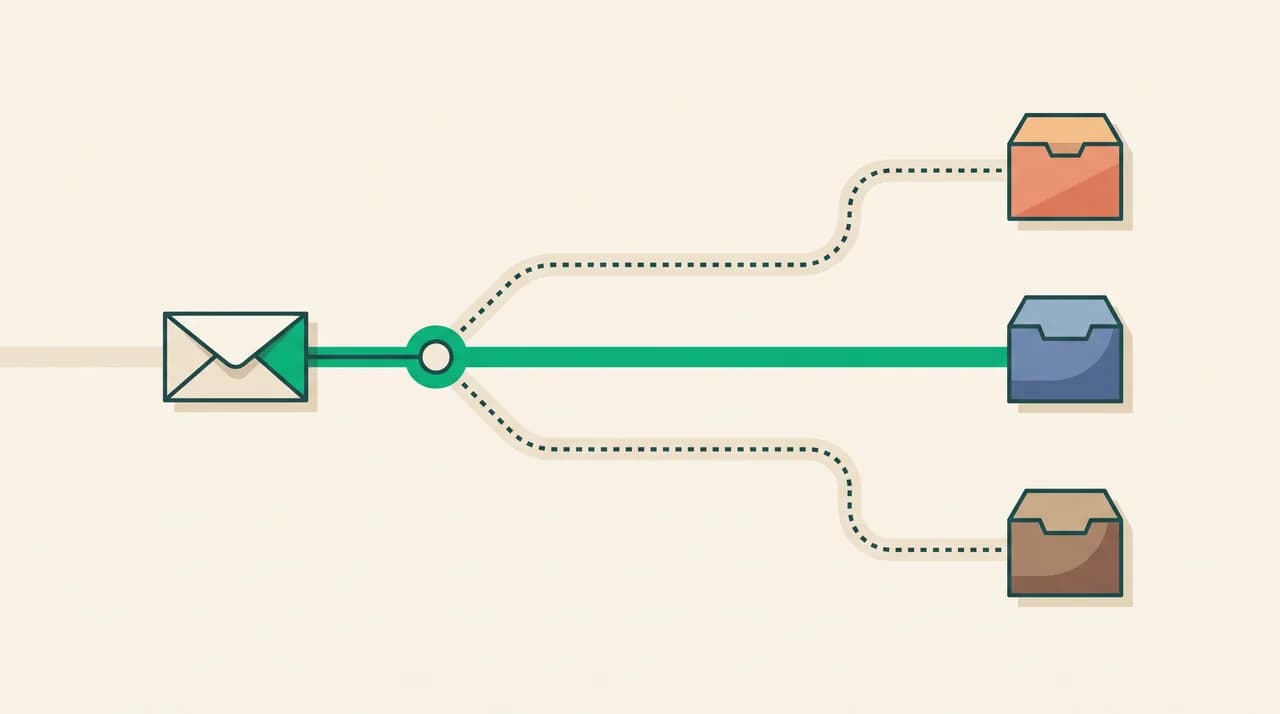
A standalone AI email client can run an agent on its own server. That agent does not need your phone or laptop to be awake — it can triage overnight, draft replies, and queue them for your approval so they are waiting when you wake up. This is the architectural gap that no amount of plugin polish closes: continuous, device-independent work needs code that runs somewhere other than your browser tab.
The same logic explains mobile. "Do Gmail extensions work on mobile?" — for browser extensions, effectively no. Chrome and most mobile browsers don't run desktop extensions, and the Gmail app on your phone can't load them at all. Workspace add-ons fare better and do appear in Gmail on Android, but Google's own documentation notes that some capabilities, including iOS, are not yet supported by the Workspace Add-ons API. A standalone client ships an actual mobile app, so the AI is simply there on your phone.
Where a Gmail plugin wins#
A plugin is not the compromise choice for everyone — for a large group of people it is the correct one, and pretending otherwise would be dishonest.
The biggest advantage is zero disruption. You keep Gmail exactly as it is, install an extension or add-on in a couple of minutes, and your muscle memory, filters, labels, and keyboard shortcuts all survive. There is no migration, no re-learning, and no risk of leaving mail behind. For a workflow that is already entirely inside the Gmail web tab, that is a real and underrated benefit.
Plugins are also usually cheaper and lower-commitment. Many are packaged with a free tier or a low monthly price, and because you are adding one capability rather than replacing your whole email app, the stakes of trying one are small. If it does not work out, you uninstall it and nothing else changes.
- Lowest switching cost — keep your existing Gmail setup entirely.
- Fast to try and fast to remove; low risk if it doesn't fit.
- Focused single-purpose tools (send-later, follow-up reminders, templates, tracking) that do one job well.
- No new inbox to learn and no mail to migrate.
When a plugin is genuinely the right buy
Where a standalone AI email client wins#
The standalone client wins exactly where the plugin architecture hits its ceiling — and those wins are structural, not a matter of one product trying harder than another.
First, reach. A dedicated client shows up on your phone as a real app and keeps its AI working there. Second, continuity: a server-side agent can keep triaging and drafting while your devices are off, so routine mail is handled or queued before you open your inbox. Third, provider coverage: if you also have Outlook or an IMAP account, a client can pull Gmail, Outlook, and IMAP into one inbox, while a Gmail plugin stays Gmail-only by definition.
This is where AI Emaily fits, and to be plain about it: we build AI Emaily. It is a standalone AI email client that connects to Gmail, Outlook, and IMAP, with a server-side agent so it can work when your laptop is closed and a mobile presence so it works on your phone. Its voice matching comes from a Personal Context brain you set up plus per-client profiles — you tell it how you write and who you're writing to; it does not quietly mine your sent mail. It does not train on your email.
The part that matters most in a client that can act for you is the control model, because "AI that can send" is only safe if you stay in charge of what goes out. AI Emaily runs in three modes. In Manual it drafts and you send. In Copilot it prepares a reply and waits for your one-tap approval. In Autopilot it can send only the routine messages you have explicitly allowed, within rules you set — and every action is logged in an audit trail with an undo on sends. That approve-before-send-plus-undo model is the thing most Gmail plugins don't try to address, because most of them aren't in the business of acting autonomously on your behalf.
On platforms, we say the whole truth. AI Emaily ships real downloadable desktop apps — a macOS app (Apple Silicon only, and not in the Mac App Store) and a Windows installer — plus a native iOS app and an installable Android PWA. There is no Linux build, and the desktop apps are an Electron shell around the web interface, so they will not match a native client like Apple Mail or Mimestream on memory footprint or deep OS integration. What they do give you is same-day feature parity with the web app and a real app window with system notifications.
We won't claim to win everything. If your entire life is in Gmail and you want the fastest possible keyboard-driven inbox, a client like Shortwave — an AI-native Gmail client built by ex-Google engineers, with strong semantic search — may fit you better than we do. Conceding that is not modesty; it is the reason the rest of this page is worth trusting.
"Are Gmail extensions safe with inbox access?"
Pricing: how each model is packaged#
Prices in this category change constantly, so this section describes the shape of each pricing model rather than quoting numbers — always confirm the current figure on the vendor's own pricing page before you buy.
Gmail plugins tend to be packaged as a free tier plus a low monthly subscription, or a single flat price, because they add one capability to an inbox you already run. Standalone AI email clients are usually priced per seat, sometimes with a free plan or a time-limited trial, and a few are moving to usage-metered pricing where what you pay tracks how much the AI does.
Watch for two traps when you compare. First, usage-metered pricing can hide the real cost when the vendor doesn't define what one unit of usage is — you can see the price and still not know the bill. Second, "free" tiers move; a plan that reviews describe as free may have changed by the time you read this. Both are reasons to read the live pricing page rather than a summary, ours included.
Verify every price on the vendor's own page
Who each option is genuinely for#
The cleanest way to decide is to match the tool to where and how you actually work, not to who has the longest feature list.

| If this is you… | The better fit | Why |
|---|---|---|
| You live in the Gmail web tab on a desktop and rarely need AI on mobile | A Gmail plugin | Lowest cost and disruption; the plugin's limits never bite because you never leave the tab. |
| You need AI help on your phone as much as your laptop | A standalone AI email client | Browser extensions don't run in the Gmail mobile app; a client ships a real mobile app. |
| You want mail triaged and drafted while your computer is off | A standalone AI email client | Only a server-side agent keeps working when your devices are asleep. |
| You have Outlook or IMAP accounts too, not just Gmail | A standalone AI email client | A Gmail plugin is Gmail-only by design; a client unifies providers. |
| You want the fastest keyboard-driven Gmail workflow and nothing else | An AI-native Gmail client like Shortwave | It's built around Gmail speed; that's a fair place a competitor beats a generalist. |
| You want light AI and no new vendor at all | Gmail's built-in Gemini features | It's already in Gmail; no install, no extra subscription to manage. |
A third option, honestly#
There is a middle path worth naming before you buy anything third-party: the AI Google already ships inside Gmail. Gemini features are built into Gmail and Workspace and can summarize threads and help draft replies without adding another vendor or another login. If you only want light assistance and want to keep your surface area small, that may be enough, and it costs you nothing extra to try first. Confirm what's included in your plan on Google's own page, as availability varies by account type and region.
There is also a category between a plugin and a full client: overlays such as Fyxer, which add triage and drafting on top of Gmail or Outlook without being a full email client you switch to. They sit closer to the plugin end of the spectrum on disruption while reaching more than a single-purpose extension. As with everything here, check the current capabilities and packaging on the vendor's own page before relying on them.
The point of listing these is simple: the best way to add AI to Gmail is not the same for everyone. Start with the built-in Gemini features if you want the least commitment, reach for a plugin if you want one focused capability inside the Gmail tab, and switch to a standalone client only when you genuinely need mobile, always-on, or multi-provider AI — which is exactly when the plugin model runs out of room.
Frequently asked
See it in AI Emaily
Keep reading
Sources

Written by
Nafiul HasanNafiul Hasan is an entrepreneur and AI automation system builder with 10+ years of experience turning messy, manual workflows into reliable automated systems. He designs and ships AI enterprise solutions end-to-end — the agent logic, the data plumbing, and the product people actually use — and founded AI Emaily to give busy professionals their attention back. He writes here from the builder's seat: what works, what breaks, and how to put AI to work without giving up control.