Apple Mail Not Receiving Emails on Mac: How to Fix Sync

The short answer
Apple Mail stops receiving emails on Mac when an account goes offline, credentials expire after a provider auth change, or the IMAP connection itself stalls. Take All Accounts Online resolves most cases instantly. For expired credentials, re-enter the password or re-authorize the account. For a silent connection failure, Connection Doctor shows exactly which step breaks.
Apple Mail not receiving emails on Mac usually means the account went offline, credentials expired, or the IMAP connection stalled. Here is how to fix each.
On this page
- 01What causes Apple Mail to stop receiving emails on Mac?
- 02Fix 1: Take All Accounts Online
- 03Fix 2: Re-enter or re-authorize your account credentials
- 04Fix 3: Use Connection Doctor to pinpoint a silent connection failure
- 05How to tell which fix to try first
- 06How to prevent Apple Mail sync problems on Mac
Apple Mail not receiving emails on Mac announces itself in a few ways: the message list stops updating while the rest of the Mac works normally, a red exclamation mark appears next to one or more accounts in the sidebar, the spinner in the status bar reads "Checking for mail..." without ever resolving, or messages visible in webmail have not landed in Mail. All of these point to the same root: the IMAP or Exchange connection to the mail server has broken.
Apple Mail keeps a persistent connection open to the server so new messages arrive in near real time. When that connection drops, Mail cannot pull new mail. The server keeps receiving on your behalf — messages wait there safely — but nothing reaches the local client until Mail can authenticate and open a working connection again. Three things break this: the account going offline, a credential rejection, and a lower-level TCP or SSL failure.
This guide covers the step-by-step fix for each. Fix 1 takes ten seconds and resolves the majority of cases. Fix 2 takes two to five minutes and handles expired or revoked credentials. Fix 3 uses the built-in Connection Doctor to identify exactly where a silent connection failure is occurring, so you stop toggling settings at random.
What causes Apple Mail to stop receiving emails on Mac?#
Apple Mail uses IMAP to connect to Gmail, iCloud, Yahoo, and most other providers, and Exchange ActiveSync for Microsoft accounts and most corporate setups. Both protocols maintain a persistent connection so new messages arrive quickly. The table below maps the six most common reasons that connection breaks, how to confirm which one you have, and which fix applies.
| Cause | How to confirm | Fix to apply |
|---|---|---|
| Account taken offline — automatically after a network drop, sleep-wake cycle, or VPN toggle | Red exclamation mark in the sidebar; Mailbox > Take All Accounts Online is available and not greyed out; no password dialog when you click the badge | Fix 1: Take All Accounts Online |
| Password changed on another device or in webmail without updating Mail | Exclamation mark that opens a password dialog when clicked; the old password is rejected | Fix 2: Re-enter the current password at the prompt or in Mail > Settings > Accounts |
| OAuth token revoked — provider security review, idle period, or forced re-authentication | Exclamation mark returns within minutes of clicking Take All Accounts Online; password prompts clear briefly then reappear | Fix 2: Remove and re-add the account in System Settings > Internet Accounts to issue a fresh token |
| App-specific password required — Gmail, iCloud, or Yahoo with two-factor authentication active | Password prompt appears; any password is rejected; webmail sign-in works fine with the same credentials | Fix 2: Generate an app-specific password at accounts.google.com or appleid.apple.com |
| IMAP server address, port, or SSL setting mismatch | Connection Doctor shows a red X on the incoming-mail row; badge persists after Fix 1 and Fix 2 with no password prompt | Fix 3: Verify incoming server name, port, and SSL/TLS in Mail > Settings > Accounts > Server Settings |
| Too many simultaneous IMAP connections or a per-account session cap | Connection Doctor log shows 'Too many connections' or 'Maximum number of connections exceeded' | Fix 3: Quit and reopen Mail; verify Mail is not open on other devices using the same account |
Fix 1: Take All Accounts Online#
Apple Mail takes an account offline automatically after a network interruption — a dropped Wi-Fi connection, a VPN toggle, a sleep-and-wake on a different network, or a brief server timeout. When it does, it does not always reconnect on its own. Take All Accounts Online sends a fresh connection request to every offline account simultaneously, and for most users who see the exclamation mark without a password prompt, this resolves it in seconds.
- 1
Check the sidebar for the red exclamation mark
A red exclamation mark to the right of an account name indicates that account is currently offline. If multiple accounts show it, all of them reconnect in the next step. If no exclamation mark appears but new mail has still stopped arriving, skip directly to Fix 3 — the account is reporting as online but the connection is failing silently.
- 2
Open the Mailbox menu and click Take All Accounts Online
In the menu bar, click Mailbox. Take All Accounts Online appears near the top of the menu. Click it. If the item is greyed out, all accounts are already considered online by Mail — the problem is a connection or authentication failure, and Fix 3 is the right next step.
- 3
Or click the exclamation mark to reconnect one account at a time
Clicking the red exclamation mark next to an individual account opens a status popover showing that account's state and a Go Online button. This reconnects only that specific account without disturbing others that are syncing correctly — useful when one account is offline while the rest remain healthy.
- 4
Wait 30 to 60 seconds and watch for new messages
After reconnecting, Mail immediately fetches any messages that arrived while the account was offline. The status bar at the bottom of the Mail window shows sync activity as messages download. If messages appear within a minute and the exclamation marks disappear, the fix is complete.
- 5
If the exclamation mark returns within a few minutes, move to Fix 2
A persistent offline badge that comes back shortly after reconnecting means the server is rejecting authentication rather than the connection simply dropping. That is a credential problem, and Fix 2 addresses the specific cause.
Fix 2: Re-enter or re-authorize your account credentials#
A rejected credential produces the same red exclamation mark as a transient offline event, but it does not clear permanently with Take All Accounts Online. The session may open briefly and fail again within minutes as Mail re-authenticates. The scenarios below each require a slightly different response — identify which applies before making changes.
- 1
Enter the current password at the prompt
Clicking the exclamation mark often opens a dialog asking for the account password. Enter your current, correct password and click OK or Sign In. If the password changed recently on another device, use the new one here. If this clears the error and mail starts arriving normally, the fix is complete.
- 2
Update the stored password in Mail's account settings
If no prompt appeared, open Mail > Settings with Command-Comma and click the Accounts tab. Select the offline account, then click Server Settings. In the Incoming Mail Server section, clear the Password field and type the current password. Click Save. If the outgoing server uses a separate login, update it there as well.
- 3
For Gmail, iCloud, or Yahoo with two-factor authentication — generate an app-specific password
These providers block standard password authentication when two-factor authentication is active. A normal account password is rejected at the server level. For Gmail, visit myaccount.google.com and go to Security > App Passwords. For iCloud, visit appleid.apple.com and go to Sign-In and Security > App-Specific Passwords. Generate a password labelled 'Apple Mail', copy it, and paste it into Mail > Settings > Accounts > Server Settings in place of the normal account password.
- 4
For OAuth accounts — remove and re-add the account in System Settings
When a Google, Microsoft, or Apple OAuth token is revoked — by a security review, a long idle period, or a forced re-authentication — re-entering a password does not help because Mail uses the OAuth token rather than a static password. Open System Settings > Internet Accounts, select the affected account, and remove it. Then add it again. Mail redirects you to the provider's web sign-in page, which issues a fresh token.
- 5
If the credential keeps reverting — clear the stale entry from Keychain Access
If Mail repeatedly ignores a correct password entered in Server Settings, macOS Keychain may be overwriting it with an older cached credential. Open Keychain Access from Applications > Utilities, search for your email domain, and delete any login keychain entries related to Mail and that account. Then enter the correct password in Mail > Settings > Accounts again. The next successful connection saves the new credential.
Confirm the password works before changing anything in Mail
Fix 3: Use Connection Doctor to pinpoint a silent connection failure#
When Take All Accounts Online does nothing and credentials are confirmed correct, the connection is failing at a lower level: a wrong server address or port, an SSL/TLS mismatch, or a network path blocking port 993. Connection Doctor runs a live IMAP and SMTP handshake for every configured account and reports exactly where the connection stops working — replacing guesswork with a specific diagnosis.
- 1
Open Window > Connection Doctor
In the menu bar, click Window, then click Connection Doctor. On macOS Monterey 12 and earlier, the keyboard shortcut is Option-Command-L. The panel lists every account Mail has configured with separate rows for the incoming mail server and the outgoing server.
- 2
Wait for the connection test to complete
Connection Doctor runs a fresh test automatically when the panel opens. Each row shows a spinning indicator during the check, then a green checkmark or a red X when it finishes. Wait for the full test to complete before acting on any result — a row that looks red mid-test may clear by the time all checks have run.
- 3
Identify which row failed
Note which accounts and which rows — incoming or outgoing — show a red X. For apple mail not receiving emails, the relevant failure is on the incoming mail row. A failure only on the outgoing row means Mail can receive but not send — a different problem with a different fix.
- 4
Click Show Detail to read the connection log
Click the disclosure arrow next to a failed account to expand the raw connection log. The log records each step of the handshake: DNS lookup, TCP connection, SSL negotiation, and authentication. The line where the log stops or shows an error is the specific cause. 'Connection refused' means the server address or port is wrong. 'Certificate verification failed' means SSL is misconfigured. 'Authentication failed' after confirmed credentials points to an app-specific password issue covered in Fix 2.
- 5
Correct the setting and retest
Open Mail > Settings > Accounts, select the affected account, and click Server Settings. Compare the incoming mail server hostname and port against your provider's published IMAP settings: Gmail uses imap.gmail.com on port 993 with SSL/TLS; iCloud uses imap.mail.me.com on port 993 with SSL; Outlook and Microsoft 365 use outlook.office365.com on port 993. For SSL errors, toggle between SSL/TLS and STARTTLS. Return to Connection Doctor after each change and rerun the test to confirm the fix.
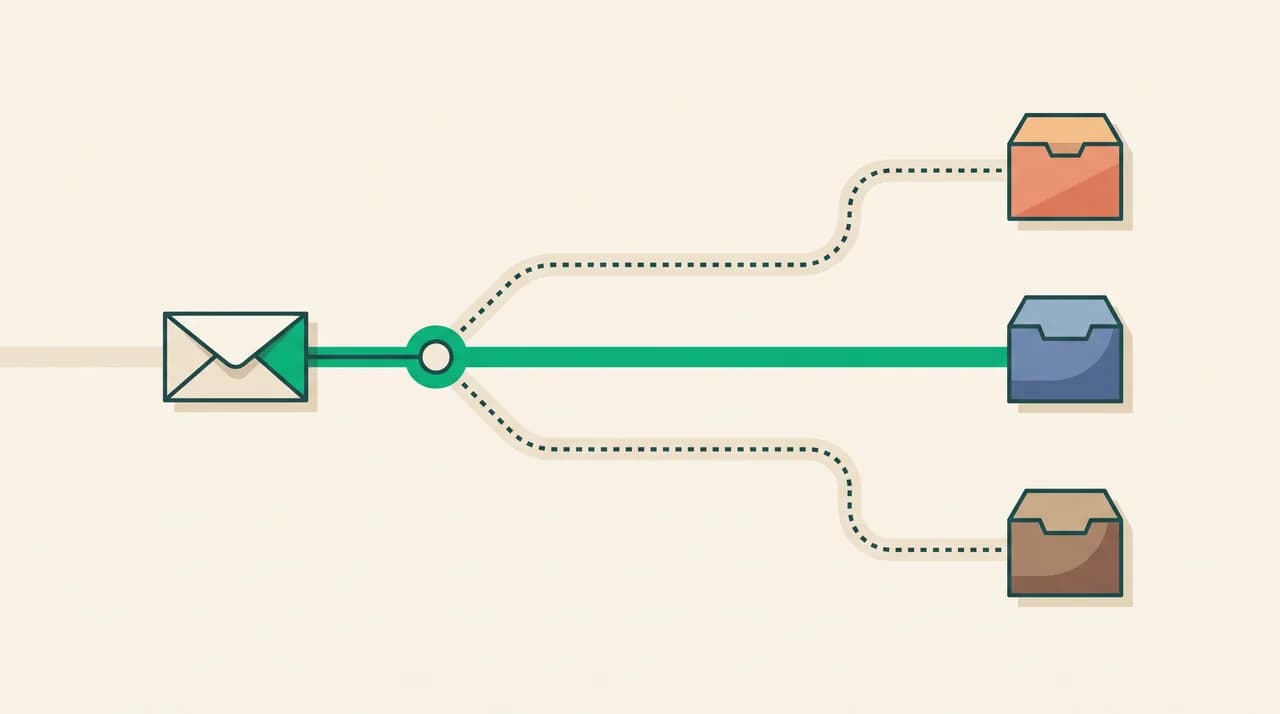
Green checkmark but still no new mail? Check server-side filtering
How to tell which fix to try first#
The three fixes address distinct failure modes, and starting with the right one avoids steps that cannot help in a given situation. The signals Apple Mail already displays are enough to identify the correct path before opening any settings panel.
- Red exclamation mark in the sidebar, Mailbox > Take All Accounts Online is not greyed out, and no password dialog appears when you click the badge: the account is simply offline. Fix 1.
- Red exclamation mark and a password dialog opens when you click it: the server rejected the authentication attempt. Fix 2.
- Exclamation mark that returns within a few minutes of clicking Take All Accounts Online: the credential is being rejected on reconnect. Fix 2 — look at OAuth tokens or app-specific passwords specifically.
- No exclamation mark, the account shows as online in the sidebar, but new messages have stopped arriving: the connection is failing silently. Fix 3.
- Mail stuck on 'Checking for mail...' that never resolves: a TCP or SSL handshake that starts but stalls mid-way. Fix 3.
- Problem started within minutes of changing the email password in webmail or on another device: Fix 2 directly, updating the password stored in Mail > Settings > Accounts.
- Problem appeared immediately after a macOS update: try Fix 1 first, then Fix 2 if the badge returns within minutes, then Fix 3 if the connection keeps failing and credentials are unchanged.
How to prevent Apple Mail sync problems on Mac#
Most Apple Mail sync failures trace to predictable triggers. The habits below prevent the majority of cases where new mail stops arriving without warning.
- Keep macOS current: Apple ships Mail reliability fixes in point updates, including improvements to how Mail reconnects after sleep and after network changes. A release note mentioning 'improved reliability for mail account connections' is worth installing promptly.
- Watch for provider security emails: Google, Apple, and Microsoft send a notification when they revoke a token, detect unusual access, or require re-authentication. Acting on those within 24 hours prevents the offline surprise — the message usually contains a direct link to re-authorize the account.
- Prefer OAuth sign-in over app-specific passwords: When adding a new account in System Settings > Internet Accounts, choosing Sign in with Google or Sign in with Microsoft is more reliable than manually entering IMAP settings with a static app-specific password. OAuth tokens refresh in the background; a static password fails the moment you change the account password elsewhere.
- Update Mail immediately after changing a password anywhere else: If you reset your email password in webmail or on a mobile device, open Mail on the Mac and update the stored credential in Mail > Settings > Accounts within the hour. Waiting means Mail runs against a rejected credential overnight.
- Do not force-quit Mail during an active sync: An interrupted IMAP session can leave the connection in an inconsistent state on the server side. Use Mail > Quit Mail rather than forcing the process to exit, so Mail can cleanly close the session.
The steps above resolve nearly every case of Apple Mail not receiving emails on Mac. If you manage Gmail, Outlook, iCloud, and other IMAP accounts from multiple devices, every credential expiry triggers the same fix separately on each device — because client-side IMAP sync is inherently per-device and per-account. We build AI Emaily, an AI-native email client with server-side sync and a unified inbox across providers; reconnecting one account fixes it across every surface at once. If recurring sync maintenance across several accounts is a familiar pattern, the 7-day free trial is a practical way to see whether the architecture difference holds up for your setup.
Frequently asked
See it in AI Emaily
Keep reading
Sources

Written by
Nafiul HasanNafiul Hasan is an entrepreneur and AI automation system builder with 10+ years of experience turning messy, manual workflows into reliable automated systems. He designs and ships AI enterprise solutions end-to-end — the agent logic, the data plumbing, and the product people actually use — and founded AI Emaily to give busy professionals their attention back. He writes here from the builder's seat: what works, what breaks, and how to put AI to work without giving up control.