Best Email Client for People Who Hate Filing Email (2026)


The short answer
If you never want to file email into folders again, pick a client that pairs strong semantic search with auto-labels you can inspect and correct, plus an archive-everything default. AI Emaily does this across Gmail, Outlook and any IMAP account; HEY enforces the strictest no-file philosophy; Shortwave and Gmail cover a Gmail-only workflow.
Best email client without folders in 2026: which apps make search, auto-labels and archive-everything actually viable across every provider.
On this page
- 01The short answer, and the honest concession
- 02How we compared
- 03The eight clients at a glance
- 04Where each one wins and where it does not
- 051. AI Emaily — inspectable auto-labels, semantic search, one-key archive
- 062. HEY — the client that refuses to let you file
- 073. Shortwave — semantic search for a Gmail-only workflow
- 084. Gmail — the original search-first client, still holding up
- 095. Superhuman Mail — Split Inbox as a folderless shape
- 106. Apple Mail — Smart Mailboxes as saved searches
- 117. Spark — bundled categories on top of standard mail
- 128. Thunderbird — Saved Search folders and tags
- 13How to choose for your situation
- 14The bottom line on going folderless
The best email client without folders is the one that makes search and auto-labels reliable enough that the folder tree stops being useful. That is a higher bar than "has good search" — it means the categorisation you rely on is inspectable, correctable, and does not degrade the moment you switch provider or archive a message. This roundup ranks eight clients on how well a strictly folderless workflow actually holds up in each one.
The order below is by how well each client supports the three habits that make a no-filing workflow viable in practice: archive by default with one keystroke, auto-labels you can audit, and a search that finds a message you last read six months ago. AI Emaily is entry #1 and we build it — that disclosure is here so the rest of the page can be read for what it is worth. Where a competitor is stronger on a specific dimension, we say so plainly and name the dimension.
The short answer, and the honest concession#
For most readers who want to stop filing email into folders, the best client is AI Emaily. It labels incoming mail automatically using an inspectable Rules Brain — every label carries a reason you can open and edit, so the categorisation is not a black box you have to trust. Semantic search and "Ask your inbox" find messages by what they were about rather than by exact keyword, so archiving into one pile becomes safe. Archive is a single keystroke. It runs across Gmail, Outlook, iCloud, Fastmail, Proton and any IMAP account, so a search returns the same result whether the mail arrived at work or personal. There is a 7-day free trial on Pro and Autopilot — card captured, $0 due if cancelled before day 7 — and no permanent free tier.
The honest concession. HEY has built harder on the folderless philosophy from first principles than we have. Its Screener refuses to let a new sender through until you accept them, and Imbox / The Feed / Paper Trail enforces a rigid three-way sort with no user-defined folders on offer at all — you cannot file even if you want to. If what you actually want is the client that punishes filing rather than merely making it optional, HEY is the purer take on "never file email again," and we do not try to match its opinionated refusal to expose folder-like structure. Trade-offs come with that: HEY is its own hosted mail service on hey.com or a paid custom-domain plan, so choosing it means moving mail, not just switching client. We build AI Emaily.
Prices, ratings and review counts belong on vendor sites, not here
How we compared#
A folderless workflow only works when the software takes over the sorting the folders used to do. Every client below was graded on behaviour, not on marketing copy — capabilities each vendor publishes on its own live help or pricing pages as of August 2026. Verify before you buy.
The five dimensions are the ones a heavy user hits within a week of committing to "never file again":
- Auto-labelling that is inspectable — can you see why a message was labelled, and correct it, or is it a black box.
- Search quality — does it match by meaning (semantic) or only by exact keyword, and does it search bodies plus attachments.
- Archive by default — is there a single-key "done, get out of the inbox" action, or do you have to choose a folder.
- Cross-provider — does the same workflow apply to Gmail, Outlook and other IMAP mailboxes, or is it wedded to one.
- Screener / cold-mail wall — does the client keep unknown senders out of the main view without a manual rule per sender.
The eight clients at a glance#
The table summarises the shape of the comparison; the per-client sections below explain what each row actually feels like in daily use. Rows are ordered by how well a strictly no-filing workflow holds up in each client, not by market share or by our preference.
| Client | Auto-labels (inspectable?) | Search | Archive default | Providers | Packaging shape |
|---|---|---|---|---|---|
| AI Emaily | Yes — Rules Brain shows the rule/reason and lets you edit | Semantic "Ask your inbox" + full-text | One key, archive to All Mail | Gmail, Outlook, iCloud, Fastmail, Proton, any IMAP | 7-day free trial on Pro/Autopilot, subscription after |
| HEY | Categorisation is opinionated and fixed — Imbox / Feed / Paper Trail; no user folders | Keyword + filters; no semantic search | "Reply Later" and "Set Aside" stacks; no traditional archive | Hosted only on hey.com or a paid custom-domain plan | Annual subscription per address (verify on vendor page) |
| Shortwave | AI labels/bundles for Gmail; rules editable | Semantic search on Gmail archive | Gmail archive (e key) | Gmail only | Free tier or paid — verify on vendor page (has changed in 2026) |
| Gmail | Category tabs (Primary/Social/Promotions/…); rules via filters, no per-message reason | Full-text, operator-rich; no semantic layer natively | Yes — archive removes from Inbox, keeps in All Mail | Gmail only | Free tier for personal; Workspace per-seat |
| Superhuman Mail (post-Grammarly) | Split Inbox splits by rule; you write the rules | Fast keyword search on Gmail/Outlook | One key, provider archive | Gmail, Outlook | Per-seat subscription; trial (verify on vendor page) |
| Apple Mail | No auto-labels; Smart Mailboxes are saved searches | Full-text local + server; on-device categorisation on Apple Intelligence | One-key archive per account (if provider supports) | iCloud, Gmail, Outlook, IMAP, Exchange | Free with macOS/iOS |
| Spark | Smart categories bundle newsletters/notifications; taxonomy is fixed | Full-text + Smart Search operators | Yes — Gestures configurable | Gmail, iCloud, Outlook, Yahoo, IMAP | Free tier plus paid Premium (verify on vendor page) |
| Thunderbird | No auto-labels; tags and Saved Search folders (query-based) | Full-text via Gloda index; operator search | Yes — provider archive with A key | Any IMAP, Exchange, Gmail, Microsoft 365 | Free, open-source; MZLA donations |
Where each one wins and where it does not#
A comparison table can only summarise. The trade-off you actually feel is the first time you go looking for a six-month-old message with only a fuzzy memory of the sender, or the first time an auto-label puts a client's contract in the wrong bucket. Below is what each client does when that happens.
1. AI Emaily — inspectable auto-labels, semantic search, one-key archive#
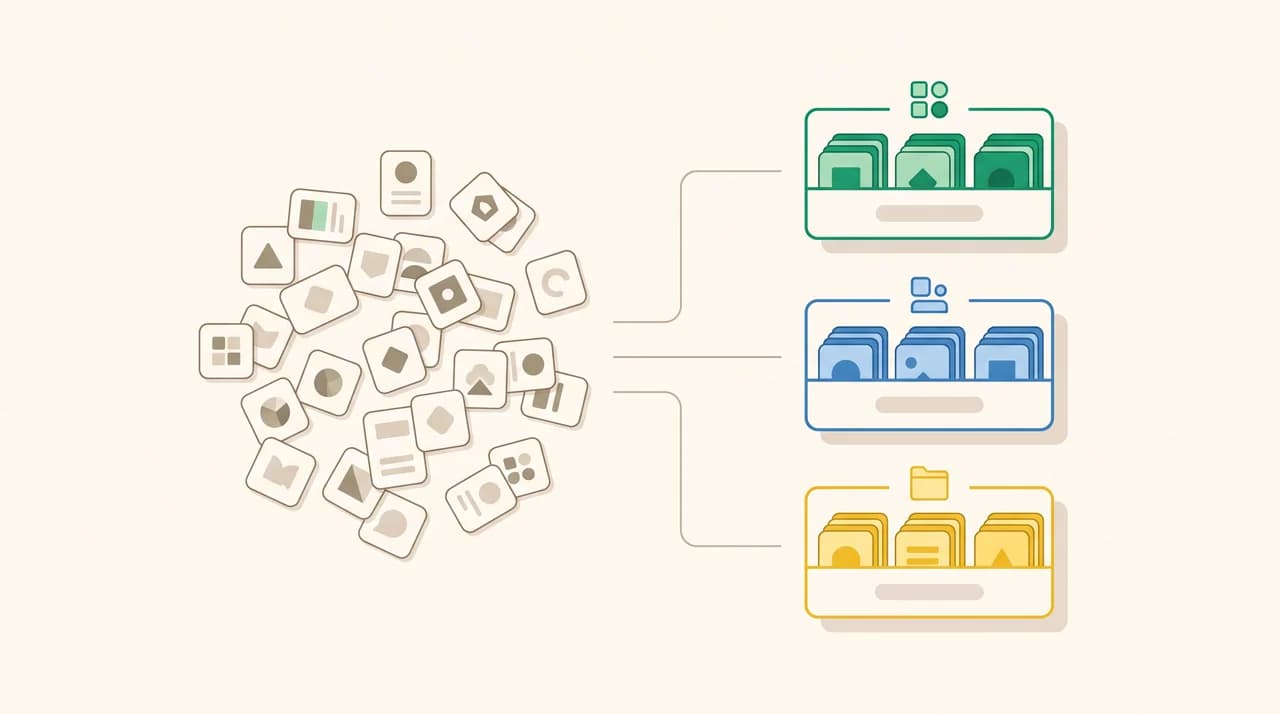
AI Emaily is built for the reader who has already decided folders are a losing game. Incoming mail is auto-labelled by the Rules Brain — a mix of AI classification and plain-English rules you can write yourself — and every label on a message carries a reason: which rule fired, or which signal the classifier keyed on. You can open the reason, edit the rule, and the next similar message follows the new logic. This is the correction loop that automatic categorisation needs to be trusted; without it, auto-labels are a black box you eventually stop believing.
Search is where the archive-everything workflow lives or dies. AI Emaily runs a semantic "Ask your inbox" layer over full-text — you can search for "the contract amendment from the lawyer about the payment schedule" without remembering the sender, the subject, or a keyword that actually appears in the body. Results are grounded in the messages themselves, with links back to the source thread. Archive is a single keystroke; the message leaves the inbox but stays in the account (All Mail on Gmail, Archive on IMAP), so a folderless "one bucket plus search" workflow is the intended default rather than an accident.
It runs across Gmail, Outlook, iCloud, Fastmail, Proton and any IMAP account, so the same auto-labels, search and archive shortcut apply whether the mail arrived at work or personal. A Cold-Email Filter keeps unsolicited outreach out of the inbox without a per-sender rule. We build AI Emaily. Packaging is a 7-day free trial on Pro and Autopilot — card captured, $0 charged if cancelled before day 7 — with subscription tiers after that; the current tiers are on aiemaily.com/pricing. There is no permanent free tier.
2. HEY — the client that refuses to let you file#
HEY is the most opinionated take on folderless email currently shipping, and it is the reason the concession above is HEY and not us. The Screener is the front door: a new sender does not reach the main view at all until you screen them in or out, which does more to keep an inbox clean than any label ever could. Once accepted, mail lands in one of three fixed bins — Imbox for the messages that matter, The Feed for newsletters, Paper Trail for receipts — and there are no user-defined folders on offer. You cannot file, so you stop trying.
The trade-off is that HEY is a mail service, not a client. To use it you host on hey.com or you pay for the custom-domain plan; you cannot point HEY at an existing Gmail or Outlook mailbox and get the same behaviour on that account. That moves the decision from "which client" to "do I want to move my mail," which is a bigger call. Search is keyword and filter, not semantic, and the taxonomy is theirs — if the three bins do not match how you think about your mail, there is no dial to change that. Packaging is an annual per-address subscription; verify current pricing on hey.com.
3. Shortwave — semantic search for a Gmail-only workflow#
Shortwave is an AI-native client built for Gmail and only Gmail, from a team of ex-Google engineers, and it has built harder on Gmail archive semantic search than most competitors — including, on that one Gmail-shaped dimension, us. AI bundles group related mail (newsletters, receipts, updates) into stacks that you can process together and clear in one action. Rules and labels are editable, and the archive action (e) is Gmail's native archive, so the folderless muscle memory carries over cleanly.
The pitch is also the ceiling: it is Gmail only. If your setup includes an Outlook work account, an iCloud personal, or any IMAP mailbox, Shortwave is not the client for those. Packaging shape has moved more than once in 2026 — a free plan appeared in some tiers and disappeared in others — so verify the current tiers on shortwave.com before you commit. For a reader whose entire mail life is inside Gmail and who wants an AI-first reading UI on top of Gmail's own archive, this is a legitimate pick.
4. Gmail — the original search-first client, still holding up#
Gmail is where the folderless idea entered the mainstream: All Mail is the one-bucket archive, e archives from anywhere, and search is the primary retrieval tool. Category tabs (Primary, Social, Promotions, Updates, Forums) split the front page into rough auto-labels; filters let you write your own rules, and labels give you the tagging system that replaces folders. A no-filing workflow in Gmail itself is entirely viable — millions of people run it — and requires nothing beyond turning off tabs you do not want and archiving anything you have read.
The limits show up on two axes. Auto-labelling by tab is not inspectable per message — you cannot open a Promotions decision and see why Gmail decided that, and there is no correction loop beyond "Move to Primary," which trains slowly. Search is powerful with operators (`from:`, `has:attachment`, `older_than:`) but has no semantic layer natively, so you have to know what to search for. Packaging is a free tier for personal accounts and per-seat Workspace subscriptions; see Google's Gmail Help for current controls.
5. Superhuman Mail — Split Inbox as a folderless shape#
First a disambiguation carried by any 2026 Superhuman post: in July 2025 Grammarly acquired Superhuman the client, and in October 2025 Grammarly renamed the parent company to Superhuman. Two distinct things share the name — Superhuman Mail (the client) and the Superhuman Suite (the bundle). This section is about the client. Superhuman Mail is a keyboard-driven reading UI for Gmail and Outlook, and its Split Inbox feature is the closest thing it has to auto-labels: you write splits (rules) that carve incoming mail into strips within one view, so News, VIP, Everything Else are visible at once without filing.
The trade-off: the rules are yours to write and maintain, and there is no semantic search layer beyond fast provider-side keyword search. Threading, archive and search are inherited from Gmail or Outlook underneath. Packaging is a per-seat subscription with a trial; verify tiers on superhuman.com.
6. Apple Mail — Smart Mailboxes as saved searches#
Apple Mail does not do auto-labelling in the AI sense, but it exposes the closest classical equivalent: Smart Mailboxes on macOS are saved searches that behave like folders — "any message from a client domain, unread, in the last 30 days" appears as a single view without moving any mail. On Apple platforms with Apple Intelligence, mail is categorised on-device (Primary, Transactions, Updates, Promotions), keeping the classification off any vendor's server.
The limit is scope. Apple Mail is Apple platforms only, its rules engine is thinner than Outlook's, and there is no semantic search — you get local plus server keyword search, which is fast but literal. If you already live in the Apple ecosystem, want a native client, and are content that the "folderless" behaviour comes from Smart Mailboxes rather than AI, this is the shortest path. Verify current behaviour on Apple's Mail support page — options shift between macOS and iOS releases.
7. Spark — bundled categories on top of standard mail#
Spark takes a light-touch approach: incoming mail is bundled by fixed Smart Categories — Newsletters, Notifications, Personal, Pins — so you can process a category in one pass without filing into folders. Gestures are configurable (swipe-to-archive is one tap), search supports operators, and it works across Gmail, iCloud, Outlook, Yahoo and IMAP. For a reader who wants a folderless shape without moving to a fully AI-native client, Spark is the shortest path to that.
The trade-offs are real and worth stating. The category taxonomy is Spark's, not yours — you cannot add "Client-A vs Client-B" as a bundle. Spark's account model has historically synced through its own servers, which is a legitimate privacy dimension to check on their current privacy page; some of the categorisation runs there. Packaging is a free tier plus paid Premium; verify on the vendor site.
Intermediary sync is a real privacy dimension
8. Thunderbird — Saved Search folders and tags#
Thunderbird does not do AI auto-labelling. It gives you two adjacent primitives that add up to a folderless-adjacent workflow: Tags, which are Thunderbird-local labels you can apply and colour-code, and Saved Search Folders, which are query-based virtual folders — "unread and from anyone in my address book, across all accounts" appears as a folder without moving any mail. Combined with the A key for provider archive and the Gloda full-text index for search, it is the do-it-yourself version of a no-file setup.
The limits are honest and Thunderbird's community will tell you the same. There is no classifier — every rule is one you wrote. Search is keyword and operator, not semantic. Cross-account is well supported, and cross-folder dedup on Gmail-style label systems is not Thunderbird's strength. Packaging is free, open source, donations to MZLA. If "folderless" for you means "replace the folder tree with saved queries I control," Thunderbird does that with no subscription. If it means "the software categorises for me," it is not what you want.
How to choose for your situation#
The ranking above is by average behaviour on a strict no-filing workflow. Your own answer depends on which dimension you actually care about most. Match yourself to the row that best describes your setup.
| Your situation | The honest pick |
|---|---|
| You use two or more providers (Gmail + Outlook, or work + personal + iCloud) and want the same folderless workflow across all of them. | AI Emaily — auto-labels, semantic search and one-key archive work identically across every account. |
| You are willing to move your mail to a service whose whole product is the anti-folder philosophy. | HEY — the Screener and the fixed Imbox / Feed / Paper Trail are the strictest no-file design shipping. |
| You are 100% Gmail and want AI on top of Gmail's own archive, no more. | Shortwave, or Gmail's native client if you do not need AI beyond category tabs. |
| You want a keyboard-fast reading UI and are happy to write your own splits/rules. | Superhuman Mail on top of Gmail or Outlook. |
| You are 100% Apple (iCloud + macOS + iOS) and want Smart Mailboxes plus on-device categorisation. | Apple Mail with a handful of Smart Mailboxes replacing your old folders. |
| You want a lighter, mobile-first client that bundles newsletters and notifications without a full AI layer. | Spark — with the intermediary-sync caveat above. |
| You want no subscription, no vendor lock-in, and are happy to write every rule yourself. | Thunderbird — Tags plus Saved Search folders and the A-key archive. |
The bottom line on going folderless#
A folderless workflow is not a client feature — it is a habit that some clients support well and some fight. The habits are the same across every tool above: archive on one key when you are done, let the software label rather than filing yourself, trust search to find it later. The client's job is to make those three moves fast and reliable. That is the only bar that matters, and the ranking above is really a ranking of how many of the three each client actually clears.
If you already live entirely in Gmail and want the AI-lightest version, Gmail itself will do it. If you want the strictest philosophy and are willing to move mail, HEY is the right pick and we do not try to talk you out of it. If you want inspectable auto-labels, semantic search and one-key archive on every provider you already use, that is the job we built AI Emaily for — start with a 7-day free trial on aiemaily.com/pricing, and see aiemaily.com for how the Rules Brain and Ask-your-inbox work together in practice.
Frequently asked
See it in AI Emaily
Keep reading
Sources

Written by
Nafiul HasanNafiul Hasan is an entrepreneur and AI automation system builder with 10+ years of experience turning messy, manual workflows into reliable automated systems. He designs and ships AI enterprise solutions end-to-end — the agent logic, the data plumbing, and the product people actually use — and founded AI Emaily to give busy professionals their attention back. He writes here from the builder's seat: what works, what breaks, and how to put AI to work without giving up control.