Best Email Client With a Split Inbox (2026)


The short answer
The best email client with a split inbox depends on whether you want rules, an AI classifier or a screener. Gmail tabs and Outlook's Focused Inbox split by ML and let you retrain them by moving mail. HEY refuses unknown senders at the door. AI Emaily uses editable AI triage plus a Rules Brain across Gmail, Outlook and IMAP.
The best email client with a split inbox depends on who decides the split — a rule, an AI classifier or a screener. Eight approaches compared honestly.
On this page
- 01The short answer — our top pick and the honest concession
- 02How we compared these split inboxes
- 03Split inbox comparison table
- 041. AI Emaily — editable AI triage plus a Rules Brain
- 052. Superhuman Mail — hand-defined Splits with deterministic filters
- 063. Outlook — Focused Inbox is a two-lane server-side ML classifier
- 074. Gmail — Tabs are five lanes and better than their reputation
- 085. HEY — the Screener puts you in the classifier's seat
- 096. Shortwave — AI bundles group related mail on Gmail
- 107. Spark Mail — Smart Inbox splits four lanes across every provider
- 118. Apple Mail — Priority Ranking, not a real lane split
- 12How to choose the right split inbox for your situation
- 13Putting it together
Every split inbox answers the same question differently: who is the classifier, and what happens when it gets a message wrong? Outlook's Focused Inbox uses a server-side model that learns from your Move to Focused / Move to Other actions. Gmail Tabs uses category classifiers you retrain by dragging. HEY makes you the classifier at first-touch with a screener. Shortwave groups related mail into AI bundles. Superhuman Mail lets you define splits by hand with rules you write. AI Emaily runs an editable AI triage layer plus a Rules Brain across Gmail, Outlook and IMAP.
This roundup ranks eight of them on the axis that actually decides the purchase — who does the sorting, and how much control you have when the sorting is wrong. AI Emaily is entry #1 and we build AI Emaily; the disclosure is here so the rest of the page can be read for what it is worth.
The short answer — our top pick and the honest concession#
The best email client with a split inbox for most readers is AI Emaily. It splits by AI category — cold outreach, newsletters, receipts, notifications and important — and every category is a rule you can edit, override or add to in the Rules Brain. Corrections take effect immediately for that sender or pattern rather than waiting on a black-box classifier to retrain from your behaviour. Because it connects to Gmail, Outlook and any IMAP account, the split follows you across providers instead of ending at whichever mailbox the client happens to speak.
The honest concession: if you want to hand-define your lanes rather than accept an AI-chosen taxonomy, Superhuman Mail's Split Inbox is more literal. You write a filter — from this sender, containing this word, from this domain — and mail matching it goes into a lane you named yourself. That is a different design bet from ours, and if what you want is deterministic per-lane control rather than an editable AI classifier, Superhuman is the fit and you should stop reading and try it.
Everyone else should pick from the ranking below rather than defaulting to whatever their provider ships. Focused Inbox and Gmail Tabs are already on the account you use; the question is only whether they are enough.
How we compared these split inboxes#
Every product here ships a real split inbox as a first-class feature, not as an aftermarket filter you build yourself. Beyond that, they diverge sharply on who is doing the classification and what recourse you have when it is wrong.
We compared on six dimensions, in roughly the order they decide the purchase:
- Who classifies — a fixed rule, a machine-learned classifier, an AI model, or you at first-touch through a screener.
- Correction path — how do you tell the split it got a message wrong, and does that correction stick for one sender or all similar mail.
- Lane taxonomy — are the lanes fixed (Focused/Other, Primary/Social/Promotions), user-definable (Superhuman Splits, AI Emaily Rules) or self-organising (Shortwave Bundles).
- Provider coverage — Gmail-only, Gmail plus Outlook, cross-provider, or a full-replacement domain like HEY.
- What happens when you do nothing — does the default split match how you actually work, or is a lot of setup required before the split earns its keep.
- Cross-device consistency — does the split live server-side so the phone and the desktop agree, or client-side where it drifts.
We do not print competitor prices in this comparison because published tiers move — check each vendor's live page at purchase time. We describe packaging shape instead: free tier, paid trial, per-seat monthly, bundled with the OS. We verified capabilities against vendors' own live pages in August 2026, and one thing that has shifted quickly is the Superhuman name after Grammarly's 2025 acquisition and 2026 parent-company rename; this roundup compares Superhuman Mail, the standalone client, not the Superhuman Suite bundle.
Split inbox comparison table#
Read across each row: no column wins on every dimension, and the right pick depends on which kind of split you are actually trying to buy.
| Client | Who classifies | Correction path | Provider coverage | Packaging shape |
|---|---|---|---|---|
| AI Emaily | Editable AI triage plus a Rules Brain you can extend by sender, domain, subject, list-id or keyword. | Move a message and add a rule in the same step; the rule wins over the classifier for that pattern forever. | Gmail, Outlook, any IMAP account (iCloud, Fastmail, Proton Bridge, Zoho, Yahoo, custom domain). | Paid; 7-day free trial on Pro or Autopilot with a card taken and $0 charged if you cancel before day 7. |
| Superhuman Mail | You define lanes by hand as Splits (from sender X, contains word Y, from domain Z). | Edit the split's filter directly; deterministic, no model to retrain. | Gmail and Outlook. | Per-seat monthly or annual; brief trial. Grammarly-owned after the 2025 acquisition. |
| Outlook — Focused Inbox | Microsoft's server-side ML classifier splits Focused and Other. | Right-click Move to Focused / Move to Other; the model retrains from your actions. | Outlook.com, Microsoft 365 (personal and work). | Free in Outlook.com; included with Microsoft 365 subscriptions. |
| Gmail — Tabs | Google's category classifier splits Primary, Social, Promotions, Updates and Forums. | Drag between tabs; Gmail asks whether to always do this for the sender. | Gmail personal accounts; Google Workspace administrators can enable it. | Free with Gmail; bundled with Google Workspace. |
| HEY | You classify at first-touch through the Screener — yes-forever or no-forever per sender. | Approve or block a sender once; the decision is permanent until you reverse it manually. | hey.com address; separate HEY for Work plan for teams on a shared domain. | Flat annual subscription (individual and Work tiers). Verify on hey.com. |
| Shortwave | AI bundles related mail into groups (Newsletters, Notifications, Marketing, Calendar, To do) plus custom bundles. | Move a message between bundles; pin, mute or auto-summarise per bundle. | Gmail only (personal and Workspace). | Paid tiers with a short full-access trial; the plan structure shifted in 2026 — check the live pricing page. |
| Spark Mail | Smart Inbox splits mail into Personal, Notifications, Newsletters and Pinned. | Move a message; Spark learns and asks whether to apply the rule to future mail from that sender. | Gmail, Outlook, iCloud, Yahoo, Exchange, IMAP. | Free tier plus paid Premium and Teams plans. |
| Apple Mail | No lane split; Priority Ranking (Apple Intelligence) lifts likely-important mail to the top of one list. | No corrective UI — the ranker is not user-trainable. | iCloud, Gmail, Outlook, IMAP; supported OS versions only. | Bundled with macOS and iOS at no separate cost. |
Three patterns fall out of the table. First, an editable rule beats a black-box classifier for anyone who actually wants control — Focused Inbox and Gmail Tabs will retrain over weeks, but you never see the rule they learned. Second, provider coverage decides more than any single feature: HEY, Shortwave and (to a degree) Superhuman are tied to specific providers, and if your mail lives elsewhere the split cannot follow. Third, the lane taxonomy matters: a fixed two-lane split like Focused/Other is easy to reason about but blunt, and Gmail's five-tab split is more useful in practice than most people give it credit for.
1. AI Emaily — editable AI triage plus a Rules Brain#
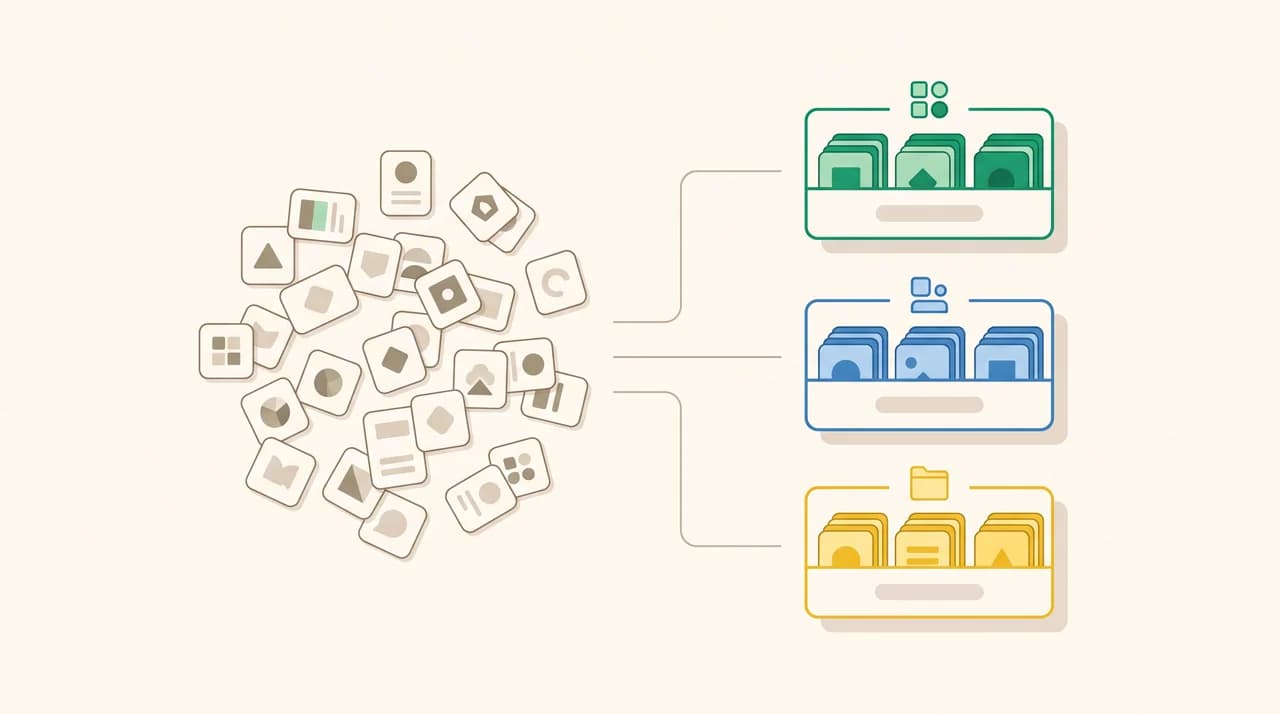
AI Emaily's split inbox is a two-part system. An AI triage layer reads every incoming message and drops it into a category — Important, Newsletters, Cold Email, Receipts, Notifications, Calendar. Under that layer sits the Rules Brain, where every rule the classifier learned is visible, editable and yours to override. If a client's founder is being routed to Newsletters because their weekly product update looks like one, you write a rule that pins their address to Important, and that rule wins over the classifier forever — no waiting for a model to retrain and no wondering whether it stuck.
Because AI Emaily talks to Gmail, Outlook and any IMAP account, the split follows you rather than the mailbox. You get the same categories, the same rules and the same triage on your work Outlook, your personal Gmail and the Fastmail address you use for freelance clients. Cross-device consistency is a consequence: the rules live server-side, so the classification you see on the phone is the classification you see on the Mac.
The agent layer adds one more move that most split inboxes do not: drafts. Once mail is categorised as Important and needing a reply, AI Emaily writes the draft in your voice using a Personal Context brain and per-client profiles, and the draft waits under the thread for you to approve. Approve-before-send is the default (Copilot mode); Autopilot only sends within rules you set explicitly per client, with an undo on every action and a full audit trail. The split does not just show you what matters — it queues the reply.
The honest limits: on Linux we ship only the web app, the initial classifier takes a few days to feel personal (as any classifier does), and if what you want is a screener that refuses unknown senders at the door, we do not do that. See how much it costs on the pricing page; the free trial is 7 days on Pro or Autopilot with a card taken and $0 charged if you cancel before day 7.
2. Superhuman Mail — hand-defined Splits with deterministic filters#
Superhuman Mail's Split Inbox is the most literal answer to the query. You create a Split, give it a name, and write a filter — from this sender, containing this word, from this domain, in this label. Mail matching the filter goes into your named lane; everything else stays in the main view. There is no model to retrain, no classifier to overrule and no ambiguity about why a message landed where it did. If you moved it, you moved it; if the filter caught it, the filter caught it.
That deterministic-per-lane control is the trade Superhuman made. You get more work up front — someone has to define the Splits — and less mystery afterwards. It pairs well with a keyboard-first workflow where you triage a Split in one sweep and move on, and Reminders push a whole Split out of view until later. Superhuman Mail is the standalone email client, distinct from the Grammarly-owned Superhuman Suite that shares the name after the 2025 rename — most reviews still conflate the two.
Provider coverage is Gmail and Outlook; there is no IMAP. Packaging is per-seat monthly or annual with a brief trial, and it is one of the most expensive options in the category — check the sticker on superhuman.com. Worth it primarily to people who will use the keyboard workflow every day and want the Splits behaviour rather than an AI classifier.
3. Outlook — Focused Inbox is a two-lane server-side ML classifier#
Outlook's Focused Inbox splits your mail into two tabs — Focused and Other. Microsoft's server-side ML classifier decides which is which, using signals from your own move history and aggregated across the tenant. You correct it with Move to Focused or Move to Other, and the model retrains from those moves. The split lives on the server, so it agrees across Outlook on the web, Windows, Mac, iOS and Android.
Focused Inbox is the split inbox with the least setup on the planet: if you have an Outlook.com or Microsoft 365 account, you already have it. That is a real advantage over anything that requires installing an app or migrating a provider. The trade is that you cannot see or edit the rule the model learned. Corrections work by pattern matching from your behaviour, not by a rule you wrote, so a stubborn miscategorisation can take a week of moving to fix.
Provider coverage is Outlook.com and Microsoft 365 — personal and work. Packaging is free with Outlook.com and included in every Microsoft 365 subscription. For anyone whose primary account is on Microsoft and whose two-lane needs are simple, this is often enough on its own; the split inboxes above earn their place mostly on richer categorisation or cross-provider reach.
4. Gmail — Tabs are five lanes and better than their reputation#
Gmail Tabs split your inbox into up to five categories — Primary, Social, Promotions, Updates and Forums — using Google's category classifier. Drag a message from Promotions to Primary and Gmail asks whether to always do this for that sender, which is the closest thing any provider ships to a visible rule the user can consent to.
The Tabs are underrated because their default behaviour is aggressive — Promotions is where marketing goes, and marketing is a lot of most inboxes — but the mechanism is sound. It runs server-side, agrees across every Gmail surface, and the classifier is one of the most-tuned in the world simply because Google runs it against every consumer inbox. It also composes with Gmail's other machinery: labels, filters and Priority Inbox stack on top of it.
Provider coverage is Gmail personal accounts; Google Workspace administrators can enable Tabs for their domain. Packaging is free with Gmail and included in every Workspace tier. If Gmail is your only account and Primary-plus-Promotions is the split you want, you do not need to buy anything above this — the built-in tool already does it. The clients above earn their fee mostly on cross-provider reach, richer taxonomies or an AI layer that also drafts replies.
5. HEY — the Screener puts you in the classifier's seat#
HEY, from the Basecamp team, does not classify at all — it makes you the classifier at first-touch. The first time a new address writes you, the message sits in the Screener queue and you decide yes-forever or no-forever. Approved senders land in the Imbox (spelled deliberately); newsletters go to The Feed, laid out like a magazine; receipts and confirmations go to Paper Trail, sorted by vendor. There is no probability, no training and no wondering why a message landed where it did.
This is a genuinely different bet from every other product in this ranking. Rules-based and AI-based classifiers assume mail should reach you and then be sorted; HEY assumes mail should be sorted at the door and much of it should not reach you at all. For anyone who is tired of the whack-a-mole of unsubscribing from lists you never signed up for, that structural subtraction is worth more than any AI classifier.
The trade is that HEY is a full-replacement service, not a client. You get a hey.com address and use HEY's apps, so most people run HEY alongside their work Gmail or Outlook rather than instead of it. There is no third-party AI drafting layer. Packaging is a flat annual subscription (with a separate HEY for Work plan for teams on a shared domain); verify current terms on hey.com.
6. Shortwave — AI bundles group related mail on Gmail#
Shortwave, built by an ex-Google Inbox team, splits your Gmail into AI-grouped bundles — Newsletters, Notifications, Marketing, Calendar, To do — plus custom bundles you name yourself. A ten-thread negotiation collapses into a bundle; a week of marketing emails collapses into another. You can pin, mute, auto-summarise or auto-archive per bundle, which is how the split earns its keep on a high-volume inbox.
For Gmail users, this is a strong split inbox and the closest heir to Google's own retired Inbox by Gmail. Shortwave's semantic search across your Gmail history is genuinely better than ours on that specific axis — if reflexive full-history search is what you actually want, Shortwave is the fit. Corrections work by moving a message between bundles and by adjusting the bundle's rule.
The catch is provider coverage: Shortwave is Gmail only, with no Outlook and no IMAP. If you are Gmail-only that is a non-issue and Shortwave belongs on your shortlist. Packaging is paid tiers with a short full-access trial, and the plan structure shifted in 2026 — check the live pricing page. We heard reports of a free plan that appear to be stale as of writing.
7. Spark Mail — Smart Inbox splits four lanes across every provider#
Spark Mail's Smart Inbox splits incoming mail into Personal, Notifications, Newsletters and Pinned. It is a rule-based classifier with an ask-before-learning correction path: when you move a message, Spark asks whether to apply the same rule to future mail from that sender, which is the friendliest correction UI in this comparison.
Spark's real strength is provider coverage — Gmail, Outlook, iCloud, Yahoo, Exchange, IMAP — which puts it in the same rough shape as AI Emaily on that dimension. If you want a rule-based split (rather than an AI classifier) across every provider you use, Spark is the pick over Superhuman Mail (which does not do IMAP) or Focused Inbox (Outlook only).
The trade compared to us is that Spark does not run an AI agent that drafts replies for you, and its rule editor is less exposed than the Rules Brain — you tune it through the ask-when-you-move dialog rather than by writing rules directly. Packaging is a free tier plus paid Premium and Teams plans; verify current terms on sparkmailapp.com. A good choice if a rule-based four-lane split is what you want and you are provider-agnostic.
8. Apple Mail — Priority Ranking, not a real lane split#
Apple Mail does not ship a lane split in the sense of the other seven products. Recent OS versions add Priority Ranking (Apple Intelligence): mail the model thinks is likely important is lifted to the top of the same list, with a short summary underneath. There is no separate lane, no Focused-vs-Other split and no user-visible rule.
The absence of a corrective UI is the real limitation. If Priority Ranking is wrong about a sender, you cannot tell the ranker to always rank them higher. VIP mail — a pre-Apple-Intelligence feature — is still available and does provide a small always-important lane, but it is opt-in per contact rather than a classifier.
Provider coverage is broad — iCloud, Gmail, Outlook, IMAP — and packaging is that it comes with macOS and iOS at no separate cost. If you are already inside Apple's Focus system and Priority Ranking plus VIP is enough of a split, Apple Mail is free and there. For anyone who wants a lane split with an editable classifier, this is not the right tool.
How to choose the right split inbox for your situation#
Work backwards from the classifier you actually want, not from the client's marketing page. The lane taxonomy on the screenshot matters less than what happens when the classifier is wrong.
- 1
If you want an editable rule the classifier can never override
AI Emaily's Rules Brain or Superhuman Mail's Splits. Both let a rule you wrote win over any classifier decision. AI Emaily adds AI category triage on top; Superhuman keeps the whole thing rule-only.
- 2
If you already live on Outlook and want a two-lane split with zero setup
Focused Inbox. It is already there, it is free with your account and it retrains from your Move to Focused / Move to Other actions. Do not buy anything above this unless you need more than two lanes or cross-provider coverage.
- 3
If you already live on Gmail and want a five-lane classifier with zero setup
Gmail Tabs. Turn on all five and drag corrections; Gmail will offer to apply the rule to that sender. Shortwave is the paid upgrade if you want AI bundles and semantic search on top of that same Gmail account.
- 4
If strangers reaching you is the actual problem
HEY. Its screener refuses unknown senders at the door, which no ML classifier can replicate. Accept that you will be running HEY alongside a work Gmail or Outlook rather than instead of it.
- 5
If your mail spans Gmail, Outlook and IMAP and you want one split across all of them
AI Emaily and Spark Mail are the two options. Pick AI Emaily if you want the AI classifier and drafts under approval; pick Spark if you want a rule-based four-lane split without the agent layer.
- 6
If an agent is going to touch replies, insist on human approval
Anything that acts on your mail needs an approval step, an undo and a full audit trail. AI Emaily's Copilot mode requires approval on every send by default; Autopilot only sends within rules you set explicitly per client. Do not connect an AI agent to a real inbox without those three properties.
A split inbox does not fix a taxonomy that is wrong for you
Putting it together#
Split inboxes divide into four camps. Fixed-taxonomy ML classifiers (Focused Inbox, Gmail Tabs) come free with your account and retrain from behaviour. User-defined rule engines (Superhuman Splits) trade setup for determinism. AI category triage with editable rules (AI Emaily) sits between the two and works across providers. First-touch screeners (HEY) refuse the mail before it enters the system.
Pick the camp whose classifier and correction path match how you want to work. If you want an editable AI classifier with a Rules Brain that follows you across Gmail, Outlook and IMAP, and drafts that queue under approval, start with AI Emaily on the 7-day free trial — card taken, $0 charged if you cancel before day 7, and no free tier below that. If you want the most literal Split Inbox with hand-defined lanes, try Superhuman Mail. If your provider ships one for free and two lanes are enough, use it and save the money.
Frequently asked
See it in AI Emaily
Keep reading

Written by
Nafiul HasanNafiul Hasan is an entrepreneur and AI automation system builder with 10+ years of experience turning messy, manual workflows into reliable automated systems. He designs and ships AI enterprise solutions end-to-end — the agent logic, the data plumbing, and the product people actually use — and founded AI Emaily to give busy professionals their attention back. He writes here from the builder's seat: what works, what breaks, and how to put AI to work without giving up control.