Best Tools to Assign Emails Round-Robin to a Team (2026)


The short answer
Front, Missive, Hiver, Help Scout, Freshdesk, Zendesk and HubSpot all assign incoming email round-robin. The differences that matter are what happens when a rep is out-of-office (some skip them, some don't) and what happens on reassignment. AI Emaily takes a different route: agent-suggested assignment inside a shared inbox with human approval, not a rotation dialer.
The best tools to assign emails round-robin to a team, ranked by what actually happens when a rep is out-of-office or a message gets reassigned.
On this page
- 01How we compared these tools
- 02The best tools to assign emails round-robin to a team, compared
- 03The reason round-robin drops messages when someone is out
- 041. AI Emaily — assignment on the thread, not a rotation dialer
- 052. Front — the shared inbox with the most flexible rules
- 063. Missive — team inbox with load-balanced assignment and working hours
- 074. Hiver — the Gmail-native shared inbox with skip-if-unavailable
- 085. Help Scout — round-robin via workflows
- 096. Freshdesk — round-robin, load-balanced or skill-based routing
- 107. Zendesk — round-robin via triggers, skill-based on Enterprise
- 118. HubSpot Service Hub — round-robin routing on the paid tiers
- 12How to choose for your situation
- 13The Google and Microsoft native options, briefly
The best tools to assign emails round-robin to a team all do the basic rotation. That is the easy part. The part that decides whether the setup keeps working after month three is what the tool does when someone is out sick, when a rep clocks off, when a message gets reassigned halfway through, and when nobody replies at all. Most round-robin setups quietly drop mail in one of those cases, and the team only notices when the customer follows up.
This roundup ranks eight options by that behaviour, not by whether the settings screen has a nice toggle. The top pick for a full shared-inbox rotation with out-of-office detection is Front or Hiver, depending on whether your team lives in Gmail. AI Emaily leads the list because it solves the underlying problem — nobody knows who is on the thread — with agent-suggested assignment plus human approval, rather than a rotation. If you specifically need a queue that fires messages at reps in order and skips the ones on holiday, one of the shared-inbox tools below is a better fit than we are, and we say which.
We build AI Emaily. That disclosure is in the argument, not bolted on: it matters for the rest of the page because we are ranking the category we sell into.
How we compared these tools#
Round-robin looks like a checkbox in every vendor's feature list. It behaves very differently once real people start missing shifts. We scored each option on five things, checked against the vendor's own live pages rather than a review site.
Prices and packaging change quietly and often, so the row below states packaging shape (free tier, per-seat, usage-metered) rather than a number. Confirm the current tier and price on the vendor's own pricing page before you buy — several of these have moved plans in the last quarter.
- Rotation logic — plain round-robin (turn-by-turn), load-balanced (fewest open items), or skill-based (matches sender to specialist). Load-balanced usually distributes more evenly than pure rotation once tickets vary in size.
- Out-of-office behaviour — does the tool detect that a rep is off and skip them automatically, or does it hand them a message that then sits until someone escalates? This is the single largest source of dropped SLA in this category.
- Reassignment — when you move a thread from one rep to another mid-conversation, what happens to the audit trail, the internal notes, and the customer-visible "from" address on the next reply.
- What happens when no one replies — is there a follow-up timer, a re-queue rule, or does the thread just sit in an assignee's inbox until they notice.
- Packaging — free tier, trial, per-seat, usage-metered, and whether round-robin itself is gated behind a paid plan or add-on (several are).
Verify pricing on the vendor's own page
The best tools to assign emails round-robin to a team, compared#
Row order is the ranking, not alphabetical — AI Emaily first because it changes the shape of the problem, then the shared-inbox platforms by how honestly they handle out-of-office, then the helpdesks. The columns are the ones that actually decide the purchase.
| Tool | Rotation logic | Handles out-of-office | Reassignment trail | Packaging |
|---|---|---|---|---|
| AI Emaily | Manual or agent-suggested per thread, not a queue | Assign to a teammate who's on, or to the agent | Every action is attributed with a comment history | Free tier + paid plans; check /pricing |
| Front | Round-robin and load-balanced via rules | Yes — skip teammates marked away or off-shift | Kept in the message log; internal notes preserved | Per-seat, tiered; AI Copilot on add-on or Enterprise |
| Missive | Round-robin and load balancing on team inboxes | Yes — respects working hours per member | Preserved in the conversation with per-message attribution | Per-seat, tiered; free plan for small teams |
| Hiver | Round-robin with skip-if-unavailable | Yes — respects marked availability | Inside Gmail thread with activity log | Per-seat, tiered (Free/Growth/Pro/Elite); check current tiers |
| Help Scout | Round-robin via workflows | Partial — depends on workflow you build | Conversation history preserved | Per-seat, tiered; free plan for small teams |
| Freshdesk | Round-robin, load-balanced or skill-based | Yes — respects agent status and shift | Ticket history preserved with reassignment log | Per-agent tiered; Omniroute on higher tiers |
| Zendesk | Round-robin via triggers; skill-based on higher plans | Yes on higher plans; partial with basic triggers | Full ticket audit log | Per-agent tiered; skill-based routing on Enterprise |
| HubSpot Service Hub | Round-robin routing on paid tiers | Skips users marked away when configured | Kept on the ticket record | Per-seat tiered; routing on Service Hub Pro+ |
The reason round-robin drops messages when someone is out#
Round-robin is a queue that hands the next message to the next name on a list. If the list doesn't know who is available, it hands mail to someone who cannot read it. The tool then sits and waits, because from its point of view the assignment succeeded — the message has an owner.
There are two fixes vendors ship for this, and they are not equivalent. The first is an availability toggle each rep sets on themselves, which the router respects. The second is a working-hours or shift schedule the admin configures once, which the router uses without waiting for the rep to remember to flip a switch. Working-hours schedules survive the flu; self-toggles don't.
The failure mode looks the same either way to the customer: no reply. That is why the out-of-office column in the table above matters more than the rotation-logic column, and why most feature-checklist comparisons are misleading — they compare the toggle, not what happens when nobody clicks it.
1. AI Emaily — assignment on the thread, not a rotation dialer#
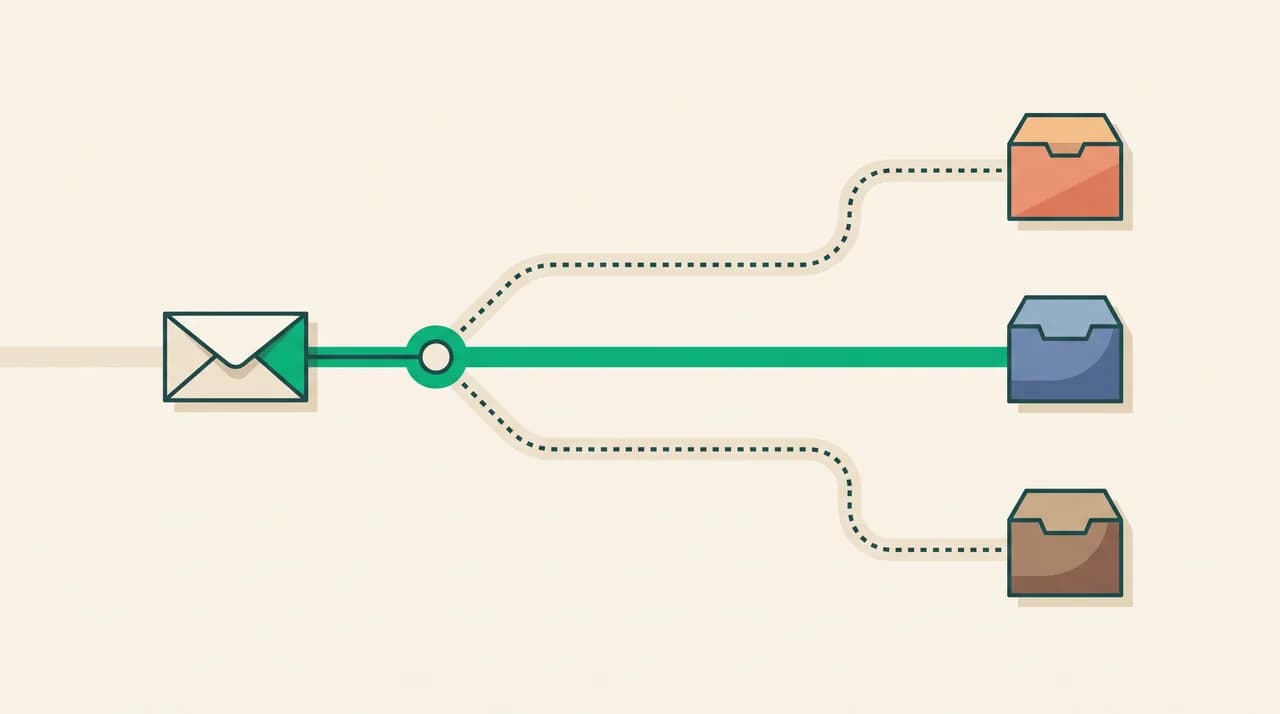
AI Emaily's shared inbox treats an incoming email as a thread the whole team can see, not a ticket in a queue. From the assign menu on any message you pick a human teammate or the AI agent as the destination; when you assign the agent you also pick its authority — Manual, Copilot, or Autopilot. A system comment summarising the handoff posts automatically, every action is attributed, and the thread carries a four-state lifecycle (open, working, needs review, done) visible to everyone at once.
That is not round-robin. It is deliberate, human-in-the-loop assignment, plus the option to hand the thread to the agent for the routine cases. The reason it earns entry number one here is that most teams reach for round-robin to solve a different problem than round-robin actually solves: they want everyone to know who owns which thread, not for the tool to pick an owner at random. Attribution, comments, and a visible lifecycle handle the ownership question directly.
Shortwave and other AI-native clients have built harder on Gmail keyboard flow than we have; if your team is entirely in Gmail and wants keyboard-driven speed above everything, that is a legitimate reason to pick a Gmail-only tool. We work across Gmail, Outlook and IMAP so a mixed team can share a single inbox.
The honest limit: we do not ship a rotation dialer that fires messages at reps in a fixed order and skips the ones on holiday. If your team's workflow is genuinely "the next message goes to the next name and I never want to think about it," one of the shared-inbox platforms further down this list is a better fit than we are. Delegation to the agent under approval-first Copilot mode is the closest we get to an automatic assignee.
Packaging is paid plans with a 7-day free trial; agent usage and autonomy scale up the plan. We build AI Emaily.
2. Front — the shared inbox with the most flexible rules#
Front is a shared inbox platform (not a client), and its rules engine is the most flexible tool on this list for building an assignment workflow that behaves the way you actually want. You can build round-robin, load-balanced, or skill-based rules; the message becomes a conversation with a single owner, an assignment log, and internal comments alongside it.
Front respects teammate availability — if a rep is marked away or off-shift, the rule skips them. Reassignment is a first-class action with a preserved log, and the customer-visible reply address stays the shared channel rather than jumping to the individual rep's address. That's what a support customer expects.
Front's Starter tier caps you at ten seats and one channel type (email or chat or SMS, not combined), with a limited number of automation rules. Professional adds omnichannel and macros. AI Copilot, QA and CSAT are paid add-ons on Starter and Professional and are included on Enterprise. Annual billing is meaningfully below monthly, and contracts over a certain threshold include a mandatory onboarding package. There is no Front Growth plan — the tiers are Starter, Professional, and Enterprise; confirm current plan limits on Front's own pricing page before you commit.
3. Missive — team inbox with load-balanced assignment and working hours#
Missive is a team inbox that treats a conversation as a single object multiple people can work on together, with round-robin and load-balanced assignment available at the team level. Load-balancing distributes to the teammate with the fewest active conversations rather than the next name in line, which handles uneven ticket sizes better than pure rotation.
The out-of-office behaviour is real — Missive respects working hours configured per member, so a message that lands at midnight for a European rep goes to whoever is on shift in another timezone instead. Reassignment preserves per-message attribution inside the conversation, so a reader can see who did what without leaving the thread.
Missive publishes a free tier for small teams and per-seat tiers above it. It is a strong fit for teams that want the shared-inbox pattern without the ticketing baggage of a full helpdesk, and it's one of the few tools in this category that treats an internal chat message and an external reply as the same object.
4. Hiver — the Gmail-native shared inbox with skip-if-unavailable#
If your team already lives in Gmail and you don't want to move them into a separate app, Hiver is the shared-inbox layer built for exactly that case. It runs inside the Gmail interface — no new tab, no import — and adds shared labels, assignment, and automation rules on top of the standard Gmail thread view.
Hiver's round-robin assignment includes a skip-if-unavailable behaviour: if a rep is marked out, the next message routes past them to the next available teammate. The tool markets that behaviour explicitly, which is why it ranks above generic rule-based tools that require you to build it yourself.
Packaging is Free, Growth, Pro and Elite tiers, per seat, with round-robin and automation on the paid tiers. The trade for staying inside Gmail is that Hiver is Gmail-only — if your company has a mix of Google Workspace and Microsoft 365 mailboxes, this is the wrong tool. Check the current tier limits on Hiver's own pricing page.
5. Help Scout — round-robin via workflows#
Help Scout is a shared-inbox helpdesk where round-robin is built with workflows rather than a dedicated assignment engine. You define a workflow that triggers on new conversations and rotates the assignee across a named list of users. It works, and for a small support team it works well.
The catch is that out-of-office handling is only as good as the workflow you write. There isn't a built-in "skip if this user is on PTO" branch — you either add a manual step to the workflow (edit the user list every time someone goes on holiday), or you accept that a message may sit until the rep returns and reassigns it. Larger teams outgrow this quickly; three-person teams often don't.
Help Scout publishes a free plan for very small teams and per-seat tiers for anything larger, with workflows available across paid plans. Conversation history and internal notes are preserved on reassignment, and the customer-visible reply address stays the shared support address.
6. Freshdesk — round-robin, load-balanced or skill-based routing#
Freshdesk is a full helpdesk with three flavours of automatic ticket routing: round-robin (turn-by-turn), load-balanced (assigns based on open ticket count per agent), and skill-based (matches ticket attributes to agent skills). Freshdesk calls the combination Omniroute on higher tiers, and it is one of the more mature implementations in the category.
Out-of-office behaviour is native — the router respects agent status and shift schedules, so a message that arrives outside a rep's shift routes to whoever is on. Reassignment carries a full log on the ticket, and reply threads keep the shared support address as the visible "from".
Packaging is per-agent tiered, with Omniroute and skill-based routing on higher plans. Round-robin itself is available on lower tiers; the skill-based layer is what pushes teams up a plan. Check current tier availability on Freshdesk's own pricing page before you commit — the plans have moved recently.
7. Zendesk — round-robin via triggers, skill-based on Enterprise#
Zendesk is the largest helpdesk platform on this list, and its assignment story is a mix: basic round-robin can be built with triggers and automations available on standard tiers, while skill-based routing (matching tickets to agents by attributes like language, product line or tier) is native on the Enterprise plan.
Out-of-office handling depends on the layer you use. Skill-based routing on the higher plans respects agent status and unified agent presence. Basic trigger-based round-robin on lower tiers can be built to skip an unavailable rep, but you write the trigger yourself — it isn't a checkbox.
Zendesk publishes per-agent tiered pricing with meaningful capability gates between plans. It's the natural fit for teams already running the rest of their support stack on Zendesk; a team choosing fresh mostly does so because they want the wider ecosystem, not because they specifically need round-robin. Confirm what's on which plan on Zendesk's own pricing page.
8. HubSpot Service Hub — round-robin routing on the paid tiers#
HubSpot's Service Hub adds ticketing and round-robin conversation routing on top of the HubSpot CRM. The router assigns incoming conversations across a rotation of specified users and can be configured to skip users marked as away, so it handles the basic out-of-office case natively.
The strength of HubSpot Service Hub isn't the rotation itself — it's that the routed conversation lands on a record that's already tied to the customer's contact, deal and history in the CRM. If your team already runs sales in HubSpot, keeping support conversations in the same graph is worth more than the routing feature is by itself.
Round-robin routing is on Service Hub Professional and above; the Starter tier doesn't include it. Packaging is per-seat tiered — verify the current tier on HubSpot's own pricing page, since Service Hub plans have restructured more than once.
How to choose for your situation#
The right pick depends on three things: whether the team wants a rotation or a shared queue, whether you're on Gmail or Microsoft 365 or a mix, and whether you need helpdesk features (SLA reporting, CSAT, canned macros) around the assignment.
- Small team, personal inbox rather than a support queue, willing to skip the rotation — AI Emaily's per-thread assignment with an agent as an optional assignee handles the ownership problem without a queue.
- Support team on Gmail that wants shared inbox in Gmail's interface — Hiver, with its skip-if-unavailable round-robin.
- Mixed Gmail and Outlook team that wants the flexible rule engine — Front, accepting the seat-and-channel caps on the Starter tier and the AI add-on cost on lower tiers.
- Team that wants working-hours-aware load balancing without full helpdesk overhead — Missive.
- Team that already runs a helpdesk and needs skill-based routing — Freshdesk (Omniroute) or Zendesk on Enterprise; Help Scout for smaller teams where workflow-based round-robin is enough.
- Sales or CS team already living in HubSpot — Service Hub, so the routed conversation stays on the same record as the deal and the contact.
Test the out-of-office case before you buy
The Google and Microsoft native options, briefly#
A Google Workspace collaborative inbox (a Group with the collaborative-inbox setting on) lets members take assignment from the group's view. Nothing rotates automatically and there is no out-of-office logic — it's a shared label with a claim button. Microsoft 365 shared mailboxes work the same way at the platform level: everyone with permission sees the mailbox and assignment is manual. Both are free with the underlying subscription and appropriate for very small teams; both stop scaling the moment the volume needs a queue instead of a claim.
Frequently asked
See it in AI Emaily
Keep reading
Sources

Written by
Nafiul HasanNafiul Hasan is an entrepreneur and AI automation system builder with 10+ years of experience turning messy, manual workflows into reliable automated systems. He designs and ships AI enterprise solutions end-to-end — the agent logic, the data plumbing, and the product people actually use — and founded AI Emaily to give busy professionals their attention back. He writes here from the builder's seat: what works, what breaks, and how to put AI to work without giving up control.