Contractor Follow-Up Email After an Estimate (Templates)

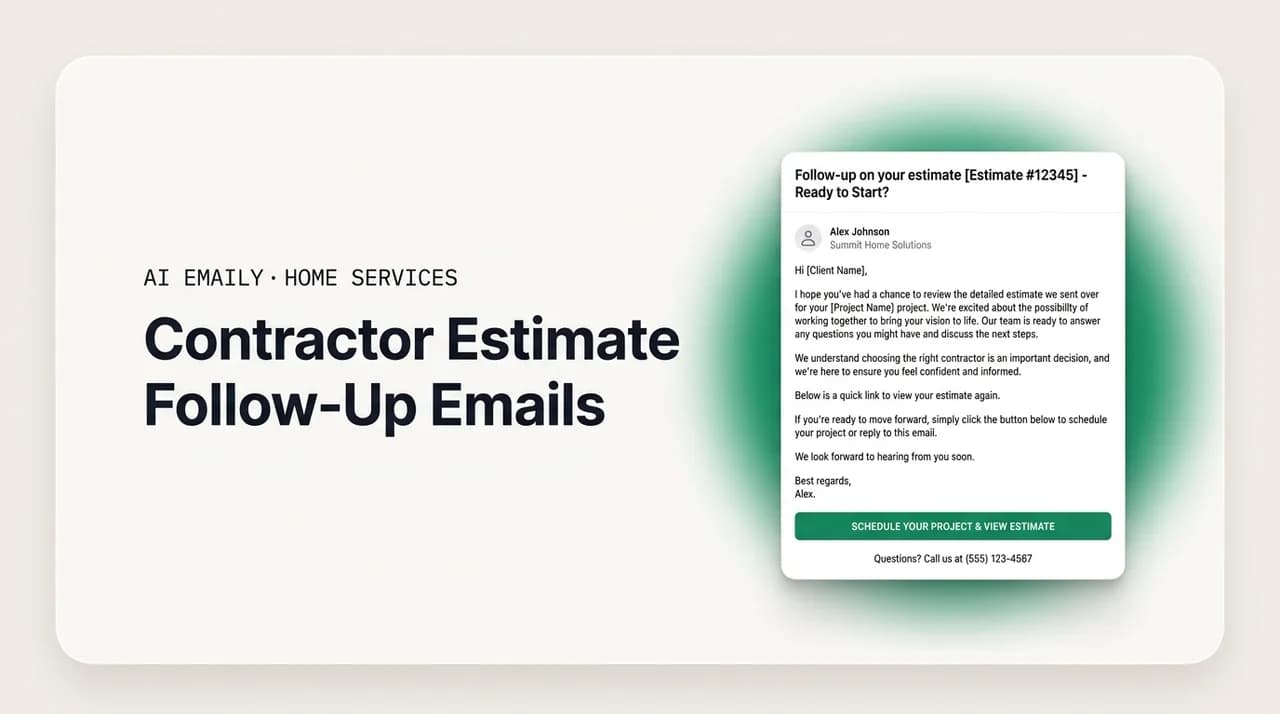
The short answer
Knowing how to write a contractor follow up email is what turns sent estimates into signed jobs. Reply fast, lead with value instead of price, and follow up on a predictable cadence — roughly day two, day five or six, then day ten to fourteen — with a clear next step in every message. Most quotes die from silence, not from a lost bid, so a short, helpful, low-pressure nudge that makes it easy to say yes is the single highest-return email a contractor sends.
Most estimates die from silence, not a cheaper bid. Follow up on day 2–3, day 5–6, then day 10–14, leading with value over price — templates for every stage included.
On this page
- 01Why most contractor estimates die in silence
- 02What are the principles of a contractor estimate follow-up email?
- 03How fast should you send the estimate — and follow up?
- 04What makes a good subject line for a follow-up email?
- 05Example: sending the estimate (the email everything hinges on)
- 06Example: follow-up #1 (the gentle receipt check, day 2–3)
- 07Example: follow-up #2 (add value or urgency, day 5–6)
- 08Example: follow-up #3 (the direct ask or graceful close, day 10–14)
- 09How do you handle a price objection over email?
- 10Example: winning the job (and setting up the next one)
- 11Example: losing the job gracefully (the long game)
- 12Estimate and follow-up etiquette: how to be persistent without being pushy
- 13What are the most common estimate follow-up mistakes?
- 14Estimate follow-up do's and don'ts at a glance
- 15How can AI Emaily help contractors follow up on every estimate?
- 16Putting it all together
Why most contractor estimates die in silence#
You measured the roof, priced the job, wrote up a clean estimate, and hit send. Then nothing. A day passes, then a week, and the quote you spent an hour building just sits there, unread or unanswered, while you move on to the next site. This is the quiet way most home-services revenue leaks out of a business: not from losing a bid to a cheaper competitor, but from never following up on the estimate you already worked hard to produce.
If you have ever wondered how to write a contractor follow up email that actually gets a reply, you are asking the right question at the right time. The estimate is not the finish line — it is the halfway point. The homeowner who asked you for a number is, by definition, a warm lead. They invited you out, they gave you their address, they want the work done. What they do not do reliably is decide on your timeline. Life gets in the way. They are collecting other quotes. They meant to reply and forgot. And the contractor who follows up — clearly, promptly, and without being a pest — is the one who wins the job that the contractor who stayed silent assumed was already lost.
This guide is written for the owner-operator on a ladder, the solar rep whose leads are sold to three other companies, the HVAC shop juggling emergency calls, and the remodeler nurturing a job for six weeks. It walks through the principles of a follow-up that converts, gives you copy-paste example emails for every stage from sending the estimate through winning or losing the job, and shows you exactly how to stay persistent without ever sounding desperate. By the end you will have a repeatable system you can run on every quote you send, plus an honest look at how an AI email client can run that system for you when you are on a jobsite instead of in your inbox.
First, the size of the problem. Speed and persistence are not soft skills in home services — they are the whole game. Research on inbound sales leads has long shown that the odds of qualifying a lead drop dramatically the longer you wait to respond, with the sharpest fall happening in the first hour. In the trades, that pattern is even more brutal: leads are frequently sold to several companies at once, and a large majority of buyers hire whoever gets back to them first. A quote follow up email that lands two weeks after the homeowner requested three bids is not competing on price. It is competing with a signed contract from the contractor who replied that afternoon.
The good news is that this is one of the most fixable problems in your business. You do not need a bigger ad budget or a slicker website to close more of the estimates you already send. You need a follow-up habit, a handful of well-written messages, and the discipline — or the automation — to run them every single time. That is what the rest of this guide gives you.
Follow-up is not pestering — it is service
What are the principles of a contractor estimate follow-up email?#
Before the templates, the principles. Every good follow-up email a contractor sends — whether it is the first nudge or the fourth — obeys the same handful of rules. Learn these and you can write your own for any situation, in any trade, without copying a template at all. Ignore them and even a polished-looking message falls flat.
- 1
Give one clear next step
Every message must answer the reader's silent question: what do you want me to do? "Let me know if you have questions" is not a next step; it is an off-ramp. "Reply with a yes and I'll put you on the schedule for the week of the 14th" is a next step. Ask for a decision, a call, or a signature — one specific action, not a vague invitation.
- 2
Lead with value, not just price
A quote is a number attached to an outcome. When you follow up, remind them of the outcome — the leak that stops, the energy bill that drops, the kitchen they finally love — not just the figure. Price is what they pay; value is why they pay it. A follow-up that only repeats the total invites a discount conversation; one that reframes the benefit invites a yes.
- 3
Respect their timeline, and set yours
Acknowledge that a home improvement is a real decision. But also give them a reason to move: a scheduling window that is filling up, a material price that changes next month, a seasonal deadline. Gentle, honest urgency beats artificial pressure every time and gives a stalled quote a nudge without a shove.
- 4
Keep it short and skimmable
Homeowners read your email on a phone between other things. Three or four short sentences beat three paragraphs. Front-load the point, keep one ask, and make the reply feel like a five-second task, not a chore they have to schedule time for.
- 5
Stay warm and human
You are not a collections agency. Write the way you'd talk on their porch: friendly, confident, unhurried. A little warmth — using their name, referencing their specific project — signals that this is a real person who remembers them, not an automated dunning notice.
- 6
Make it effortless to say yes
Remove every ounce of friction. Restate the price so they don't have to dig for the original email. Offer two concrete times instead of "when works for you?" Include the link, the deposit amount, the next date. The easier you make the yes, the more yeses you get.
Sitting underneath all six is a seventh principle that deserves its own moment: overcome the "we're still thinking about it" without arguing with it. When a homeowner says they need to think, they usually mean one of three things — the price feels high, they don't fully trust the outcome, or they simply got busy. A good follow-up gently surfaces which one it is rather than pushing back. You do that by making it safe to tell you the real objection: "Totally understand wanting to be sure — is it the number, the timing, or something about the scope I can clarify?" That single question turns a dead "thinking about it" into a conversation you can actually win.
Notice that none of these principles is about being clever. There is no trick subject line or psychological hack that beats simply being fast, clear, helpful, and persistent. The contractors who close the most estimates are almost never the best writers — they are the ones who reliably send the second, third, and fourth message when everyone else stopped at the first.
The one-sentence test
How fast should you send the estimate — and follow up?#
Speed decides more jobs in home services than almost anything else you control. The estimate itself is a follow-up to the lead, and the same rule applies at every stage: the faster you respond, the more you win. Inbound-lead research consistently finds that response time in the first hour matters enormously, and in trades where a lead is sold to three to eight companies at once, the window is measured in minutes, not hours. If a homeowner requested a quote this morning, the contractor who emails a number this afternoon is playing a completely different game than the one who gets to it next week.
So the first follow-up rule is really a first-contact rule: acknowledge every lead immediately, even before you can price the job. A two-line reply that says "Got your request — I can be out Thursday to take a look, does 2 p.m. work?" holds the lead while a slower competitor is still deciding whether to check their inbox. Then send the estimate as fast as the job allows. After that, the cadence below keeps the quote alive without smothering it.
| When | Message | Tone & goal |
|---|---|---|
| Immediately (minutes) | Acknowledge the lead and lock a next step (site visit or a promise of the quote). | Fast and reassuring. Beat every slower competitor to the reply. |
| Same day / within 24h | Send the estimate itself, with a clear price, scope, and one call to action. | Professional and complete. Make it easy to say yes right now. |
| Day 2–3 (Follow-up 1) | Short check-in: "Did the estimate come through okay? Happy to walk you through it." | Light and helpful. Confirm receipt, open the door to questions. |
| Day 5–6 (Follow-up 2) | Add value or gentle urgency: a benefit reminder, a scheduling window, a small proof point. | Warm and useful. Give a reason to decide, not just a nudge. |
| Day 10–14 (Follow-up 3) | The direct ask or the graceful close: "Are we still a fit? If the timing's off, no problem." | Clear and low-pressure. Get a yes, a no, or a real reason. |
| Day 30+ (Long-cycle nurture) | For big remodels: a seasonal check-in, a relevant tip, or "thinking of you this spring." | Patient and no-strings. Stay top of mind for a slow decision. |
Treat that table as a default, not a law. A $400 gutter-cleaning quote does not need a four-touch sequence; two nudges and you move on. A $60,000 kitchen remodel might warrant six weeks of patient, spaced-out contact because the decision genuinely takes that long. Match the cadence to the size and speed of the decision. The mistake almost nobody makes is following up too much; the mistake nearly everyone makes is stopping after one message — or zero.
Timing also depends on your trade. Solar and insurance-restoration leads that are sold to multiple buyers need near-instant first contact and tight follow-up in the first 48 hours, because the whole thing is decided fast. A remodeler's leisurely six-week nurture would be pointless there. Know your decision cycle and set your cadence to fit it.
Three to four touches, then let it rest
What makes a good subject line for a follow-up email?#
The best follow-up email in the world does nothing if it is never opened, and on a phone the subject line is most of what a homeowner sees before deciding. Good contractor subject lines are specific, personal, and low-pressure. They reference the actual project, they sound like a person, and they never read like a mass-market sales blast. Vague or salesy subjects ("Checking in!" or "Don't miss out!!") get ignored; concrete ones ("Your roof estimate — quick question") get opened.
A few patterns that work well for estimate and quote follow-ups:
- Name the project: "Your kitchen remodel estimate" or "Follow-up on your HVAC quote." Specific beats generic every time.
- Ask a light question: "Any questions on the roof estimate?" invites a reply more than a statement does.
- Reference the timeline: "Holding your install window for next week" adds gentle, honest urgency.
- Keep it human: "Great meeting you Tuesday — here's that number" sounds like a person, not a funnel.
- Reply in the same thread when you can: keeping the follow-up on the original estimate thread means your subject and history travel together, and it lands as a continuation rather than a cold new pitch.
- Avoid all-caps, multiple exclamation points, and words like "FREE" or "ACT NOW" — they read as spam and can hurt deliverability.
Example: sending the estimate (the email everything hinges on)#
The follow-up sequence only works if the original estimate email is clear. Too many estimates arrive as a bare attachment with a one-line "Here's your quote, let me know." That puts all the work on the homeowner to open a PDF, interpret it, and figure out what to do next — and gives them every excuse to set it aside. Your estimate email should restate the price and scope in the body, remind them of the value, and end with a single, obvious next step.
Here is a strong general-purpose estimate email you can adapt to any trade:
Notice what that email does. It restates the price so she never has to open the PDF to remember it. It reframes the number as an outcome — "the leak is handled for good" — instead of a bare figure. It offers one specific next step (reply yes) and one concrete scheduling window (the week of the 14th). And it stays warm and human, using her name and referencing their actual meeting. Every follow-up you send after this builds on that foundation.
One more thing: send the estimate in the email body, not only as an attachment. Attachments get missed on phones, land in spam, or simply feel like homework. Put the essentials in plain text where they can be read in the preview pane, and use the attachment for the detailed line items.
Example: follow-up #1 (the gentle receipt check, day 2–3)#
Your first follow-up has one job: confirm the estimate landed and reopen the conversation. It is not the place to push for a decision — the homeowner may have only seen it hours ago. Keep it light, assume the best, and make replying feel like a two-second favor rather than a commitment. If knowing how to write a contractor follow up email intimidates you, start here: this is the easiest and most natural message in the whole sequence.
The "sometimes they slip into spam" line is doing quiet work: it gives the homeowner a graceful, no-guilt reason to have not replied yet, which makes them far more likely to actually respond. Nobody wants to admit they've been ignoring you; everybody is happy to say "oh yes, I got it, just been busy." That reply — any reply — is what you want, because it restarts the conversation and tells you the lead is still alive.
Example: follow-up #2 (add value or urgency, day 5–6)#
By the second follow-up, a simple "did you get it?" has run its course. This message needs to give the homeowner a reason to move — either by reminding them of the value they'll get, or by introducing an honest, specific piece of urgency. Do not manufacture fake scarcity; homeowners can smell it, and it damages the trust you're trying to build on a big purchase. Real urgency — a genuine scheduling window, a seasonal deadline, a material price change you actually know about — works because it's true.
A value-forward version:
This message reframes the price around a benefit (leak sealed before the storm), offers a real scheduling window, and — crucially — ends with a choice rather than a yes-or-no. Offering "a call or some references?" lowers the stakes: the homeowner can take a small step instead of committing to the whole job, and any step forward keeps momentum. It also quietly surfaces objections. If she says "send references," she's telling you she needs more trust before she buys, which is a signal you can act on.
Give them a small yes
Example: follow-up #3 (the direct ask or graceful close, day 10–14)#
By the third follow-up, kindness and clarity beat persistence for its own sake. It is time to ask directly — are we doing this, or not? — while giving the homeowner a completely graceful way to say no. Counterintuitively, explicitly offering an exit often gets you a yes, because it removes the pressure they've been avoiding and makes it safe to re-engage. And if the answer really is no, you learn that now instead of chasing a ghost for another month.
This is the "breakup" email, and it is one of the most effective messages in sales precisely because it releases the pressure. It does three things at once: it asks for the decision plainly, it invites the real objection ("if it's the number or the scope…"), and it leaves on warm terms so a future callback is still possible. Many contractors report that this message pulls more replies than any other in the sequence — people who'd been meaning to respond finally do, because the door is visibly closing.
If they do reply with an objection, you've won the hardest part: you now know why they stalled, and a real objection is something you can address. That's where the next scenarios come in.
How do you handle a price objection over email?#
"That's more than we were hoping to spend" is the most common objection in home services, and email is a fine place to handle it — as long as you don't immediately fold on price. Discounting the moment someone flinches teaches them your first number wasn't real and trains every future customer to haggle. Instead, respond by clarifying value, offering options, or adjusting scope, not by simply chopping the total.
This reply defends the value of the original number, then gives the homeowner a way to reduce the price by changing what they get (a different shingle) or how they pay (phasing) — never by simply slashing the figure for the same scope. It ends, as always, with a clear next step: an offer to build a second option. That keeps you in control of the conversation and positions you as a helpful advisor rather than a vendor who caves under the slightest push.
A note on the psychology: when you hold your price with a good reason, you signal confidence and quality. When you drop it instantly, you signal the opposite. Homeowners buying a five-figure home improvement are often reassured, not deterred, by a contractor who stands behind their number — as long as you pair it with genuine flexibility on scope.
Example: winning the job (and setting up the next one)#
When the yes comes, your job is to make the transition from "quote" to "scheduled job" feel effortless and reassuring. This is also a quiet marketing moment: a homeowner who feels well cared for at the booking stage is the one who leaves a five-star review and refers their neighbor. Confirm the details, restate what happens next, and set expectations clearly.
The confirmation email does more than log a booking. It removes anxiety ("you don't need to be home"), it sets a clear sequence of events, and it reinforces the value one last time ("getting that leak sorted for good"). A homeowner who reads this feels like they hired a professional, which is the feeling that produces referrals. Consider adding a separate note a day or two after the job is done, thanking them and — if they seem happy — gently asking for a review. In trades where word of mouth and online reviews decide the next dozen jobs, that ask is worth building into your follow-up habit too.
Example: losing the job gracefully (the long game)#
Sometimes the answer is no — they went with someone else, the project got shelved, the budget vanished. How you handle a lost job says as much about your business as how you handle a won one, and a gracious loss is a surprising source of future work. Plans change, other contractors flake, and the homeowner who felt respected by your reply is the one who calls you back in six months.
No guilt, no pressure, no passive-aggressive digs about the competitor's quality. Just a warm, professional close that leaves the relationship intact. Contractors who master the graceful loss build a quiet pipeline of comeback jobs — the customer whose cheaper contractor did shoddy work, the homeowner whose deferred project finally got approved. The email that costs you nothing to send is often the one that books a job a season later.
A "no" is data, not failure
Estimate and follow-up etiquette: how to be persistent without being pushy#
The line between persistent and pushy is real, and crossing it costs you jobs in a local market where reputation compounds. The difference is rarely about how many times you follow up — three or four well-spaced touches almost never feels like too many. It's about how each message feels to receive. Persistent follow-ups are helpful, calm, and reader-centered. Pushy ones are anxious, self-centered, and demand a response the homeowner doesn't owe you.
- Space your touches out. Following up every day feels like harassment; every few days feels like service. Give the homeowner room to live their life between your messages.
- Always give an easy exit. "No problem if the timing's off" makes you easier to say yes to, not harder. Pressure creates resistance; permission creates replies.
- Add something each time. Every follow-up should carry a small gift — an answer, a reference, a scheduling option, a benefit reminder — not just "any update?" A message that only asks takes; a message that gives earns a reply.
- Never guilt-trip. "I spent an hour on this quote" or "I haven't heard back" as a complaint makes it about you. Keep the focus on their project and their outcome.
- Match your medium to their preference. If they only ever text back, follow up by text. Meeting people where they are is a form of respect that closes jobs.
- Know when to stop. After the graceful close, let it rest. A lead that goes quiet after four honest touches is telling you something; respect it and move your energy to fresher opportunities.
There's a mindset shift underneath all of this. Pushy follow-up comes from scarcity — the fear that this one job is the only one, so you cling to it. Confident follow-up comes from abundance — you'd love this job, you'll follow up thoroughly and professionally, and if it's not a fit, there's another lead behind it. Homeowners can feel the difference in a single sentence, and they're drawn to the calm confidence of a contractor who clearly doesn't need to beg. The irony is that the less desperate you sound, the more you close.
What are the most common estimate follow-up mistakes?#
Most follow-up failures aren't dramatic. They're small, repeated habits that quietly bleed jobs. Here are the ones that come up again and again in home services, with what to do instead.
- Not following up at all. By far the biggest leak. Contractors send the estimate, assume silence means no, and never send a single follow-up. Most sales are made after multiple touches — one message is almost never enough.
- Following up too slowly. A quote that arrives days after the request, or a first nudge that comes two weeks later, is competing against contracts already signed. Speed at every stage wins the trades.
- Sending a bare attachment. "Here's your quote" with a PDF and nothing else puts all the work on the homeowner. Restate the price and value in the email body.
- Only ever repeating the price. A follow-up that just re-sends the number invites a discount conversation. Reframe around the outcome — what the job does for them — not the figure.
- No clear next step. "Let me know your thoughts" gives the reader nowhere to go. Every message needs one specific ask: reply yes, book a call, pick a window.
- Folding on price at the first flinch. Discounting instantly teaches customers to haggle and signals your number wasn't real. Defend value and adjust scope or terms instead.
- Being pushy instead of persistent. Daily chasing, guilt trips, and fake urgency lose jobs and damage your local reputation. Space touches out and always offer an easy exit.
- Giving up too early. Two touches and out leaves money on the table; the third and fourth message often close the job. Persistence, not brilliance, is what wins.
- Doing it inconsistently. Following up well on the estimates you remember, and not at all on the ones you forget, means your revenue depends on your memory. A system — or automation — beats willpower every time.
The silent estimate is a lost estimate
Estimate follow-up do's and don'ts at a glance#
Here is the whole playbook compressed into a quick reference you can scan before you hit send. When a habit on the left is tempting, the column on the right is what to do instead.
| Do | Don't |
|---|---|
| Follow up on every estimate, on a set cadence. | Send the quote and hope they reply on their own. |
| Acknowledge leads in minutes and send quotes fast. | Let a warm lead sit for days while a competitor replies. |
| Restate price, scope, and value in the email body. | Send a bare attachment with "here's your quote." |
| End every message with one clear next step. | Close with a vague "let me know your thoughts." |
| Reframe the number as an outcome they want. | Only repeat the total and invite a haggle. |
| Defend value; adjust scope or terms if needed. | Cut the price the instant someone flinches. |
| Space touches out over days and add value each time. | Chase daily or send "any update?" with nothing new. |
| Give an easy, guilt-free exit in later follow-ups. | Guilt-trip, pressure, or manufacture fake urgency. |
| Send a graceful close after three or four touches. | Keep chasing a silent lead indefinitely. |
| Lose gracefully and leave the door open for later. | Get cold or passive-aggressive when the answer is no. |
How can AI Emaily help contractors follow up on every estimate?#
Here's the honest problem with everything above: it all assumes you're at a desk with time to write. You're not. You're on a roof, under a house, or driving between jobs, and the follow-up you meant to send on day five gets buried under the twenty things that came up that day. The system in this guide is simple; running it by hand, on every quote, every time, while doing the actual work — that's the hard part. Which is exactly the gap an AI email client is built to close.
AI Emaily is an AI-native email client that connects to Gmail, Outlook, iCloud, Fastmail, Proton, and any IMAP account, and acts as an autonomous chief of staff for your inbox. When an estimate goes quiet, it drafts the next follow-up for you — the receipt check, the value nudge, the graceful close — in your own voice, because it learns how you actually write rather than pasting in generic templates. You get a ready-to-send message that sounds like you, sitting there waiting, so following up becomes a two-second approval instead of a blank page you never get around to.
For the high-value, well-understood touches — instant lead acknowledgments, appointment confirmations, and quote follow-ups — this is textbook, high-ROI work to templatize, given what a single booked roofing or remodeling job is worth. The pricing and scope specifics, though, stay human-checked: those are your judgment calls, and the product is built to keep them yours.
The way you stay in control is the point. AI Emaily runs in three modes — Manual, Copilot, and Autopilot — so you decide how much rope to give it. In Copilot, which is where most contractors will want to live, the app drafts every follow-up and waits for your approval before anything sends; you glance at it between jobs, tap approve, and it goes. Nothing leaves your outbox without your say-so. As you build trust, Autopilot can handle the most routine, repetitive touches on its own — always gated, always with undo, and always with a full audit trail of exactly what it did and when.
That combination — drafts in your voice, mandatory approval before send, undo and audit on everything — is what makes it safe to let software handle your follow-up without it ever emailing a customer something you wouldn't. You keep the relationship and the judgment; the app keeps the discipline of following up on every single estimate, on cadence, even on the days you never touch your inbox. You can try it free at app.aiemaily.com/signup, with a Free plan at no cost and Pro at $12.42 per month on the annual plan.
Putting it all together#
Learning how to write a contractor follow up email is one of the highest-return skills in home services, because it turns work you've already done — the site visit, the measurements, the estimate — into signed jobs instead of silence. The estimate is the halfway point, not the finish line. The contractor who follows up clearly, promptly, and kindly wins jobs the contractor who stayed quiet assumed were lost.
The system is simple enough to memorize. Respond fast at every stage. Send an estimate that restates price and value with one clear next step. Then follow up on a predictable cadence — a gentle receipt check around day two or three, a value-or-urgency nudge around day five or six, and a direct-but-graceful close around day ten to fourteen — stretching the timeline for big, slow decisions and tightening it for fast-moving trades. Lead with the outcome, not the number. Defend your price and flex on scope. Stay persistent without ever tipping into pushy, and lose gracefully so today's no can become next season's yes.
Grab the examples above, swap in your details, and run the same sequence on every quote you send. And if you'd rather not run it by hand from a jobsite, let your email client draft each follow-up in your voice and hold every send for your approval — so no estimate you ever send goes quiet again just because you were busy doing the work. Either way, the goal is the same: stop letting good quotes die in silence, and start closing the jobs you already earned the chance to win.
Frequently asked
See it in AI Emaily
Keep reading
Sources

Written by
Nafiul HasanNafiul Hasan is an entrepreneur and AI automation system builder with 10+ years of experience turning messy, manual workflows into reliable automated systems. He designs and ships AI enterprise solutions end-to-end — the agent logic, the data plumbing, and the product people actually use — and founded AI Emaily to give busy professionals their attention back. He writes here from the builder's seat: what works, what breaks, and how to put AI to work without giving up control.