Is Inbox Rotation Safe for Cold Email? The Honest Answer

The short answer
Inbox rotation spreads outreach across many mailboxes so no single account trips a per-mailbox limit, but it is not a safe way to scale. Providers correlate mailboxes by domain, content and reputation, sending from Workspace or 365 mailboxes can breach their terms, and one flagged mailbox can drag in the rest.
Is inbox rotation safe for cold email? It spreads volume under per-mailbox limits but adds pattern, reputation and terms-of-service risk. The honest read.
On this page
Is inbox rotation safe for cold email? The short, honest answer is that it lowers the odds of any single mailbox hitting a hard sending limit, but it does not make a campaign safe. Rotation spreads your volume across many mailboxes, and it spreads the evidence of a pattern with it.
Mailbox providers correlate sends on far more than a per-account counter, so the technique that hides you from one limit can expose you to a bigger one. This post is an honest risk assessment: what rotation does, what it does not touch, and the failure mode where one flagged mailbox drags in the rest of the estate.
What inbox rotation is, and what it does#
Inbox rotation, sometimes called mailbox rotation, is when cold-email software cycles each message through a pool of sending mailboxes so no single account carries the whole day's volume. A 400-message send split across ten mailboxes is 40 per mailbox, comfortably under any provider's per-account cap.
Does mailbox rotation avoid sending limits? For the per-mailbox cap, largely yes, and that is the one thing it reliably does. But per-mailbox caps are rarely what gets a campaign killed. The risks that do are reputation, pattern detection, and the sending platform's own terms of service.
So the honest verdict is that rotation is a volume-distribution trick, not a safety mechanism. It can be one part of a careful, low-volume, well-authenticated setup, and it is dangerous when used to push more unsolicited mail than a domain should ever send.
What rotation does and doesn't do
Before you start: the risks rotation doesn't remove#
Before you build a rotation setup, price in the risks it does not remove. Sending unsolicited bulk mail from Google Workspace or Microsoft 365 mailboxes can breach their acceptable-use terms no matter how you spread it, and Google's own documentation says accounts that send spam "might be permanently restricted from sending email."
Three provider rules matter most, and all three survive rotation. Dates below are current as of August 2026; verify each against the provider's own page before you rely on it, because these limits change and Google notes its figures "can change without notice."
- Bulk-sender status to personal Gmail triggers near 5,000 messages in 24 hours, counted per primary domain and aggregating every subdomain, and once assigned it is permanent with no expiration.
- Google Workspace caps a single user around 2,000 messages a day, with a maximum of 500 external recipients per message, and blocks new sends for up to 24 hours once a limit is hit.
- Microsoft enforces SPF, DKIM and DMARC on any domain sending more than 5,000 messages a day to Outlook.com, live since 5 May 2025, and rejects non-compliant bulk mail rather than only junking it.
- The risks of multiple sending accounts in outreach are reputation and correlation, not counting, so every rotated domain needs its own SPF, DKIM and DMARC before it sends a single message.
A bulk-sender flag does not reset
How to rotate as safely as possible#
If you have weighed the risks and still need to rotate, these steps reduce the exposure; they do not remove it. Doing them out of order is how whole estates get burned in a week.
- 1
Use separate domains, not subdomains
Gmail's bulk-sender count aggregates every subdomain under one primary domain, so ten subdomains share one reputation and one permanent flag. Separate registered domains isolate reputation; subdomains do not.
- 2
Authenticate every domain before it sends
Publish SPF, DKIM and a DMARC record of at least p=none on each sending domain. Microsoft rejects unauthenticated bulk mail to Outlook.com outright, and Gmail requires all three of bulk senders.
- 3
Warm each mailbox slowly
Start a new mailbox at a handful of messages a day and raise it over weeks. A cold mailbox that jumps straight to its cap on day one looks exactly like the abuse pattern filters are trained to catch.
- 4
Keep per-mailbox volume far below the cap
The documented Workspace ceiling is roughly 2,000 a day; a defensible cold-outreach figure is a small fraction of that. The cap is the point of failure, never the target.
- 5
Keep outreach off your primary business domain
Send only from dedicated domains that are not your main company domain, so a reputation problem cannot reach the address your customers and vendors actually reply to.
- 6
Watch spam and bounce rates per mailbox, and pause fast
Google's target spam rate is under 0.1% and it must never reach 0.3%; past that you lose access to support mitigation for a stretch. Monitor each mailbox and stop the whole pool the moment one crosses the line.
How rotation plays against each provider#
Rotation behaves differently against each provider because the rules it is trying to route around are different. Here is what changes, and what doesn't, across the three environments a cold-email estate touches. Figures are current as of August 2026.
| Environment | Documented limit or rule | What rotation changes |
|---|---|---|
| Google Workspace (your sending platform) | ~2,000 messages/day per user; max 500 external recipients per message; accounts that send spam "might be permanently restricted"; limits can change without notice | Splits volume under the per-user cap; does not change the abuse rule or the domain reputation behind the mail |
| Personal Gmail (your recipients) | Bulk-sender status near 5,000/day to Gmail, counted per primary domain and aggregating subdomains, permanent once assigned; target spam rate under 0.1%, never 0.3% | Rotating subdomains still counts as one primary domain; only separate registered domains spread the count |
| Microsoft 365 / Outlook.com | SPF + DKIM + DMARC required above 5,000/day to Outlook.com, enforced since 5 May 2025; non-compliant bulk mail rejected, not just junked | A separate regime from Gmail; every rotated domain must clear the same authentication bar |
What to do when deliverability drops#
The failure mode that surprises people is not one dead mailbox. It is that one flagged mailbox drags in the rest. Rotation software shares a lot across a pool: a common sending platform and IP range, near-identical message bodies, the same links and footer, and often domains registered together on the same day. Filters correlate on exactly those signals.
So when deliverability drops, treat it as an estate problem rather than a single-mailbox one. Pull the worst-performing mailbox out of the pool, cut total volume hard, and check whether the whole set shares a domain, an IP range or a template that is now carrying a bad reputation.
If a primary domain has already tripped Gmail's bulk-sender classification, accept that it will not reset. Google enforces roughly a week of clean sending before support mitigation is even available, and Workspace accounts that keep sending spam can be permanently restricted. At that point the fix is fewer, better-targeted emails from clean domains, not a larger rotation.
A faster way than a bigger rotation#
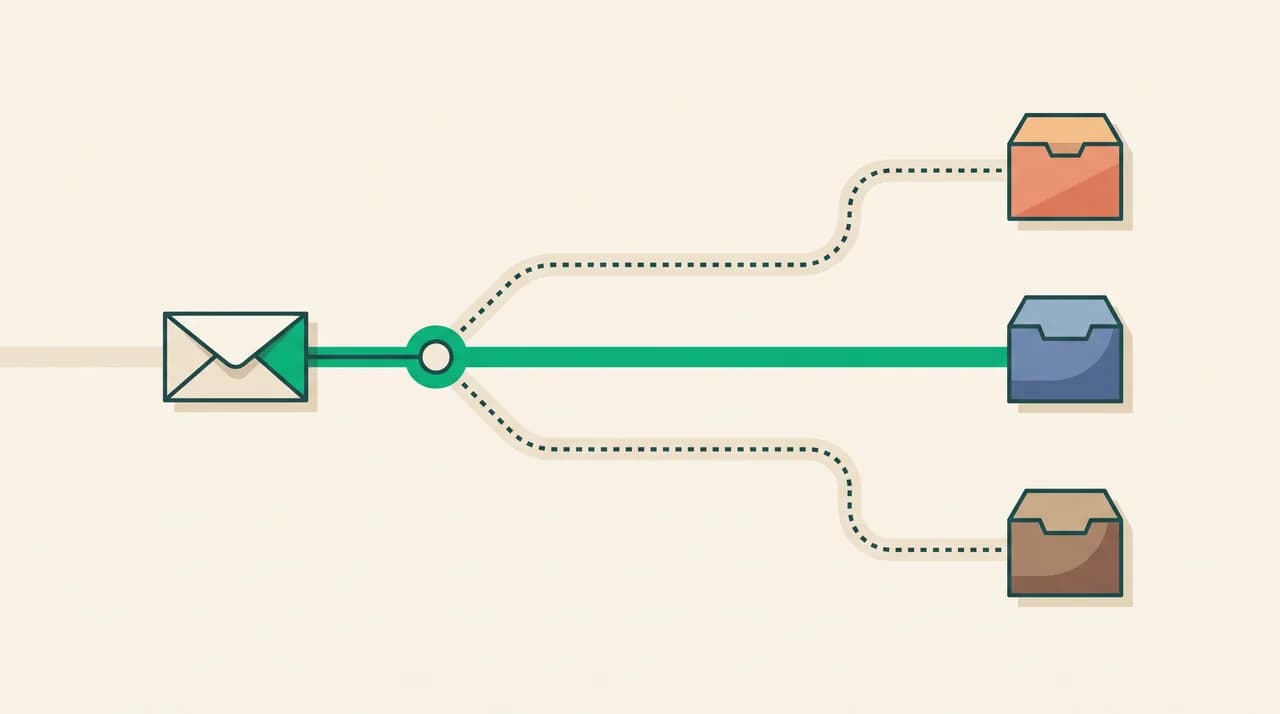
The genuinely faster path is not more mailboxes; it is fewer, more relevant emails from fewer, cleaner domains. Inbox rotation vs lower volume is the real trade-off, and lower volume wins on every axis that kills campaigns: reputation, spam-complaint rate and terms-of-service exposure. Rotation buys headroom under a counter; relevance buys a reply.
A disclosure, because this is our site: we build AI Emaily, an AI email client with a cold email filter. It is a receiving-side tool, not a sending platform, so it will not rotate mailboxes or run outreach for you; if scaling outreach is the goal, you want a dedicated sending tool, not us. What it shows is the other end of this problem. Our cold email filter matches on sender behaviour and domain rather than a single address, so rotating addresses inside a domain does not reset it, which is the same correlation the big providers do and exactly why rotation keeps getting less safe.
Frequently asked
See it in AI Emaily
Keep reading
Sources

Written by
Nafiul HasanNafiul Hasan is an entrepreneur and AI automation system builder with 10+ years of experience turning messy, manual workflows into reliable automated systems. He designs and ships AI enterprise solutions end-to-end — the agent logic, the data plumbing, and the product people actually use — and founded AI Emaily to give busy professionals their attention back. He writes here from the builder's seat: what works, what breaks, and how to put AI to work without giving up control.