Recover Permanently Deleted Emails in Gmail: What's Possible

The short answer
Gmail keeps Trash for 30 days; once purged, Google offers no user-facing restore. Exceptions: All Mail for messages that were only archived, Google Workspace admin restore within 25 days of purge, and Google Vault where a retention policy applies. No third-party tool recovers mail the provider has deleted.
How to recover permanently deleted emails in Gmail — every route that exists: Trash, All Mail, Workspace admin, and Vault, plus what no tool can undo.
On this page
- 01What 'permanently deleted' actually means in Gmail
- 02Which recovery route applies to your situation
- 03Fix 1: Restore from Trash (up to 30 days after deletion)
- 04Fix 2: Retrieve from All Mail (the email was archived, not deleted)
- 05Fix 3: Google Workspace admin restore and Google Vault
- 06How to tell which situation you are in
- 07Preventing accidental permanent deletion
When you search for how to recover permanently deleted emails in Gmail, there is a real chance the email is not actually gone. Gmail deletion happens in two stages, and most people who think they have lost a message are in a recoverable situation — either the email is still in Trash, or it was archived rather than deleted and is sitting in All Mail right now. This guide covers every real recovery route that exists, with the documented time limits from Google's own documentation, so you spend your effort on the path that actually matches your situation.
One thing needs stating plainly before we start: if a message has been purged from Gmail's Trash and no Workspace retention policy was configured beforehand, it is gone. No browser extension, no paid data-recovery service, no third-party tool recovers mail that Google's servers have deleted. Any product claiming otherwise is either describing one of the legitimate paths below or misrepresenting what it can do.
What 'permanently deleted' actually means in Gmail#
Gmail deletion works in two stages. The first is moving a message to Trash — that happens when you click Delete, press the Delete key in the web interface, or swipe in the mobile app. At this point the email is fully intact in your account; it just lives in Trash. The second stage is the actual purge: Gmail automatically empties Trash after 30 days, or immediately if you select 'Empty Trash now.' After the purge, the message is gone from every Gmail interface and from any standard recovery path.
Archiving is a different action entirely. When you archive a message — by pressing 'e', clicking the archive icon, or using the swipe gesture in Gmail mobile — the message leaves your inbox but stays in All Mail. It is not in Trash. It is not deleted. It will never expire on its own. The message looks missing from your inbox view but is fully intact and searchable at any time. This is the single most common source of 'permanently deleted' reports: the email was archived, not deleted, and appears immediately once you search All Mail.
Before concluding you need to recover a deleted message, confirm whether you deleted it or archived it. The difference determines whether you have a 30-day window in Trash, instant access through All Mail, or no recovery path at all.
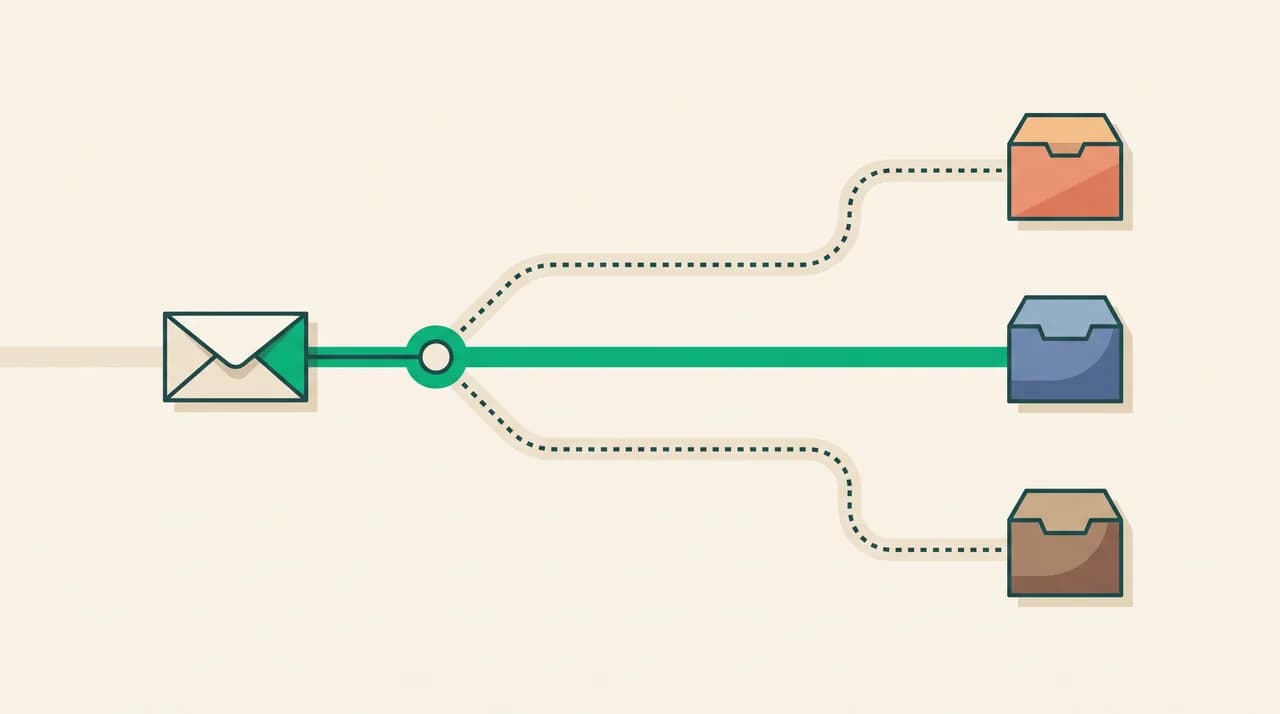
Archive keeps the email; Delete moves it to Trash
Which recovery route applies to your situation#
The table below maps each scenario to the correct recovery path. Find the row that matches your situation, then follow the corresponding fix.
| Scenario | How to confirm | Recovery route |
|---|---|---|
| Deleted within the last 30 days | Message appears in Trash (search: in:trash) | Fix 1: Restore from Trash |
| Email is missing but was only archived | Message appears in All Mail (search: in:anywhere plus a keyword) | Fix 2: Retrieve from All Mail |
| Purged over 30 days ago — Google Workspace account | Account is on a Workspace domain; purge was within the last 25 days | Fix 3: Workspace admin restore |
| Purged over 30 days ago — Workspace with Vault enabled | A Vault retention rule was active at the time of deletion | Fix 3: Google Vault retrieval |
| Purged over 30 days ago — personal Gmail account | Consumer @gmail.com account; Trash was emptied more than 30 days ago | No recovery path exists |
Fix 1: Restore from Trash (up to 30 days after deletion)#
If the email was deleted within the last 30 days, it is still in Trash and straightforward to restore. Gmail does not display the deletion date in the Trash list by default, but you can see an approximate timestamp when you open a message there. If you are unsure how long ago you deleted the message, start here — it takes under a minute to check.
- 1
Open Trash
In Gmail on the web, scroll the left sidebar until you see Trash. If the sidebar is collapsed, click More to expand it. On mobile, tap the hamburger menu at the top left and select Trash. You can also reach it by typing in:trash in the Gmail search bar.
- 2
Find the message
Scroll through Trash or use the Gmail search bar while in Trash to filter by sender address, subject line, or any keyword you remember. If you deleted a thread, the entire conversation appears as one item.
- 3
Restore it
On web: right-click the message and choose Move to Inbox, or open the message, click the folder icon at the top, and select Move to Inbox. On mobile: tap the three-dot menu on the message and select Move to Inbox. The message moves back immediately.
- 4
Confirm it is back
Search your inbox for the message by sender or subject to confirm it arrived. All original content and attachments are intact.
Fix 2: Retrieve from All Mail (the email was archived, not deleted)#
If the message is not in Trash, there is a real chance it was archived accidentally rather than deleted. The 'e' keyboard shortcut archives in one keystroke, and the Gmail mobile swipe gesture defaults to archive on some account configurations. Messages in All Mail are fully intact and have no expiry — they are as accessible as any inbox message, just not visible in the inbox view.
- 1
Search across all folders
In the Gmail search bar, type in:anywhere followed by a keyword, the sender address, or part of the subject line. This searches every folder including All Mail, Trash, and Spam simultaneously. Example: in:anywhere from:sarah subject:contract.
- 2
Browse All Mail directly
In the left sidebar on web, click More to expand the folder list, then select All Mail. This shows every message in your account that has not been permanently purged, including all archived messages. On mobile, tap the hamburger menu and select All Mail.
- 3
Move it back to your inbox
Once you find the message, open it and click Move to Inbox from the folder icon, or right-click the message in the list and choose Move to Inbox. On mobile, tap the three-dot menu and select Move to Inbox.
Fix 3: Google Workspace admin restore and Google Vault#
Google Workspace accounts — the paid Google accounts used by organisations, typically on a custom domain — have two recovery mechanisms that personal Gmail accounts do not: admin restore and Google Vault. Both require a Workspace administrator.
The admin restore window is 25 days after a message is purged from Trash, as documented in Google's Workspace Admin Help. The clock starts from the date of purge, not the date the user deleted the message. If a user deleted a message on 1 June and Trash auto-purged it on 1 July, the admin restore window runs until 26 July. After that date, the admin restore tool no longer has the data to work with, even for Workspace accounts.
- 1
Admin restore via the Google Admin console (Workspace only)
The Workspace administrator signs in at admin.google.com and navigates to Directory, then Users. They open the affected user's account and click the Restore data option. In the dialog, they set the date range to cover the period when the message existed, select Gmail as the application, and confirm. Restored messages appear in the user's inbox within a few minutes.
- 2
Google Vault retrieval (Workspace with Vault configured)
Google Vault is a separate Workspace product that preserves email under retention rules set by the administrator. If a Vault retention rule was active at the time of deletion, a Vault administrator can search for and export the message at vault.google.com. Vault is not enabled by default and must have been configured before the deletion occurred. If Vault was not set up beforehand, it cannot retrieve messages retroactively.
The 25-day admin window starts from the purge date, not the deletion date
How to tell which situation you are in#
The fastest diagnostic is two searches. First, type in:trash in the Gmail search bar and look for the message. If it appears, you are in Fix 1 territory and can restore it in seconds. Second, type in:anywhere plus a keyword and check whether the message appears without a Trash label — that means it is in All Mail and Fix 2 applies.
If neither search finds the message, check whether your account is on Google Workspace. Look at the email address: if it ends in @gmail.com, you are on a personal consumer account and admin restore is not available. If it uses a custom domain, contact your Workspace administrator immediately and ask them to check the admin restore window and whether Google Vault was in place at the time the message was deleted.
For personal Gmail accounts where Trash has already been purged and the message is not in All Mail, there is no further path. Google does not offer a user-accessible backup restore for consumer accounts, and the Gmail Help Center confirms this directly. At that point the practical options are: check whether another copy exists in a different account (a forwarded copy, a sent-mail record held by the other party), or check whether an email client you used — such as Outlook, Apple Mail, or Thunderbird — downloaded and cached the message locally before it was purged.
Preventing accidental permanent deletion#
Most of what gets permanently deleted from Gmail was either archived accidentally or deleted with the wrong keyboard shortcut. The 'e' key archives a message instantly in Gmail on the web; the Delete key moves it to Trash. On mobile, confirm which action your swipe gesture is configured for: Gmail settings under General let you set swipe left and swipe right to archive, delete, or mark as read. Checking that setting takes thirty seconds and prevents the most common source of these situations.
For Workspace accounts, Google Vault with a retention policy is the only reliable safety net for messages that are deleted beyond the Trash window. With Vault configured, an administrator can retrieve almost anything within the retention period regardless of what users do in their inboxes. This is primarily a compliance tool, but it doubles as accidental-deletion insurance for any organisation where email records carry operational or legal weight.
The habit that prevents most of these searches is treating Archive as the default and Delete as intentional. If you archive rather than delete, messages never leave your account until you take a deliberate second action. Your inbox stays clean, nothing expires on its own, and in:anywhere always finds it. The distinction is simple: 'e' archives, Delete deletes. Internalising that one key difference eliminates the most common version of this problem entirely.
We build AI Emaily, an AI-native email client. The most common reason 'permanently deleted' turns out to be 'accidentally archived' is that managing a high-volume inbox by hand creates the conditions for quick mistakes — a fast keystroke, a swipe in the wrong direction, a bulk-select that caught more than intended. AI Emaily's smart search covers your entire inbox history, including All Mail, so a message that looks missing surfaces in a natural-language query rather than a manual folder dive through the sidebar. It does not undo a purge that has already happened, but for the far more common case — an archived message that looks gone — it finds it in seconds. If that is a problem you run into regularly, you can try it with your own inbox at aiemaily.com.
Frequently asked
See it in AI Emaily
Keep reading
Sources

Written by
Nafiul HasanNafiul Hasan is an entrepreneur and AI automation system builder with 10+ years of experience turning messy, manual workflows into reliable automated systems. He designs and ships AI enterprise solutions end-to-end — the agent logic, the data plumbing, and the product people actually use — and founded AI Emaily to give busy professionals their attention back. He writes here from the builder's seat: what works, what breaks, and how to put AI to work without giving up control.