Recover Permanently Deleted Emails in Outlook: Every Route

The short answer
When you empty Deleted Items in Outlook, the email moves to a hidden Recoverable Items area — not oblivion. Use Recover Deleted Items within the retention window (14–30 days) to retrieve it yourself. After the window closes, only an admin can reach purged items via Microsoft 365 compliance tools — and only if a hold policy is in place.
Emptying Deleted Items in Outlook doesn't actually delete the email — it moves to a hidden Recoverable Items folder. You have 14–30 days to retrieve it before only an admin can.
On this page
- 01What does permanently deleted actually mean in Outlook?
- 02What causes a deleted email to be unrecoverable?
- 03Fix 1: Recover Deleted Items — the self-service route
- 04Fix 2: Admin recovery via the Microsoft Purview compliance portal
- 05Fix 3: Restore from a local PST or OST file
- 06How do you tell which recovery route applies?
- 07How do you prevent permanent email loss in Outlook?
When you delete an email in Outlook and empty the Deleted Items folder, it does not disappear. Outlook moves it to a hidden folder called Recoverable Items — Microsoft's server-side safety net that sits beneath every Exchange and Microsoft 365 mailbox. This is not widely known, and that gap is why people lose emails they could have recovered.
The challenge is that Recoverable Items has its own clock. Inside the retention window — 14 days by default, up to 30 on Exchange Online — you can recover permanently deleted emails in Outlook yourself, in a few clicks. Once the window closes, only an administrator can reach the purged copies, and only if the organization has a hold in place. A third route exists for users on non-Exchange accounts or local data files: restore from a PST or OST backup, if one was created before the deletion happened.
This guide covers all three routes in the order you should try them. Each section explains what you need, the exact steps for classic Outlook desktop, New Outlook, the Outlook web app, and the limits that mark when a route is already closed.
What does permanently deleted actually mean in Outlook?#
Outlook uses three deletion layers. Understanding which layer an email is in tells you which tools can reach it.
Layer 1 is the visible Deleted Items folder. Emails land here when you press Delete. Nothing is gone — drag items back any time. Layer 2 is the Recoverable Items folder, which is hidden from the normal folder list. It contains a Deletions subfolder that catches everything cleared from Deleted Items — whether through emptying the folder, Shift+Delete, a policy sweep, or a mobile swipe-to-delete. The Recover Deleted Items command in Outlook surfaces this subfolder directly. Layer 3 is the Purges subfolder, also inside Recoverable Items. Items reach Purges when they are removed from Deletions — either because the user clicked Purge inside the Recover Deleted Items dialog, or because the retention window expired and the Managed Folder Assistant moved them. The Purges subfolder is invisible in the Outlook UI; only Microsoft 365 compliance tools and admin PowerShell can access it.
One variable changes the answer entirely: account type. Exchange Online and Exchange Server accounts have the full Recoverable Items infrastructure. POP3, IMAP, and standalone PST accounts do not. For those accounts, there is no server-side dumpster, so Recover Deleted Items either does not appear or shows nothing, and recovery depends on a local data file.
Exchange Online default retention is 14 days, configurable to 30
What causes a deleted email to be unrecoverable?#
| Situation | How to confirm | Recovery route |
|---|---|---|
| Deleted within the retention window (under 14–30 days), Exchange account | Recover Deleted Items dialog shows the item | Fix 1 — self-service, no admin needed |
| Recover Deleted Items is greyed out or missing entirely | Account is POP3, IMAP, or local PST — not Exchange | Fix 3 — check for a local PST or OST file |
| Recover Deleted Items available but the item is not listed; deletion was recent | Exchange account; retention window may be longer — confirm with IT | Fix 2 — admin compliance restore if a hold is active |
| Item was manually purged from the Recover Deleted Items dialog | User clicked Purge inside the dialog, bypassing the normal window | Fix 2 — admin compliance tools if a hold exists; otherwise gone |
| No hold in place; retention window expired; Exchange Online account | Admin confirms no litigation hold or retention policy covers the mailbox | No recovery path — item has been permanently expunged |
Fix 1: Recover Deleted Items — the self-service route#
This is the right starting point for any Exchange or Microsoft 365 account where the deletion happened within the past 14 to 30 days. No admin access is needed — you can do this yourself in under five minutes.
The Recover Deleted Items command surfaces everything in the hidden Recoverable Items Deletions subfolder, including items you deleted weeks ago and then forgot about. The exact location of the command differs slightly by client.
- 1
Classic Outlook desktop (Windows)
Open any mail folder in Outlook. On the Folder tab in the ribbon, click Recover Deleted Items. A dialog opens listing every item in your Recoverable Items Deletions subfolder. Select the message and click Restore Selected Items. The email returns to the folder it was deleted from. If the Folder tab is not visible, try the menu at Tools > Recover Deleted Items.
- 2
New Outlook for Windows
Click Deleted Items in the left sidebar. Near the top of the message list, look for a Recover items deleted from this folder link. Click it to open the recoverable items panel. Select the item and click Restore. If the link does not appear, the account is not Exchange-based or the retention window has already closed.
- 3
Outlook web app (OWA)
Sign in at outlook.office.com or outlook.office365.com. Right-click Deleted Items in the sidebar and choose Recover deleted items. A panel opens on the right showing items still within the retention window. Check the box next to the item and click Restore. The email returns to its original folder.
- 4
Outlook for Mac
Select the Deleted Items or Trash folder in the sidebar. In the menu bar, go to Tools > Recover Deleted Items. The same recovery dialog appears for Exchange-connected accounts. Select the item and click Restore.
- 5
If the item does not appear in the list
Items whose retention window has closed, or items purged manually from within the Recover Deleted Items dialog, will not appear. If you searched the list and the email is absent, proceed to Fix 2 (admin compliance restore) if your account is Exchange-based, or Fix 3 (local PST backup) if it is not.
Recover Deleted Items is greyed out on non-Exchange accounts
Fix 2: Admin recovery via the Microsoft Purview compliance portal#
When an email has moved past the user-accessible Deletions subfolder — because the retention window expired or the item was manually purged — it lands in the Purges subfolder. The Outlook UI cannot reach it. An administrator with Compliance or eDiscovery Manager permissions can search and export from the Purges subfolder through the Microsoft Purview compliance portal, but only if the mailbox is covered by a litigation hold or compliance retention policy at the time of the purge. Without a hold, expiration is final.
The steps below are for IT administrators. If you are a user, send this section to your IT team along with the account address and approximate deletion date.
- 1
Confirm a hold is active on the mailbox
Before taking any other step, verify the mailbox has a litigation hold, in-place hold, or retention policy. In the Exchange admin center (admin.exchange.microsoft.com), open the mailbox and check the compliance or mailbox features section. If no hold exists and the retention window has passed, nothing in compliance tools will find the item — it is permanently gone.
- 2
Open the Microsoft Purview compliance portal
Go to compliance.microsoft.com and sign in with Global Admin, Compliance Admin, or eDiscovery Manager credentials. Under Solutions in the left navigation, click Content search. For a managed investigation, open eDiscovery > Standard or Premium and create or open a case.
- 3
Create a new content search scoped to the mailbox
Click New search. Under Locations, select Exchange mailboxes and choose the specific affected mailbox. Under Search conditions, add keywords or date filters that identify the lost email — subject line, sender address, a phrase from the body, or a date range. Narrowing the scope reduces export time and result volume.
- 4
Run the search and review results
Click Run query and wait for results, which typically takes one to ten minutes for a single mailbox. Preview the returned items. Items from the Purges subfolder appear in search results when a hold is active, even though they are invisible in the Outlook UI.
- 5
Export results and restore to the user's mailbox
Export the search results as a PST file from the Export tab. Open the PST in Outlook via File > Open and Export > Open Outlook Data File, locate the recovered message, and drag it into the target inbox folder. For larger mailboxes, the New-MailboxExportRequest PowerShell cmdlet can export directly to a network share, avoiding the intermediate download step.
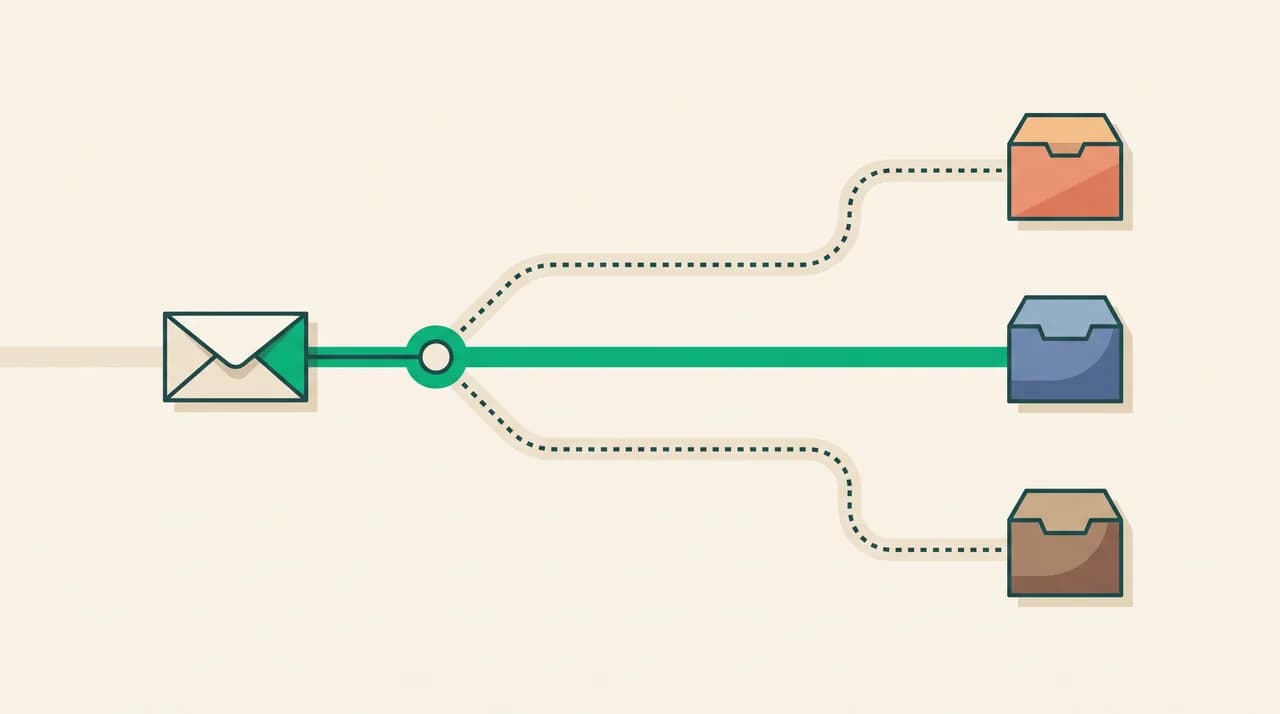
Every deleted email follows one of three paths after it leaves Deleted Items. Which path it is on when you realize it is missing determines which recovery route is still open.
Fix 3: Restore from a local PST or OST file#
POP3, IMAP, and Exchange accounts using Cached Exchange Mode write a local data file to your hard drive. If Outlook was configured to keep a local copy before the deletion happened, that file may contain the missing email.
This is the only option when Recover Deleted Items is unavailable. It depends entirely on whether a data file from before the deletion exists on your machine or a backup. If Outlook had no local cache, or if the file was last synchronized after the email was already deleted, there is nothing to recover here.
- 1
Find the local data file
In classic Outlook, go to File > Account Settings > Account Settings > Data Files tab. The list shows all OST and PST files attached to the current profile with their file paths on disk. An OST is created automatically by Exchange Cached Exchange Mode; a PST is a manually created personal archive or an imported data file.
- 2
Check the file modification date before opening it
In Windows Explorer or Finder, check the last modified date on the file. If the file was last modified after the deletion occurred, that version of the mailbox may already be missing the email. Files with a modified date before the deletion date are the ones worth opening.
- 3
Open the data file in Outlook
Go to File > Open and Export > Open Outlook Data File, navigate to the file path shown in the Data Files tab, and click OK. The file appears as a separate folder tree in the Outlook sidebar, labeled with the file name rather than your email address.
- 4
Search the data file for the email
Browse the folder structure in the data file, including the Deleted Items folder inside it. Use the Outlook search bar with the data file folder selected to search by sender, subject, or date. The file reflects the state of the mailbox at the last synchronization before it was closed.
- 5
Drag the email back to the live inbox
Select the recovered email in the data file folder tree and drag it to the corresponding folder in the live account sidebar. Outlook copies the item to the server. When finished, close the data file connection via File > Account Settings > Data Files, select the file, and click Remove.
- 6
If no current data file pre-dates the deletion, check system backups
If no local PST or OST file pre-dates the deletion, check whether the machine has a system backup — Windows Backup, a third-party backup agent, or an IT-managed solution — that includes the Outlook data file directory. Restore that file to a temporary location and open it in Outlook as described in steps 3 and 4.
How do you tell which recovery route applies?#
Three questions narrow it down quickly.
First: is Recover Deleted Items available in Outlook? Open the Folder tab in classic Outlook or right-click Deleted Items in the web app. If the command is missing or greyed out, the account is not Exchange-based — go to Fix 3.
Second: does the email appear in the Recover Deleted Items dialog? If yes, Fix 1 works now and you can stop reading. If the dialog is empty or the item is absent, the retention window has closed or the item was purged early.
Third: does the organization have a hold policy on the mailbox? This is a question for IT. If yes, Fix 2 is open — an admin can search the Purges subfolder through the compliance portal. If no hold was in place when the retention window expired, the item has been permanently expunged and no route remains for an Exchange account. In that case the only remaining option is a local data file from before the deletion (Fix 3).
How do you prevent permanent email loss in Outlook?#
Most permanent losses happen because the retention window closes before anyone realizes the email is missing. A few practices close that gap.
Archive rather than delete. Moving an email to an archive folder instead of deleting it keeps it retrievable without cluttering the inbox. Exchange Online includes an online archive that is separate from the primary mailbox quota and does not count against the Recoverable Items clock.
Extend the retention window. Administrators can raise the deleted-item retention period from the 14-day default to the 30-day maximum using the Exchange admin center or the Set-Mailbox PowerShell command. On an active team, those extra two weeks frequently make the difference between recoverable and gone.
Enable litigation hold on critical mailboxes. A litigation hold removes the retention clock entirely — items in Recoverable Items are kept indefinitely and remain searchable through compliance tools. This matters most for executives, legal staff, finance, or anyone subject to records-retention rules.
Check Recover Deleted Items immediately. The moment you realize an email is missing, open the dialog before doing anything else. Waiting a week to start looking is how 14 days becomes a closed door.
Extend the retention window to 30 days — it costs nothing
The pattern that leads most people to this guide is straightforward: the email felt unimportant until it was needed, and by then the window had closed. A mail client that makes archiving the natural path — and that lets you search across everything you have kept, not just what is in the active inbox — reduces the pressure to delete in order to manage volume. We build AI Emaily, an AI email client that connects to Outlook, Gmail, and any IMAP account. Its smart-search feature indexes and searches across all connected accounts, so finding an older message without relying on recovery tools is often faster than any of the routes above. AI Emaily offers a 7-day free trial if you want to try it.
Frequently asked
See it in AI Emaily
Keep reading
Sources

Written by
Nafiul HasanNafiul Hasan is an entrepreneur and AI automation system builder with 10+ years of experience turning messy, manual workflows into reliable automated systems. He designs and ships AI enterprise solutions end-to-end — the agent logic, the data plumbing, and the product people actually use — and founded AI Emaily to give busy professionals their attention back. He writes here from the builder's seat: what works, what breaks, and how to put AI to work without giving up control.