Best Email Management Software for Chiropractic Clinics (2026)

The short answer
Put the compliance foundation on a mailbox provider that signs a BAA — Google Workspace or Microsoft 365 both do — and keep clinical records out of ordinary email. For triage and drafting across new-patient, insurance and attorney threads, add a management layer like AI Emaily, but never route PHI through a tool with no BAA.
Best email management software for chiropractic clinics, compared on triage, attorney and insurance threads, and the HIPAA reality most roundups skip.
On this page
- 01The short answer: what to actually run
- 02First, the part no email tool does for you: HIPAA
- 03How we compared
- 04Comparison table
- 05The tools, one by one
- 061. AI Emaily — the management layer, with an honest limit
- 072. Microsoft 365 (Outlook) — a compliance foundation many clinics already have
- 083. Google Workspace (Gmail) — the other compliant foundation
- 094. Front — when a shared front desk is the bottleneck
- 105. Shortwave — strong if you are all-in on Gmail
- 116. Fyxer — an overlay, not a client
- 127. Superhuman Mail — fast, but check which "Superhuman" you mean
- 138. Serif — autonomy-led, with pricing you must read closely
- 14How to choose for your situation
A chiropractic clinic's inbox carries three very different kinds of mail at once: new-patient inquiries that need a fast, warm reply; personal-injury attorney and lien correspondence tied to open cases; and insurance authorisation threads that decide whether you actually get paid. The best email management software for chiropractic clinics has to pull those apart, move quickly on the first, and stay careful with the other two — because those two routinely carry protected health information (PHI).
This guide compares the tools that can do that job, and it is honest about the one thing none of them replaces: a real HIPAA program. We rank a top pick, but we spend the first section on the part no email app decides for you, because getting that wrong is far more expensive than picking the wrong triage tool.
The short answer: what to actually run#
There is no single product that is both your compliance foundation and your fastest triage layer, so the honest answer has two parts. First, put your mailbox on a provider that will sign a Business Associate Agreement (BAA) — Google Workspace and Microsoft 365 both offer one — and keep clinical records out of ordinary email. Second, add a management layer on top to tame the operational flood.
For that management layer, our pick is AI Emaily. It triages the inbox, routes new-patient, attorney and insurance threads to the right place, and drafts replies you approve before they send, with an undo and an audit trail on everything. AI Emaily is our own product, so read that as the recommendation it is — and read the concession in its section below, because it does not sign a BAA and is not your compliance layer.
If a shared front desk is your real bottleneck, Front is the better first move. If your clinic lives entirely in Gmail, Shortwave is a strong native option. The rest of this guide shows where each one fits, and where it does not.
First, the part no email tool does for you: HIPAA#
Most chiropractic clinics are HIPAA covered entities. Under the rules administered by HHS, any health care provider who electronically transmits health information in connection with a standard transaction — most commonly, billing insurance electronically — is a covered entity, regardless of the practice's size. If your clinic files insurance claims electronically, and nearly all do, you are almost certainly covered.
Being covered does not mean you cannot use email. HHS states plainly that the Security Rule permits a covered entity to send ePHI by email, as long as it applies reasonable administrative, physical and technical safeguards. Encryption for transmission is an "addressable" implementation specification, not a flat requirement — you either implement it or document why a reasonable alternative is appropriate. That is the rule as it stands as of August 2026; HHS has issued a proposed rulemaking that would make encryption of ePHI required rather than addressable, but that change is not in effect at the time of writing, so confirm the current position on the HHS site before you rely on it.
The load-bearing mechanism is the BAA. A covered entity must have a signed Business Associate Agreement with any vendor that creates, receives, maintains or transmits PHI on its behalf — and your mailbox provider is exactly such a vendor. Microsoft makes a HIPAA BAA available by default to covered-entity customers through its product terms for in-scope services such as Exchange Online, so there is no separate contract to chase. Google requires an administrator to review and accept the BAA in the Workspace Admin console, and states that customers who have not accepted it must not put PHI in the services. A consumer @gmail.com or personal Outlook.com account cannot sign a BAA at all.
The habit that keeps you safe is to minimise PHI in email in the first place. Use a patient portal or secure messaging for records and detailed clinical information, and reserve ordinary email for logistics — scheduling, general questions, document requests. Every AI or automation layer you add is one more vendor touching your mail, so each needs its own BAA before PHI passes through it, or it must be kept off PHI entirely.
A BAA is not optional, and privacy features are not a substitute for it
How we compared#
We did not run a lab test of a dozen products. We compared documented capabilities against what a chiropractic front desk actually deals with, which is more defensible and easier for you to re-check on each vendor's own page. Prices and plan names change, so we describe packaging by shape — free tier, trial, per-seat, usage-metered — rather than printing figures that will be stale by the time you read this.
The dimensions that decide the fit for a clinic:
- What it is. A mailbox provider, a full email client, an overlay that sits on top of your existing mailbox, or a shared-inbox platform — these solve different problems and are not interchangeable.
- HIPAA posture. Does the vendor sign a BAA, and is the tool your compliance foundation or a layer that must be kept off PHI? This is the dimension most clinic roundups skip.
- Provider coverage. Gmail, Outlook and IMAP, or locked to a single provider — a clinic on Microsoft 365 cannot use a Gmail-only tool.
- Control before send. Approve-before-send, undo, and an audit trail matter more here than almost anywhere, because a wrong reply can land in front of an attorney or an insurance adjuster.
- Routing and triage. Can it tell a new-patient inquiry from a lien thread from an authorisation request, and treat each differently?
- Packaging shape. Trial, per-seat, or usage-metered — verify the current terms on the vendor's page before you commit.
Comparison table#
| Tool | What it is | Works with | Approve-before-send + audit | Vendor BAA | Packaging shape |
|---|---|---|---|---|---|
| AI Emaily | AI email client (management layer) | Gmail, Outlook, IMAP | Yes — Copilot approval, undo, audit log | Not offered (as of Aug 2026) — keep PHI off it | 7-day trial, then paid; no free tier |
| Microsoft 365 (Outlook) | Mailbox provider + client | Its own Exchange mailbox | Standard client controls | Available by default to covered entities | Per-user subscription |
| Google Workspace (Gmail) | Mailbox provider + client | Its own Gmail mailbox | Standard client controls | Available — admin accepts it in console | Per-user subscription |
| Front | Shared-inbox platform | Gmail, Outlook, IMAP + channels | Assignment, comments, activity log | Confirm with vendor | Per-seat tiers; AI is a paid add-on on lower tiers |
| Shortwave | AI-native email client | Google Workspace / Gmail only | Client controls | Confirm with vendor | Paid plans with a trial |
| Fyxer | AI overlay (not a client) | Gmail, Outlook | Drafts for your review | Confirm with vendor | Paid, with a trial |
| Superhuman Mail | Fast keyboard email client | Gmail, Outlook | Client controls | Confirm with vendor | Per-seat paid, with a trial |
| Serif | Autonomy-focused AI assistant | Gmail, Outlook | Varies by autonomy level | Confirm with vendor | Usage-metered tiers, 7-day trial |
The tools, one by one#
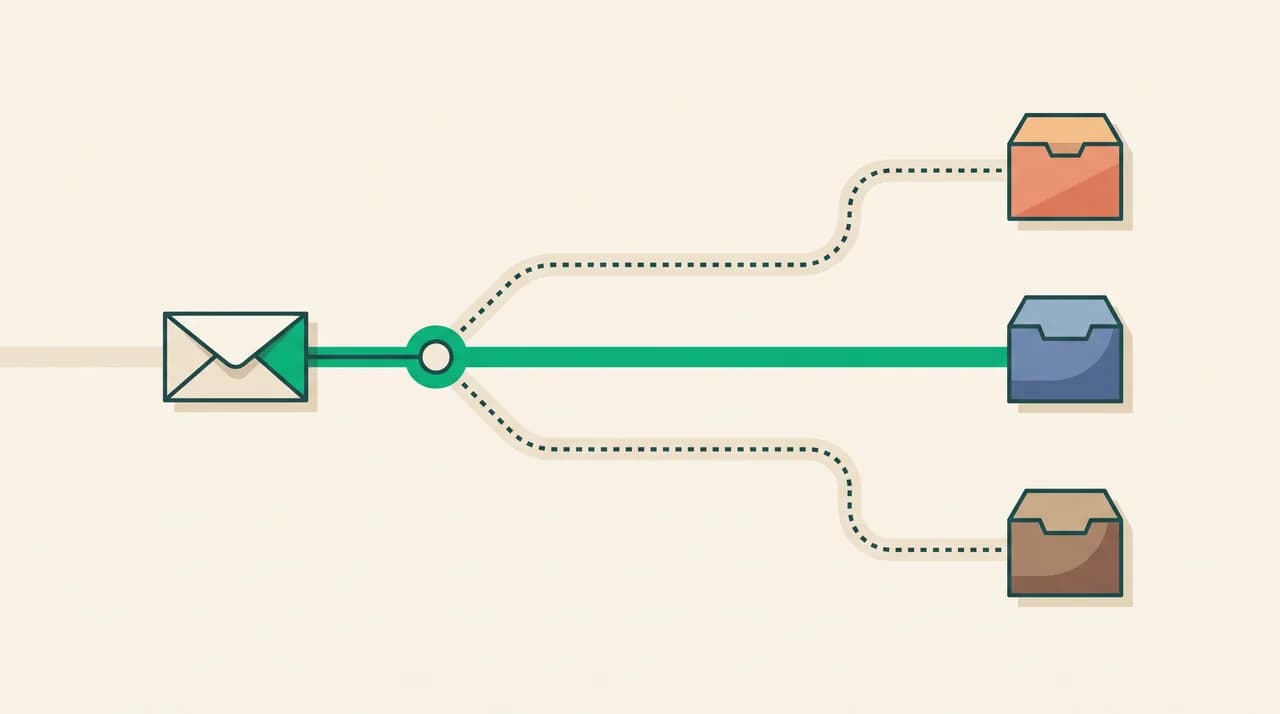
The comparison above sorts the field into three jobs: the provider that holds your mailbox and signs the BAA, the client or overlay that helps you work the mail, and the shared-inbox platform that coordinates a team. A chiropractic clinic usually needs the first plus one of the others — not all three. Keep the routing picture below in mind as you read: the whole game is getting the three kinds of mail into three lanes and treating each correctly.
1. AI Emaily — the management layer, with an honest limit#
AI Emaily is an AI-native email client that connects to Gmail, Outlook and any IMAP mailbox, so it works on the inbox you already run instead of asking you to migrate. For a clinic, its value is the routing this guide keeps returning to: its Rules and Context Brain can tell a new-patient inquiry from a lien thread from an authorisation request and handle each differently, and it drafts replies using a user-set Personal Context and per-client profiles — not by studying your sent mail — so an attorney update reads differently from a warm reply to a prospective patient.
The control model is what makes it defensible in a clinic. In Copilot mode it drafts and waits for your one-tap approval before anything sends; in Autopilot mode it acts only within rules you set; every action is logged in an audit trail and every send has an undo. It does not train on your email content. We build AI Emaily, so weigh that, and weigh the limit honestly.
The limit: AI Emaily does not sign a BAA (as of August 2026). It is not your compliance layer, and you should not point it at mail that contains PHI. Its real job in a clinic is the operational flood — new-patient inquiries before any record exists, scheduling, general questions, and the logistics of attorney intake — while records and detailed clinical information stay in a BAA-backed portal or secure channel. Used that way, on top of a compliant mailbox, it removes the busywork without becoming the weak link.
There is no free tier. There is a 7-day free trial on Pro or Autopilot; a card is required and you are not charged if you cancel before day seven. Confirm the current terms on the pricing page before you sign up.
2. Microsoft 365 (Outlook) — a compliance foundation many clinics already have#
Microsoft 365 is a mailbox provider and email client in one, and it is the compliance foundation for a large share of healthcare offices. The reason it belongs near the top of any clinic list is the BAA: Microsoft makes a HIPAA Business Associate Agreement available by default to covered-entity customers through its product terms for in-scope services including Exchange Online, with no separate contract to sign. That removes the single most common blocker to using email for PHI.
As an email manager, though, Outlook is basic. Rules, categories and folders will get you a tidy inbox, but they do not read intent, so a new-patient inquiry and a lien request look the same to them. Most clinics on Microsoft 365 keep it as the compliant foundation and add a triage layer on top. Packaging is a per-user subscription; verify plan eligibility for the BAA on Microsoft's compliance documentation.
3. Google Workspace (Gmail) — the other compliant foundation#
Google Workspace is the equivalent choice for a clinic that lives in Gmail. Google offers a HIPAA BAA, but it is not automatic: an administrator must review and accept the Business Associate Amendment in the Admin console, and Google states that customers who have not accepted it must not put PHI in the covered services. A personal @gmail.com account cannot sign one — this has to be paid Google Workspace with the BAA accepted.
Gmail's labels and filters handle light organisation, and its search is strong, but like Outlook it does not distinguish an attorney thread from an appointment request on its own. It is the foundation, not the triage engine. Packaging is a per-user subscription. If your clinic is already on Google Workspace, confirming the BAA is accepted is often the highest-value HIPAA task you can do this week.
4. Front — when a shared front desk is the bottleneck#
Front is a shared-inbox platform rather than a personal email client, and it earns its place when several front-desk staff work one address like [email protected]. It gives you assignment so two people do not reply to the same insurance thread, internal comments so a biller can flag an authorisation without a separate email, and an activity log of who did what. That coordination is exactly what a busy multi-provider clinic struggles with.
Front's plans are per-seat across Starter, Professional and Enterprise, and its AI Copilot features are a paid add-on on the lower tiers rather than included everywhere. On HIPAA, do not assume — confirm the BAA terms directly with Front before routing PHI through it. Treat Front as the coordination layer over your compliant mailbox, not as a replacement for the provider's BAA.
5. Shortwave — strong if you are all-in on Gmail#
Shortwave is an AI-native email client built by former Google engineers, with semantic search that is genuinely good at finding a buried thread from a fuzzy memory — useful when an adjuster references a message from three months ago. The catch for a clinic is that Shortwave works only with Google Workspace and Gmail, so it is a non-starter if you are on Microsoft 365.
Its packaging is paid plans with a trial; descriptions of a free tier have circulated, but check the live pricing page for the current terms rather than trusting a third-party summary. As with any AI layer, confirm whether the vendor will sign a BAA before it reads mail that could contain PHI.
6. Fyxer — an overlay, not a client#
Fyxer is worth understanding because it sits in a different category: it is an overlay on Gmail or Outlook, not a client you switch to. It triages, drafts replies and takes meeting notes on top of your existing mailbox, so you keep working in the interface you already know while it works in the background.
That overlay-versus-client distinction is the sharpest axis in this category, and it matters for a clinic because an overlay still reads your mail — which means the same BAA question applies before any PHI is involved. Fyxer is paid with a trial. Confirm its HIPAA posture with the vendor directly.
7. Superhuman Mail — fast, but check which "Superhuman" you mean#
Superhuman Mail is a fast, keyboard-driven email client for Gmail and Outlook, aimed at people who want to move through a high-volume inbox quickly. Its strength is speed and shortcuts rather than clinic-specific routing, so a solo chiropractor who processes their own mail may value it, while a shared front desk will not.
One caution on the name. Grammarly acquired Superhuman, the email client, in July 2025, then renamed its parent company Superhuman in October 2025 — so "Superhuman" now refers to two different things: Superhuman Mail, the client meant here, and the broader Superhuman Suite bundle. Make sure a quote or a plan you are looking at is for the mail client. Packaging is per-seat and paid with a trial; confirm the BAA position with the vendor.
Two products now share the Superhuman name
8. Serif — autonomy-led, with pricing you must read closely#
Serif positions itself on autonomy — an assistant that acts on your inbox rather than just drafting. For a clinic, autonomy is exactly the capability you want tightly bounded, so the important question is how much you can approve before anything goes out, not how much it can do on its own.
Its packaging is usage-metered across several tiers with a 7-day full-access trial, and the tiers are separated by usage multiples. Read the plan page carefully: it defines the tiers by usage but does not clearly define what one unit of usage is, so model your likely volume before committing. Confirm the BAA position with Serif before any PHI is in scope.
How to choose for your situation#
The right stack depends less on which app is "best" and more on the shape of your clinic. Two rules hold in every case: the provider that signs your BAA is the compliance foundation, and PHI-heavy content — medical records, detailed treatment notes, the documents attached to a lien or a case — belongs in a portal or secure channel, not in ordinary email. With that fixed, match your situation to a starting point.
| If your clinic is… | Start with | Then add |
|---|---|---|
| A solo chiropractor handling your own mail | Google Workspace or Microsoft 365 with the BAA in place | A triage layer like AI Emaily on the operational mail |
| A busy front desk sharing one inbox | The BAA-backed provider, plus Front for assignment | Rules to route new-patient, attorney and insurance threads |
| Heavy on personal-injury and lien cases | A secure channel for records exchange | A rules layer that tags case threads and never auto-touches PHI |
| Insurance-authorisation heavy | The compliant mailbox for the PHI-bearing threads | Automation for follow-up reminders that expose no PHI |
The personal-injury and lien workflow is the one generic clinic roundups miss, so it is worth naming directly. Attorney correspondence in an open case often includes medical records, which are PHI, and the request itself usually needs a signed authorisation before you release anything. The safe pattern is to keep the records exchange in a BAA-backed secure channel, and to use your management layer only for the coordination around it — tagging the case, chasing the missing authorisation form, making sure nothing sits unanswered — not for moving the records themselves.
Do that, and inbox automation becomes a help rather than a liability: the routine new-patient and scheduling mail clears fast, the case and authorisation threads are visibly tracked, and the tools that never signed a BAA never see the mail that would put you at risk.
Keep PHI out of email before you choose any tool
Frequently asked
See it in AI Emaily
Keep reading
Sources

Written by
Nafiul HasanNafiul Hasan is an entrepreneur and AI automation system builder with 10+ years of experience turning messy, manual workflows into reliable automated systems. He designs and ships AI enterprise solutions end-to-end — the agent logic, the data plumbing, and the product people actually use — and founded AI Emaily to give busy professionals their attention back. He writes here from the builder's seat: what works, what breaks, and how to put AI to work without giving up control.