Best Tools to Connect Email to Other Apps Without Zapier (2026)

The short answer
For high-volume email automation without per-task pricing, n8n leads — open source, self-hostable, with built-in email trigger nodes. Make is second for a visual-first cloud tool, Pipedream for developer-heavy stacks, Google Apps Script for Gmail-only work, Microsoft Power Automate for Outlook. If your real goal is triage and replies rather than routing mail to other apps, an AI email client removes the need for the workflow entirely.
Best tools to connect email to other apps without Zapier: n8n, Make, Pipedream, Apps Script, native integrations — compared on cost at high message volume.
On this page
- 01The short answer: n8n is the top pick, and here is where we do not compete
- 02How we compared these tools
- 03Comparison table
- 04The tools, one at a time
- 05AI Emaily — the adjacent thing we build
- 06n8n — the top pick for self-hosted, high-volume email plumbing
- 07Make — the strongest visual-first cloud alternative
- 08Pipedream — the developer-first hybrid
- 09Google Apps Script — free, Gmail-native, quota-limited
- 10Microsoft Power Automate — the Outlook-side equivalent
- 11Native provider rules — the free floor, and where it stops
- 12Custom IMAP IDLE worker — the honest option for extreme volume
- 13How to choose for your situation
- 14Where AI Emaily is the wrong pick
- 15Bottom line
- 16Frequently asked questions
Almost every team asking for a "Zapier alternative for email" is really asking one of two things: the task bill got embarrassing, or the workflow must run on infrastructure they control. Zapier's per-task metering drives the first — every action step costs a task and inbound email is a firehose. Data residency drives the second, especially in EU, healthcare and legal work where "email body left our tenant" needs justification.
This roundup ranks the tools that solve those two problems. The top pick is n8n — open source, self-hostable, priced per workflow execution rather than per step. Make is the strongest visual-first cloud alternative; Pipedream is the developer-first one; Apps Script and Power Automate are the native provider options; inbox rules plus a custom worker cover more ground than most teams try. AI Emaily appears as the adjacent thing we build — if the reason to route email out is triage or drafting, an AI email client removes the need for the workflow. Where we do not compete is the plumbing, and we say so.
The short answer: n8n is the top pick, and here is where we do not compete#
For high-volume email automation without per-task pricing, n8n is the strongest Zapier alternative. It is open-source, self-hostable, ships native Gmail and IMAP trigger nodes, and meters cloud plans per workflow execution rather than per step — so a new message can fan out to anything reachable by HTTP or native connector. On Community Edition, an execution costs the compute it uses and nothing else.
We are naming n8n first honestly. **n8n has built harder on self-hosted email triggering than we do — for high-volume plumbing that must never leave your infrastructure, n8n is the right tool and AI Emaily does not compete on that job.** We are a mail client with an approval-first agent, not a workflow engine. There is no "AI Emaily webhook that fires when a message matches a filter," and it would be dishonest to imply otherwise.
The reason AI Emaily is entry #1 in the table is more specific. A real fraction of readers at this query are trying to solve inbox problems — triage, drafting, follow-up — by bolting them onto a workflow tool because the mail client is the wrong shape. If that is the actual goal, an AI email client is what you want, not a webhook chain. Pick n8n for plumbing; pick us for mail.
Name the question before picking the tool
How we compared these tools#
Feature checklists make every automation tool look interchangeable, so we compared on the axes that decide cost and fit at real message volume, not connector counts. Every capability was checked against vendor docs and pricing pages in August 2026. We do not print competitor prices — packaging shape only, because exact figures go stale within weeks.
- Pricing axis. Per-task, per-operation, per-execution, per-seat, or free/self-hosted — this is what makes email automation expensive or affordable at volume, more than any feature.
- Where the message body lives. Vendor cloud, your own server, or the mail provider's tenant — the difference between passing a compliance review and rewriting the architecture.
- Email trigger fidelity. Native IMAP/Gmail/Graph trigger, polling only, or forwarding through a parser — which changes latency and the messages you miss.
- Runtime shape. Visual builder, code, or hybrid — and whether you can escape into raw code when the visual runs out.
- Provider coverage. Gmail only, Google Workspace + Microsoft 365, or full IMAP — most workflow tools quietly drop the last one.
- Maintenance surface. Who fixes it when the connected app renames a field or deprecates an endpoint — you, the vendor, or nobody until it fails silently.
Verify pricing on the vendor page at the moment you buy
Comparison table#
AI Emaily is the first row because this is our site — see the previous section for the honest framing of what we do and do not compete on. The rest of the table is grouped by shape: self-hosted / open source, then cloud workflow platforms, then native provider automation, then the free floor.
| Tool | Category | Pricing axis | Where message data lives | Email trigger | Packaging shape |
|---|---|---|---|---|---|
| AI Emaily | AI email client (adjacent, not a workflow tool) | Per seat plus AI usage | Our infrastructure, no training on your mail | Not a webhook target — inbox-side triage, drafting, follow-up | 7-day free trial on Pro/Autopilot, card required, $0 if cancelled before day 7 |
| n8n | Open-source workflow engine | Per workflow execution (cloud); self-hosted is free of license | Your server (Community Edition) or n8n cloud (paid tiers) | Native Gmail Trigger and IMAP Email Trigger nodes | Community Edition is free/open source; paid cloud tiers exist — verify at n8n.io |
| Make (formerly Integromat) | Visual cloud workflow platform | Per operation (each module call) | Make cloud (EU or US region selectable) | Native Gmail, Outlook and IMAP watch modules | Free tier with paid tiers — verify at make.com |
| Pipedream | Developer-first workflow platform (code + no-code) | Per credit (metered by workflow duration) | Pipedream cloud | Native Gmail, Outlook and generic email inbound endpoints | Free tier with paid tiers — verify at pipedream.com |
| Google Apps Script | Native Google Workspace scripting | Free within daily quotas | Inside your Google Workspace tenant | GmailApp and time-based triggers, plus Gmail add-on triggers | Included with any Google account — verify quotas at developers.google.com/apps-script |
| Microsoft Power Automate | Native Microsoft 365 automation | Per user or per flow (licensed via M365) | Inside your Microsoft 365 tenant | Outlook and Graph triggers, plus premium connectors | Some flows included with M365; premium tiers separate — verify at microsoft.com |
| Gmail filters / Outlook rules | Native provider rules (the free floor) | Free (included) | Inside the provider tenant | Rule-based, in-provider only (no external fan-out) | Included with every Gmail / Outlook account |
| Custom IMAP IDLE worker | Your own code | Compute cost only | Whatever host you deploy to | IMAP IDLE for near-real-time triggers on any provider | Free of license; your engineering time and hosting |
AI Emaily has no permanent free tier
The tools, one at a time#
Each entry covers what the tool does with an incoming email, where it beats Zapier, and the reader it fits. We are honest about where AI Emaily is not the answer.
AI Emaily — the adjacent thing we build#
AI Emaily is a full mail client (web, macOS, Windows, iOS, Android PWA) with an approval-first AI agent that triages, drafts and follows up on messages inside the inbox. It is not a workflow engine, does not fire outbound webhooks, and will not replace n8n for teams whose job is moving email data into another app. We build it, and being clear about that shape is what makes the rest of this page worth reading.
Where it belongs on this list: a real fraction of "connect email to other apps without Zapier" queries are people trying to solve triage or drafting by bolting it onto a workflow tool. In that case the workflow wraps the wrong tool. AI Emaily reads and judges the message in-client, drafts from your user-set Personal Context brain and per-client profiles (not from your sent mail), and lets the agent close the loop under Manual, Copilot or Autopilot authority — with undo and an audit trail. Provider coverage is Gmail, Outlook and standard IMAP in one workspace.
Honest limits. No webhook trigger on inbound mail — n8n, Make and Pipedream own that job. Mac is Apple Silicon only; Android is a PWA; Linux is web-only. Packaging: 7-day trial on Pro/Autopilot, card required, $0 if cancelled before day 7; verify at aiemaily.com/pricing.
n8n — the top pick for self-hosted, high-volume email plumbing#
n8n is the honest #1 for the exact job this page is titled around. Open-source, self-hostable, with native Gmail and IMAP trigger nodes — and cloud plans meter per workflow execution rather than per step, so a ten-action chain costs one execution, not ten. That single detail changes the math for any team running high-volume email triggers.
Two more wins. Self-hosting Community Edition means the email body never leaves your infrastructure — the vendor never sees the message, which is what data residency actually requires. And any workflow step can be a Function node with your own JavaScript, so you are never trapped in the visual builder.
Where n8n loses ground is support — self-hosted means you own patching, monitoring and security, and forum help is not an enterprise SLA. Cloud tiers buy that back; verify at n8n.io. Pick n8n if your problems are per-task pricing and data residency, and you have the engineering to run a Node.js service.
Make — the strongest visual-first cloud alternative#
Make is what most teams end up on when they want Zapier's ease plus better economics at volume. Metering is per operation — each module call counts once — so a two-step workflow burns two units per run. On email triggers firing hundreds of times a day, that is usually cheaper than Zapier's per-task model.
Make ships native Gmail, Outlook and IMAP watch modules, supports EU or US region selection, and the visual builder is accessible to non-developers. The free tier lets you prove a workflow before paying; verify at make.com.
Where it does not fit: code-first teams find the visual overhead slow, and Make is a cloud service — message data goes through Make's infrastructure regardless of region. If "body never leaves our tenant" is a hard requirement, use n8n Community Edition or Apps Script. Otherwise Make is the closest Zapier replacement in this list.
Pipedream — the developer-first hybrid#
Pipedream is the pick if the team can code. Every step is a Node.js or Python function you write directly — "visual builder" and "custom code" are the same thing. Native triggers cover Gmail and Outlook, and Pipedream provides an inbound email endpoint (a unique address that turns any incoming message into a trigger event), a shape neither Zapier nor Make expose as cleanly.
Metering is credit-based — each workflow execution consumes credits scaled to how long the run took. That works out cheaper than per-task on short workflows, and about equivalent on long ones. A free tier exists; verify current limits and pricing at pipedream.com.
The trade-off is the audience. If your operations team was hoping to build workflows without a developer nearby, Make or Zapier are easier on non-technical builders. If you have a developer, Pipedream is the higher ceiling.
Google Apps Script — free, Gmail-native, quota-limited#
Apps Script is the most underused tool on this list. It runs inside your Google Workspace tenant with direct Gmail access, costs nothing beyond your existing account — no per-task metering, no operation limit, just Google's daily quotas. For a Gmail-only team, that is the honest zero-cost answer to "connect email to other apps without Zapier."
You write JavaScript, wire an installable trigger (time-based or Gmail add-on), and the script can read messages, call other Google APIs, and hit any external HTTP endpoint. Google's Apps Script docs cover quota limits and trigger types in detail.
Two ceilings. Google Workspace only — no Outlook, no IMAP. And quotas: hitting the daily limit silently stops the script until midnight Pacific. Fine for a small team; not for a support inbox processing thousands of messages a day.
Microsoft Power Automate — the Outlook-side equivalent#
Power Automate is the honest first choice if the mailbox is on Microsoft 365. Native Outlook and Graph triggers, message data stays inside your Microsoft tenant, and some flows are included with existing M365 licenses. For an Outlook shop, this is often already paid for.
The visual builder is closer to Make than to Zapier — richer, slightly more complex — and the templates library covers most "new email arrives, do X in another 365 app" cases without writing custom logic. Approvals, DLP integration, and audit belong to the Microsoft compliance stack you already run.
Where it doesn't fit: multi-provider workflows. Power Automate is fluent inside 365, awkward on Gmail or IMAP. Use n8n or Make if the team spans both ecosystems. Verify licensing at microsoft.com — "included with M365" quietly excludes the premium connectors you were planning to build on, and that is the most common planning mistake.
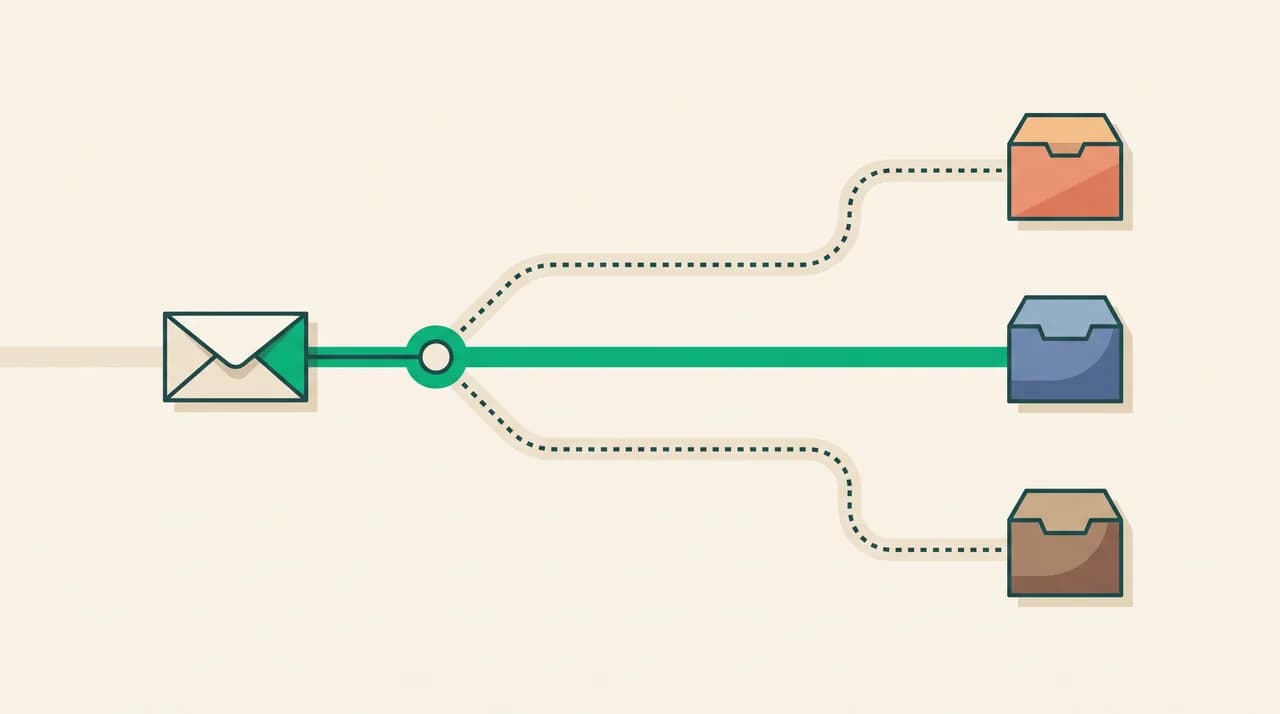
The picture below is a mental model. One message fanning out to four different places — chosen by which infrastructure you want the body to touch.
Native provider rules — the free floor, and where it stops#
Before paying for any of the above, your mail provider already automates the simplest cases for free. Gmail filters can label, archive, forward, star or categorize. Outlook rules can move, forward, flag or reject. For "newsletters skip the inbox" or "receipts go to a label," that is enough — no workflow builder, no external service.
The ceiling is hard. Native filters cannot compose replies, judge content, reach external apps, or chain more than a few simple actions. The moment the workflow needs a webhook, a Slack ping, or content-adaptive replies, you have outgrown filters. That is the fork: workflow tools for plumbing, an AI email client for reading and reply.
Custom IMAP IDLE worker — the honest option for extreme volume#
For teams processing hundreds of thousands of emails a week, no hosted platform is cheaper than a small worker you build yourself. An IMAP IDLE connection gives near-real-time notifications on message arrival; a few hundred lines of Node.js, Python or Go turn each into whatever downstream action you need. Cost is compute and engineering time — no per-task, per-operation or per-execution.
The catch is maintenance. You own connection health, token refresh, retry logic, observability, and on-call when a provider changes its API. Budget that honestly against a hosted n8n or Make tier before assuming "we'll just build it." Most teams that go this route already had the operational muscle. If you are choosing between hiring for maintenance and buying a hosted plan, buy the plan.
How to choose for your situation#
The right pick depends on which axis hurts most — cost, residency, workflow complexity, or the fact that the real problem is inbox chores. Say your constraint and the shortlist collapses.
- 1
1. Your Zapier task bill got embarrassing at high message volume
Move to a per-execution or per-operation platform. n8n cloud (per execution) is cheapest at high step-count workflows. Make (per operation) is competitive for short workflows and easier for non-developers. Pipedream (per credit) fits code-heavy teams. Switch when the saving is a factor of two or more — common above ~10k triggered events a month.
- 2
2. The message body must never leave your infrastructure
Self-host n8n Community Edition, use Google Apps Script inside your Workspace tenant, or run a custom IMAP IDLE worker in your own cloud. Every SaaS workflow platform — Zapier, Make, Pipedream, n8n cloud — holds the message body on their infrastructure while the workflow runs. If a compliance review will fail on that fact, you cannot pick a hosted service regardless of region setting.
- 3
3. You live entirely in Google Workspace and workflows are simple
Start with Gmail filters for the routing you can express as rules, and add Apps Script for anything filters cannot do. Free, native, no third party in the loop, and the quotas will cover most teams. Reach for a workflow platform only when you need to hit non-Google services regularly.
- 4
4. You live in Microsoft 365 and the automation is inside Outlook or Graph
Power Automate is already partly paid for. Check what your M365 license includes before buying anything else — most "connect Outlook to another 365 app" workflows are covered without premium connectors. Add n8n or Make when you need to reach Google Workspace or non-Microsoft services alongside it.
- 5
5. Your team can code and you want the highest ceiling
Pipedream or self-hosted n8n. Both let you escape into raw code inside any workflow step. Pipedream is faster to prototype; n8n is more portable because you control the runtime. Pick Pipedream for developer velocity, n8n for control.
- 6
6. The real problem is inbox triage, drafting or follow-up
Do not build a workflow around it. Use an AI email client that reads, judges and drafts inside the inbox — that is the job AI Emaily is built for, and a webhook chain into Slack or an LLM step is a distant second best for that specific job. Take the 7-day trial before assuming you need to build.
For confidential mail, ask every vendor two questions
Where AI Emaily is the wrong pick#
AI Emaily is not the answer if the job is fanning inbound email out to Slack, a CRM and a webhook — n8n is. Not the answer if your compliance profile requires message bodies on your own infrastructure — n8n Community Edition, Apps Script or a custom worker are the honest options. Not the answer if all you need is Gmail filter rules for a Gmail-only team.
It is the right answer when the reason you were about to build the workflow was the mail itself — triage, drafts, follow-up under approval — and routing was a proxy for wanting the inbox handled. For that reader, in-client is the right shape.
Bottom line#
For connecting email to other apps without Zapier — self-hostable, per-execution priced, native email triggers — n8n is our top pick. Make is second for visual-first cloud with better per-operation math. Pipedream is the developer hybrid. Apps Script is the free floor for Google Workspace; Power Automate is the equivalent for M365. Native filters plus a custom worker cover more ground than most teams try.
AI Emaily's place here is the adjacent one — the mail client for the reader whose real problem was inbox triage and drafting, not routing. We do not do webhook fan-out on inbound mail. Packaging: 7-day free trial on Pro/Autopilot, card required, $0 if cancelled before day 7, no permanent free plan. Verify current pricing at aiemaily.com/pricing and any competitor's on their own site.
Frequently asked questions#
The questions readers ask most when shopping for a Zapier alternative — on pricing math, self-hosting, native versus connector platforms, and when to build versus buy.
Frequently asked
See it in AI Emaily
Keep reading
Sources

Written by
Nafiul HasanNafiul Hasan is an entrepreneur and AI automation system builder with 10+ years of experience turning messy, manual workflows into reliable automated systems. He designs and ships AI enterprise solutions end-to-end — the agent logic, the data plumbing, and the product people actually use — and founded AI Emaily to give busy professionals their attention back. He writes here from the builder's seat: what works, what breaks, and how to put AI to work without giving up control.