Best Tools to Route Email to Slack, Teams or a Webhook (2026)

The short answer
The best way to route selected emails into Slack, Teams or a webhook is to filter first and forward second. Use Slack's channel email address for a whole distribution list, Gmail or Outlook filters for a single-address dump, Zapier or Make for cross-app routing with conditions, and AI Emaily when the filter itself needs judgment.
Best tools to route email to Slack or webhooks in 2026: Zapier, Make, n8n, Power Automate, native forwarding and AI Emaily — signal first, not flood.
On this page
- 01The short answer: filter first, forward second
- 02How we compared
- 03At a glance: eight tools for routing email to Slack, Teams or a webhook
- 041. AI Emaily — filter-first, with signed outbound webhooks
- 052. Zapier — the widest connector library
- 063. Make — visual scenarios with cheaper metering
- 074. n8n — self-hosted routing
- 085. Microsoft Power Automate — native to the Outlook and Teams stack
- 096. Slack's email-to-channel address — free, native, no filter
- 107. Gmail and Outlook forwarding rules — the free floor
- 118. Parseur or Mailparser — parse first, then route
- 12How to choose for your situation
- 13A minimal setup that actually holds up
The reason "best tools to route email to Slack or webhooks" is a search at all is that most first attempts make the problem worse. Someone forwards their inbox into #alerts, the channel becomes unreadable inside a week, and everyone mutes it. The tool did what it was told; the setup skipped the step that mattered, which is deciding what should have reached the channel in the first place.
This roundup ranks eight tools by that criterion — signal preservation — because the difference between a useful channel and a graveyard is almost never the connector. It is the filter in front of it, and how honestly the tool lets you say "only these." We build AI Emaily, one of the tools compared below, and we will name plainly where another one is the better fit.
The short answer: filter first, forward second#
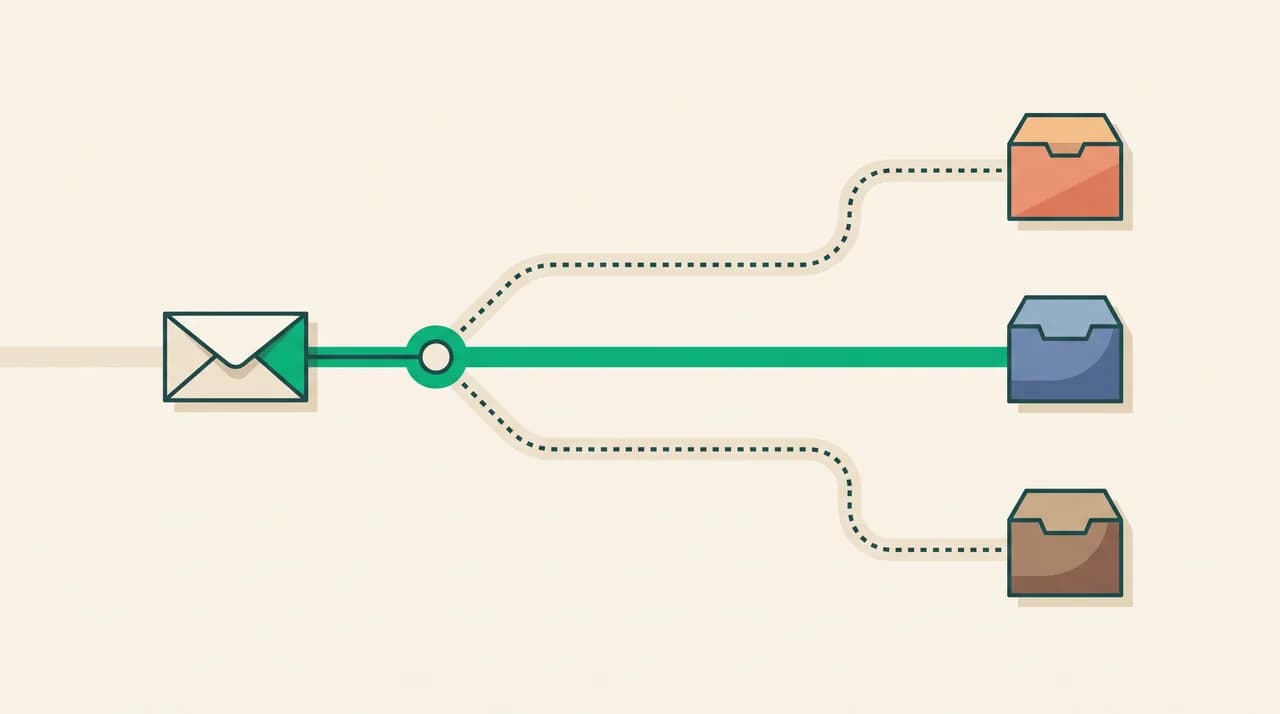
The correct order is filter, then route. Every tool in this post can move a message from A to B; only some of them let you decide what qualifies as A. Skip that decision and you are just moving the overload to a new window with fewer keyboard shortcuts.
In practice that means four different jobs, and the right tool depends on which one you are doing. Getting a whole distribution list into a Slack channel wants Slack's own email-to-channel address — free, native, no extra software. Getting matching messages from a personal Gmail or Outlook to one destination address wants the built-in filter. Getting form submissions, receipts or structured alerts into another app wants Zapier, Make, n8n or Power Automate, because the value is the branching and the mapping across apps. And getting only the emails that actually need a human reaction into Slack or a webhook wants a tool that reads the message first — which is where an AI email client earns the row.
If we had to pick one recommendation for the general reader routing personal or team mail: start with the native filter for anything that can be described by sender and subject, and reach for one of the automation platforms the moment the condition needs an OR, a lookup, or a transform. Reach for an AI email tool when the condition is "is this actually important," which no rule can answer honestly.
The test for a good routing setup
How we compared#
We picked eight tools that cover the four honest jobs above — native destination addresses, native forwarding rules, cross-app automation platforms, and filter-first email clients. For each we looked at the same six dimensions.
- Filter fidelity — can you say "only these" precisely, or only "everything from this sender"?
- Signal handling — does the message arrive as a useful summary or a raw email dump?
- Destination coverage — Slack, Teams, Discord, a generic HTTPS webhook, or one email address only?
- Cost shape — free tier, trial, per-seat, per-task metering, or bundled with an existing plan?
- Setup effort — a paste-a-URL job, a filter rule, a visual builder, or code?
- Reliability and observability — retries, signing, and a delivery log you can read after a failure.
At a glance: eight tools for routing email to Slack, Teams or a webhook#
| Tool | Best for | Filter fidelity | Destinations | Cost shape (verify on vendor) |
|---|---|---|---|---|
| AI Emaily | Filter-first routing when "important" needs judgment, plus signed outbound webhooks | AI triage + rules across Gmail, Outlook and IMAP | Slack, Discord, Telegram (scheduled brief); generic HTTPS webhooks with HMAC signing | 7-day trial on paid tiers, per-seat after that |
| Zapier | Cross-app routing with the widest connector library | Trigger conditions plus Filter and Formatter steps | Slack, Teams, Discord, thousands of apps, generic webhooks | Free tier plus paid tiers, metered per successful task |
| Make | Visual scenarios with heavier branching and cheaper metering per operation | Filter routers, iterators, aggregators between modules | Slack, Teams, Discord, native modules for most apps, HTTP module for webhooks | Free tier plus paid tiers, metered per operation |
| n8n | Self-hosting the routing pipeline so no third party sees the mail | Node-based workflows, IF/Switch nodes, custom JavaScript | Slack, Teams, generic HTTP webhooks, anything you can hit from a Function node | Open source self-hosted or paid cloud |
| Microsoft Power Automate | Outlook and Teams inboxes on Microsoft 365 | Outlook rules + flow conditions on subject, sender, importance | Teams (first-class), Slack via connector, HTTP for webhooks | Bundled with many Microsoft 365 plans, premium connectors extra |
| Slack email-to-channel address | Piping a whole distribution list into one Slack channel | None — anything sent to the address posts | One Slack channel per address | Bundled with paid Slack plans |
| Gmail and Outlook forwarding rules | Sending matching messages to one email address, free | Native filter dialogs — sender, subject, has-words | One email address per rule (Slack address, Teams address, forwarding target) | Included with Gmail and Outlook |
| Parseur or Mailparser | Parsing structured emails first, then routing the fields | Template-based field extraction, then downstream rules | Zapier, Make, webhook, direct integrations | Free tier plus paid tiers, metered per document |
The table hides one important point that decides which row you actually want. The three automation platforms — Zapier, Make and n8n — are wire-level tools that will connect anything to anything, and the price you pay for that generality is that you are the one who has to decide what "important" means and encode it as a rule. The email-client entry (AI Emaily) is the opposite trade: narrower destinations, but the tool reads the message and can filter on meaning rather than fixed patterns. Neither is universally better; they solve different halves of the routing problem.
1. AI Emaily — filter-first, with signed outbound webhooks#
AI Emaily is an AI-native email client, and this is our site — we build it, so treat this entry as an interested party's argument. It goes first here because filter-first routing is what the product is built for, but the honest boundary is stated below and it matters.
The reason to reach for a client rather than a connector is that the filter can read the message. A rule that says "from *@stripe.com" cannot distinguish a $3 test-mode charge from a real payment failure. An AI client can, and the Living Brief is a scheduled digest of the categorised, prioritised result — Work, Social, Others, with counts and summaries — delivered into Slack, Discord or Telegram on the cadence you set. That is a different shape of Slack notification than most tools ship: fewer messages, more information per message, and a link back into the thread when it turns out to need action. If your team stopped reading #alerts because it was unreadable, this is the entry to try.
For arbitrary integrations there is a second path. Settings → Developer → Webhooks creates HTTPS endpoints subscribed to specific events, with per-endpoint HMAC signing secrets, automatic retries, an auto-disable on repeated failure with a re-enable step that clears the streak, and a per-endpoint delivery log you can expand inline to see the response code and attempts. The signing secret is shown exactly once at create and at rotation, and rotation keeps the old secret valid for a 24-hour dual-sign window so the swap is calm rather than urgent. That is a genuine per-event webhook system, not a scheduled export.
Packaging: a 7-day trial on Pro or Autopilot (card required, $0 if you cancel before day seven), no permanent free tier, per-seat after that. Current numbers live on the pricing page.
The dimension where Zapier or Make will beat us
2. Zapier — the widest connector library#
Zapier is the default answer whenever the question is "how do I get an email from A into an app that is not A." It has more integrations than anything else in this list, and for the shape of "when an email matches these fields, do this specific thing in Slack, Teams or a webhook," it is the most predictable tool on the shortlist.
The routing precision comes from combining a trigger (Gmail, Outlook, Email Parser or a Zapier-provided inbound address) with a Filter step, then chaining a Slack, Teams, Discord or Webhooks action. The Filter step is what most "my channel is a graveyard" setups skip; done well, it is the difference between #alerts working and being muted. Zapier's Formatter and its newer AI actions can shape the message before it lands, so the Slack post is a two-line summary rather than the raw body.
Cost shape: free tier plus paid tiers, metered on "tasks" (each successful action step counts once; triggers, Filter and Formatter do not). That matters here because a fan-out into three channels is three tasks, not one, and a high-volume mailbox can move you up a plan faster than the seat count suggests. Verify current tiers on Zapier's own pricing page before you commit.
3. Make — visual scenarios with cheaper metering#
Make (formerly Integromat) is a natural switch when the routing you want to build has real branching in it — an email that goes to Slack if it is a support request, to a webhook if it is a form submission, and to a Teams channel if it mentions a specific keyword. The visual canvas makes those branches legible in a way Zapier's linear chain does not, and the router and aggregator modules are first-class citizens rather than workarounds.
For the routing job specifically, Make also tends to be cheaper for the same work because it meters per operation and its filter modules are usually free-standing rather than counted as an extra step. If you already know your workflow is going to have four branches and a couple of aggregations, Make will often price out below Zapier at the same volume.
It has fewer integrations than Zapier and a slightly steeper learning curve, which is the trade you pay for that flexibility. If you are wiring up a first-time "email to Slack channel" flow and never plan to branch it, Zapier will be faster to ship. If you know you will iterate on the routing logic, start with Make.
4. n8n — self-hosted routing#
n8n is the entry to pick when the reason for routing at all is that the mail is sensitive and you do not want a third-party SaaS in the middle. It is source-available and self-hostable, so the email content only touches the machine you run it on. That is the whole point; if your legal or security team is the reason "can we just use Zapier" got a no, n8n is the honest answer to "then what."
The routing model is node-based — an Email (IMAP) or Gmail trigger, then IF and Switch nodes to filter, then Slack, Microsoft Teams, HTTP Request or one of the community webhook nodes to deliver. Function nodes let you write short JavaScript when the built-in nodes fall short, which happens more often than the marketing suggests but less often than a Zapier user might fear.
The trade is operational: you own the uptime, the retries, the version upgrades, and the secret handling. If the reason you are routing email is that a webhook needs to fire in under five seconds every time, self-hosting is more responsibility than most teams want to carry for a notification. If the reason is data residency, this is the row.
5. Microsoft Power Automate — native to the Outlook and Teams stack#
If your organisation lives in Microsoft 365 and the destination is Teams, Power Automate is often already available in your existing plan and always the least-friction path to a Teams channel. The Outlook connector understands folders, categories, importance and shared mailboxes without extra scopes, and the Teams connector posts as a card that renders well in the channel rather than as raw text.
The routing rules are a superset of native Outlook rules — you can start from an existing rule and extend it with conditions the mailbox side cannot express, like "only if the sender is inside the tenant" or "only during business hours." For Slack specifically you will end up on the Slack connector, which works but is a second-class citizen next to Teams — expect fewer message-formatting options.
Packaging: bundled with many Microsoft 365 plans for the standard connectors; premium connectors and higher trigger frequencies require a paid Power Automate plan. Verify what your tenant includes before you build a workflow that turns out to need a premium connector.
6. Slack's email-to-channel address — free, native, no filter#
Slack ships a native "send email to this channel" feature on paid plans: right-click a channel, get email address, and every message sent to it posts as a Slack message with the subject as the header, the body below, and attachments preserved. For piping a whole distribution list into a channel — a shared alerting alias, a vendor status list, a low-volume mailing group — nothing beats it on setup effort. There is nothing to configure and nothing to maintain.
The reason it is not higher in the ranking is the reason people search for a filter-first alternative in the first place: it forwards everything sent to the address, unconditionally. The filter has to live somewhere upstream — a Gmail rule, a Google Group's filter, or an Exchange transport rule — and if you skip that step the channel is a graveyard inside a week. Treat this feature as the destination, and always pair it with a filter on the mailbox side.
Also honest: the sender field in Slack is the channel-address alias, not the original author, so replies inside Slack do not go back to the original sender. It is a notification path, not a conversation path.
7. Gmail and Outlook forwarding rules — the free floor#
Before paying for anything, check whether your mail client already does the job. Gmail's filter dialog can forward any message that matches your conditions to a verified forwarding address — including a Slack email-to-channel address, a Teams channel address, or a mailbox that itself feeds a webhook service. Outlook has an equivalent through rules on the mailbox and, on Microsoft 365, through transport rules and mail flow rules at the tenant level. Both are free with your mail plan and both are underused.
The ceiling is real and worth knowing. Native filters match on fixed patterns — sender, subject, has-the-words, size, has-attachment. They cannot judge importance, cannot call an API, cannot transform the body, and cannot fan out to two different destinations from one match without duplicating the rule. When you outgrow "file it and forget it," the fork is clear: reach for an automation platform if the ceiling is functional, and reach for an AI client if the ceiling is judgment.
One security note: Gmail requires you to verify each forwarding destination once by clicking a confirmation link sent to that address, and Google Workspace admins can restrict external forwarding tenant-wide. If a filter you know you set up is silently not forwarding, that admin policy is the first place to check.
8. Parseur or Mailparser — parse first, then route#
For emails that arrive in a predictable structure — order confirmations, form submissions, lead notifications from a specific portal, scraped alerts — an email parser is the tool that pulls the interesting fields out and hands them downstream in a shape a webhook or a Slack card can actually use. Parseur, Mailparser and similar services give you a template editor: you show them one example, mark the fields, and every future email matching that structure produces a clean JSON payload.
That is often the missing step between "the email arrived" and "the Slack post says something useful." Without a parser you either post the raw body (which is why the channel gets muted) or you build a fragile regex inside a Zapier Formatter step. With a parser, the routing tool gets fields and can build the message from them.
These are not routing tools themselves — they hand off to Zapier, Make, n8n or a webhook. If your source emails are unstructured human replies, a parser will not help you. If they are machine-generated notifications from the same sender every time, this is the row that quietly saves you the most work.
How to choose for your situation#
The eight tools sound like a menu, but the choice collapses fast once you know two things: what is the source, and what is the destination.
- Whole distribution list into one Slack channel — Slack's email-to-channel address, paired with an upstream filter. Do not add a paid tool for this job.
- One personal Gmail or Outlook, one destination, filter is describable by sender and subject — the native filter. Nothing else earns its cost.
- Cross-app fan-out with real branching or a lookup — Make first for anything with three or more branches, Zapier first if you need the widest connector library or the fastest first-time build.
- Mail residency is the reason you are routing at all — n8n, self-hosted, no third party in the pipe.
- Microsoft 365 tenant, destination is Teams — Power Automate, before you look anywhere else.
- Structured incoming emails that need real fields — Parseur or Mailparser in front of any of the routing tools.
- "Important" is the filter, and no rule can honestly describe it — AI Emaily's Living Brief for the Slack/Teams/Discord path, and AI Emaily's outbound webhooks for the per-event integration path.
The last line is the one to be plain about. If the reason your Slack channel keeps failing is that the concept of "important" in your inbox is a judgment call — a client asking for something urgent in a polite sentence, a legal notice hidden in a footer, a founder-to-founder introduction next to a hundred cold pitches — then no filter you can write in Zapier will fix it, because the problem is not the connector. That is where an AI email client is the honest tool, and it is where AI Emaily sits. We build AI Emaily.
A minimal setup that actually holds up#
- 1
Write the filter before you pick the tool
In one sentence: what qualifies as a message worth interrupting the channel for? If the sentence contains "important" or "urgent" without a testable definition, no rule-based tool will implement it faithfully — you need a client that can read.
- 2
Pick the destination first, not the connector
Slack channel address, Teams channel, a webhook endpoint, a Discord channel. This decides half the shortlist for you and rules out the tools that do not natively support your target.
- 3
Add filter fidelity you can actually maintain
Use the native mailbox filter for anything expressible as sender+subject. Use an automation platform when the condition needs an OR, a lookup, or a transform. Use a filter-first client when the condition is judgment.
- 4
Sign your webhooks and log deliveries
Any webhook receiver you set up should verify a signature and log the payload with the response code. That is the difference between "the alert stopped last Tuesday" being a five-minute question and a five-hour investigation.
- 5
Review the channel after two weeks
Ask the people watching it whether they still read every message or scan for a keyword. If it is the second, tighten the filter, do not blame the tool. This is the step every guide skips and it is the one that saves the setup.
Frequently asked
See it in AI Emaily
Keep reading

Written by
Nafiul HasanNafiul Hasan is an entrepreneur and AI automation system builder with 10+ years of experience turning messy, manual workflows into reliable automated systems. He designs and ships AI enterprise solutions end-to-end — the agent logic, the data plumbing, and the product people actually use — and founded AI Emaily to give busy professionals their attention back. He writes here from the builder's seat: what works, what breaks, and how to put AI to work without giving up control.