How to Free Up Gmail Storage Without Deleting Emails

The short answer
You can free up Gmail storage without deleting any emails. Empty Trash and Spam first — both still count against your 15 GB quota. Then save large attachments to Drive and remove them from the original messages. Switching Google Photos to Storage Saver compresses your photo library without losing anything.
Free up Gmail storage without deleting any emails: clear Trash and Spam, move large attachments to Drive, and switch Google Photos to Storage Saver.
On this page
Gmail, Google Drive, and Google Photos share a single 15 GB storage pool on every free Google account. When that pool fills up, new mail starts bouncing back to senders. The good news is that you can recover significant space without touching a single email you want to keep — because the real culprits are almost always large attachments, uncleared bins, and photo libraries stored at full resolution rather than the messages themselves.
Plain-text email takes almost no space. A decade of text-only correspondence barely fills a gigabyte. This guide diagnoses which Google service is actually responsible for your full bar, then gives you the exact steps to reclaim storage while your archive stays intact.
Before you start: find out which Google service is actually using your space#
Before you move or delete anything, spend two minutes identifying where the storage is actually going. Many accounts show a full bar where the culprit is Google Photos or a Drive backup — not Gmail at all. Diagnosing first means you do not spend an hour cleaning the wrong service.
Open storage.google.com in a browser. It shows a real-time breakdown across Gmail, Drive, and Photos as separate figures. If Photos is consuming 11 of your 15 GB, no amount of inbox work will meaningfully change the total. Start where the numbers are largest.
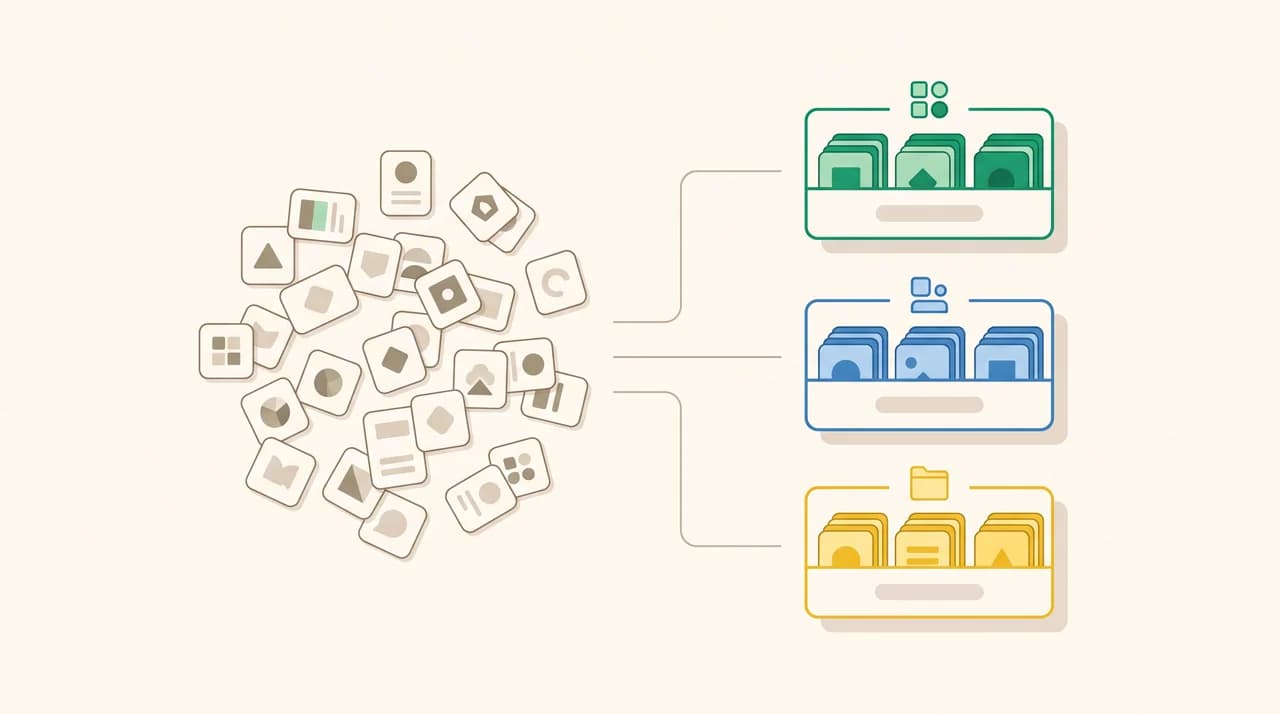
| Service | What uses the space | How to check your usage |
|---|---|---|
| Gmail | Message attachments — large PDFs, images, and video files embedded in threads. Plain-text messages are negligibly small. | Search `has:attachment larger:10m` in Gmail to find the biggest files, or visit storage.google.com for the total. |
| Google Drive | Every file you own: documents, spreadsheets, recordings, presentations, Android phone backups, form responses. Files shared with you by others do not count against your quota. | Open drive.google.com, click Storage in the left panel, then click the storage bar to sort files by size. |
| Google Photos | Every photo and video backed up at original quality. Storage Saver mode compresses them to a smaller footprint, though photos backed up after June 2021 count regardless of quality setting. | Open photos.google.com, tap your profile photo, then Manage storage to see your usage and run a cleanup scan. |
How to free up Gmail storage without deleting emails#
Work through these steps in order. Each targets a specific bucket of wasted space. The first three do not touch any email at all; steps four and five are where Gmail-specific storage gets addressed.
- 1
Empty Trash and Spam — zero content risk, immediate payoff
Gmail holds deleted messages in Trash for 30 days and accumulates spam in the Spam folder until you clear it. Both folders count against your 15 GB quota the entire time they sit there. Open the Trash folder and click 'Empty Trash now.' Repeat for Spam with 'Delete all spam messages.' A six-month backlog of deleted messages can easily account for several gigabytes. This is the safest first step — these messages are already marked for disposal.
- 2
Switch Google Photos to Storage Saver mode
In Google Photos on the web, click your profile photo, go to Photos settings, then Backup, and change Backup quality from Original quality to Storage Saver. Google will offer to compress your existing library to match. Storage Saver compresses photos to up to 16 megapixels and video to 1080p — visually indistinguishable at normal screen sizes. Note that photos backed up in Storage Saver mode after June 1, 2021 still count toward your 15 GB quota, but at a substantially smaller footprint than original-quality uploads. For a Photos-heavy account, this single change can recover the majority of used storage.
- 3
Clear large Drive files you no longer need
Open drive.google.com and click Storage in the left sidebar. The page lists your files sorted by size. Delete old project archives, downloaded video recordings, exported spreadsheets, and any Android device backups you no longer use — backups appear under Storage then Backups. After deleting, empty Drive's own Trash to confirm the space is reclaimed; Drive holds deleted files for 30 days just as Gmail does.
- 4
Search Gmail for attachment-heavy messages
In the Gmail search bar, type `has:attachment larger:10m` to list every message carrying an attachment over 10 MB. Lower the threshold to `larger:5m` for a broader sweep, or raise it to `larger:25m` to find only the largest offenders first. Work through results from biggest to smallest. For each message, save the attachment to Google Drive using the Drive icon on the attachment thumbnail — this preserves the file at a stable Drive link — and then decide whether to keep or delete the source email.
- 5
Remove attachments from emails you want to keep
For threads where the conversation matters but the attachment does not need to live in Gmail, open the message in Gmail web, hover over the attachment thumbnail, and click the three-dot menu. If a Remove option appears, it strips the attachment from the email while preserving the message, subject, and body intact — the cleanest outcome. This option is more consistently available on Google Workspace accounts than on personal Gmail. If Remove is not shown, download the attachment to Drive first, then forward the email to yourself without the attachment (remove it before sending), archive the forwarded copy, and delete the original. The thread content survives; the attachment-sized storage is freed.
What you can do from each platform#
The five steps above work fully from a desktop browser. The Gmail mobile app and Google One app have a narrower range of available actions.
| Platform | Empty Trash/Spam | Search by attachment size | Remove attachment from email | Compress Photos |
|---|---|---|---|---|
| Gmail web (desktop browser) | Yes — 'Empty Trash now' and 'Delete all spam messages' links appear at the top of each folder | Yes — `has:attachment larger:Xm` works in full, with results visible on the web | Sometimes — hover the attachment, open three-dot menu; more reliable on Google Workspace than personal Gmail | Yes — via Google Photos Settings on the web |
| Gmail mobile app (iOS / Android) | Yes — open Trash or Spam, tap the three-dot menu in the folder header, then Empty Trash or Delete all spam | Partial — the search query runs but results cannot be sorted by size in the app | No — the Remove attachment option is not available in the mobile Gmail app; use the web version for this step | Yes — via the Google Photos app Settings |
| Google One app | No — shows quota totals only; links you to Gmail or Drive to take action | No — use Gmail web | No — use Gmail web | Yes — the Manage storage scan identifies compressible photos and videos and walks you through freeing them |
| storage.google.com | No | No | No | Partial — shows your per-service breakdown and links to each service's own cleanup tool |
What to do when these steps are not enough#
If you have emptied Trash and Spam, compressed Photos, cleared Drive, and removed the attachment-heavy email you can find, and the storage bar is still critically full, two paths remain.
The first is Google One. Google's paid storage plans extend the shared pool to 100 GB, 200 GB, 2 TB, and above, billed monthly or annually. If you receive large attachments routinely and need to keep all of them, buying more storage is usually more practical than managing the quota as a permanent chore. The second path is Google Takeout (takeout.google.com). You can export all of your Gmail as a .mbox archive file, store it locally or on an external drive, and then delete the exported threads from Gmail. The archive is preserved offline; the online space is recovered. It requires managing your own backups, but it is the right answer for users who need every email and cannot or will not pay for more storage.
Archiving does not free storage
A faster way to keep storage under control#
The steps above work well as a one-time cleanup. The harder problem is that large attachments arrive every month, and most people only notice when the storage bar turns red again. The real solution is a layer upstream that handles attachment-heavy email as it lands, rather than letting it accumulate into a quarterly crisis.
We build AI Emaily — an AI-native email client that connects to Gmail, Outlook, and IMAP. Its smart search surfaces attachment-heavy threads in seconds, so you can find and process a month of storage-consuming messages in a single search instead of running a manual audit. You can also set rules to automatically label or archive bulk newsletters and large-attachment senders before they pile up in your inbox. That keeps both the inbox and the storage bill predictable. There is a 7-day free trial — see AI Emaily pricing for current plan details.
Frequently asked
See it in AI Emaily
Keep reading

Written by
Nafiul HasanNafiul Hasan is an entrepreneur and AI automation system builder with 10+ years of experience turning messy, manual workflows into reliable automated systems. He designs and ships AI enterprise solutions end-to-end — the agent logic, the data plumbing, and the product people actually use — and founded AI Emaily to give busy professionals their attention back. He writes here from the builder's seat: what works, what breaks, and how to put AI to work without giving up control.