How to Migrate Gmail to Proton Mail (Step by Step)

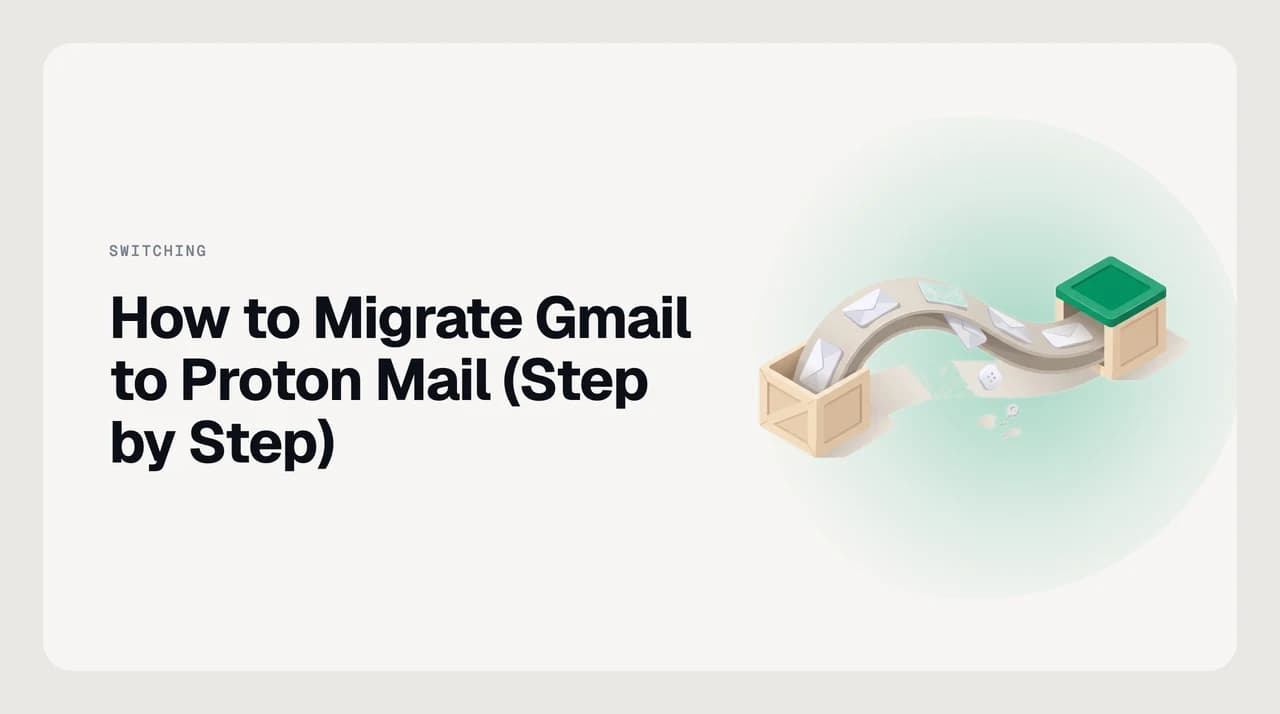
The short answer
Proton's Easy Switch imports your Gmail messages (up to 80% of your Proton storage), contacts (up to 10,000), and calendars via OAuth. Gmail filters, aliases, and nested labels deeper than three levels do not carry over. Desktop clients require Proton Mail Bridge, which is paid-only. Keep your Gmail account alive and forwarding to Proton for at least 90 days before considering closure.
How to migrate Gmail to Proton Mail with Easy Switch, plus what does not carry over: Gmail filters, aliases, and IMAP access for desktop clients.
On this page
How to migrate Gmail to Proton Mail has two parts: the import, which Proton's Easy Switch handles in the background, and the cutover, which is the part most guides stop before covering. Getting the import right takes an afternoon. Getting the cutover order wrong means losing mail or announcing a new address before it reliably receives anything.
This guide follows Proton's own current documentation. The steps are verified against Proton's support pages as of July 2026. Where something doesn't carry over, it says so explicitly.
What actually moves when you run Easy Switch#
Easy Switch imports data from your Google Account over OAuth. It is a one-time copy, not an ongoing sync — changes you make in Gmail after the import do not appear in Proton, and vice versa. Before you start, know what the tool does and does not touch.
| Item | Does it move? | Notes |
|---|---|---|
| Email messages | Yes — up to 80% of your available Proton storage | Most-recent-first; spam and trash are excluded; folder names over 100 characters are skipped |
| Contacts | Yes — up to 10,000 | Imported as-is into Proton Contacts |
| Calendars | Yes — one-time import | Creates a new Proton Calendar or merges with existing; 20-calendar limit per account |
| Gmail filters and rules | No | Proton uses a separate filter system; rebuild each rule manually after migration |
| Flat Gmail labels | Yes, as Proton labels | Labels become Proton labels, not folders; name conflicts with existing Proton folders cause a warning |
| Nested Gmail labels | Partially | Labels up to 3 levels deep convert to "Parent – Nested" format; deeper nesting is reorganised |
| Gmail aliases (Send mail as) | No | Aliases live in Google Account settings and do not import; each needs a manual decision |
| Your Gmail address itself | No | The address belongs to Google and stays there; you announce the Proton address separately |
| Read/unread state sync | Import only | Email states are captured at import time; ongoing read/unread changes do not sync back to Gmail |
| IMAP access for desktop clients | No — requires Bridge | Proton's encryption blocks standard IMAP; Proton Mail Bridge (paid plan only) is the only path |
Before you start: the pre-migration checklist#
Do each of these before launching Easy Switch. A few cannot be undone after the Gmail account is closed.
- Check your Proton storage. Easy Switch imports up to 80% of what's available. If your Gmail archive is large, either upgrade your Proton plan, run a selective import by time range, or trim Gmail first.
- Export your Gmail filters. Gmail Settings → See all settings → Filters and Blocked Addresses. Each filter has its own row; copy the conditions and actions to a document — you will rebuild them in Proton Mail.
- List your Gmail aliases. Settings → See all settings → Accounts → Send mail as. Each alias on that list needs a decision: add it as a custom address in Proton, or start updating the services that use it.
- Run Google Takeout before anything else. Go to myaccount.google.com → Data and privacy → Download your data. Select Gmail (MBOX format), Contacts (vCard), and Calendar (ICS). This local copy is your safety net.
- Count your Google Calendars. Proton has a 20-calendar limit. If you have more than 20, decide which to merge or remove before the import. Easy Switch will stop when it hits the cap.
- Write your address-change list. Every service where your Gmail is the login email or the notification address is something you will need to update. Banking accounts, subscription services, domain registrars, social profiles — anything where a confirmation going to the wrong place causes real pain. This list drives the cutover phase.
Running Easy Switch: the import#
The import itself is straightforward. The steps below follow Proton's current documentation.
- 1
Sign in to mail.proton.me and open Settings
Navigate to All settings. Find the Import via Easy Switch option.
- 2
Select Gmail as your source
Click Connect to Gmail. Proton redirects you to a Google OAuth screen.
- 3
Grant all requested permissions
Google asks for read and compose access. Grant both. Partial grants cause authentication failures that look like a settings problem but are actually a permission one — Proton's own troubleshooting documentation calls this out explicitly.
- 4
Choose what to import
Select emails, contacts, calendars, or any combination. For email, pick a time range: all messages, or the last 12, 3, or 1 month. You can also exclude specific folders from the import.
- 5
Review the folder-to-label mapping
Easy Switch maps Gmail folders to Proton labels. Inbox, Sent, Drafts, and Archive map to their Proton equivalents; all other Gmail folders map to All Mail labels. Edit the mapping if your Gmail folder structure doesn't match what you want in Proton.
- 6
Start the import and let it run
The import runs in the background. You can use Proton Mail normally while it works. Progress appears under Settings → Import via Easy Switch. A large archive with years of mail can take several hours.
- 7
Set up Gmail forwarding separately
The import copies your existing messages; it does not automatically forward new Gmail mail to Proton going forward. That is a separate step in Gmail Settings → Forwarding and POP/IMAP → Add a forwarding address. Proton sends a verification code to your Proton inbox; confirm it there to activate forwarding.
Free plan: one Gmail connection; paid plans: up to three
Once the import completes, your historical Gmail messages are in Proton. What remains is the harder part of the migration: making sure mail you have not yet received ends up in Proton, and that the people and services who email you know where to send it.
What breaks when you switch — and what you can recover#
Several things either do not survive Easy Switch or work differently enough that they require action before you close the Gmail account.
| What breaks | What actually happens | What to do |
|---|---|---|
| Gmail filters | Not imported; Proton Mail does not receive them and has no way to read them | Rebuild each rule in Proton Mail → Settings → Filters; the condition logic is similar, the interface differs |
| Nested labels deeper than 3 levels | Easy Switch reorganises them; deeper nesting does not survive the hierarchy | Check All Mail in Proton after import and rename or restructure what was flattened |
| Calendar sync | Events are a one-time copy; no ongoing sync after import | Manage calendar events in Proton Calendar from this point forward; export from Google first for backup |
| Gmail aliases | Not imported; services that send to an alias continue sending to it at Gmail | Add each alias as a custom address in Proton Settings, or update every service that uses the alias to your Proton address |
| Desktop email client (Outlook, Thunderbird, Apple Mail) | Standard IMAP cannot connect to Proton; existing desktop client configurations stop working | Install Proton Mail Bridge (paid plan required); configure your client to connect to the local IMAP Bridge provides |
| Gmail forwarding rules already set in Gmail | If you delete Gmail, any forwarding rules you had set up there stop | Recreate equivalent filters in Proton before closing Gmail; note the source is now your Proton inbox |
| Mail sent to Gmail after account deletion | Bounces; the sender gets a non-delivery report | Do not delete Gmail until everyone who has the address has updated — and probably not even then |
The cutover order most migration guides skip#
The import is the easy part. The cutover — the sequence in which you redirect mail flow and notify people — is where mistakes cause real problems. The order matters. Doing step 5 before step 2 means announcing an address that isn't reliably receiving yet.
- 1
Verify your Proton address works before anything else
Send yourself a test message from a non-Gmail account — a personal account, a colleague's address, anything that isn't going through Google. If you cannot receive at your Proton address, forwarding and announcements are useless. Fix receive first.
- 2
Turn Gmail forwarding on before you tell anyone
In Gmail: Settings → See all settings → Forwarding and POP/IMAP → Add a forwarding address. Enter your Proton address. Gmail sends a confirmation code to that address; open Proton and click the confirmation link. Once active, new mail sent to your Gmail address arrives in Proton. Set this up before step 3 so the address is already receiving by the time anyone tries to reach you there.
- 3
Monitor both inboxes in parallel for at least a week
Forwarding works for most mail, but some transactional senders — login codes, bank alerts, shipping notifications — send directly to the address and ignore forwarding headers. A week of parallel monitoring shows you what is still going to Gmail. This window also catches any services that have your Gmail address as a recovery or secondary contact and need updating.
- 4
Work through the address-change list, starting with high-stakes accounts
Open the list you made during the checklist phase and update each service. Bank and financial accounts first — these send the kinds of one-time codes and alerts where a missed message causes a real problem. Then subscription services (they often send to the billing address rather than the login email, so check both). Then less-critical accounts. Give each category a day before moving to the next, and confirm in your Proton inbox that the confirmations arrived.
- 5
Announce to contacts only after the address is confirmed working
A single short email sent from both your Gmail and Proton addresses is the clearest approach — it lands whether the recipient has the old address or has already updated to the new one. Include a note that the Gmail address still forwards to Proton, so replies sent to the old address will still reach you during the transition.
- 6
Keep your Gmail account alive for at least 90 days
People who have your Gmail address will keep sending to it for months. Forwarding covers most of this, but some senders strip forwarding metadata and the original message must be in Gmail to be recovered. One-time login codes from services you forgot you signed up for will also arrive there. Keep the Gmail account open, keep forwarding active, and check it monthly. For most people, the right long-term outcome is dormancy — the account stays open, forwarding stays on, and you simply stop thinking about it — not deletion.
- 7
Do not delete the Gmail account at all unless you are sure
Deleting Gmail means any mail sent to that address bounces with a non-delivery report. The sender is told the address no longer exists. This is irreversible, and there is almost no case where it is the right move in the first 12 months. The exceptions: you have a custom domain ([email protected] via Google Workspace) and you are redirecting DNS MX records, or you are certain every sender has been updated and you have confirmed it empirically over several months. Otherwise, leave it open.
Custom domain users: the forwarding step is different
Desktop clients after migration: Proton Mail Bridge#
If you use Outlook, Apple Mail, Thunderbird, or any other desktop client, there is a fundamental constraint to understand: Proton's end-to-end encryption means your messages are stored encrypted in a way that standard IMAP and SMTP cannot reach. A desktop email client cannot connect to Proton the way it connects to Gmail or Fastmail.
The solution is Proton Mail Bridge, a local application that runs on your computer. Bridge decrypts incoming messages, presents a local IMAP and SMTP interface to your desktop client, and encrypts outgoing messages before they leave your machine. To your client, it looks like a normal mail server; to Proton, the encryption is preserved.
Bridge is available on macOS, Windows, and Linux. It is not available on mobile.
Bridge requires a paid Proton Mail plan. Free Proton accounts cannot use Bridge and have no IMAP access path. If you are on a free plan, the Proton web app (mail.proton.me) and Proton's own desktop app for macOS and Windows are your options.
Let Bridge sync before pointing your client at it
The rollback#
If Proton does not work out, your Gmail account is unchanged as long as you have not deleted it. Disable forwarding, reconnect your desktop client, and resume. The messages Easy Switch copied to Proton stay there, but your Gmail archive is untouched and your Gmail address never went away.
The only thing you cannot undo is the announcements you made to people. That resolves itself as senders update their records — and if you left Gmail forwarding on, mail sent to the old address reaches you in Gmail again the moment you disable the Proton forward.
Frequently asked
See it in AI Emaily
Keep reading
Sources

Written by
Nafiul HasanNafiul Hasan is an entrepreneur and AI automation system builder with 10+ years of experience turning messy, manual workflows into reliable automated systems. He designs and ships AI enterprise solutions end-to-end — the agent logic, the data plumbing, and the product people actually use — and founded AI Emaily to give busy professionals their attention back. He writes here from the builder's seat: what works, what breaks, and how to put AI to work without giving up control.