What Are Mail Routing Rules? Server-Side Mail Flow Explained

The short answer
Mail routing rules are server-side instructions that run on the mail server before a message reaches any mailbox. They can reroute, copy, reject, or transform a message at the envelope level — which is the key difference from inbox rules, which fire inside a client after delivery. A routing rule can intercept mail an inbox rule will never see.
Mail routing rules intercept messages at the server before delivery. Learn how they differ from inbox rules and why the order of operations matters.
On this page
Mail routing rules are server-level instructions that intercept a message on its way to a mailbox and decide what happens to it before any client sees it. The server can reroute the message to a different address, copy it to a compliance archive, stamp it with a legal disclaimer, or reject it outright — all before delivery. That is the short definition of what are mail routing rules, and the key word is before: every inbox rule, filter, and client-side automation you have set up in Gmail or Outlook runs after delivery, not before it.
That order of operations is the whole story. This guide explains what routing rules are, how they work in Microsoft 365 (where they are called mail flow rules or transport rules) and Google Workspace (where they appear under Gmail routing settings in the admin console), and where they differ from the inbox rules that live inside individual mailboxes. If you have ever set an inbox rule that did not fire when you expected it to, a server-side routing rule may have intercepted the message before the client ever had a chance to act on it.
What is a mail routing rule?#
A mail routing rule is a condition-action pair that runs on the mail server or email gateway — not inside any individual mailbox. When a message arrives at the mail server, the server evaluates its routing rules against the message envelope: the sender address, the recipient address, and sometimes the message headers or body content. If the conditions match, the server takes the configured action before placing the message into any mailbox.
The actions available at the server level go well beyond what a client-side filter can do. A routing rule can redirect a message to an entirely different recipient or domain, deliver it to two addresses simultaneously, quarantine it pending review, apply a legal disclaimer to the message body, strip an attachment before delivery, reject the message with a specific SMTP error code, or route it through a third-party compliance or scanning gateway. None of these actions are available in a typical inbox filter, because they require acting on the message envelope before it settles into a mailbox.
The terminology differs by platform. Microsoft 365 and Exchange use two names interchangeably for the same feature: mail flow rules and transport rules. In the Exchange admin center, they appear under Mail flow > Rules. Google Workspace calls them routing rules, accessible under Apps > Google Workspace > Gmail > Routing in the Google Admin Console. Proofpoint, Mimecast, and other gateway products each have their own naming, but the underlying concept is the same across all of them: a server-side instruction that evaluates and acts on the message at the delivery layer, before any user sees it.
Mail flow rules and transport rules are the same thing
How does email routing work in a company?#
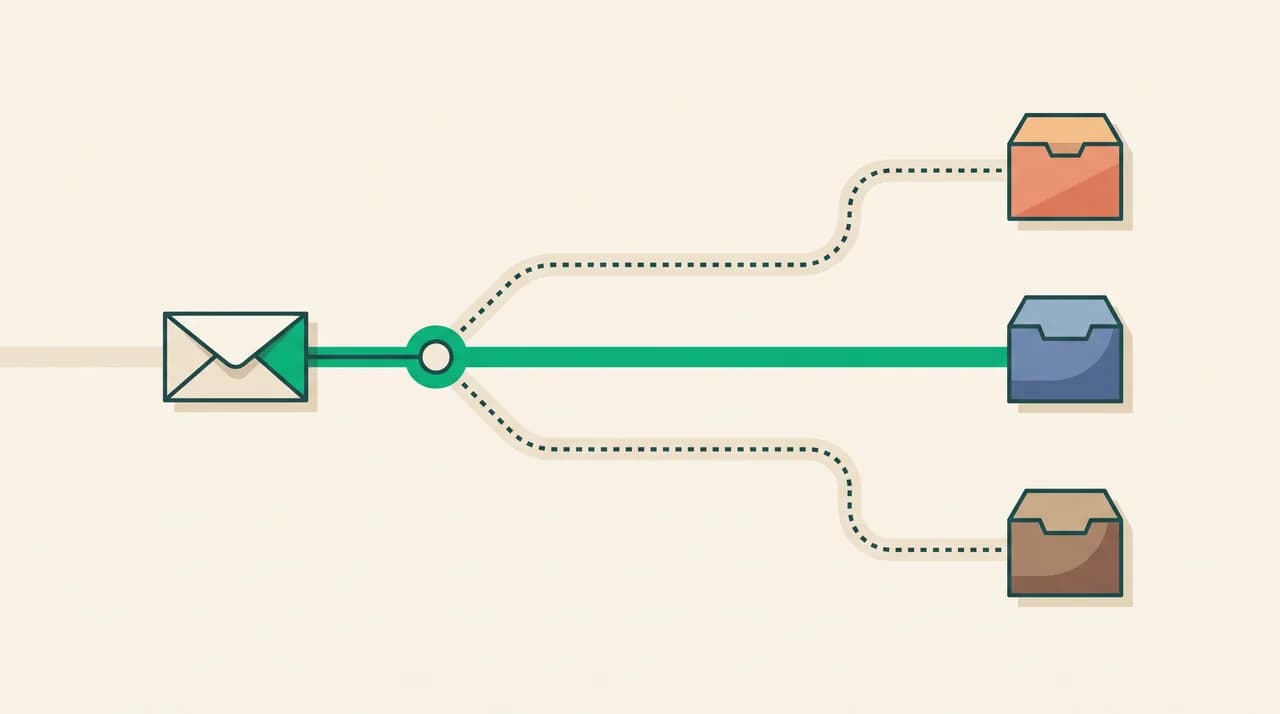
Trace a message from sender to inbox to see where routing rules live in the sequence. A message sent to a company email address arrives at the organization's mail server — Exchange Online for Microsoft 365, or Google's servers for Google Workspace. Before the message is placed in any mailbox, the server runs it through a set of routing rules in a defined priority order. Each rule has conditions and actions. When the conditions match, the server takes the action. After the action runs, the server either stops processing further rules for that message or continues to the next rule in the priority order, depending on whether a stop-processing flag is set.
The conditions a routing rule can evaluate include the sender address, the recipient address, whether the sender is inside or outside the organization, the presence of specific words in the subject or body, the message size, the message type (such as calendar invites or read receipts), and whether the message was sent by a specific user or group. The actions include redirecting the message, adding a recipient in blind copy, applying a message classification, adding a disclaimer, removing a header, or routing the message to a specific connector that sends it to an external service.
The critical detail is where in the delivery process all of this happens: at the SMTP layer, on the envelope, before the message is placed in any mailbox. When a routing rule redirects a message to a different address, the original recipient's mailbox never receives it. When a rule copies a message to a compliance archive, the copy is made before the user sees the original. Client-side rules — Gmail filters, Outlook rules, Apple Mail rules, and any other inbox automation — only have access to messages after they have already been delivered to a specific mailbox. They have no visibility into messages that were rerouted, quarantined, or rejected at the server level.
Why routing rules exist — and what breaks without them#
Routing rules exist because several standard corporate email requirements are structurally impossible to enforce at the client level. Compliance archiving is the clearest example: a legal requirement to retain copies of all business email cannot be satisfied by asking each user to manually archive their own messages. A server-side routing rule copies every inbound and outbound message to a compliance archive automatically, with no user action required and no possibility of a user bypassing it. The same logic applies to email security scanning: a gateway that inspects messages for malware or phishing links only works if it sees the message before it reaches the endpoint. The routing rule is what sends every incoming message through the scanner first.
Two other scenarios make the importance of order concrete. The first is split delivery in hybrid environments. Organizations that have migrated some users to Microsoft 365 while keeping others on on-premises Exchange use routing rules to direct each inbound message to the correct server based on the recipient. Without the routing rule, the on-premises server does not know that certain mailboxes have moved to the cloud, and those messages fail to deliver. The second is domain-wide disclaimer injection. Many organizations are legally required to append a confidentiality notice to every outbound message. A routing rule applies the disclaimer at the server before the message leaves the organization — which means it applies regardless of which email client the sender uses, which device they send from, and whether they remembered to add it themselves.
Without routing rules, all of these requirements fall back on individual users or client-side configurations — both of which are unreliable and ungovernable at scale. Routing rules move enforcement from the client to the infrastructure, where it applies consistently across every mailbox in the domain.
Routing rules vs inbox rules: how they differ#
The line between server-side routing rules and client-side inbox rules is where most confusion about mail routing originates. The table below lays out the differences across the dimensions that matter for understanding which layer does what.
| Dimension | Server-side routing rule | Client-side inbox rule |
|---|---|---|
| When it runs | Before delivery — on the mail server, during the SMTP transaction | After delivery — inside the client or mailbox, once the message has arrived |
| Who configures it | Mail admin, applied domain-wide or to selected users or groups | Individual user, applies to that mailbox only |
| Typical name by platform | Transport rule or mail flow rule (Microsoft 365); routing rule (Google Workspace) | Gmail filter; Outlook rule; Apple Mail rule |
| Scope of effect | Domain-wide — applies across all matching messages, all mailboxes | Single mailbox — applies only to messages delivered to that inbox |
| Actions available | Redirect, copy, reject, quarantine, add recipient, apply disclaimer, route to gateway | Move to folder, label, forward, delete, mark as read, auto-reply |
| Can prevent delivery to a mailbox | Yes — a redirected or rejected message never reaches the original recipient | No — the message is already delivered; a rule can move or delete it, not intercept it |
| Visibility to the user | Not visible in the mailbox; admin-configured and logged server-side | Visible to the user who set it; runs silently inside their inbox |
Common misconceptions about mail routing rules#
Several misunderstandings about routing rules come up repeatedly in admin forums and support tickets. Understanding them makes it easier to diagnose the real problem when something unexpected happens to a message.
The first misconception: an inbox rule will catch a message if the routing rule misses it. This is backwards. If a server-side routing rule redirects or rejects a message, the intended recipient's mailbox never receives it. An inbox rule in that mailbox has nothing to act on, because the message was never delivered there. The two mechanisms run at different points in the delivery pipeline and cannot serve as fallbacks for each other. If a routing rule redirected your message, the inbox rule was never consulted.
The second misconception: routing rules only matter for large organizations. Not true. Any domain using hosted email — including a two-person company on Google Workspace — may run routing rules for spam quarantine, auto-forwarding to a support queue, or disclaimer injection. Routing rules ship with every hosted email plan, not only enterprise tiers. The admin console for a small Google Workspace account exposes the same routing settings as a deployment with ten thousand seats.
The third misconception: Gmail filters and Google Workspace routing settings are the same thing. They are not. Gmail filters are per-user, client-side rules configured in the Gmail settings panel. They run inside a specific mailbox after delivery and apply only to the mailbox that owns them. Google Workspace routing settings are admin-configured, server-side rules set in the Google Admin Console. They run at the domain level before messages reach any mailbox. A Gmail filter cannot copy a message to a second address or reroute it to a different domain. A Workspace routing rule can do both.
Where does AI Emaily fit — inbox-level automation, not transport routing#
AI Emaily is a mail client, not a mail server, so it operates after delivery: the same layer where Gmail filters and Outlook rules live. What it replaces is the brittle pattern-matching of traditional inbox rules with context-aware triage — a Rules Brain that files, prioritizes, and routes mail inside your mailbox based on what a message actually means, not just whether a field matches a string. It cannot intercept a message before it arrives (that is the transport layer's job and requires admin access to the mail server), but it is considerably more flexible than a static inbox rule once the message lands: it can reason about the nature of a thread rather than checking whether the sender address matches a list you wrote six months ago. We build AI Emaily.
Frequently asked
See it in AI Emaily
Keep reading
Sources

Written by
Nafiul HasanNafiul Hasan is an entrepreneur and AI automation system builder with 10+ years of experience turning messy, manual workflows into reliable automated systems. He designs and ships AI enterprise solutions end-to-end — the agent logic, the data plumbing, and the product people actually use — and founded AI Emaily to give busy professionals their attention back. He writes here from the builder's seat: what works, what breaks, and how to put AI to work without giving up control.