What Does Archive Mean in Email? Gmail vs Outlook vs IMAP


The short answer
Archiving an email removes it from your inbox without deleting it, but the mechanism is not the same in every system. Gmail removes the Inbox label while the message stays in All Mail. Outlook and most IMAP clients physically move the message to an Archive folder. In every case the mail is preserved and still counts against your storage quota.
What does archive mean in email? Gmail removes the Inbox label; Outlook moves the message to an Archive folder; IMAP depends on special-use mapping.
On this page
- 01The verdict, up front
- 02At a glance: what archive does in each system
- 03Where the label model wins
- 04Where the folder model wins
- 05Storage, deletion, and quota — the money question
- 06Who each archive model is genuinely for
- 07IMAP All Mail and the third option, honestly
- 08How archive behaves across the mainstream clients
- 09Where AI Emaily fits — the third position
Archive is one of the most inconsistent words in email. Two different mail systems can both tell you the message was archived and mean two structurally different things — one shuffled a label off it, the other picked it up and moved it into another folder. Both are correct. Neither behaves like the other when you go looking for the message a week later.
This page explains what archive actually does in the three systems most inboxes run on: Gmail's label model, Outlook and Exchange's folder model, and IMAP with the special-use extension in between. It answers the questions the term keeps producing — is archive the same as delete, where does the mail go, does it free up storage, and does it sync — and it ends with where a client like AI Emaily fits, since we are a mail client and this decision is part of what we have to render honestly. We build AI Emaily.
The verdict, up front#
Archive means remove-from-inbox-without-deleting. The message stays in your account, stays searchable, and still counts against your mailbox quota. It is not the same as delete, which sends the message to Trash and eventually purges it, and it is not the same as moving to a custom folder, which is a user-chosen destination rather than a system-defined one.
The mechanism differs by system, and the difference is the whole reason the term confuses people. In Gmail, archive is a label change: the client removes the Inbox label, and the message stays in All Mail with any other labels intact. In Outlook, Exchange, and most folder-based clients, archive is a physical move: the message leaves the Inbox folder and lands in a separate Archive folder. In IMAP, whether the message goes to an Archive folder at all depends on whether the server publishes one via the special-use extension defined in RFC 6154, and on what the client does when it does not.
For a reader in a single mail app this rarely matters. For anyone whose Gmail is open in the browser and also connected to Apple Mail, or whose IMAP archive from one client cannot be found by another, it explains why archive keeps behaving like a different feature depending on where they use it.
At a glance: what archive does in each system#
The three rows below are the mechanisms — not vendor names, not client names. Every mail app you use is implementing one of these three shapes underneath.
| System | What archive does | Where the message ends up | Freed storage |
|---|---|---|---|
| Gmail (label model) | Removes the Inbox label | Stays in All Mail with any remaining labels | None — same account, same quota |
| Outlook / Exchange (folder model) | Moves the message into the Archive folder | Archive folder inside the same mailbox | None — same account, same quota |
| IMAP with special-use Archive | Moves the message into the mailbox flagged with the \Archive attribute | The server-defined Archive mailbox | None — same account, same quota |
| IMAP without special-use | Depends on the client — some create a local Archive folder, some fall back to All Mail semantics, some do nothing | Client-dependent; may not be visible on other devices | None |
| Delete (for contrast) | Moves the message to Trash | Trash for 30 days on Gmail, up to 30 on Outlook, then purged | Freed after the Trash retention window expires |
Where the label model wins#
Gmail is the most common label-model system in use — the Inbox is not a folder, it is a label the mail account applies to newly delivered messages. Archive is just the removal of that one label. The message is still in All Mail, still under any other labels you applied, still returned by search. Nothing about the storage or the underlying object changes.
The advantage is that a message can belong to more than one context at the same time. A thread labelled Client-Acme and Contracts still lives under both after you archive it — you have removed only the Inbox marker. In a folder-based mail system, a message is in one folder at a time, so putting a copy in two contexts means literal duplication.
The other advantage is that archive is genuinely reversible from any device. Because archived mail simply lost its Inbox label, adding the Inbox label back on any client puts it exactly where it was — same thread, same participants, same conversation position. Move a Gmail thread through the web, Apple Mail, an Android client, and a third-party AI client, and the archive state stays consistent because every client is reading and writing the same server-side label.
The trade is that archive here is not a location. Users trained on folders keep expecting an Archive to click into, and All Mail confuses them — it shows archived and inboxed threads together, sorted by date. The concept is doing exactly what the reader asked for; the interface just does not draw a room for it.
All Mail is not the archive folder
Where the folder model wins#
Outlook, Exchange, and most classic IMAP clients use a folder model. Archive is a physical destination — a folder named Archive that lives inside your mailbox, at the same level as Inbox, Sent, and Trash. Archiving moves the message there. Opening the Archive folder shows the archived messages and only the archived messages.
This is what most non-technical users mean when they say archive: a place mail goes when it is out of the way. The archive is a room you can walk into. On mobile Outlook, on Outlook for Windows, on Outlook for Mac, and on the web, the Archive folder appears in the folder tree next to the Inbox — there is nothing to search or filter to see what is in it.
For Exchange and Microsoft 365 accounts, the Archive folder is a real server-side folder, so archiving on one device shows up on every other device that mounts the same account. This is not the same feature as Microsoft's In-Place Archive, sometimes called the Online Archive — that is a separate archive mailbox added to a user's account under enterprise retention policies, and it is a licensed enterprise feature rather than the archive button most people use. The archive button on your inbox writes to the ordinary Archive folder in your primary mailbox.
The trade is that a message can only sit in one folder at a time. If you use Outlook categories to tag messages by project, you can archive one and the category stays on it, but the message itself is no longer alongside the other project threads in the Inbox. Getting a message back into the Inbox means moving it back — a manual step that Gmail's label model handles with one label toggle from any device.
Storage, deletion, and quota — the money question#
The single most common misconception about archive is that it frees up mailbox space. It does not. Archived messages still live inside your account, and every mail provider counts the archive against the storage quota on your plan. On Google's consumer accounts, the 15 GB pool shared across Gmail, Drive, and Photos includes All Mail. On Microsoft's consumer accounts, the OneDrive-plus-Outlook.com quota includes the Archive folder. Archive is a filing action, not a compression or a deletion.
If your goal is to actually recover space, the operation you want is delete — followed by emptying the Trash, since deleted messages sit in Trash for a retention window (30 days on Gmail, up to 30 on Outlook) before purging. Sorting by attachment size and deleting the largest culprits recovers meaningfully more space than archiving thousands of small threads.
Providers publish their own storage costs and enforce them differently, so any specific number a blog post prints will age. Verify current storage limits and paid-plan pricing on the vendor's own live page — Google's storage tiers on Google One, Microsoft's on the Microsoft 365 plans page — rather than in a third-party writeup. The packaging shape is durable; the exact figure is not.
Archive is worth doing anyway. A tidy inbox has real value that is separate from storage cost, and search is faster to reason about when the inbox is small — a search restricted to in:inbox behaves differently from one that scans years of All Mail. Just do not archive to save disk.
Who each archive model is genuinely for#
The choice is not usually yours to make — your archive model is whatever your provider or client implements. But when a switch is on the table, or when you are running both systems and cannot understand why they behave differently, this is the shape of the decision.
| If this is you | Model that fits | Why |
|---|---|---|
| You want a message to belong to multiple contexts at once | Label model (Gmail-style) | Labels overlap; folders do not |
| You want a clickable folder called Archive with the archived mail inside it | Folder model (Outlook-style) | The archive is a physical location, not a filter view |
| You use several clients against the same account and want archive state consistent | Either, as long as the archive is server-side | Label toggles and physical moves both propagate; local-only client archives do not |
| You are on IMAP and want archive to sync across devices | IMAP with server-side special-use Archive | Server-defined Archive folder is visible to every compliant client |
| You care about disk space more than tidy inbox | Neither — you want delete | Archive preserves the message; only delete plus Trash purge frees quota |
| You want retention-policy-driven archiving for compliance | Enterprise archive (M365 In-Place Archive, Google Vault) | The user-facing archive button is not a retention archive; those are separate licensed products |
IMAP All Mail and the third option, honestly#
IMAP is the protocol that lets any compliant mail client — Apple Mail, Thunderbird, K-9 Mail, an AI-native client — read and write your account without the provider's own app. Archive over IMAP is where the term gets genuinely ambiguous, and where two apps mounted on the same account can behave differently for the same button.
The relevant standard is RFC 6154, the IMAP LIST extension for special-use mailboxes. It defines a small set of attributes a server can attach to standard mailboxes so clients know what each one is for — including \Sent, \Drafts, \Trash, \Junk, and \Archive. When a server publishes an \Archive mailbox, a compliant client can send archived messages there and any other compliant client will find them in the same place. This is how archive sync works on IMAP.
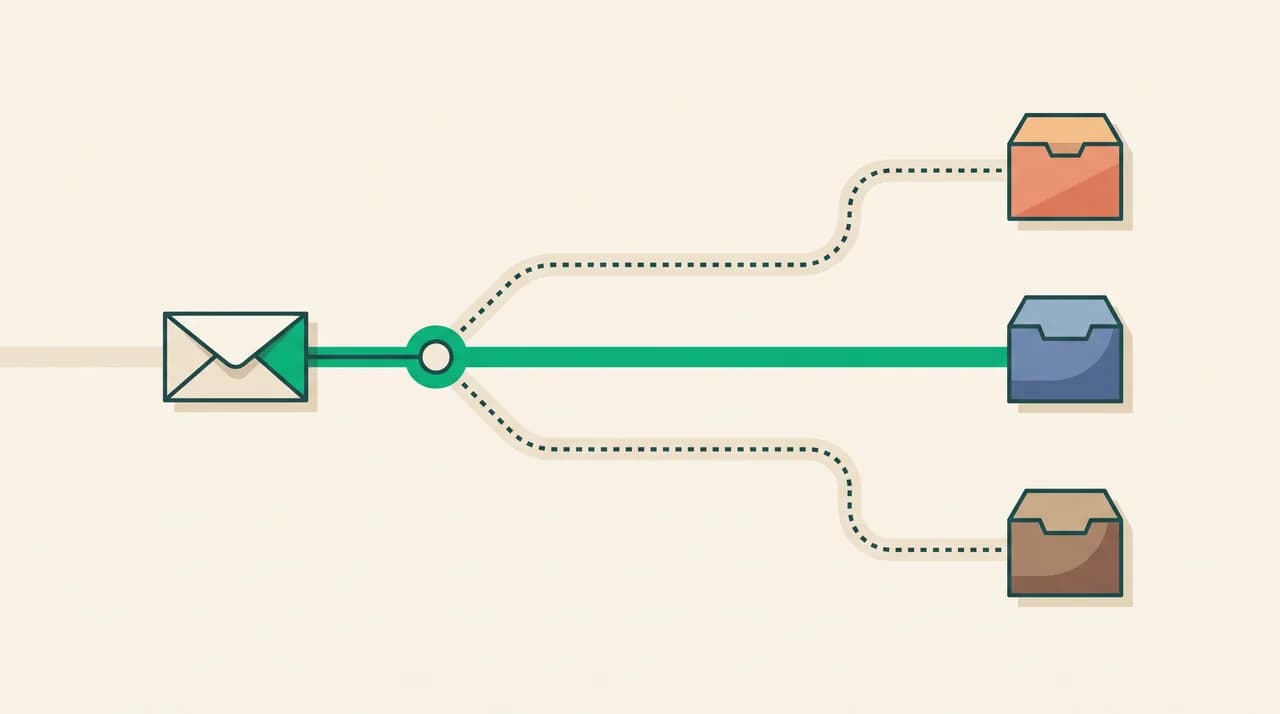
The catch is that the archive special-use is not universally implemented. Gmail's IMAP surface, for example, does not publish an \Archive mailbox in the classic sense — Gmail's archive is a label operation, and clients archive by removing the Inbox label rather than by moving the message. Some IMAP servers publish \Archive but keep it empty by default. Some IMAP clients, when the server does not publish one, create a local Archive folder on the device rather than on the server, which means the archive is not visible from any other client.
Practical implication: if you connect the same IMAP account to two clients and archive from one, and the message does not appear in the archive of the other, the question to ask is not why does archive not sync — it is which client is archiving to a server folder and which is archiving to a local folder. Once you know that, either point both clients at the same server-side special-use mailbox, or use one client's archive.
How archive behaves across the mainstream clients#
Same account can produce different archive behaviour depending on the client. This table names what each mainstream client does when you press archive, so you can predict what will happen on your setup rather than guessing.
| Client | Archive action against Gmail | Archive action against Outlook or IMAP |
|---|---|---|
| Gmail web / Gmail mobile | Removes the Inbox label; message stays in All Mail | Not applicable — Gmail's own apps only address Google accounts |
| Outlook for Windows / Mac / Web | Uses the Google API to remove the Inbox label | Moves the message into the Archive folder in the mailbox |
| Apple Mail (macOS / iOS) | Removes the Inbox label if Archive Mailbox is enabled; otherwise moves to All Mail | Moves the message to the account's Archive mailbox; creates one if the server does not publish it |
| Thunderbird | Moves the message to a client-defined Archives folder, typically with year subfolders | Moves to the account's \Archive special-use mailbox if published, else creates Archives |
| A native AI email client (e.g. AI Emaily) | Removes the Inbox label via the Gmail API — server-side, syncs everywhere | Moves the message to the server-side Archive folder — syncs everywhere |
Before you rely on cross-device archive, run one test
Where AI Emaily fits — the third position#
This post compares two archive architectures — labels and folders — and AI Emaily is not one of them. We are a mail client that reads and writes both, so putting us into a row that pits label against folder would be a category error. The honest placement is what a client-side triage layer does that the architectural choice does not: turn the archive decision into something the inbox helps you make.
Concretely, that means auto-categorisation of incoming mail so archive-worthy threads are recognised as archive-worthy before you touch them, Copilot mode where the agent proposes an archive and you approve it, and a full audit log so a bulk archive is undoable rather than a leap of faith. On the account-mechanics side we write to the underlying provider's archive correctly — label removal on Gmail, physical move on Outlook and folder-based IMAP with the server-side special-use folder when it exists — so archive behaves the way the rest of your mail stack expects. We build AI Emaily, and the trade-off is real: adding a client is a switching cost the provider's own app does not have, and if you are happy in Gmail or Outlook the archive itself is already correct. We are the third position on this page, not the first, because the reader who asked what archive means did not ask what mail client to use. Read more at aiemaily.com or check pricing at aiemaily.com/pricing.
Frequently asked
See it in AI Emaily
Keep reading
Sources

Written by
Nafiul HasanNafiul Hasan is an entrepreneur and AI automation system builder with 10+ years of experience turning messy, manual workflows into reliable automated systems. He designs and ships AI enterprise solutions end-to-end — the agent logic, the data plumbing, and the product people actually use — and founded AI Emaily to give busy professionals their attention back. He writes here from the builder's seat: what works, what breaks, and how to put AI to work without giving up control.