What Happens If You Don't Meet Bulk Sender Requirements

The short answer
Providers escalate in stages. First your mail lands in spam. Then Gmail, Yahoo and Outlook.com return temporary 4xx deferrals that retry but delay delivery. Persistent failure or a high spam rate triggers permanent 5xx rejection — the message is refused outright and never reaches the recipient, not even their spam folder.
What happens if you don't meet bulk sender requirements: Gmail, Yahoo and Outlook.com move from spam-foldering to deferrals to hard 5xx rejection.
On this page
- 01The short answer: three stages, not one
- 02What counts as failing bulk sender requirements
- 03The escalation ladder at a glance
- 04Is a 421 or a 550 error worse for deliverability?
- 05How to recover after Gmail starts rejecting your mail
- 06Platform differences: Gmail, Yahoo and Outlook.com
- 07What to do when recovery stalls
- 08A faster way — and where it won't help
If you send more than about 5,000 messages a day to personal Gmail, Yahoo or Outlook.com accounts, you are a bulk sender, and the mailbox providers hold you to a published set of rules. So what happens if you don't meet bulk sender requirements? Not one thing — a ladder of escalating consequences that starts quietly and ends with your mail being refused at the door.
The most useful distinction to hold onto is between mail that is filtered and mail that is refused. Filtered mail still arrives; it just lands in the spam folder where almost nobody looks. Refused mail never arrives at all — the receiving server hands yours an error code and closes the connection. This guide walks that ladder in the order the providers describe it, and shows what recovery looks like at each rung. Facts are dated because the thresholds move; verify the current numbers on each provider's own page before you act.
The short answer: three stages, not one#
Providers do not flip a single switch from delivered to blocked. They escalate, and each stage is a louder warning that something is wrong with your authentication, your list, or your complaint rate. As of August 2026 the sequence is broadly the same at Gmail, Yahoo and Outlook.com, even though the exact thresholds and error codes differ by provider.
- Stage 1 — spam-foldering. Your mail is accepted but routed to the recipient's spam or junk folder. The delivery technically succeeded; the reader almost never sees it.
- Stage 2 — temporary rejection. The receiving server refuses the message for now with a 4xx code and tells your server to retry later. Delivery is delayed, retried for a day or two, then often gives up.
- Stage 3 — permanent rejection. The server refuses the message outright with a 5xx code and does not want it retried. It bounces back to you. The recipient never sees it, not even in spam.
Filtered is not the same as refused
What counts as failing bulk sender requirements#
Failing means your traffic crosses a provider's bulk threshold — roughly 5,000 messages in 24 hours to that provider's personal accounts — while missing one of the required signals. As of August 2026, Google, Yahoo and Microsoft all demand the same core three, published on their own sender pages.
- SPF and DKIM authentication, aligned with the domain shown in your visible From address.
- A published DMARC policy set to at least p=none, and your mail must pass it.
- One-click unsubscribe — a List-Unsubscribe header using the RFC 8058 one-click POST method — on marketing and subscribed mail.
Bulk-sender status is permanent, and it counts per domain
The escalation ladder at a glance#
Google tells bulk senders to keep their spam-complaint rate below 0.1% and to never reach 0.3%; Yahoo asks bulk senders to stay below 0.3%. Cross a threshold with authentication, unsubscribe or complaint rate out of line, and you start climbing this ladder. Here is the same ladder mapped to what you actually see in a bounce message or your outbound logs.
| Stage | Typical response | SMTP class | What happens to the message |
|---|---|---|---|
| Spam-foldering | Accepted, then filtered to Junk | 2xx accept | Delivered, but unread in spam |
| Temporary deferral | e.g. Gmail 421 4.7.28 or 421 4.7.0 | 4xx — try again later | Queued and retried, then often expires |
| Permanent rejection | e.g. Gmail 550 5.7.26 or 550 5.7.1; Outlook 550 5.7.515 | 5xx — refused | Bounced; never delivered |
Is a 421 or a 550 error worse for deliverability?#
In the moment, a 550 is worse: it is a permanent refusal, so that specific message is gone and bounces back to the sender. A 421 is a temporary deferral — the receiving server is saying not now, try again — and a well-behaved sending server will retry for a day or two before giving up on it.
But do not relax at a 421. A steady stream of 4xx deferrals is the provider's early warning that a 5xx is coming if you don't fix the cause. The rule of thumb is that the first digit tells you the severity: 4xx means temporary and retryable, 5xx means permanent and final for that message. Gmail, for example, uses 421 4.7.28 when a sender's IP is sending faster than its reputation allows, and rejects with 550 5.7.26 when a message cannot be authenticated at all.
So neither code is safe. A 550 is the harder wall today; a persistent 421 is the wall you are about to hit. Both mean the same thing: fix authentication or reputation now, before a temporary problem hardens into a permanent one.
How to recover after Gmail starts rejecting your mail#
Recovery follows the same order whether it is Gmail, Yahoo or Outlook.com. Work top to bottom; do not skip ahead to reputation before authentication passes.
- 1
Read the actual SMTP response
Find the code in your bounce or mail-server logs. A 4xx such as 421 4.7.28 is temporary and will retry; a 5xx such as 550 5.7.26 is permanent and that message is already lost. The code tells you which problem you have and how urgent it is.
- 2
Confirm authentication passes and aligns
Send a test to a Gmail account and open Show original. SPF and DKIM must both say PASS, and at least one must align with your From domain; DMARC must be published and pass. A 550 5.7.26 specifically means Gmail could not authenticate the sender — an alignment or DNS problem, not a content problem.
- 3
Check your complaint rate in Postmaster Tools
Google Postmaster Tools shows your domain's spam rate. Get it under 0.1% and keep it well away from 0.3%. Yahoo's Sender Hub and Microsoft's SNDS give you the equivalent view for those providers.
- 4
Fix the highest-severity cause first
Authentication failures and a missing one-click unsubscribe are pass/fail — fix them the same day. A high complaint rate is a slower repair: remove inactive and non-consenting recipients, honor unsubscribes within a couple of days, and stop mailing people who never open.
- 5
Hold volume steady while reputation rebuilds
Do not spike volume to catch up on a backlog — a sudden surge reads as an attack and deepens the block. Send consistent, clean, wanted mail. Recovery is measured in days of good behavior, not hours.
Platform differences: Gmail, Yahoo and Outlook.com#
The three big providers run separate regimes with the same backbone. The table shows where they diverge as of August 2026 — confirm each on the provider's own page, because the enforcement dates and codes are exactly the facts that change.
| Provider | Bulk threshold | Core requirements | Non-compliance signal | In effect since |
|---|---|---|---|---|
| Gmail | ~5,000/day to personal Gmail | SPF + DKIM + DMARC; one-click unsubscribe; spam rate under 0.1% | Spam-foldering, then 4xx deferrals, then 550 5.7.26 / 550 5.7.1 | Mandatory Feb 2024; enforcement stepped up Nov 2025 |
| Yahoo | ~5,000/day | SPF + DKIM + DMARC (p=none minimum); one-click unsubscribe; spam rate under 0.3% | Gradual enforcement; Yahoo does not publish a specific error code | Feb 2024 |
| Outlook.com | 5,000+/day | SPF + DKIM + DMARC | Junk-foldering first, then rejection with 550 5.7.515 | 5 May 2025 |
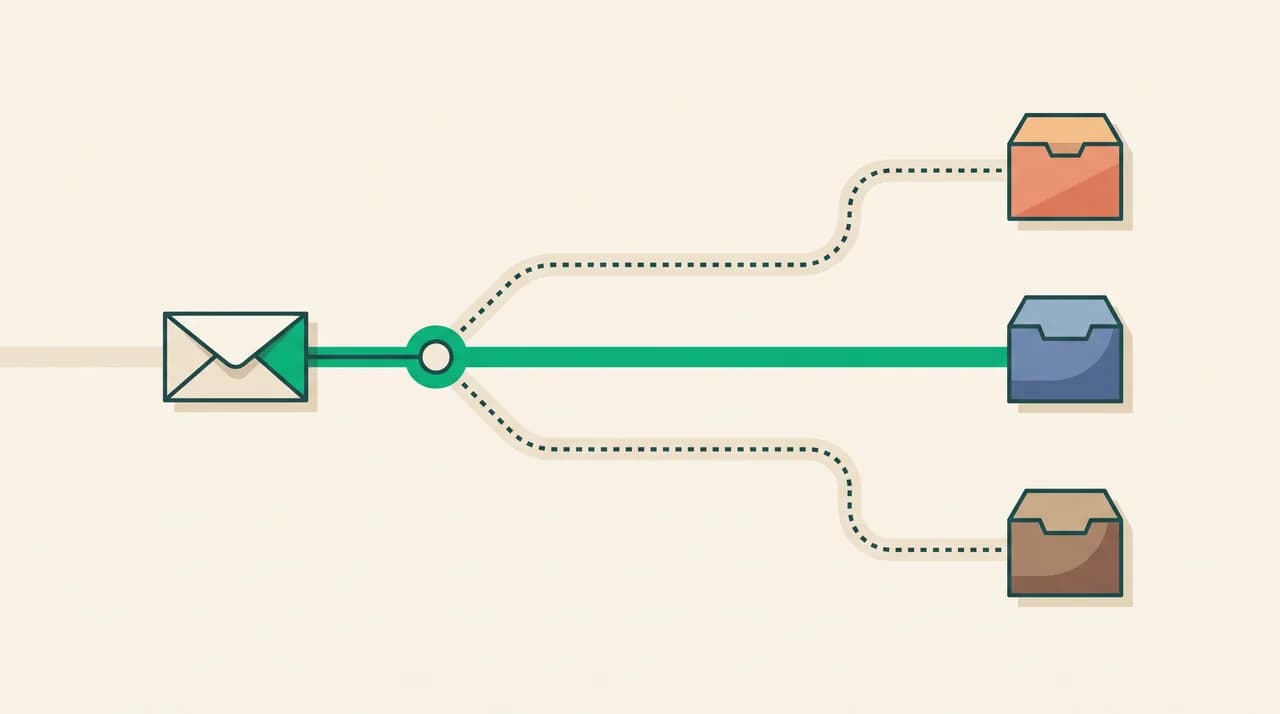
One message, four possible fates: it reaches the inbox, it is filtered to spam, it is deferred with a temporary 4xx and retried, or it is refused with a permanent 5xx and bounced. Failing bulk sender requirements pushes your mail down and to the right along that fork. Apple's Mail follows the same joint standards and asks bulk senders for one-click unsubscribe on marketing mail; it publishes guidance rather than a fixed 5,000-a-day number, so check Apple's postmaster page. Microsoft's regime is the one most Gmail-and-Yahoo checklists forget: it went live on 5 May 2025 and now junk-folders non-compliant bulk mail, with outright rejection being phased in.
What to do when recovery stalls#
Sometimes authentication passes and the block still won't lift. If your complaint rate is high, it will not clear on its own. Google's FAQ is specific: a bulk sender becomes eligible for mitigation support only after its spam rate stays below 0.3% for seven consecutive days. There is no faster path — one clean day does not qualify you.
Since June 2024, Google also says senders sitting at or above a 0.3% spam rate are not eligible for mitigation at all until they get back under it. So the order is fixed: get under 0.3%, hold there for a full week, then request review through Postmaster Tools. Microsoft and Yahoo run their own review queues through their postmaster portals.
If a clean week changes nothing, it's the list, not the config
A faster way — and where it won't help#
Everything above is sending-side work, and it is worth being blunt: AI Emaily will not get your bulk mail delivered. It is a mail client — the app you read and write email in — not an email service provider, a bulk-sending platform, or a deliverability tester. If you send five thousand campaign messages a day, the tools that fix compliance are your ESP and Google Postmaster Tools, and the steps above are the job.
Where AI Emaily fits is the receiving end of the same standards. The SPF, DKIM and DMARC results that decide whether your bulk mail is refused are the signals an inbox reads to sort wanted mail from junk. AI Emaily's spam filter weighs sender authentication, domain reputation and behavior to keep unauthenticated and cold mail out of your inbox, holding every drafted reply for your approval and drafting in a voice set by your Context brain. We build AI Emaily; it is a 7-day free trial, and it is the wrong tool for fixing a bulk-sending problem.
Frequently asked
See it in AI Emaily
Keep reading
Sources

Written by
Nafiul HasanNafiul Hasan is an entrepreneur and AI automation system builder with 10+ years of experience turning messy, manual workflows into reliable automated systems. He designs and ships AI enterprise solutions end-to-end — the agent logic, the data plumbing, and the product people actually use — and founded AI Emaily to give busy professionals their attention back. He writes here from the builder's seat: what works, what breaks, and how to put AI to work without giving up control.