What Is an Email Feedback Loop (FBL) and How Do You Join?


The short answer
An email feedback loop (FBL) is an arrangement where a mailbox provider forwards a recipient's spam complaint back to the sender, usually in the ARF format defined by RFC 5965. Each report identifies the complaint type ("abuse"), the reporting software, and the original message headers, so the sender can suppress that recipient.
What is an email feedback loop? An FBL forwards spam complaints back to senders in ARF format. How FBLs work, what reports contain, and how to join.
On this page
- 01What is an email feedback loop (FBL)?
- 02How does an email feedback loop work?
- 03What does an ARF complaint report contain?
- 04Which providers run a feedback loop — and in what form?
- 05How do you sign up for a feedback loop?
- 06Why do feedback loops matter, and what breaks without one?
- 07Common misconceptions about feedback loops
- 08How feedback loops relate to AI Emaily
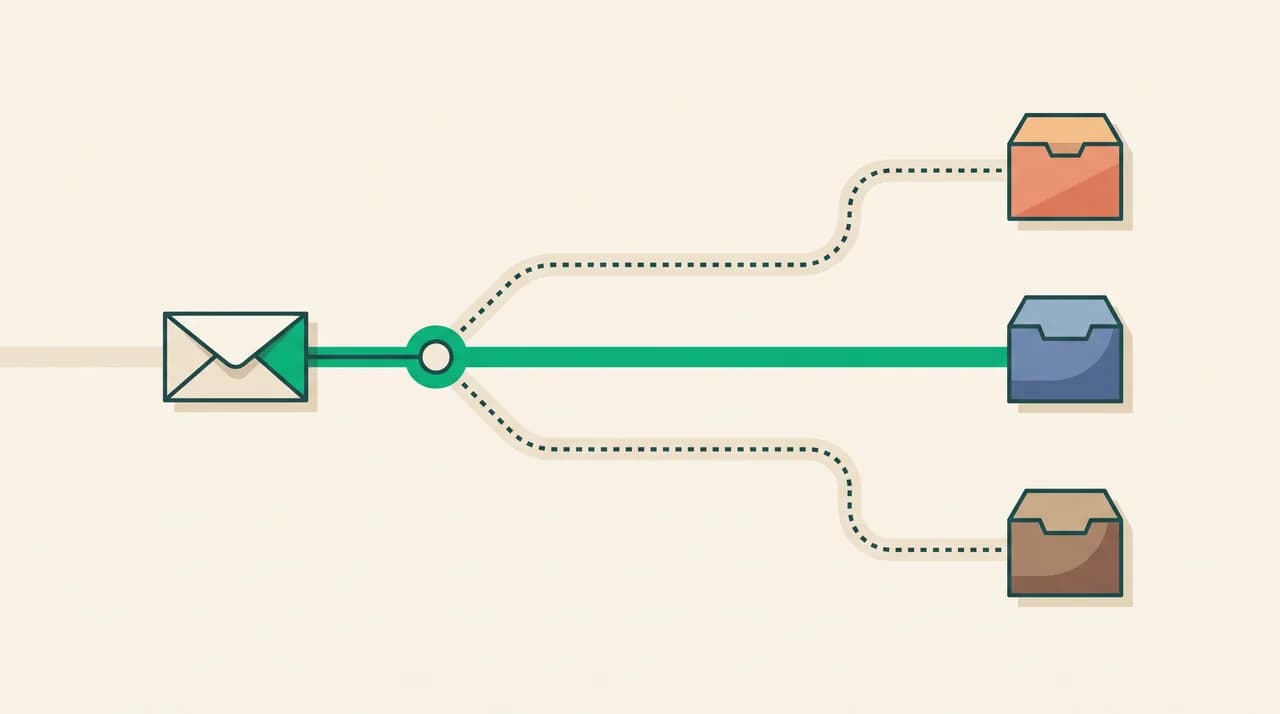
An email feedback loop (FBL) is an arrangement where a mailbox provider — Gmail, Yahoo, Outlook.com — forwards a spam complaint back to the sender, so the sender can stop mailing that person. When a recipient clicks "report spam," an FBL turns that private complaint into a report the sender actually receives, usually in a standard shape called ARF.
This matters most to anyone sending email in volume — a newsletter, a product's transactional mail, an outreach campaign. A complaint is the strongest negative signal a mailbox provider has, and an FBL is how you learn which recipient sent it before your sending reputation pays the price. Miss the complaint and you keep mailing someone who has already told their provider they do not want you.
What is an email feedback loop (FBL)?#
A feedback loop is the channel a mailbox provider uses to tell you when one of its users marks your mail as spam. Instead of keeping that complaint to itself, the provider sends it back to you, the sender, so you can remove that recipient from future mail. The complaint itself is the ordinary "report spam" or "mark as junk" button a recipient clicks in their inbox.
Most feedback loops deliver that complaint in a common structure called ARF — the Abuse Reporting Format, defined in RFC 5965, "An Extensible Format for Email Feedback Reports." ARF gives every provider a shared shape, so one parser can read complaints coming from many sources. An ARF report is a multipart/report message with three parts: a human-readable note, a machine-readable message/feedback-report block, and a copy of the original message or just its headers.
The feedback type for a spam complaint is "abuse." RFC 5965 defines other types, but the abuse loop is what senders care about — everything downstream, suppressing the address and protecting reputation, hinges on receiving and reading those reports reliably.
The core idea in one line
How does an email feedback loop work?#
The loop is a short chain of events, and the whole point is that it closes: a signal leaves the recipient, travels through the provider, and returns to you as something you can act on. Each provider handles the middle differently, but the shape is the same.
One prerequisite has to be in place first: identity. A provider will only route complaints to senders it can verify — keyed to your DKIM signing domain or your sending IP, depending on the provider.
- 1
A recipient reports the message
Someone who received your email clicks "report spam" or "mark as junk" in their inbox at Gmail, Yahoo, Outlook.com, or another provider.
- 2
The provider matches it to you
It ties the reported message to an enrolled sender — by the DKIM domain that signed it or the IP it was sent from — so it knows where to route the complaint.
- 3
It generates an ARF report
The provider builds a machine-readable complaint in Abuse Reporting Format: the feedback type, the reporting software, and a copy of the original message or its headers.
- 4
It sends the report to your enrolled address
The ARF message arrives at the mailbox you registered when you joined the loop — not at your normal support inbox unless you set it there.
- 5
You suppress the recipient
You parse the report, identify the complaining address, and remove it from every list. Continuing to mail a complainer is the fastest way to damage reputation.
What does an ARF complaint report contain?#
The useful part of an ARF report is its middle section, a message/feedback-report block that carries the complaint as structured fields. RFC 5965 requires three fields in every report and allows a set of optional ones; providers vary in how many of the optional fields they include, and some redact parts of the original message to protect the recipient's privacy.
Here are the fields you will most often rely on. The recipient's address you need for suppression usually comes from the returned original message or its headers — the third part of the report — rather than from a single named field, which is why an FBL parser reads the whole report, not one line.
| ARF field | Required by RFC 5965? | What it tells the sender |
|---|---|---|
| Feedback-Type | Yes | The kind of report; "abuse" identifies a spam complaint |
| User-Agent | Yes | The software that generated the report |
| Version | Yes | The ARF version, currently "1" |
| Original-Mail-From | Optional | The envelope sender of the reported message |
| Original-Rcpt-To | Optional (repeatable) | The recipient who complained — the address to suppress |
| Arrival-Date | Optional | When the reported message arrived |
| Reported-Domain | Optional (repeatable) | A domain named in the complaint |
| Source-IP | Optional | The IP the message was received from |
Which providers run a feedback loop — and in what form?#
This is where senders get tripped up, because the big providers do not all run the same kind of loop — and the largest one does not run a traditional FBL at all. As of August 2026, the picture below holds; because programs and postmaster tooling change, verify each against the provider's own postmaster site before you rely on it.
Yahoo and Microsoft run classic per-complaint loops: click "report spam" and an ARF report goes back to the enrolled sender. Gmail does not — it reports aggregate spam-rate data by an identifier inside Postmaster Tools, not individual complaint messages. That distinction is the most common misunderstanding in this topic, so it has its own callout.
| Provider | Program | Keyed to | Report form |
|---|---|---|---|
| Gmail | Feedback Loop via Google Postmaster Tools | Feedback-ID header + a DKIM domain verified in Postmaster Tools | Aggregate spam-rate data by identifier — not per-complaint messages |
| Yahoo Mail and AOL Mail (both run by Yahoo) | Complaint Feedback Loop (CFL) via Yahoo Sender Hub | Your DKIM d= signing domain | Per-complaint ARF reports to your enrolled address |
| Outlook.com / Hotmail / Live (consumer) | Junk Email Reporting Program (JMRP) via SNDS | Your sending IP address | Per-complaint ARF reports to your configured address |
| Microsoft 365 (business tenants) | No consumer-style FBL for external senders | — | Not a per-complaint FBL; senders use SNDS/tenant tooling instead |
| Other ISPs (some cable/telecom mailboxes) | Various ARF loops; several enrolled through a third-party aggregator | IP or domain, varies | Usually per-complaint ARF — confirm each program is still live |
Gmail's "feedback loop" is not a traditional FBL
How do you sign up for a feedback loop?#
There is no single sign-up — you enroll with each provider separately, through that provider's postmaster program. All three below are free to join. The prerequisites differ: Gmail and Yahoo key on your DKIM signing domain, while Microsoft keys on your sending IP, so make sure the relevant one is in order before you start.
- 1
Gmail — add a Feedback-ID and verify in Postmaster Tools
Add a Feedback-ID header to outbound mail with a consistent 5–15 character SenderId (the required last field; the optional a:b:c fields let you tag campaigns). DKIM-sign with a domain you control and verify that domain in Google Postmaster Tools. You then read aggregate complaint data there — no per-message reports arrive.
- 2
Yahoo — enroll your DKIM domain in Sender Hub
In Yahoo Sender Hub, create a sender profile, add and verify your sending domain, and DKIM-sign your mail with that d= domain. Once the domain is enrolled in the Complaint Feedback Loop, Yahoo sends ARF reports for any message signed with it to your enrolled address.
- 3
Microsoft — register your IPs in SNDS, then request JMRP
At the Outlook.com postmaster site, register your sending IPs in Smart Network Data Services (SNDS); Microsoft verifies you control them via WHOIS or DNS. Then request the Junk Email Reporting Program and set the address that should receive ARF complaints. This covers consumer Outlook.com, Hotmail, and Live — not business Microsoft 365 mailboxes.
Point the reports somewhere that acts on them
Why do feedback loops matter, and what breaks without one?#
A spam complaint is the most damaging signal a sender can generate. The 2024 Gmail and Yahoo bulk-sender rules set a hard complaint ceiling of 0.3%, with guidance to stay under 0.1% — roughly one complaint per thousand messages. A feedback loop is how you catch the complainers early enough to keep your rate under that line.
Without a loop, complaints are invisible. Recipients keep clicking "report spam," the provider keeps counting it, and the first sign you get is a quiet drop in inbox placement or an outright block — long after the damage is done. You fly blind on the metric providers weigh most heavily.
With a loop, each complaint becomes an action: suppress that address, treat it as a hard opt-out, and investigate if a campaign or list segment is generating a spike. The loop does not fix a bad list on its own — it tells you which addresses to stop mailing so the list stays good.
Common misconceptions about feedback loops#
A few beliefs about FBLs cause real trouble, usually because senders assume every provider behaves like the traditional per-complaint model. They do not.
- "Gmail sends me each complaint." It does not — Gmail reports aggregate spam-rate data by Feedback-ID in Postmaster Tools, not individual ARF messages.
- "A complaint is like an unsubscribe I can queue." Treat it as an immediate, permanent opt-out. Mailing a complainer again is worse than mailing a bounce.
- "One sign-up covers everyone." Each provider has its own program and prerequisite — DKIM domain for Gmail and Yahoo, sending IP for Microsoft.
- "The report names the recipient in a tidy field." The address you suppress usually comes from the returned original message or headers, so you have to parse the whole ARF report.
- "Feedback loops are for one-to-one email." They are a bulk-sending tool. Normal personal or team mail neither triggers meaningful complaint volume nor needs an FBL.
How feedback loops relate to AI Emaily#
We build AI Emaily, so we will be direct about where it fits here — and where it does not.
Signing up for a feedback loop is a sender's job, and AI Emaily is not a sender-side tool. It is not an email service provider or a bulk-sending platform, so if you send newsletters or run outreach at volume, you need an ESP plus the provider programs above — not us. We will say that plainly rather than imply otherwise.
Where AI Emaily sits is the other end: the AI-native client you read and triage your inbox in, across Gmail, Outlook, and any IMAP account. When you mark a message as spam, that action is applied to your connected account — the same signal a provider counts. AI Emaily's spam and cold-email filtering keeps unwanted mail out of your inbox by scoring sender behavior and content, so you are not the person clicking "report spam" as often in the first place. See what it does at aiemaily.com; plans at aiemaily.com/pricing.
Receiving side, not sending side
Frequently asked
See it in AI Emaily
Keep reading
Sources

Written by
Nafiul HasanNafiul Hasan is an entrepreneur and AI automation system builder with 10+ years of experience turning messy, manual workflows into reliable automated systems. He designs and ships AI enterprise solutions end-to-end — the agent logic, the data plumbing, and the product people actually use — and founded AI Emaily to give busy professionals their attention back. He writes here from the builder's seat: what works, what breaks, and how to put AI to work without giving up control.