Email Alias vs Forwarder: What Is Actually Different?

The short answer
An email alias is a second address that drops mail into an existing inbox with no extra hop. A forwarder re-sends mail from one mailbox to another, adding a hop that can break SPF alignment and send messages to spam. Use an alias to relabel; use a forwarder to relocate.
The email alias vs forwarding difference: an alias relabels one mailbox with no new hop; a forwarder re-sends mail and can break SPF and DMARC.
On this page
- 01The verdict up front
- 02Alias vs forwarder at a glance
- 03One address, one mailbox — or one extra hop
- 04Where an email alias wins
- 05The limit of an alias
- 06Where an email forwarder wins
- 07Why forwarded mail fails SPF and lands in spam
- 08How SRS and ARC keep forwarded mail deliverable
- 09Pricing model, and what to verify
- 10Who each is genuinely for
- 11A third option, honestly
Providers use the words alias and forwarder loosely, and the email alias vs forwarding difference is the one that decides whether your mail lands in the inbox or in spam. Both let one address feed another place. Only one of them re-sends the message, and re-sending is where email authentication — SPF, DKIM and DMARC — can quietly break.
This guide draws that line first, then shows where each one wins and who each is genuinely for. If you only remember one thing: an alias is a label on a mailbox, and a forwarder is a relay to a different mailbox.
The verdict up front#
An alias is a second address on the same mailbox. Mail sent to it drops into your existing inbox with no extra delivery hop, so it never touches authentication. A forwarder is different: it accepts mail at one address and re-sends it to a separate mailbox, adding a hop that can break SPF alignment.
Pick an alias when you want another name for the inbox you already read — sales@, billing@, or a public address that hides your real one. Pick a forwarder when the mail has to physically move to a different mailbox, usually on another provider.
If you can avoid the second hop, do. It is the only one of the two that puts deliverability at risk, and most of the trouble people blame on aliases is really a forwarder in disguise.
Alias vs forwarder at a glance#
Here is the whole comparison on one screen. The rows that matter most are the authentication ones near the bottom — they are where the two architectures actually diverge, and everything else follows from them.
| Dimension | Email alias | Email forwarder |
|---|---|---|
| What it is | A second address on one mailbox | A rule that re-sends mail to another mailbox |
| Delivery hops | None — delivered once | Adds a hop — received, then re-sent |
| Separate inbox? | No — the same inbox you already read | Yes — lands in a different mailbox |
| SPF at the destination | Not re-checked; normal delivery | Can fail — the forwarder's IP is not in the sender's SPF record |
| DKIM signature | Untouched | Survives only if the message is not modified |
| DMARC impact | None | Can fail if the sender used SPF only, or if the message is altered |
| Send or reply as the address | Usually, via send-as | Only if you set up send-as separately |
| Typical use | Role addresses on one mailbox | Moving a custom-domain or old address into your main inbox |
| Common failure | Rare | Forwarded mail junked or rejected |
The same word, two meanings
One address, one mailbox — or one extra hop#
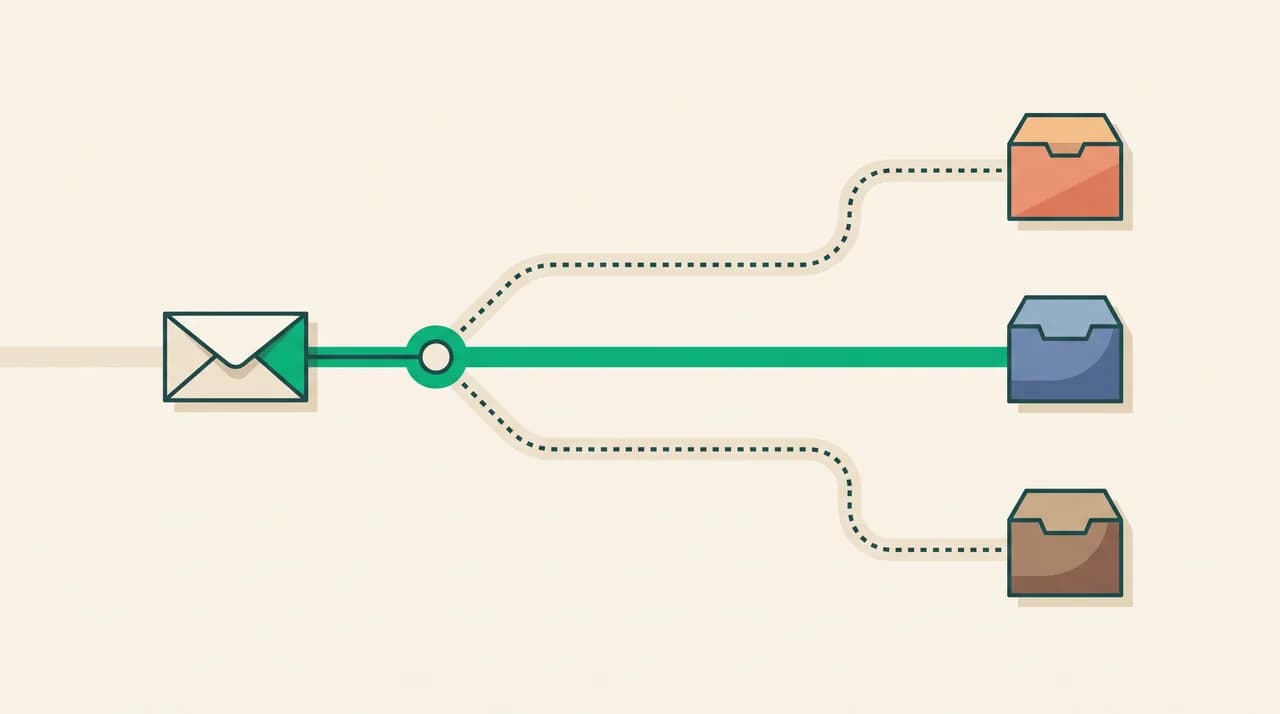
The cleanest way to keep the two straight is to ask a single question: does the message get re-transmitted to a new destination, or delivered once into a store you already open?
An alias is a label. Mail for the alias and mail for your primary address arrive at the same mailbox, are checked once on the way in, and sit in the same inbox. Nothing is sent again.
A forwarder is a relay. Your provider accepts the message, then opens a fresh connection and sends it onward to another mailbox. That second connection comes from the forwarding server, not the original sender — and that one fact is the root of every forwarding deliverability problem below.
Where an email alias wins#
An alias is the right tool whenever the goal is another name for a mailbox you already read.
- No deliverability risk. Because nothing is re-sent, SPF, DKIM and DMARC are evaluated once on arrival, exactly as they are for any direct message.
- One inbox to watch. sales@, support@ and billing@ can all land in a single mailbox, so you are not logging into three accounts to catch everything.
- Send as the address. Most providers let you reply from the alias, so the recipient never sees your private address.
- Instant to set up. An alias is a routing entry at your provider — no DNS changes, no second account, no warm-up.
The limit of an alias#
The trade-off is that an alias cannot move mail somewhere else. Everything lands in the one mailbox the alias belongs to.
If you need messages to reach a different account — a personal Gmail, a teammate's inbox, a mailbox on another provider — an alias alone will not do it. That is the job a forwarder exists for.
Where an email forwarder wins#
A forwarder earns its place when the mail genuinely has to end up in a different mailbox, often on a different provider.
- It relocates mail. A custom-domain address can feed your everyday Gmail or Outlook inbox, so you read everything in one place without hosting a second mailbox.
- It bridges providers. Leaving an old account? Forwarding keeps stragglers arriving while you migrate off it.
- It works without a full account. You can point an address at a mailbox you do not otherwise log into.
The cost is the extra hop
Why forwarded mail fails SPF and lands in spam#
SPF (Sender Policy Framework, defined in RFC 7208) lets a domain publish the list of servers allowed to send its mail. The receiving server checks the IP that connected against that list. RFC 7208 itself notes that forwarding breaks this check, because the message now arrives from a server the original domain never authorized.
When a forwarder re-sends your mail, the connecting IP is the forwarder's, not the original sender's. If the return-path still names the sender's domain, that domain's SPF record does not list the forwarder — so SPF fails at the destination.
DMARC is what turns an SPF failure into a spam folder
How SRS and ARC keep forwarded mail deliverable#
DKIM signs the message itself, so it can survive a forward — but only if the forwarder passes the message untouched. Add a footer, rewrite the subject, or change the body and the signature no longer validates.
The Sender Rewriting Scheme (SRS) has the forwarder rewrite the envelope return-path to its own domain, so SPF passes for the forwarder rather than failing against the original sender. SRS is a widely used convention rather than a formal internet standard. It keeps mail from being rejected as unauthenticated — but the rewritten return-path is no longer aligned with the original sender, so it does not by itself restore that sender's DMARC pass.
The Authenticated Received Chain (ARC, defined in the experimental RFC 8617) takes a different approach: the forwarder records the authentication result it saw when the message arrived and seals it cryptographically. A downstream receiver that trusts the forwarder can then honor that original pass even though SPF and DKIM now fail on their own. ARC is a chain of trust the receiver may choose to honor, not a repair — and because RFC 8617 is Experimental, support is not universal.
The practical takeaway: a good forwarding service does SRS and ARC and keeps the message unmodified. A basic one that only re-sends under the original return-path will see a share of its mail fail authentication. If you can connect the source account directly instead of forwarding it, you avoid the hop and the whole problem.
Pricing model, and what to verify#
Aliases and forwarders are usually priced by how they are packaged, not sold as products in their own right. Treat the shapes below as a map, and confirm current terms on each provider's own page before you commit — this is an area where limits and tiers change often (checked August 2026).
- Aliases are commonly bundled into a mailbox plan, with a set number included and more available on higher tiers. Some providers cap them; some offer unlimited.
- Standalone forwarding services tend to package a limited free tier plus paid plans that add custom domains, higher volume, or features such as SRS and ARC. Usage-metered pricing shows up here too.
- Privacy-focused alias services — the kind that generate a throwaway address per site — usually run a free tier alongside a paid plan for custom domains and unlimited aliases.
Who each is genuinely for#
Match the tool to the job, not the other way around. The choice is almost always obvious once you know whether the mail has to move.
- Choose an alias if you want tidy public addresses — sales@, hello@, a per-service throwaway — all feeding the one inbox you already live in. On a custom domain, aliases are usually the right default for role addresses.
- Choose a forwarder if mail has to physically arrive in a different mailbox: an old address you are retiring, a custom domain you want to read inside a personal Gmail, or an address handed to someone who will not host a mailbox for it.
- Choose a forwarder that does SRS and ARC, and never modifies the message, if you forward anything you cannot afford to lose to spam.
- Reach for neither if what you actually want is to read several real accounts in one place. Forwarding them together sacrifices authentication; the cleaner answer is to connect each account directly, which the next section covers.
A third option, honestly#
There is a case where people reach for a forwarder and end up fighting spam filters for no reason: they have three or four real mailboxes and just want to read them in one place. Forwarding them all into a single account bolts on the exact hop this post has been warning about.
The cleaner answer is to not forward at all — connect each mailbox directly over IMAP or OAuth, so every message reaches you on its original hop with SPF, DKIM and DMARC intact and nothing is re-sent. That is the approach we take in AI Emaily: a unified inbox that reads your Gmail, Outlook and IMAP accounts in one place without forwarding, plus an agent that triages what lands using inbox rules you set. We build AI Emaily, so read this as the vendor's own view.
To be clear about the limits: AI Emaily is not an alias service and not a forwarder. It will not mint you a sales@ address or relay mail to someone else's mailbox — an alias or a forwarding service is the right tool for those jobs. What it does is handle the mail that reaches you, once it is there. It runs on a 7-day free trial with a card required and no charge if you cancel before day seven; there is no permanent free tier.
Frequently asked
See it in AI Emaily
Keep reading
Sources

Written by
Nafiul HasanNafiul Hasan is an entrepreneur and AI automation system builder with 10+ years of experience turning messy, manual workflows into reliable automated systems. He designs and ships AI enterprise solutions end-to-end — the agent logic, the data plumbing, and the product people actually use — and founded AI Emaily to give busy professionals their attention back. He writes here from the builder's seat: what works, what breaks, and how to put AI to work without giving up control.