Gmail Categories vs Labels vs Tabs: What Each One Does


The short answer
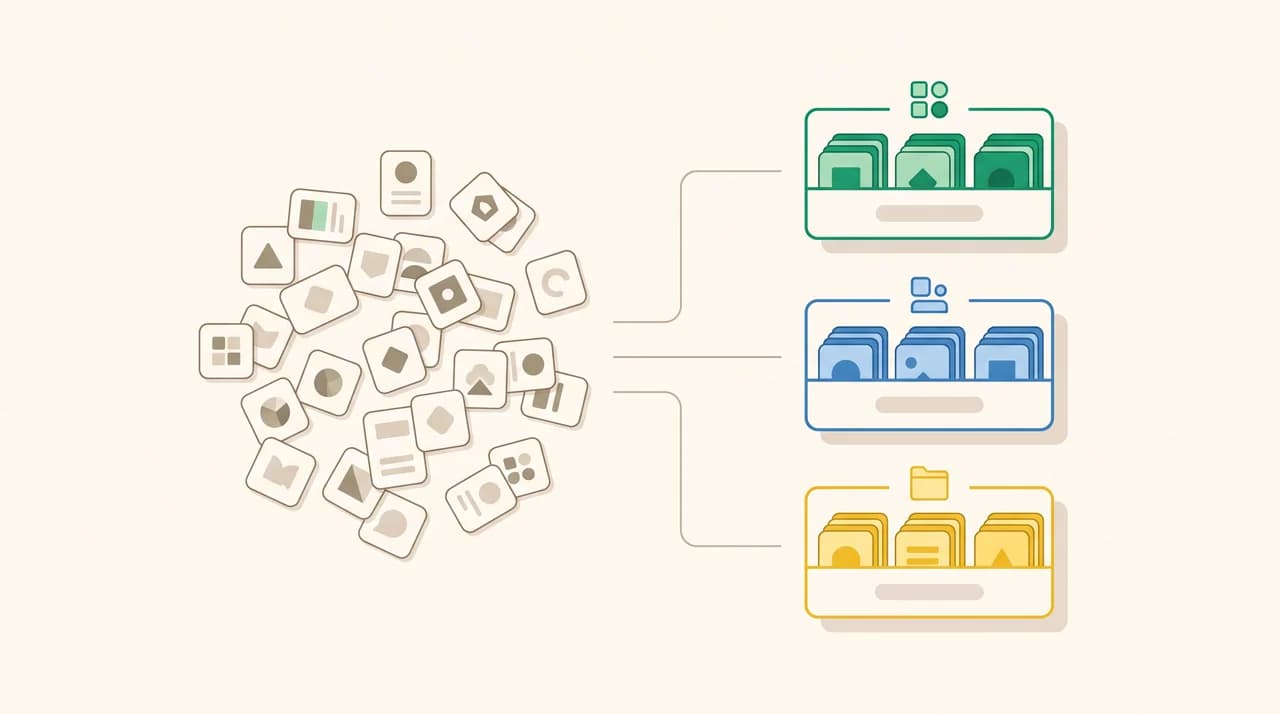
Gmail categories are system-assigned tags applied automatically by a classifier — Primary, Social, Promotions, Updates, Forums, plus Purchases and Travel. Labels are user-created tags you attach yourself, by hand or by filter. Inbox tabs are just the display surface for the five main categories. Turning off a tab hides the view; the category is still applied and search still finds it.
Gmail categories vs labels: categories auto-tag by classifier, labels are user-created, tabs display categories. Turning off a tab keeps the category.
On this page
- 01The verdict up front
- 02At-a-glance: categories vs labels vs tabs
- 03What Gmail categories actually are
- 04What Gmail labels actually are
- 05What Gmail inbox tabs actually are
- 06Pricing — and the verify-on-vendor caveat
- 07Who each is genuinely for
- 08A third position — a client-side layer on top of Gmail's model
Three Gmail features sound like they do the same job, and one of them is not really its own feature at all. Categories, labels and inbox tabs all sort your mail, all appear in different places in the sidebar and toolbar, and all get called "folders" by people who wish Gmail had folders. They do different things.
This post untangles the three, in the order you actually meet them: the tabs at the top of the inbox, the categories those tabs display, and the labels you invented yourself. The most useful fact in this whole post is that turning off a tab does not turn off the category, which is why mail seems to vanish and then reappear the moment you search for it.
The verdict up front#
Labels are your tags. Categories are Gmail's tags. Tabs are the top strip that renders five of those categories as switchable views. If you only remember one line from this page, remember that one.
Labels are user-created. You make them, you apply them, you nest them, you colour them. A filter can apply one for you. They behave like folders in every place except the underlying storage — a message can carry as many labels as you like, and it stays in a single store in All Mail with those labels attached.
Categories are seven system tags Gmail's classifier attaches automatically — Primary, Social, Promotions, Updates, Forums, Purchases and Travel. You cannot rename them, you cannot delete them, and there is no menu that lets you "add a category" the way you add a label. The classifier decides, and you can nudge it by moving messages between tabs.
Tabs are the display surface. They render five of the seven categories (Primary, Social, Promotions, Updates, Forums) as buttons at the top of the inbox. Turn off the Promotions tab and the category is still applied to every promotional message that lands — you just no longer see the tab, and the messages fall back into Primary. Search for `category:promotions` and they are all still there.
The single fact that fixes 'where did my email go'
At-a-glance: categories vs labels vs tabs#
Before the detail, here is the shape of each in one table. Every row is a consequence of the same underlying model — Gmail has one store, and everything visible is a tag or a view over that store.
| Dimension | Categories | Labels | Inbox tabs |
|---|---|---|---|
| Who creates it | Gmail's classifier | You (or a filter you wrote) | Nobody — they are just switches for categories |
| What it is | A system tag attached to a message | A user tag attached to a message | A view surface at the top of the inbox |
| How many exist | Seven: Primary, Social, Promotions, Updates, Forums, Purchases, Travel | As many as you make, plus system labels | Up to five (the first five categories) |
| Can you rename it | No | Yes | No |
| Can you delete it | No | Yes (for user labels) | No — you can only hide the tab |
| Applied manually | Only indirectly, by moving a message between tabs | Yes, directly from the label menu | Not applicable — tabs are a display switch |
| Applied by filter | Yes, via 'Categorize as' in filter actions | Yes, via 'Apply the label' in filter actions | Not applicable |
| Search operator | category:primary, category:promotions, etc. | label:my-label | None — tabs are not searchable, the categories behind them are |
| Effect of turning it off | Cannot be turned off | Deleted or hidden from sidebar | Messages fall back into Primary; category still applied |
| IMAP folder | Only Important and Starred; the five inbox categories are not exposed as IMAP folders | Yes — every user label maps to an IMAP folder | Not applicable |
What Gmail categories actually are#
A Gmail category is a special class of system label. It is applied by Gmail's own classifier when a message arrives, and it is why the same account with the same rules ends up sorting a newsletter into Updates and a receipt into Purchases without you doing anything.
There are seven of them and the list has been stable for years: Primary (the default bucket for anything the classifier does not send elsewhere), Social (updates from social networks), Promotions (marketing and offers), Updates (receipts, statements, confirmations, notifications from services), Forums (mailing lists and group discussions), Purchases (order confirmations and shipment updates) and Travel (bookings, itineraries, boarding passes). Only the first five ever appear as inbox tabs. Purchases and Travel are search-only categories — you find them with `category:purchases` or `category:travel`, and they cluster inside the Updates view.
You cannot apply a category from the label menu the way you apply a user label. There is no "Categorize as Promotions" button on a single message the way there is an "Apply label" button. What you can do is drag a message from one tab to another, or right-click and choose Move to tab, and Gmail asks whether to do the same for future mail from that sender. That is the manual override — it is a hint to the classifier, not a direct assignment.
Filters are the exception. In a filter you can tick "Categorize as" and pick a category — including the two that never appear as tabs. This is the honest way to route mail into a category on rules you control, and it is one of the few places where Purchases and Travel are useful without search.
What Gmail labels actually are#
A label is a tag you attach to a message. You make it, you name it, you can colour it, you can nest labels inside other labels (Clients/Acme is a real label nested under Clients), and you can apply as many as you like to a single message. Nothing is filed anywhere — the message stays in All Mail, and every label you attached is a way of finding it later.
The label list in the sidebar mixes two kinds of thing. System labels — Inbox, Starred, Snoozed, Important, Chats, Sent, Scheduled, Drafts, All Mail, Spam, Trash and the Categories group — are built in and cannot be renamed or deleted (some can be hidden). User labels are the ones you created. Any user label can be a filter action, can be shown or hidden per label, and appears over IMAP as its own folder.
Because they are user-controlled, labels are where any real filing system in Gmail lives. Categories cannot replace them — you cannot create a category, and the seven that exist are what they are. Labels are also the only construct here that survives moving to a third-party client cleanly, because Google exposes them as IMAP folders and as `X-GM-LABELS` metadata on every message.
The one place labels stumble is against the classifier. If you apply the Newsletters label to a message, that does not prevent Gmail from also filing it under Promotions or Updates — a message can carry your label and a category at the same time, because they are two different tag systems layered on the same message. Which is fine when you understand it and confusing when you do not.
What Gmail inbox tabs actually are#
Tabs are the least real of the three, and the most visible. When you open Gmail on the web with the Default inbox type selected, the strip at the top with Primary, Social, Promotions, Updates and Forums is the tab bar. Each tab is a view over the corresponding category. Clicking Social filters the inbox to messages carrying `category:social`. That is the entire mechanism.
You can turn tabs on and off, but you cannot invent new ones and you cannot rename them. In Settings, See all settings, Inbox tab, the Categories checkboxes control which tabs render at the top. Primary is always on. The other four can be toggled independently. Uncheck a tab and messages that would have appeared there fall back into Primary — but the category is still applied, and `category:promotions` still returns them.
Tabs only exist in the Default inbox type. If you switch to Important first, Unread first, Starred first, Priority Inbox or Multiple inboxes, the tab bar disappears. Categories are still applied in the background — they just have no dedicated display, and you interact with them through search and filters instead of the tabbed view.
- 1
Confirm what your inbox type is
In Gmail on the web, Settings (gear icon), See all settings, Inbox tab. The Inbox type dropdown is the first field. Default is the only one with the tabbed view.
- 2
Toggle which categories render as tabs
On the same page, the Categories section lists Primary (always on), Social, Promotions, Updates, Forums. Untick a category to hide its tab. Purchases and Travel are not on this list — they never render as tabs.
- 3
Move a message between tabs to retrain the classifier
On the inbox view, right-click a message and choose Move to tab, then pick the destination. Gmail will ask whether to do the same for future messages from that sender. That answer is the durable override.
- 4
Verify a hidden tab has not deleted anything
In the search bar, type category:promotions and hit enter. Every promotional message the classifier ever tagged is still there, including the ones that arrived after you turned the tab off. Nothing was moved, nothing was lost.
That last step is the one that fixes most of the confusion. A hidden tab is a hidden view. The category is still on the message, the search still finds it, and the day you re-enable the tab the messages reappear as if they had been there the whole time. Because they had been.
Pricing — and the verify-on-vendor caveat#
None of the three cost anything on top of Gmail. Categories, labels and tabs are core Gmail features, available on every consumer Google account and every Google Workspace tier from the entry plan up. There is no add-on that unlocks more categories, no paid tier that adds inbox tabs. The classifier itself has always been part of the base product.
There is nothing to verify on a vendor pricing page here, but two things around it are worth checking on Google's own current documentation because they do drift: whether new inbox types have been added (Priority Inbox and Multiple inboxes have both changed behaviour in past updates), and whether the tabbed view is still available in the mobile app in the same form as the web (it has moved between menus). Both are on the Gmail Help page linked at the bottom.
- Consumer Gmail (@gmail.com): all three features are included, no cost. Storage limits apply to the underlying messages, not to the tags.
- Google Workspace (Business Starter through Enterprise, and Education plans): all three features included, subject to admin controls that can lock down settings across the org.
- Third-party mail clients (Apple Mail, Thunderbird, generic IMAP): labels appear as folders over IMAP; categories mostly do not (Important and Starred are the two system-tag exceptions). Inbox tabs do not exist outside Gmail's own interfaces.
- AI Emaily is the mail client we build. Packaging is a 7-day free trial on Pro and Autopilot (card required, $0 if cancelled before day 7). There is no permanent free tier. Current plans live on /pricing.
Admin-locked tabs in Workspace
Who each is genuinely for#
None of the three is a competitor to the others. They stack — every account uses all three whether the user knows it or not. The useful question is which one you should be reaching for when you want to change the shape of the inbox.
| If you want to… | Reach for | Why the others do not fit |
|---|---|---|
| Group all mail from a specific project or client | A label (created by you, optionally applied by a filter) | Categories cannot be renamed and are picked by a classifier, not by you; tabs are only for the five main categories |
| Push marketing mail out of the main view without deleting it | The Promotions category, rendered as its own tab | A user label needs manual filing or a rule; the classifier already does this for the class of message |
| Route receipts and shipping updates somewhere you can find them | The Purchases and Travel categories, via search or a filter | These never render as tabs, so trying to find them by clicking a tab will fail; a label works but duplicates what the classifier already does |
| Hide a whole class of mail from the main view without losing it | Turn off the corresponding tab in Settings, Inbox | Deleting a label removes your tag; the category cannot be removed, so hiding the tab is the only clean control |
| Keep the same filing available in Apple Mail or an IMAP client | A user label | Categories mostly do not appear over IMAP; tabs do not exist outside Gmail |
| Move messages sight-unseen with rules | A filter that applies a label and/or a category | Manual tab moves are one-off classifier hints; only filters are deterministic |
A third position — a client-side layer on top of Gmail's model#
The three constructs above are Gmail's, and they are what any client — Apple Mail, Thunderbird, Shortwave, Superhuman Mail or ours — inherits when it connects to a Gmail account. The friction shows up in two places. First, the classifier is opaque: you cannot see why a message went into Promotions rather than Updates, and correcting it means moving the message and hoping the hint sticks. Second, the tags do not travel — categories mostly do not survive to IMAP, and outside Gmail's own web and mobile apps the tabbed view does not exist.
AI Emaily is the mail client we build, and this is where it fits into this picture rather than replacing any of it. It reads Gmail through its labels — the same `X-GM-LABELS` data Google's IMAP extensions expose — so your existing user labels arrive intact, and your Personal Context brain drives a triage layer over the top of the classifier rather than fighting it. Rules you write in AI Emaily are visible to you, editable in one place, and applied across Gmail, Outlook, iCloud and IMAP in the same account view. Approve-before-send with undo and an audit trail is on by default; there is no training on user mail. See the homepage at / for the full picture. We build AI Emaily.
Where we do not lead: if you live entirely inside Gmail's own web interface and want the fastest keyboard workflow over Gmail's model exactly as it is, Shortwave has built harder on Gmail-native semantic search than we have, and Superhuman Mail's split inbox is a more direct evolution of the tabbed view. If those are the axes that matter to you, try them. AI Emaily is the fit if you want a triage layer over Gmail rather than a faster interface to Gmail's own categorisation, and if you want the same layer to keep working when a second account is Outlook or IMAP.
Frequently asked
See it in AI Emaily
Keep reading

Written by
Nafiul HasanNafiul Hasan is an entrepreneur and AI automation system builder with 10+ years of experience turning messy, manual workflows into reliable automated systems. He designs and ships AI enterprise solutions end-to-end — the agent logic, the data plumbing, and the product people actually use — and founded AI Emaily to give busy professionals their attention back. He writes here from the builder's seat: what works, what breaks, and how to put AI to work without giving up control.