Gmail Search Not Finding Old Emails? Why, and How to Fix It


The short answer
Gmail search misses old emails for four main reasons: the search is scoped to the wrong label or view, Trash and Spam are excluded by default, a partial word doesn't match the indexed tokens, or a third-party client is searching locally rather than on Google's servers. Add 'in:anywhere' to your query to search every folder at once.
Gmail search not finding old emails? Causes include scope limits, Trash and Spam exclusions, partial-word mismatches, and local-only client searches.
On this page
- 01What this error literally means
- 02The four causes at a glance
- 03Fix 1: search all folders with 'in:anywhere'
- 04Fix 2: search Trash and Spam directly
- 05Fix 3: work around partial-word matching
- 06Fix 4: check whether your client is searching locally
- 07How to tell which cause you have
- 08Preventing search gaps from recurring
- 09How AI Emaily approaches inbox search
You know the email exists. You sent it, received it, or replied to it within the last year. You type a phrase from it into Gmail's search bar and get nothing back. This is one of Gmail's most disorienting failures, because the message is almost certainly still there — the search just didn't reach it.
Gmail search not finding old emails is not usually a data-loss problem. It is a scope problem. Gmail's search operates within boundaries you may not have chosen deliberately — the current label, a category tab, a folder your third-party client is querying locally — and those boundaries can silently exclude the exact message you need. This guide explains the four most common causes, gives you a diagnostic table to identify which one applies, and walks through the fix for each.
What this error literally means#
Gmail indexes every message it stores. When you type into the search bar, Gmail queries that index and returns matches from the scope it is currently operating in. The default scope is often narrower than 'everything I have ever received.' If the message falls outside that scope — because it was archived, moved to Spam, sits in Trash, lives under a non-inbox label, or was downloaded by a third-party client that isn't searching the server — the index query simply won't touch it.
The result looks identical whether the message doesn't exist or just isn't in scope: an empty results page with 'No messages matched your search.' That identical appearance is why this error is easy to misread as data loss when it is usually a configuration issue.
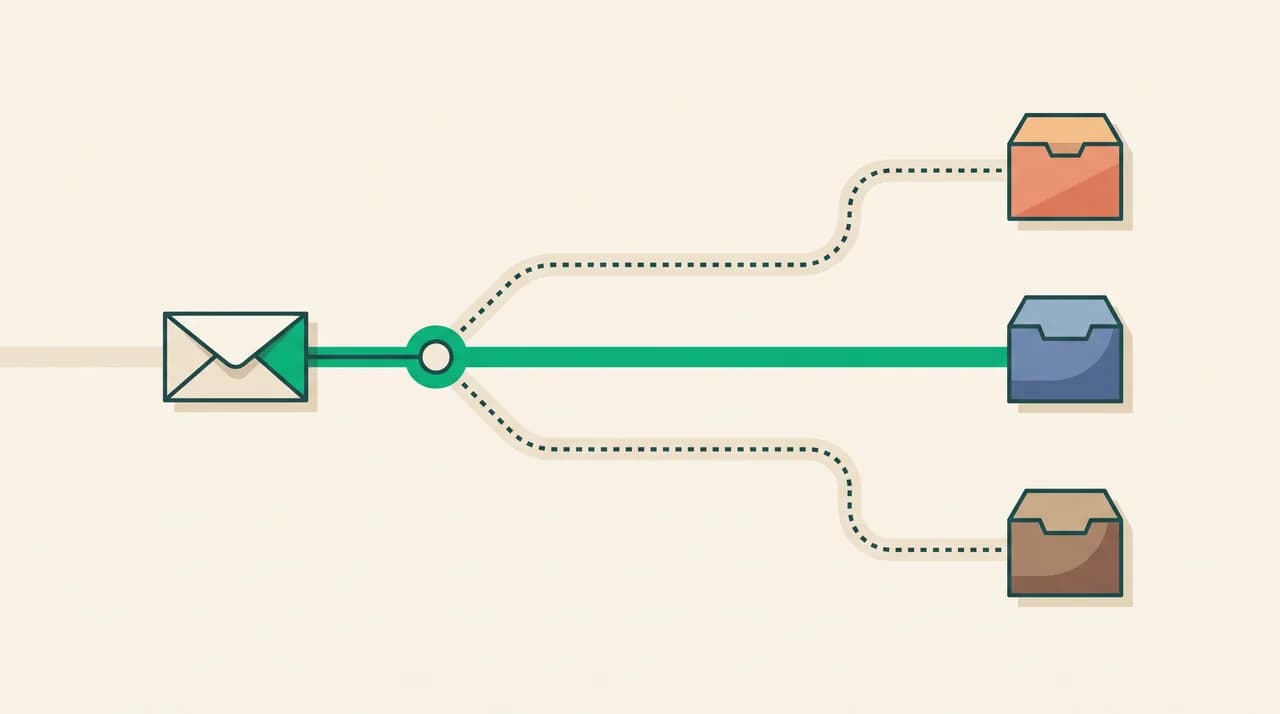
Trash and Spam are excluded from most Gmail searches
The four causes at a glance#
| Cause | How to confirm | Fix |
|---|---|---|
| Search scoped to a label, tab, or category view | Look at the top of the results page for a label chip (e.g. 'in:inbox'). Or check whether you started the search from inside a label or category | Add 'in:anywhere' to the query or search from the main search bar with no label active |
| Message is in Trash or Spam | Search 'in:trash subject:keyword' and 'in:spam subject:keyword' separately to confirm | Use 'in:anywhere keyword' to surface it, then move it to a label or inbox |
| Partial word or short token not indexed | Try a full, complete word from the message subject or body. If that returns the message but the original query didn't, the issue is partial-word matching | Search for a complete word. Add 'from:sender' or 'after:YYYY/MM/DD' to narrow further without relying on partial tokens |
| Third-party client searching locally instead of on the server | Open the same search directly in Gmail on the web (mail.google.com). If it appears there but not in your client, the client is querying a local index | Use the Gmail web interface for historical searches, or configure the client to search on the server if that option is available |
Fix 1: search all folders with 'in:anywhere'#
The fastest single fix for a missing message is to add 'in:anywhere' to your search query. This overrides Gmail's default scope and searches across Inbox, All Mail, Sent, Drafts, Spam, and Trash simultaneously. For a message you are confident exists somewhere, this will almost always surface it.
To use it, type your search terms into the Gmail search bar followed by the operator: for example, 'in:anywhere project proposal from:[email protected]'. Gmail will return matches from every folder, including Trash messages that haven't been permanently deleted yet and Spam messages that Gmail's filters intercepted.
- 1
Open Gmail on the web
Go to mail.google.com. Third-party clients sometimes search a local cache rather than Google's full index, so the web interface is the most reliable place to run this test.
- 2
Type 'in:anywhere' plus your search terms
In the search bar, type: in:anywhere followed by whatever you remember about the message — the sender's address, a word from the subject, or a distinctive phrase from the body. For example: in:anywhere budget review from:sarah.
- 3
Check Trash and Spam in the results
If the message appears in the results, look at the label shown next to it. A Trash label means it was deleted and will be permanently removed after 30 days. A Spam label means Gmail's filter caught it. From here you can move it back to your inbox.
- 4
If still empty, try a broader term
Replace any partial words with complete, unambiguous words. Gmail's search tokenizes words at spaces and punctuation — it does not support substring or wildcard matching in the middle of a word. 'Proposal' will match; 'prop' will not match 'proposal'.
Gmail search operators from Google's own documentation
Fix 2: search Trash and Spam directly#
If you know roughly when the message arrived and it might have been deleted or filtered, searching Trash and Spam directly is faster than 'in:anywhere' because the results are smaller and easier to scan.
Gmail keeps Trash messages for 30 days before permanently deleting them. Spam messages are also kept for 30 days. If you are looking for something older than 30 days that was in either folder, it is permanently gone. For messages within that window, the steps below will find them.
- 1
Search Trash
In the Gmail web search bar, type: in:trash and then any search terms you remember. For example: in:trash invoice March. This limits results to messages currently in your Trash folder.
- 2
Search Spam
Separately, type: in:spam and your search terms. For example: in:spam from:[email protected]. Spam is searched independently from Trash, so you need to check both.
- 3
Move the message if you find it
Select the message from the results. In Trash, click 'Move to inbox' or apply a label. In Spam, click 'Not spam' or 'Move to inbox'. The message will return to your inbox and will be included in future default searches.
Fix 3: work around partial-word matching#
Gmail's search engine tokenizes messages when they are indexed. It breaks text at spaces and punctuation marks and stores those complete tokens. When you search, it matches your query against those stored tokens. The consequence is that searching for a partial word — 'prop' hoping to find 'proposal', or 'cont' hoping to find 'contract' — will not work. Gmail does not support infix or substring matching.
This catches people who remember only part of a word or who type a typo that is a substring of the correct word. The fix is always to use a full, correctly spelled word that you are confident appeared in the message.
- 1
Replace partial words with complete ones
If your original query used a fragment like 'renew' hoping to match 'renewal' or 'renewed', extend it to the full word form. Try 'renewal' and 'renewed' as separate searches if you are not certain which form was used.
- 2
Add anchoring metadata to the query
Pair the word search with metadata operators that narrow the scope without relying on word matching: from:[email protected] for the sender, to:address for the recipient, after:2025/01/01 or before:2025/12/31 for a date range. Gmail's date and address matching is exact and not subject to the same tokenization limits.
- 3
Try subject: and has:attachment operators
If the email had an attachment, add 'has:attachment' to your query. If you remember a distinctive word in the subject line, use 'subject:word'. Both reduce the result set dramatically and can surface a message that a body-text search misses.
Fix 4: check whether your client is searching locally#
If you use a third-party email client — a desktop app, a mobile app, or any client that connects to Gmail via IMAP — that client may have its own local search index. When you search inside the client, it may be querying only the mail it has downloaded to your device, not Google's full index. If your client downloaded only the last three months of mail, its search will not find anything older, even though Gmail itself still has the full history.
The diagnostic is simple: run the same search directly at mail.google.com in a browser. If the message appears on the web but not in your client, the client is the bottleneck.
- 1
Search the same query at mail.google.com
Open a browser and go to mail.google.com. Run the identical search you tried in your client. If the message appears here, Gmail has it — the issue is local to your client's index.
- 2
Check your client's IMAP sync settings
Most IMAP clients have a setting for how much mail they download locally. Look for an option like 'Sync emails from the last X months' or 'Download headers only'. Increasing this range or switching to 'Download all mail' will expand the local index, though it will use more local storage.
- 3
Use server-side search if your client supports it
Some clients can be configured to search on the IMAP server rather than in their local index. Check your client's search settings for an option labeled 'Search on server' or 'Server-side search'. Enabling it will route searches to Gmail's index, which covers your full mailbox history.
- 4
For historical searches, use the Gmail web app
Until your client's sync settings cover the period you need, the most reliable option for finding old messages is to search directly in Gmail on the web. Gmail's index covers every message in your account regardless of which client originally downloaded it.
How to tell which cause you have#
The fastest diagnostic is a single test: open mail.google.com in a browser, type 'in:anywhere' plus your search terms, and see what returns. This single query collapses three of the four causes into one test — if the message surfaces, you now know which folder it lives in (Inbox, Trash, Spam, or a label), and you can act accordingly. If it doesn't surface on the web either, the issue is likely a partial-word mismatch.
The table below maps symptoms to causes, so you can identify the right fix without working through all four in sequence.
| Symptom | Most likely cause | First thing to try |
|---|---|---|
| Message found in Gmail web but not in your email client | Client searching local index, not server | Use Gmail web for the search; adjust client sync settings |
| Message found with 'in:anywhere' but not with a plain search | Message is in Trash, Spam, or a non-inbox label | Move the message to inbox or apply a label to include it in future searches |
| Searching a complete word finds the message but a fragment doesn't | Partial-word search not supported | Always use full, correctly spelled words; pair with from: or after: operators |
| Message not found with 'in:anywhere' or any operator | Message permanently deleted (over 30 days in Trash or Spam) or never received | Check if the sender received a bounce; the message may genuinely not exist |
| Message found only when searching a specific label | Search was scoped to Inbox or a category tab when run | Run searches from the main search bar with no label active, or prefix with 'in:anywhere' |
Preventing search gaps from recurring#
Most Gmail search gaps are caused by messages landing in unexpected places — Spam, archived, or under a label the filter created months ago. A few habits prevent them from recurring.
First, review your filters. In Gmail settings, go to Filters and Blocked Addresses and look for any rules that skip the inbox, apply a label, or delete messages automatically. A filter set up years ago for a newsletter that now matches a different sender can silently intercept messages you want to see. Second, check your spam folder periodically rather than only when you are looking for something specific. Gmail's spam filter is not perfect, and a legitimate message caught by it will be permanently deleted after 30 days if you don't move it. Third, if you use a third-party client, check how far back its IMAP sync goes and whether it searches on the server or locally.
These are maintenance tasks rather than one-time fixes, but they eliminate the conditions that cause Gmail search not finding old emails in the first place.
How AI Emaily approaches inbox search#
The gap this post describes — knowing a message exists but failing to find it because search is scoped to the wrong folder or tokenized incorrectly — is the kind of friction that a server-side search with a broader scope addresses directly. We build AI Emaily, an AI-native email client. Its Smart Search feature runs against the full mailbox on the server rather than a local index, and it uses semantic matching rather than exact token matching, so a search for 'the renewal discussion with the legal team in March' can surface the thread even if those exact words don't appear together in a single message. If you are regularly hitting the kind of search limits this post describes, that is the problem it is built to solve. You can try it on a 7-day free trial at aiemaily.com.
Frequently asked
See it in AI Emaily
Keep reading

Written by
Nafiul HasanNafiul Hasan is an entrepreneur and AI automation system builder with 10+ years of experience turning messy, manual workflows into reliable automated systems. He designs and ships AI enterprise solutions end-to-end — the agent logic, the data plumbing, and the product people actually use — and founded AI Emaily to give busy professionals their attention back. He writes here from the builder's seat: what works, what breaks, and how to put AI to work without giving up control.